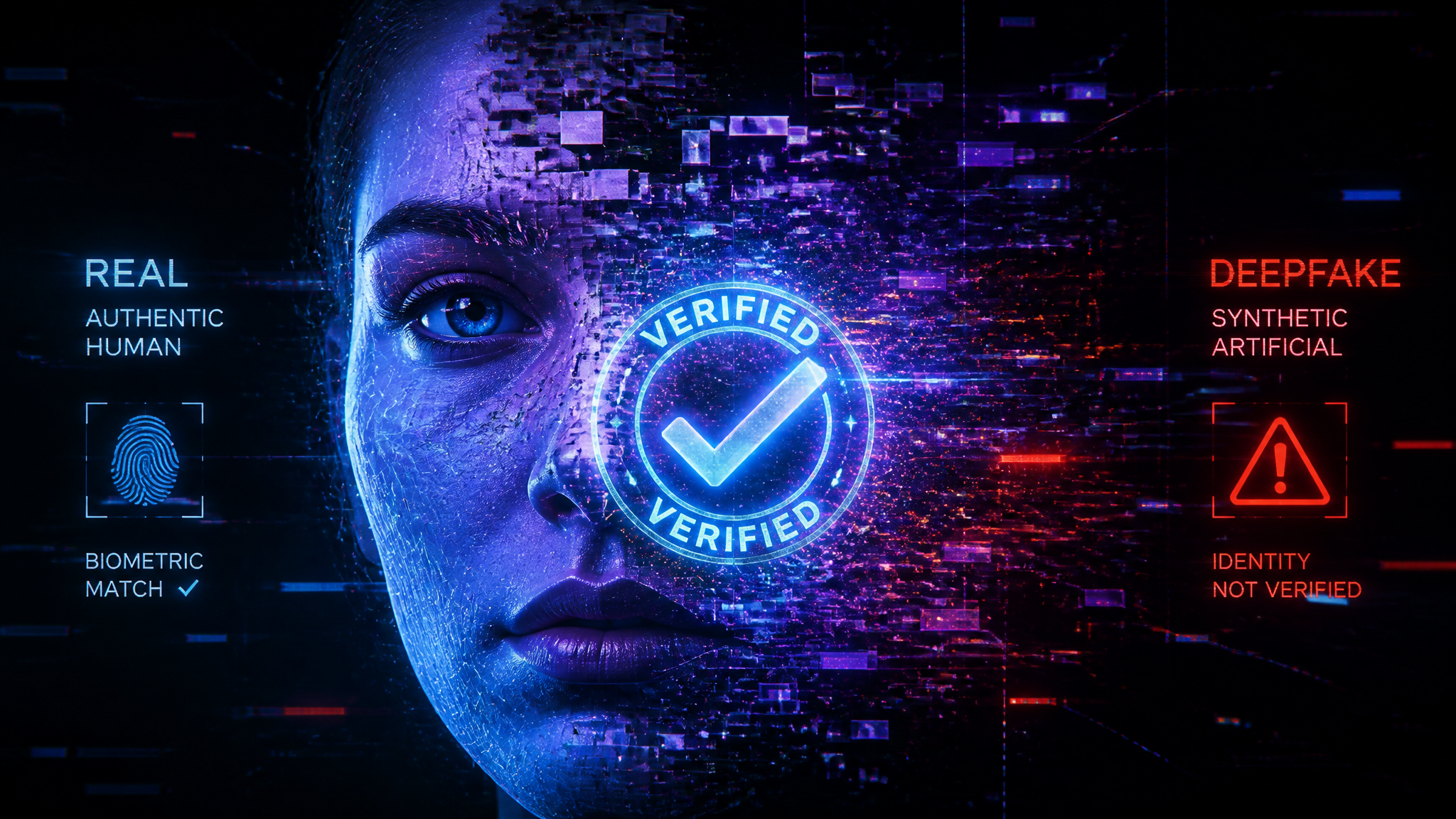
A new phase in the battle over authenticity
Digital media has always been vulnerable to manipulation, from simple image editing to coordinated disinformation campaigns. What has changed is the speed, accessibility and plausibility of fabrication. Generative systems can now produce convincing voices, faces, video clips and documents at a scale that collapses the old boundary between specialist deception and everyday misuse. The result is not only a rise in synthetic falsehoods, but a broader erosion of confidence in genuine material.
This is the core information-integrity problem. It is not limited to whether a single video is fake. It extends to whether journalists can verify evidence quickly enough, whether voters can distinguish authentic speech from manufactured provocation, and whether institutions can preserve a chain of trust around digital content. In practice, the challenge has two fronts: limiting the harms caused by deceptive synthetic media, and preventing a world in which everything becomes dismissible as fake.
The deepest risk is not merely that people believe false media, but that they stop believing authentic media when it matters most.
That second risk is sometimes described as the liar’s dividend: the advantage gained when the existence of deepfakes allows real recordings to be denied as fabrications. Researchers and policymakers increasingly treat this as a structural threat to democratic accountability. Once plausible deniability becomes cheap, the evidentiary value of recordings weakens just when public life relies on them most.
Deepfakes are only part of the synthetic-media landscape
The term deepfake attracts attention because it suggests highly realistic manipulated video or audio, often depicting people saying or doing things they never did. But the wider synthetic-media landscape is more varied. It includes fully generated images, AI-written text, cloned voices, lip-synchronised video, manipulated documents and composite media that blend real and generated elements. Not all of it is malicious. Some synthetic content is artistic, assistive or clearly labelled entertainment.
The difficulty arises when synthetic techniques are used deceptively or when provenance is absent. A realistic AI-generated image presented as eyewitness documentation can distort public understanding of a conflict or disaster. A cloned voice can mimic a candidate, official or family member. A fabricated screenshot can spread faster than any correction. In each case, the deception works because digital audiences are accustomed to treating media as evidence.
Research from academic institutions and civil-society organisations suggests that the threat is not evenly distributed. High-profile political figures attract obvious attention, but local officials, journalists, activists and ordinary citizens can be more vulnerable because they have fewer resources for rapid rebuttal. Synthetic harassment, non-consensual sexual imagery and impersonation attacks reveal that information integrity is not just a geopolitical matter; it is also personal, local and cumulative.
Politics and elections are especially exposed
Elections compress time, heighten emotions and reward attention-grabbing content. That makes them particularly susceptible to synthetic manipulation. The immediate concern is the release of fabricated or misleading media designed to depress turnout, inflame social divisions or damage a candidate just before polling, when verification and correction may come too late. Yet the broader risk is subtler: a campaign environment in which every damaging piece of evidence becomes contestable on authenticity grounds.
Public authorities have started to respond. Guidance from election bodies, risk assessments from international organisations and research from universities point to several recurrent scenarios: fabricated candidate statements, cloned robocalls, deceptive memes stripped of context, and authentic footage edited or re-captioned to imply something false. The line between deepfake and disinformation is therefore porous. Many successful deceptions rely less on perfect generation than on timing, context and audience targeting.
The deepest risk is not merely that people believe false media, but that they stop believing authentic media when it matters most.
This has implications for regulation. Rules focused narrowly on technically defined deepfakes may miss the wider ecology of manipulation. A low-quality audio fake sent to a targeted group can be more disruptive than a cinematic video released to the public. Effective responses require attention to distribution channels, disclosure requirements, election-period safeguards and the capacity of newsrooms and civil society to debunk quickly without amplifying the original falsehood.
In elections, the most consequential synthetic media may not be the most sophisticated; it may be the material that arrives at the right audience at the right moment with just enough plausibility.
Provenance is becoming a critical layer of trust
If the old internet treated files as detached objects, the next phase of information integrity may depend on attaching reliable context to content from the point of creation. Provenance systems aim to do that by recording information about how a piece of media was made, edited and published. The leading standards effort in this area is the Coalition for Content Provenance and Authenticity, whose specifications underpin what is commonly referred to as Content Credentials.
The underlying idea is straightforward. Rather than asking only whether a file looks suspicious, provenance asks whether there is a verifiable record of origin and modification. Was the image captured on a device that can sign it cryptographically? Were edits performed in software that records changes? Has the metadata remained intact as the file moved across platforms? These signals do not prove truth in any philosophical sense, but they can strengthen the chain of custody around digital artefacts.
The appeal is clear, especially for journalism. A provenance-aware workflow could help a newsroom preserve the history of a photograph from capture to publication. It could also help audiences understand whether an image is original, altered, AI-generated or lacking trustworthy source information altogether. But the limitations are equally important. Provenance only works when standards are adopted across devices, software and platforms; when metadata survives reposting; and when hostile actors cannot trivially strip or spoof signals. It is an infrastructure project, not a magic seal.
Why watermarking and detection remain necessary but insufficient
Alongside provenance, two technical approaches receive the most attention: watermarking and AI-content detection. Watermarking generally refers to embedding signals into generated content, either visibly or invisibly, to indicate synthetic origin. Detection refers to forensic techniques that try to identify whether media was generated or manipulated, often by analysing statistical artefacts, inconsistencies or traces left by models and editing processes.
Both are useful, but both are unstable. Watermarks can be removed, degraded by compression or absent from open-source and custom-built generation systems. Detection tools may perform well under laboratory conditions and then deteriorate when exposed to new models, post-processing or adversarial attacks. Regulators and journalists should therefore treat confident marketing claims with caution. Independent evaluations, benchmark transparency and clear error reporting matter more than headline accuracy rates.
There is also a conceptual problem. Detection is often framed as a binary question: real or fake. In practice, many important cases sit in the middle. An authentic video may be edited misleadingly. A real image may carry a false caption. A synthetic background may be inserted into an otherwise genuine clip. An audio recording may combine real and cloned segments. Useful integrity systems need to describe degrees and kinds of manipulation rather than promise absolute certainty.
No detector will settle the authenticity question on its own; the task is evidentiary, cumulative and context-dependent.
For that reason, technical signals should feed into broader verification rather than replace it. A detector flag can prompt scrutiny; it should not be treated as a final verdict. Likewise, the absence of a provenance record should not automatically imply deception. In a fragmented media ecosystem, many genuine files will arrive without clean metadata or authenticated origins.
In elections, the most consequential synthetic media may not be the most sophisticated; it may be the material that arrives at the right audience at the right moment with just enough plausibility.
The newsroom is becoming a verification laboratory
Professional journalism sits at the centre of the information-integrity challenge because it is still expected to convert messy digital evidence into public knowledge. Newsrooms have long verified user-generated content through geolocation, reverse-image search, source triangulation and contact with witnesses. Synthetic media raises the bar. Verification now requires combining traditional reporting with forensic methods, metadata checks, platform analysis and careful editorial judgement about what can and cannot be claimed.
Practical verification increasingly follows a layered model. First comes provenance: what is the source, and can the chain of custody be established? Second comes forensic analysis: are there anomalies in shadows, reflections, motion, audio cadence or encoding patterns? Third comes contextual reporting: does the claim align with known events, eyewitness accounts, official records or satellite imagery? Finally comes publication discipline: if uncertainty remains, how should it be framed without laundering a falsehood into mainstream circulation?
Several journalistic organisations and fact-checking networks have refined these methods, but capacity remains uneven. Large international outlets can build specialist visual-investigations teams; local publishers often cannot. Yet local journalism may be where synthetic deception does the most immediate democratic damage. Supporting verification capabilities beyond a handful of global brands is therefore a public-interest issue, not just an industry concern.
Editorial norms matter as much as tools. Newsrooms must decide when to describe material as “unverified”, when to state that evidence suggests manipulation, and when the stronger claim of fabrication is warranted. Precision protects credibility. So does restraint. Publishing a sensational fake in order to debunk it can still widen its reach, especially on fast-moving social platforms where the correction rarely catches up.
Disinformation exploits human systems more than technical ones
It is tempting to present synthetic media as a purely technological arms race. In reality, disinformation campaigns succeed mainly by exploiting human vulnerabilities and institutional weaknesses. They target polarisation, distrust, identity, urgency and pre-existing narratives. Synthetic media is simply a more efficient vehicle for old tactics: impersonation, scapegoating, outrage generation and strategic confusion.
This matters because responses framed only as content moderation or model control will fall short. Information integrity depends on distribution dynamics, political incentives and the economics of attention. A false claim amplified by partisan influencers, closed messaging groups or recommendation systems can become socially real even after forensic debunking. By then, the damage has moved from the media object itself to the interpretations and identities attached to it.
Researchers have repeatedly found that corrections often struggle against emotionally resonant falsehoods. The challenge is not just exposure to bad information but asymmetry: a fake can be produced in minutes, while verification and contextual explanation take hours or days. The policy question, then, is how to reduce the payoff to deception. Faster labelling, friction around virality, transparent archives of debunked claims and stronger election safeguards all help, but none removes the underlying incentive to manipulate attention.
Media literacy must move beyond simple scepticism
Calls for media literacy are common, but they can become vague or counterproductive. Telling the public merely to “question everything” may deepen cynicism rather than improve judgement. In an age of synthetic media, effective literacy means understanding evidence, source reliability, context, manipulation techniques and the difference between uncertainty and nihilism.
A more useful public pedagogy would teach people to ask structured questions. Where did this media first appear? Is there a trustworthy source or corroboration? Does the clip show signs of being old footage repurposed for a new event? Is the account sharing it authentic? Is the emotional framing designed to provoke instant sharing? Such habits do not require advanced forensic skill, but they do require repetition and institutional support through schools, broadcasters, libraries and civic groups.
No detector will settle the authenticity question on its own; the task is evidentiary, cumulative and context-dependent.
The aim should be resilient trust, not universal suspicion. Citizens need confidence that some institutions still have methods for validating evidence, while also recognising that authenticity claims are increasingly contested. That balance is difficult. Too much trust leaves audiences vulnerable to deception; too little dissolves the shared factual ground on which democratic debate depends.
Policy is moving, but unevenly
Governments and regulators are beginning to address synthetic media through election law, platform rules, privacy protections and transparency requirements for AI-generated content. International organisations have issued guidance, and some jurisdictions have introduced specific measures aimed at deceptive election media or non-consensual deepfake imagery. Yet policy remains fragmented. Definitions differ, enforcement is patchy and legal remedies often arrive after the moment of greatest harm.
The most promising regulatory approaches are those that recognise the full information ecosystem. This includes disclosure duties for materially deceptive synthetic political content, protections for victims of impersonation and sexual abuse, support for provenance standards, and realistic obligations on large platforms to preserve evidence and respond rapidly during high-risk periods. At the same time, safeguards for satire, artistic expression and legitimate political speech remain essential. A broad anti-deepfake law drafted in haste could easily catch too much or prove impossible to enforce.
There is also an international coordination problem. Synthetic media crosses borders easily, while legal remedies do not. Elections, conflicts and public-health emergencies can all be influenced by material generated elsewhere and spread through globally networked platforms. Standards bodies, election observers, civil-society groups and national regulators will need more interoperable approaches if they are to reduce the current patchwork of rules and expectations.
What robust information integrity will actually require
The search for a single solution is understandable, but misplaced. Provenance can strengthen chains of custody; watermarking can help in some circumstances; detection can supply useful signals; regulation can create deterrence; journalism can establish evidence; literacy can reduce impulsive sharing. None is sufficient alone. The strategic task is to connect them.
A robust system would look less like a filter and more like layered civic infrastructure. Devices and editing tools would preserve provenance where possible. Platforms would retain and display that information rather than discard it. Newsrooms would use forensic and contextual verification before publication. Election authorities would have rapid-response channels for deceptive synthetic incidents. Researchers would have access to data for independent evaluation. Schools and public institutions would teach people how digital evidence works. And the law would focus on harmful deception without criminalising ordinary expression.
The central objective is not to restore a mythical era of perfect trust. That never existed. It is to maintain enough shared confidence in evidence that public reasoning remains possible. In the coming years, the societies that manage synthetic media best will not be those that claim to have defeated fakery. They will be those that build credible processes for doubt, verification and accountability.
The future of evidence will be procedural
As synthetic media improves, authenticity will become less a property visible in the file itself and more a judgement produced by procedures around it. Who captured this? How was it edited? What corroborates it? Which institution checked it, and by what method? This is a shift from intuitive trust in what one sees to structured trust in how something is verified.
That may sound less elegant than the old maxim that seeing is believing. But it is more realistic for the digital age. Information integrity cannot be defended by nostalgia for a cleaner media environment. It must be built through standards, editorial discipline, technical humility and civic education. The future of trust will not rest on proving every image real or fake. It will rest on making the pathways from creation to belief more legible, more accountable and harder to game.