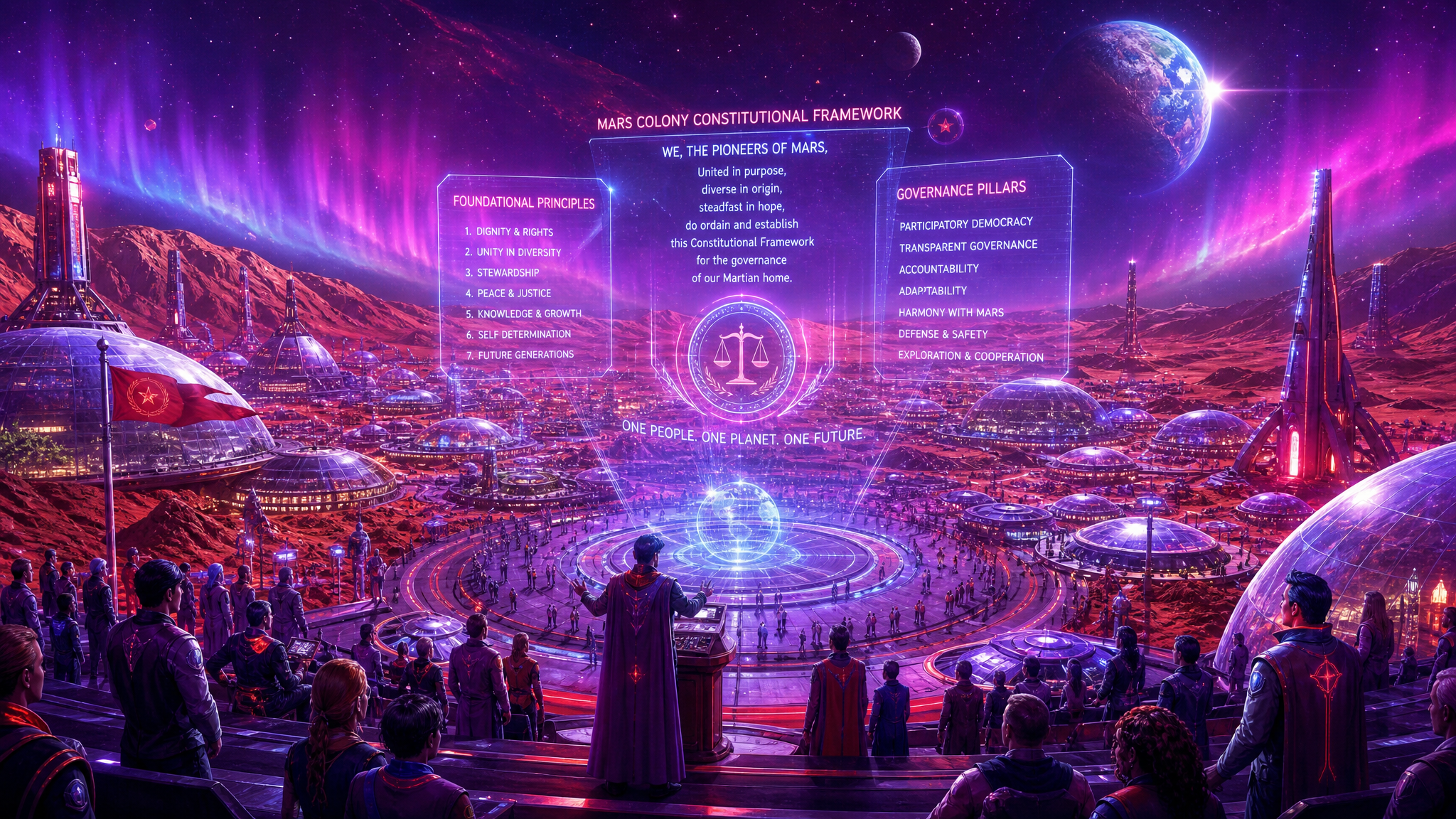
The familiar argument about life beyond Earth is framed in theatrical terms: sovereignty, liberty, ownership, secession, rights. It imagines the first Martian charter as a kind of frontier Philadelphia, drafted in red dust by settlers newly freed from terrestrial supervision. Yet the first durable question of off-world government is likely to be more prosaic. How are records kept, verified, transmitted, contested and preserved when the public sphere is separated by millions of kilometres, communications are delayed, supply chains are fragile and institutions may be periodically rebooted after accident or insolvency.
This is not a bureaucratic footnote. On Earth, constitutional order depends on documentary routines so ingrained that they are easy to overlook: land registries, court files, maintenance logs, public accounts, voting rolls, chain-of-custody procedures, standards archives, medical records and version histories for the rules themselves. Strip those away and authority becomes difficult to distinguish from improvisation. In that sense, the distinctive governance problem of a multi-planetary civilisation may not be who governs Mars, but how any polity beyond Earth secures trustworthy institutional memory.
Why records matter more in space than on Earth
Distance turns ordinary administrative weakness into constitutional risk. A town on Earth can often muddle through missing paperwork because neighbouring institutions, journalists, regulators, insurers or courts can reconstruct events. A settlement on Mars will not enjoy that redundancy. Staff turnover may be steep, hardware failure common, and legal review delayed by communications lag and political ambiguity. If an oxygen plant fails after an unauthorised software patch, if a cargo manifest is altered, or if a habitat allocation decision is challenged months later, the question will not merely be technical. It will be political: whose account is treated as authoritative.
Off-world settlements are often discussed as if legitimacy flows mainly from consent. Consent matters, but so does legibility. A resident can consent to a rule only if the rule is stably knowable, the process that produced it is reviewable and the facts used to justify it remain inspectable. That is why terrestrial states spend so much effort on formal publication, signature requirements, public registers and archival law. In space, those devices become not cumbersome rituals but survival tools.
In space, archives are not clerical residue; they are constitutional infrastructure.
The old treaties leave a quieter gap
The foundational space treaties are sparse on this problem. The 1967 Outer Space Treaty establishes non-appropriation, state responsibility and the broad principle that outer space is the province of all humankind. The Moon Agreement, with far narrower adherence, pushes further on common-interest ideas. Neither text, however, offers much guidance on the documentary architecture of off-world administration. They say a great deal about responsibility in principle and little about evidentiary systems in practice.
That gap matters because responsibility without records is thin. Under existing law, states bear international responsibility for national activities in outer space, including those by non-governmental entities. But if a settlement operates with mixed crews, leased equipment, subcontracted software and partly autonomous decision systems, the practical attribution of fault will rely on logs, standards and preserved decision trails. A legal order that cannot reconstruct action cannot enforce responsibility consistently.
Latency changes the meaning of accountability
A constitution that cannot survive communications delay is less a constitution than a wish.
On Mars, communications delay is not an inconvenience added to normal politics. It changes the structure of oversight. Many terrestrial institutions assume near-real-time supervision: regulators issue clarifications, courts grant urgent relief, executives reverse subordinates, and public scrutiny can converge rapidly after a crisis. Interplanetary delay breaks that rhythm. Orders arrive late. Facts arrive piecemeal. Context may be missing. By the time a dispute reaches Earth, the operative question may already have shifted from prevention to post hoc reconstruction.
This makes ex ante record design unusually important. A constitution that cannot survive communications delay is less a constitution than a wish. Durable governance on Mars will need standing procedures for what must be logged locally, what must be synchronised with Earth, what can be redacted for privacy or safety, and which records acquire presumptive authority when networks fragment. In effect, accountability must be engineered to tolerate asynchronous politics.
From heroic founders to boring institutions
Popular political imagination prefers founders to clerks. Yet the comparative history of states suggests that administrative order often precedes robust constitutional order. Tax rolls, censuses, land surveys and archives have repeatedly helped create the state capacities from which later rights and representation become meaningful. Off-world settlements may follow a harsher version of that sequence. Before there is a grand theory of Martian federalism, there will be maintenance schedules, allocation ledgers and emergency authorisation protocols.
This need not imply technocracy without politics. Rather, it suggests that the first constitutional conflict on Mars may concern not ideology but format. Which records count as official. Which systems are open to inspection. Which events require dual authorisation. Which data are immutable, and which may be corrected. Who controls the time standard after an outage. How dissent is recorded when consensus software fails. These are procedural questions, but they distribute power in durable ways.
Asteroid industry raises the same issue in sharper form
The point is not confined to settlements with domes and schools. Resource activity in cislunar space or on asteroids may generate even greater evidentiary difficulty. Extraction rights, safety compliance, environmental handling of debris, crew obligations and contractual performance will all depend on machine-generated records. Assets may be moved, repurposed or partially consumed before any external inspection is possible. Competing parties will therefore lean heavily on telemetry, sensor attestations and maintenance histories.
That environment is fertile ground for a subtle form of sovereignty by infrastructure. The actor that defines logging standards, synchronisation rules, fault taxonomies and evidence formats may not formally own territory, yet it can shape the practical terms on which disputes are decided. On Earth this is already visible in digital governance debates, where standards and platforms can quietly structure authority. In deep space the effect could be starker, because independent verification is harder and the costs of contestation are higher.
The first durable off-world republic may look, administratively, like an audit regime with life support.
Machine decision-making complicates constitutional memory
In space, archives are not clerical residue; they are constitutional infrastructure.
By the mid-2020s, Earth has already learned that algorithmic systems can obscure responsibility. Scholarship on constitutive algorithms has shown how rule systems embedded in code can exercise public authority while diffusing blame. A space settlement, where automation will be unavoidable in environmental control, logistics, navigation and medical triage, will face that problem under more severe conditions. If a machine learning system reprioritises water usage during a crisis, which human decision is reviewable later: the original procurement choice, the model update, the operator override, or the acceptance of a black-box recommendation.
This is why auditability is not a niche technical desideratum but a constitutional requirement. Systems that affect life support, movement, rationing or labour assignment must be intelligible enough for retrospective scrutiny. Not fully transparent in every line of code perhaps, but accompanied by preserved inputs, outputs, authorisations, model versions and override records sufficient for reasoned contest. Without such traces, appeals become theatre.
Preservation is harder than storage
There is a temptation to assume that digital abundance solves the archive problem. It does not. Preservation is not mere retention. File formats decay, encryption keys are lost, hardware interfaces become obsolete, metadata drift, and context evaporates. Terrestrial archivists know this well; digital preservation requires active stewardship, migration and institutional discipline. Off-world, each of those tasks becomes more fragile. A habitat fire or radiation event could erase local storage. A software update might make historic records unreadable. A corporate restructuring on Earth could sever access to a proprietary format needed to interpret a decade of engineering logs.
The lesson is straightforward. Governance systems for space must be designed around preservation from the outset: open documentation, redundancy across jurisdictions, human-readable summaries, verified time-stamping and clear retention classes for legal, medical and operational records. The object is not maximal disclosure. It is durable intelligibility.
Constitutional design should start with evidentiary layers
Constitutional thought for multi-planetary civilisation often begins with rights, representation and property. Those will matter, but an alternative sequence may be wiser. First define evidentiary layers. What is the canonical record of a public decision. What local records retain validity during communications blackout. What emergency actions trigger automatic later review. Which records are personal, which are public, and which are sealed but contestable by an ombudsman or court. Only then is it sensible to ask how elections, labour compacts or resource concessions should work.
Seen this way, a Martian constitution may resemble a merger of public law and archival law. It would not merely allocate powers among governor, assembly and technical command. It would specify publication duties, logging obligations, continuity plans, evidentiary presumptions and rights of inspection. In mundane form, it would answer the deepest political question: how a future population proves to itself that power was exercised according to rule.
Plural polities will require translation, not just federation
Any serious multi-planetary future is likely to be plural. Research outposts, municipal settlements, extraction zones, scientific preserves and transport hubs will not all share one constitutional template. Some will be state-led, some commercially organised, some treaty-based and some hybrid. Governance across them will depend less on a single sovereign than on interoperability among records and procedures. Translation, in other words, becomes a constitutional function.
The first durable off-world republic may look, administratively, like an audit regime with life support.
A contract signed in one jurisdiction may need recognition in another. A disciplinary record, medical waiver or environmental incident report may travel across worlds and institutions. Without common metadata and validation practices, such transfers will breed conflict. The practical equivalent of federalism in space may thus begin not with a senate but with shared evidentiary standards and mutually intelligible registries.
Legitimacy depends on who can inspect the file
Inspection rights are where the abstract and the human meet. Settlers will tolerate hardship more readily than arbitrariness. If housing assignments, risk postings, disciplinary actions or medical triage rules are unreviewable, social trust will corrode fast. Yet unlimited transparency is not feasible in a dangerous environment containing sensitive security and privacy information. The design challenge is therefore graduated access: some records public by default, some visible to affected persons, some available to an independent reviewer, and some disclosed only after a defined delay.
On Earth, freedom of information law, data protection law and administrative procedure try to balance these claims. Off-world versions will need to do the same under harsher material constraints. The point is not to copy any single terrestrial model. It is to recognise that fairness in a closed habitat will hinge on credible pathways to inspect, challenge and correct the record.
What this means for sovereignty
Debates about asteroid sovereignty and Martian self-rule often hinge on the wrong image of power. They picture flags, territory and founding declarations. But sovereignty has an administrative substrate. It lives in the capacity to issue authoritative records, preserve them over time, and have them recognised in disputes. A settlement that cannot keep stable registries may proclaim autonomy yet remain dependent in practice on whichever Earth-based authority stores its data, validates its signatures or interprets its logs.
That insight cuts both ways. It cautions against romantic claims of frontier independence. But it also suggests a more realistic path to political maturity. Off-world communities become genuinely self-governing not when they denounce Earth, but when they can maintain lawful continuity through delay, disaster and disagreement.
The archive as the first civic monument
The usual iconography of civilisation beyond Earth features launch towers, greenhouses and excavation rigs. The more important early monument may be less photogenic: a resilient public archive. Not because archives are noble in themselves, but because they make every other institution more credible. They let a community know what it promised, what it built, what failed, who decided, and whether the rules were changed in the dark.
For a civilisation stretched across planets and rocks, memory will be a form of infrastructure. Not sentimental memory, but contested, procedural, auditable memory. If that sounds austere, it is. Yet constitutional order is often built from austere things. The societies that endure are not merely those with stirring charters. They are those that can still read their own decisions after the emergency has passed.