Mars after the age of firsts
Mars remains the most politically resonant destination beyond the Moon because it sits at the edge of what current engineering can plausibly support while still promising transformative science. Yet the framing of the problem has shifted. For decades, public discussion treated a Mars mission chiefly as a question of propulsion, launch capacity and national will. Those elements still matter, but the contemporary record from space agencies and scientific advisory bodies points to a more demanding conclusion: Mars is not merely far away; it is operationally unforgiving.
The evidence is visible in recent planning documents. Human exploration roadmaps from major space agencies increasingly describe Mars through architectures rather than single missions, linking cislunar operations, long-duration habitation, in-space transport, surface power, communications and medical support. This reflects a sober reality. A crewed Mars expedition would involve months of transit each way, prolonged exposure to radiation and microgravity, communication delays measured in minutes, and a surface environment that is cold, dusty, chemically reactive and poor in accessible resources compared with Earth.
Mars is no longer best understood as a destination problem. It is an endurance problem, a logistics problem and, above all, a systems problem.
The result is a strategic reframing. Success will depend less on a singular breakthrough than on the integration of many mature-but-imperfect capabilities. In that sense, Mars resembles the history of civil aviation or polar exploration more than the Apollo programme. The question is not simply whether a vehicle can get there, but whether an entire chain of interdependent systems can keep functioning when rescue is impossible and resupply is slow.
The tyranny of distance and delay
The basic constraints are well known, but their implications are often underestimated. Depending on planetary alignment and trajectory, a one-way journey to Mars can take roughly six to nine months using currently conventional mission profiles. Even once on the surface, crews may need to wait many months for the next efficient return window. A mission can therefore become a commitment of roughly two to three years.
Distance changes the character of decision-making. Communications between Earth and Mars are subject to one-way delays of about 4 to 24 minutes, according to the European Space Agency. That makes real-time operational control impossible during many critical activities. Crews, software and local support systems will have to solve problems with a level of autonomy rarely required in low Earth orbit. For all the attention paid to launch systems, this communication lag may be one of the most profound cultural shifts in human spaceflight. It forces mission planners to move from supervision to delegation.
That delegation extends to maintenance, diagnosis and emergency response. On the International Space Station, mission control can help guide repairs, and cargo traffic is comparatively routine. On Mars, the crew may be effectively alone for long periods. Redundancy, fault detection and graceful degradation become central design principles, not optional safety margins. The architecture must assume that things will fail and that the crew will need to improvise within carefully designed limits.
Radiation is the quiet architect of every mission
Radiation is often described as one hazard among many. In reality, it shapes the entire mission. Outside Earth’s magnetic field, crews are exposed to galactic cosmic rays and sporadic solar particle events. Measurements from instruments flown on Mars-bound missions and on the Martian surface have helped quantify the scale of the challenge. Data published by NASA’s Jet Propulsion Laboratory from the Radiation Assessment Detector aboard the Curiosity rover provided some of the clearest early estimates of the exposure likely during transit and surface operations.
This matters because radiation is not only a medical risk; it drives engineering choices. Habitat mass, water storage, storm shelters, mission duration and surface siting all become entangled with exposure limits. The National Academies and agency advisory studies have repeatedly stressed that no simple shield solves the problem without imposing severe mass penalties. Passive shielding helps, but adding material quickly increases launch requirements. Active shielding remains technically uncertain for near-term use.
Mars is no longer best understood as a destination problem. It is an endurance problem, a logistics problem and, above all, a systems problem.
The practical response is architectural rather than magical. Mission planners can reduce dose through trajectory choice, timing, habitat layout and use of consumables as shielding. Surface operations might exploit local regolith berms or partially buried structures. But each of these mitigations affects cargo manifests, construction methods and crew time. Radiation therefore reaches into every subsystem. It is the quiet architect of Mars mission design.
The harshest Mars constraint may not be propulsion at all, but the cumulative burden of keeping human bodies functional when Earth is too far away to help.
Human physiology remains an unresolved frontier
If radiation shapes the outer envelope of mission design, human physiology defines the inner one. Long-duration exposure to microgravity affects bone density, muscle mass, cardiovascular function, vision and vestibular adaptation. NASA’s Human Research Program and a large body of station-based research have made clear that exercise, nutrition and monitoring can mitigate some risks. But Mars missions extend these challenges into a different regime: longer isolation, less medical support and delayed evacuation.
Surface gravity on Mars is about 38% of Earth’s, enough to alter mobility and perhaps lessen some microgravity-related problems, but not enough to guarantee normal physiological function. There is still limited evidence on how the human body performs after many months in transit followed by extended work in partial gravity. Questions remain over balance, injury risk, immune function and the interaction between confinement stress and operational judgement.
Medical care in deep space therefore becomes less about advanced intervention and more about resilience and prevention. Crews will need diagnostic tools, pharmaceuticals with long shelf lives, procedures for triage and likely a greater degree of cross-training. The World Health Organization does not set Mars policy, but its work on telemedicine, essential care and remote operations offers a useful analogue: robust systems in isolated environments rely on simplification, standardisation and local competence.
This should alter how Mars is discussed politically. The mission is not merely to transport people safely, but to sustain cognition, teamwork and physical capacity over years. In that respect, the most valuable technologies may be the least glamorous: closed-loop environmental control, compact medical diagnostics, dependable exercise systems and software that reduces cognitive load.
The surface is not empty; it is hostile infrastructure
Mars is often imagined as a barren plain awaiting human ingenuity. A better description is hostile infrastructure. The planet’s atmosphere is thin, temperatures are severe, dust is pervasive and the chemistry of the soil presents both opportunities and hazards. Dust in particular is not just an inconvenience. Experience from robotic missions suggests it can affect thermal control, seals, optics and power generation. Fine particulates can penetrate mechanisms and complicate surface operations over time.
The case for local resource use is correspondingly strong, but should be treated with caution. Producing oxygen from the Martian atmosphere has been demonstrated at experimental scale by technology aboard NASA’s Perseverance rover. That is a meaningful step, yet it does not amount to a proven industrial system. Scaling a laboratory-sized demonstration into a reliable production chain for life support or propellant requires compressors, thermal management, maintenance protocols, storage and quality control under Martian conditions.
Water is even more consequential. Orbital and landed missions have strengthened the case that water ice is present in various regions, but extracting it economically and reliably is another matter. Site selection becomes a trade-off among scientific value, engineering safety, power availability, landing constraints and access to resources. A scientifically rich location may be operationally awkward; a resource-rich site may be less ideal for landing or habitation. There is no perfect Mars outpost location, only different balances of risk.
Power is the hidden currency of settlement
The harshest Mars constraint may not be propulsion at all, but the cumulative burden of keeping human bodies functional when Earth is too far away to help.
Every credible Mars architecture eventually converges on power. Energy underwrites life support, thermal regulation, communications, mobility, resource extraction and scientific work. It is the hidden currency of surface survival. The challenge is not simply generating power in principle, but guaranteeing it through dust, night, seasonal variation, component degradation and operational peaks.
Solar power is well understood and attractive because of its maturity, but Mars offers less sunlight than Earth and its dust can reduce panel performance. The experience of robotic assets has shown both the viability and fragility of solar dependence. Nuclear fission systems, long studied for surface power by agencies in the United States and elsewhere, promise a more stable baseline supply. Yet they introduce their own issues of launch approval, reliability assurance, heat rejection and end-to-end systems integration.
The strategic lesson is that Mars missions should be judged as energy architectures as much as transportation architectures. A surface habitat without dependable power is not a base; it is a temporary shelter with a short margin for error. This has implications for mission sequencing. Robotic cargo missions may need to pre-deploy and verify power systems before any crew departs Earth. In effect, Mars exploration is moving towards the logic of infrastructure-first development.
On Mars, energy is not a support function. It is the operating system beneath every other human activity.
Autonomy will matter more than spectacle
Because Mars imposes delays and denies easy rescue, autonomy becomes more than a software feature. It becomes a governing principle. Vehicles may need to manage navigation, fault detection and system balancing with limited intervention. Habitats may need to monitor air chemistry, water recycling and maintenance priorities in ways that are intelligible to crews but not dependent on Earth-based micromanagement.
This is one reason robotic exploration remains strategically important rather than merely preparatory. Rovers, orbiters and landers are already acting as pathfinders for operational autonomy, environmental mapping and surface weather characterisation. The scientific return is substantial, but so is the practical value for future human operations. Each mission helps build a dataset on terrain, dust behaviour, thermal cycling and atmospheric variability that feeds directly into design margins.
The same logic applies to sample return efforts and to lunar operations. They are often discussed separately from human Mars missions, yet they contribute to the same knowledge base: complex remote operations, precision landing, contamination control, distributed mission planning and high-consequence logistics. Mars will reward institutions that accumulate competence gradually. Grand rhetoric cannot substitute for operational memory.
Economics favours persistence over drama
The economics of Mars are frequently distorted by imagery of heroic departure. In reality, the financial logic resembles that of other frontier infrastructures: high fixed costs, uncertain operating conditions and long payback periods in the form of science, capability and strategic prestige rather than immediate commercial returns. That argues for persistence over drama.
For governments, Mars is likely to remain a public good justified by scientific knowledge, technological spillovers and geopolitical influence. The European Space Agency, NASA and other agencies all frame exploration in terms that include science, industrial capability and long-term strategic capacity. None of these are trivial, but neither are they easily captured in a quarterly ledger. The danger is not overspending on Mars in one stroke; it is underinvesting in the unglamorous intermediate systems that make any future mission credible.
This has a direct bearing on programme design. Long-term exploration benefits from modular milestones that yield value even if the final destination slips. Surface power demonstrators, life-support improvements, radiation monitoring, autonomous maintenance and advanced entry-descent-landing capabilities are all useful in their own right. A robust Mars strategy therefore looks less like a single pledge and more like a portfolio of compounding competencies.
On Mars, energy is not a support function. It is the operating system beneath every other human activity.
Law and governance are arriving sooner than expected
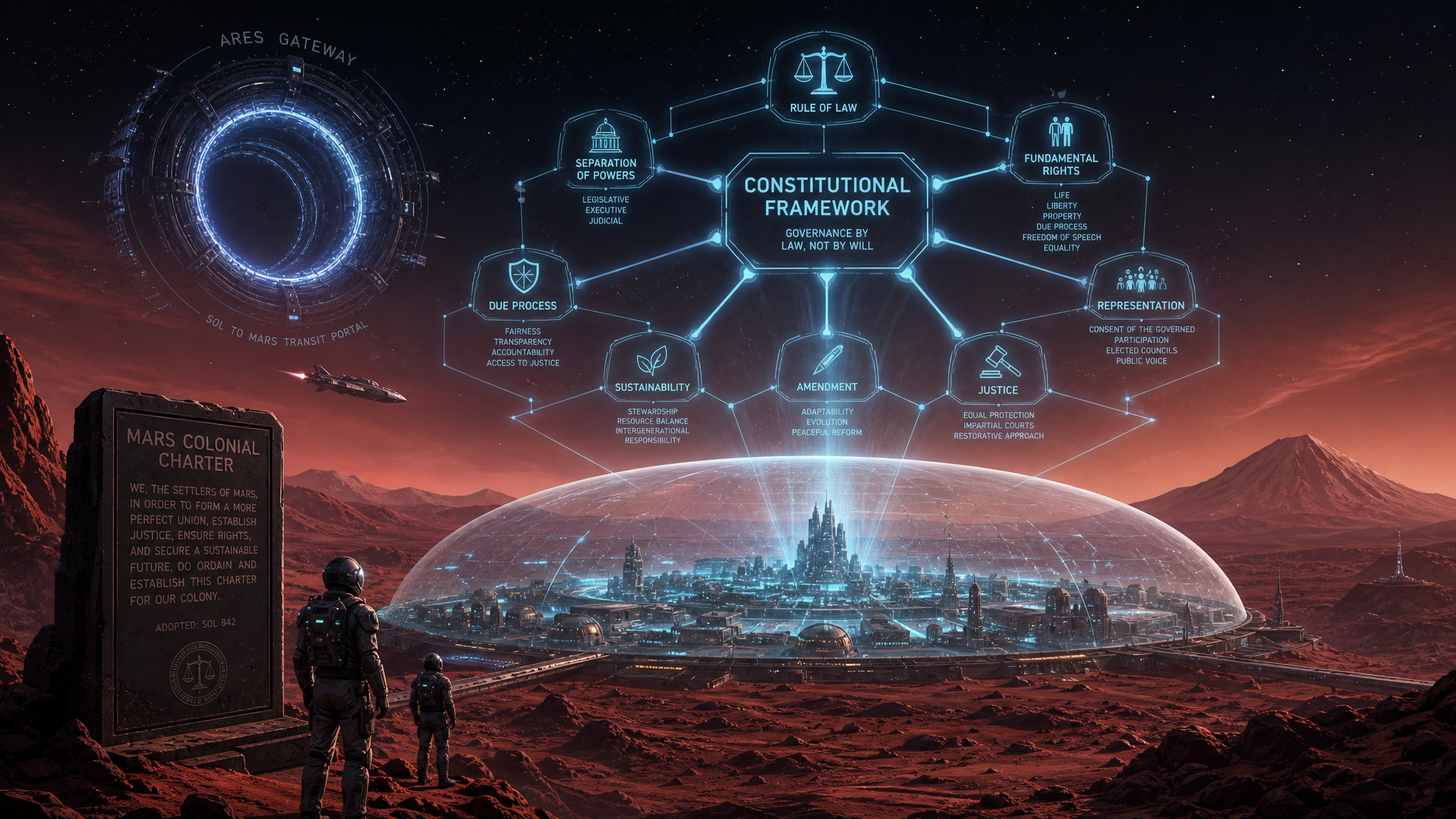
Mars may seem too distant for legal argument, but governance questions are already advancing. The Outer Space Treaty remains the foundational legal framework, establishing principles around peaceful use, national responsibility and non-appropriation. Yet a sustained human presence on Mars would raise practical issues the treaty only partly addresses: deconfliction around landing zones, protection of scientifically sensitive regions, management of waste, emergency assistance and standards for interoperability.
Planetary protection adds another layer. COSPAR’s policy framework reflects longstanding concern that human activity could compromise the scientific search for past or present life by transporting terrestrial contamination. As missions become more ambitious, the tension between exploration and preservation will sharpen. A site ideal for human operations may overlap with areas of astrobiological interest. Decisions about where to land and how to operate will carry consequences not just for engineering, but for scientific integrity.
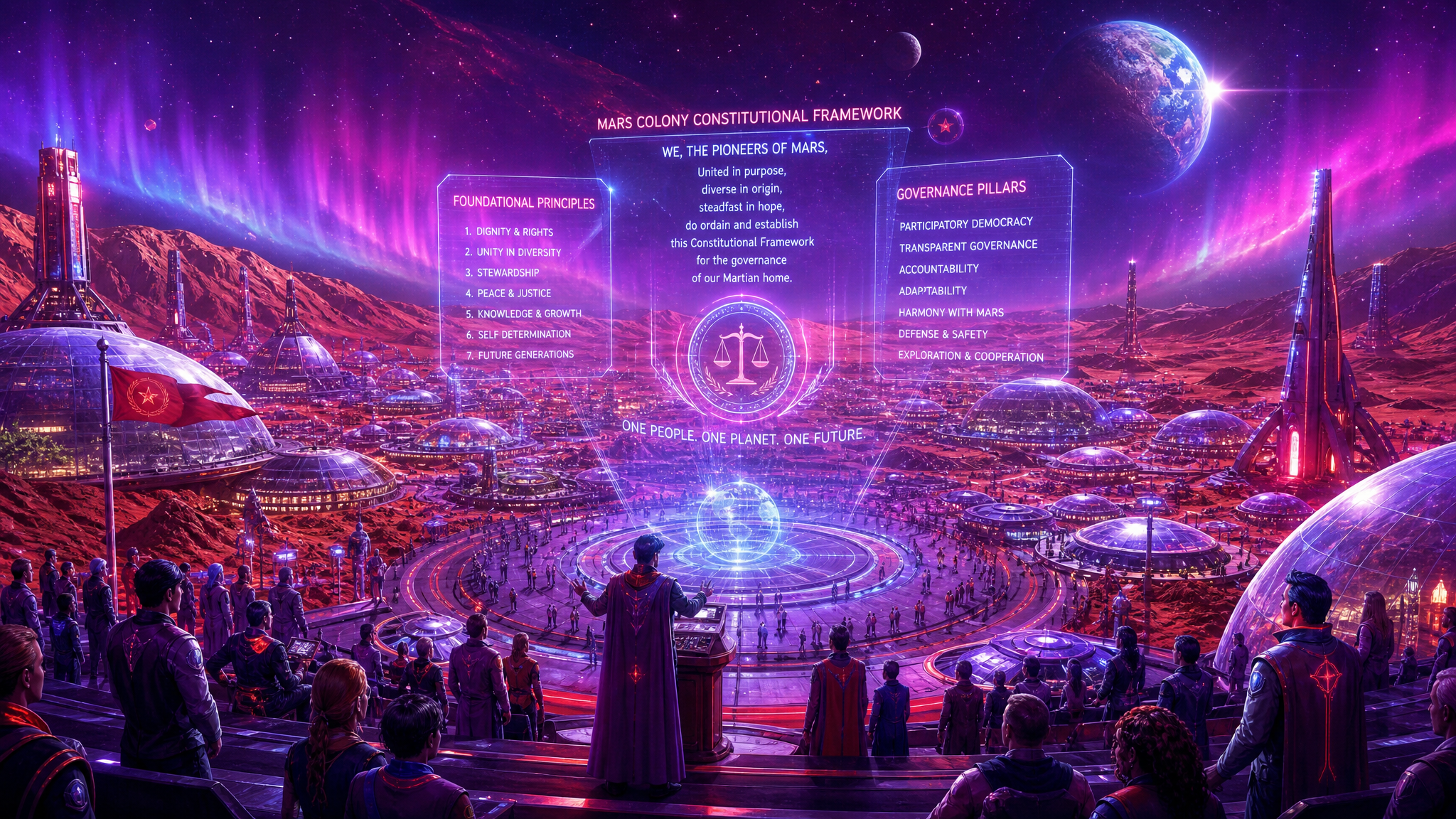
The governance challenge is therefore practical rather than abstract. Mars will require conventions, norms and technical standards before it requires grand constitutional theory. History suggests that infrastructures mature more safely when rules are clarified early. Waiting until multiple actors are operating on the surface would make agreement harder and disputes costlier.
The scientific case is broader than human presence
Human missions command attention, but the scientific value of Mars does not depend on putting people there quickly. Robotic exploration has already transformed understanding of Martian geology, climate evolution and habitability. Orbiters have mapped minerals and ice; rovers have documented ancient lake environments and sedimentary processes; atmospheric missions have illuminated how Mars lost much of its early atmosphere over time.
These findings matter far beyond planetary science. Mars is a natural laboratory for comparative climate, planetary evolution and the conditions under which life might emerge and persist. The search for biosignatures, whether in ancient sediments or protected subsurface environments, remains one of the most intellectually significant goals in modern science. That is why debates over human timelines should not eclipse the intrinsic value of robotic programmes. The best Mars strategy is not human versus robotic exploration, but a disciplined interplay between the two.
Indeed, a premature human push could undermine some of the most important science if contamination risks are not managed. The scientific case therefore supports patience as much as ambition. Mars deserves to be studied as a world, not merely visited as a milestone.
The real threshold is institutional maturity
In the end, Mars is forcing a difficult but healthy intellectual correction. The decisive barrier is not simply a powerful launcher, nor a single landing, nor even a successful short-stay expedition. The real threshold is institutional maturity: the ability to coordinate science, engineering, medicine, law and finance across decades rather than electoral cycles.
This is why the next era of Mars exploration will probably look less dramatic than enthusiasts once imagined, even if it proves more consequential. It will consist of tested subsystems, incremental demonstrations, better risk accounting and more realism about crew health and surface infrastructure. Progress may come in forms that are easy to overlook: a more robust recycler, a cleaner landing method, a more reliable autonomous diagnostic tool, a better radiation shelter design.
That should not be mistaken for timidity. On the contrary, a systems view is the only serious path to Mars. It accepts that the planet is hard not because one obstacle is insurmountable, but because many manageable obstacles interact in unforgiving ways. The societies that eventually operate there sustainably will not be those most intoxicated by the romance of departure. They will be those most competent at integration, maintenance and learning.
Mars, then, is becoming a measure of something larger than exploratory bravado. It is becoming a test of whether advanced societies can build durable capability under extreme constraints. If they can, the achievement will not only reshape deep-space exploration. It will reveal a great deal about how complex civilisations solve problems when distance, fragility and time all conspire against them.