Mars has become a mirror for Earthly ambitions
Mars occupies an unusual place in the modern imagination: close enough to be discussed in engineering meetings, far enough to absorb political fantasy. It can be framed as a scientific frontier, a civilisational insurance policy, a proving ground for industry or a theatre for national prestige. Yet the more Mars is invoked as a symbol, the easier it becomes to lose sight of what the project would actually require. The question is no longer whether humans can reach Mars in principle. It is whether any state or coalition can sustain human presence there in a manner that is technically robust, medically tolerable, economically supportable and politically legitimate.
That distinction matters. Space history is full of achievements that were astonishing in execution but narrow in duration. Flags can be planted quickly; functioning societies cannot. The leap from expedition to permanence is not measured simply in propulsion capability or launch cadence. It is measured in the reliability of systems that fail quietly: air recycling, radiation monitoring, food production, medical triage, spare parts manufacture, waste management and psychological resilience. Those are less glamorous than rockets, but they are the real architecture of settlement.
Mars is not chiefly a transport problem. It is a systems problem under conditions where rescue is implausible and error compounds slowly, then all at once.
Deep-space policy would benefit from more discipline in language. “Settlement” suggests scale, continuity and institutions. At present, what is realistically discussable is a sequence of missions, perhaps followed by a precarious outpost. There is nothing discreditable in saying so. Indeed, realism is the precondition for progress.
Distance changes the meaning of risk
Low Earth orbit has accustomed policymakers to a particular kind of space operation: risky, expensive, but still connected to Earth by relatively rapid logistics and communications. Mars alters that grammar. Depending on orbital geometry, one-way communication delays can range from several minutes to more than twenty. Launch windows are episodic. Return opportunities are constrained. There is no practical emergency evacuation once a crew has departed.
These are not merely operational inconveniences. They reshape accountability. A mission architecture that works near Earth because specialists can intervene, software can be patched rapidly and replacement hardware can be launched on demand may fail under Martian conditions. The farther humans travel, the less Earth functions as an active controller and the more it becomes a distant supplier of abstractions: procedures, software updates, moral support and delayed advice.
NASA’s human research programme and the broader biomedical literature have repeatedly underlined how spaceflight stressors interact rather than arriving one by one: isolation, confinement, altered gravity, radiation exposure, sleep disruption and limited medical capability can amplify each other. Deep-space design therefore cannot be built around average performance. It must be built around degraded performance under uncertainty. That is a sterner benchmark than most public argument admits.
Radiation is not a footnote to be engineered away with confidence
Popular narratives often treat radiation as one more technical issue awaiting an incremental fix. The evidence suggests something more sobering. Measurements reported from the Mars Science Laboratory mission provided a clearer picture of energetic particle exposure during interplanetary transit, while reviews by agencies and the National Academies have emphasised the persistent uncertainties around long-duration health risks, especially for missions extending beyond a year.
Mars is not chiefly a transport problem. It is a systems problem under conditions where rescue is implausible and error compounds slowly, then all at once.
Radiation is difficult because shielding is heavy, active mitigation remains challenging, and biological effects are not reducible to a single number. Galactic cosmic rays are especially problematic: highly energetic, hard to block completely and capable of causing cumulative damage. Solar particle events introduce a different hazard profile, demanding storm-shelter strategies and operational vigilance. Surface residence on Mars reduces some exposure relative to cruise, particularly if habitats are buried or shielded with regolith, but it does not remove the problem.
The consequence is strategic rather than merely biomedical. If exposure limits constrain crew duration, age profile or cumulative mission frequency, then the human exploration programme cannot be planned as though personnel were infinitely reusable. Training pipelines, legal standards and ethical review all become more stringent when a mission imposes health burdens that are material, probabilistic and not fully reversible.
Life support, not landing, is the true industrial threshold
Landing humans on Mars would be a historic feat. Keeping them alive there reliably is the greater one. Closed-loop life support has improved markedly through orbital operations and terrestrial analogue research, but no system at meaningful scale has yet demonstrated the level of fault tolerance required for a semi-autonomous outpost on another planet. Redundancy adds mass. Repairability adds complexity. Consumables can be stockpiled, but stockpiles are not sovereignty; they are deferred vulnerability.
The same logic applies to food. Short missions can rely heavily on pre-packaged supplies. Longer stays push planners towards hybrid models involving stored food, controlled-environment agriculture and in-situ processing. Yet agriculture in extreme environments is not merely a question of seeds and lamps. It requires water purification, nutrient cycling, contamination control, labour time, pollination strategies, disease management and stable power. Every element interlocks with every other. A failure in thermal control can become a failure in food production; a failure in spare-part availability can become a medical crisis months later.
The decisive capability for deep space is not reaching a distant surface once, but maintaining a margin of safety when every replacement part is millions of kilometres away.
This is why in-situ resource utilisation attracts justified interest, but also why it should be discussed carefully. Producing oxygen from local materials, extracting water ice, manufacturing simple components and using regolith for shielding would all reduce dependence on Earth. But each local process requires machinery, maintenance and energy. There is no magical point at which “living off the land” becomes easy. On Mars, local production would be an industrial accomplishment of the first order.
Power is the hidden constitution of a Martian outpost
Most arguments about Mars assume power in the background, as though it were a settled utility. It is not. A sustained human presence would demand dependable energy for habitat systems, communications, computing, scientific equipment, mobility, resource processing and possibly propellant production. Solar power is feasible, but Mars presents awkward constraints: lower insolation than Earth, dust accumulation, seasonal variation and occasional dust storms that can reduce output significantly. Energy storage can buffer intermittency, but storage also adds mass, cost and maintenance burdens.
Alternative power sources offer different trade-offs, particularly in relation to reliability, thermal management and logistics. The broader point is that power architecture determines not only mission safety but social organisation. A base with fragile energy margins is one in which every activity becomes a rationing decision. Scientific work, construction, crop growth and communications compete. Power abundance widens autonomy; power scarcity narrows it. In that sense, energy is the hidden constitution of any extraterrestrial settlement attempt.
This has implications for mission sequencing. Before speaking grandly about growth, policymakers should ask what level of power generation can be emplaced, maintained and expanded with high confidence. Settlement rhetoric often skips this step because it lacks cinematic appeal. Yet history on Earth offers a blunt lesson: durable frontiers are not founded on vision alone, but on reliable energy and maintenance culture.
The decisive capability for deep space is not reaching a distant surface once, but maintaining a margin of safety when every replacement part is millions of kilometres away.
Autonomy in medicine will be a moral as well as technical test
Space medicine in low Earth orbit already involves careful selection, extensive training and constant support from the ground. Mars would dilute that support precisely when needs become more severe. Crews may face dental emergencies, fractures, surgical conditions, psychiatric stress, infectious risks within closed environments, and cumulative physiological changes associated with partial gravity and prolonged confinement. Communication delays mean that telemedicine remains useful, but not decisive. The crew would need broader onboard diagnostic capability, deeper procedural competence and stronger medical decision-making authority.
This is an ethical frontier as much as an engineering one. How much risk can a society ask individuals to bear when definitive care may be unavailable for months or years? What standards of informed consent are meaningful when some hazards remain scientifically uncertain? The rhetoric of heroism cannot answer these questions. If Mars missions are to endure public scrutiny, they will require institutional frameworks that are candid about impairment, triage and the possibility that crews may have to manage conditions that would be routine on Earth but life-threatening in transit or on the surface.
The lesson from remote medicine, polar operations and submarine service is not that humans cannot cope. It is that resilience must be organised. Competence under isolation is designed, trained and rehearsed. It does not emerge from aspiration alone.
Mars will expose whether space governance has matured
For decades, space governance has balanced high principles with strategic ambiguity. The Outer Space Treaty established essential norms: non-appropriation, peaceful use, state responsibility and due regard. But a sustained human presence on Mars would stress these norms in new ways. Questions of resource use, environmental protection, liability, safety zones, labour standards, emergency assistance and scientific access become harder when activity is continuous rather than episodic.
There is a temptation to treat governance as a secondary matter to be settled after the engineering succeeds. That would be a mistake. Rules shape incentives in advance. If actors expect unclear liability, contested operating norms or a permissive attitude to exclusionary practices around infrastructure, they will design systems accordingly. Conversely, if governance frameworks encourage interoperability, transparency and emergency reciprocity, then architecture may become more modular and less politically brittle.
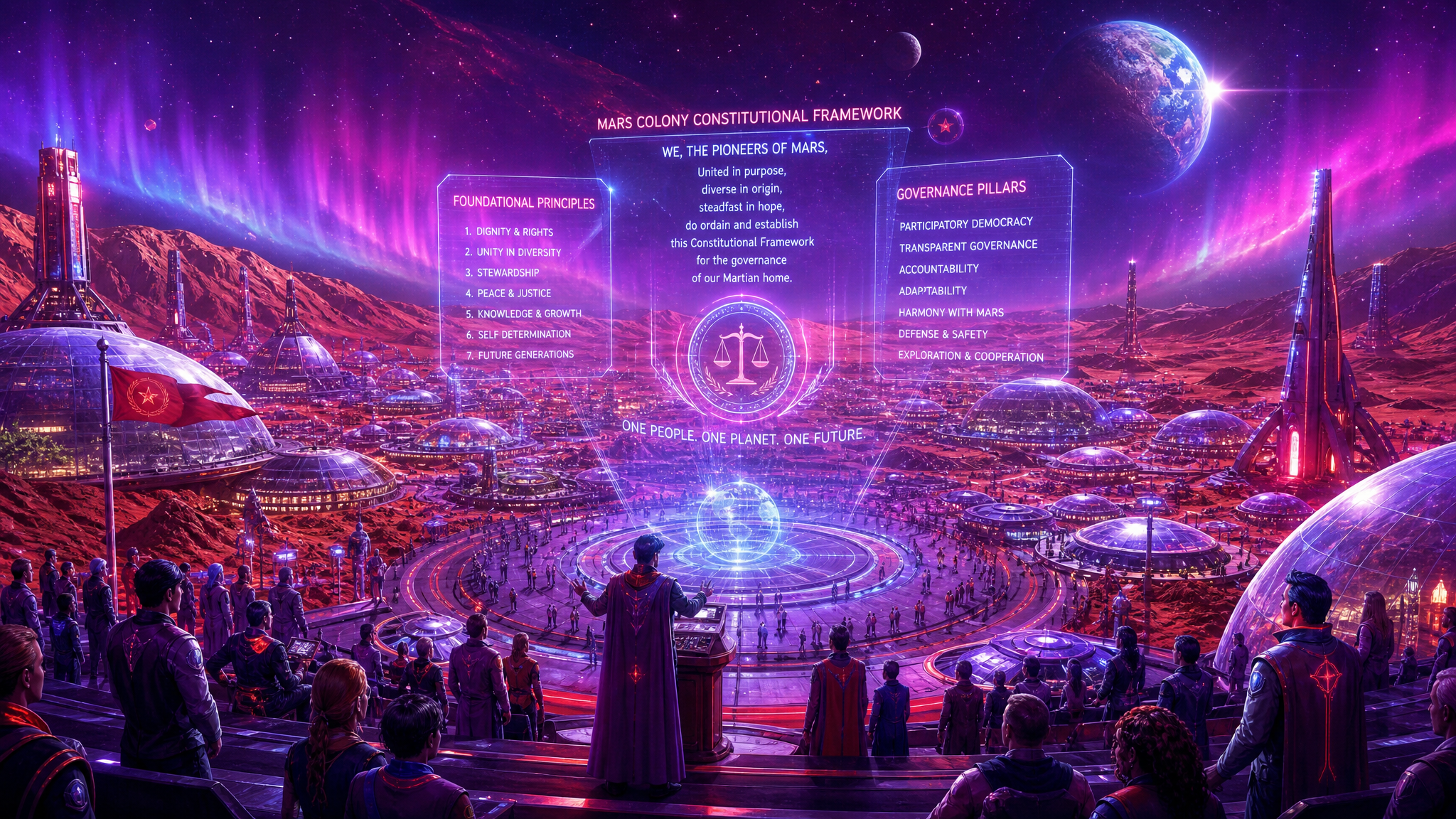
The most important political challenge is legitimacy. A tiny off-world population sustained by Earthly wealth and governed under mission protocols is not a polity in any ordinary sense. Yet the longer such an outpost endures, the more questions will arise about authority, representation, labour obligations and conflict resolution. Mars may begin as an engineering exercise, but it will rapidly become a constitutional one.
If humanity reaches Mars before it learns to govern dependence fairly, the first outposts may look less like new societies than remote company towns with a planetary horizon.
The economics of permanence remain unproved
There is a habit in frontier discourse to assume that cost curves will fall and that lowered cost will itself unlock sustainable demand. In launch and satellite services, such dynamics can be real. On Mars, however, lower transport cost would solve only one layer of the equation. The deeper challenge is that a human outpost requires a standing flow of high-value hardware, specialised labour, redundancy, training and oversight with little prospect of near-term commercial self-sufficiency.
If humanity reaches Mars before it learns to govern dependence fairly, the first outposts may look less like new societies than remote company towns with a planetary horizon.
Science can justify substantial public expenditure, as can strategic competition and technological spillovers. But those are political choices, not business inevitabilities. A durable Mars programme would therefore depend on institutions willing to fund prestige-poor maintenance after the headlines fade. Historically, this is difficult. Democracies reward visible milestones more readily than they reward decades of disciplined operations. Authoritarian systems can direct resources for longer in some sectors, but often at the cost of opacity and brittle feedback. Neither model offers an effortless path to interplanetary permanence.
The prudent conclusion is not that Mars is unaffordable in all circumstances. It is that affordability cannot be inferred from enthusiasm. Any serious debate should distinguish between one-off demonstration missions, rotating scientific expeditions and attempts at permanent habitation. They have radically different cost structures and political liabilities.
Robots will remain the strategic vanguard
Human missions attract disproportionate attention because humans embody exploration in a way that machines do not. Yet in strategic terms, robotic systems will continue to do much of the real work of opening Mars. They map terrain, assess hazards, study climate, test landing technologies, analyse resources and provide the scientific and operational data without which crewed missions would verge on recklessness. The history of Mars exploration already shows this clearly.
This should not be read as an argument against human exploration. Rather, it is an argument for sequencing. A civilisation that wishes to go far should be willing to learn slowly. Pre-deployed cargo, autonomous construction, environmental monitoring and long-duration surface experiments are not timid substitutes for human boldness. They are what boldness looks like when informed by evidence. In deep space, prudence is not the enemy of ambition; it is the discipline that keeps ambition from becoming theatre.
There is also an intellectual point here. If Mars is pursued primarily as a symbol of human exceptionalism, robotic contributions will be undervalued. If it is pursued as a serious programme of planetary presence, then machines become partners in sovereignty, maintenance and survival. The future will not be human alone; it will be human-machine systems of growing intimacy and consequence.
The real case for Mars is civilisational seriousness
The strongest argument for going to Mars is not escapism. Earth will remain humanity’s only abundant biosphere for the foreseeable future, and no credible Mars programme offers an alternative home for billions. Nor is the best case merely prestige. Prestige fades quickly when confronted by funerals, budget cycles and technical setbacks.
The deeper case is that attempting to live on Mars would test whether advanced societies can extend life-supporting order into radically hostile environments without relying on myth. It would force improvements in closed-loop systems, remote medicine, energy resilience, autonomy, international coordination and long-horizon governance. It would reveal weaknesses in our institutions as much as in our machinery. That is precisely why the project matters.
But seriousness imposes a price: rhetorical restraint. Mars should not be sold as imminent salvation, easy destiny or a substitute for planetary stewardship on Earth. It should be approached as a severe, multi-generational undertaking in which engineering, biology and politics are inseparable. The first enduring presence on Mars, if it comes, will not be built by those most adept at grand declarations. It will be built by those willing to treat maintenance as strategy, limits as information and governance as infrastructure.
In that sense, Mars is less a test of how far rockets can fly than of how mature a technological civilisation has become. The red planet will not be settled by slogans. It will be approached, if at all, by institutions capable of combining ambition with honesty.