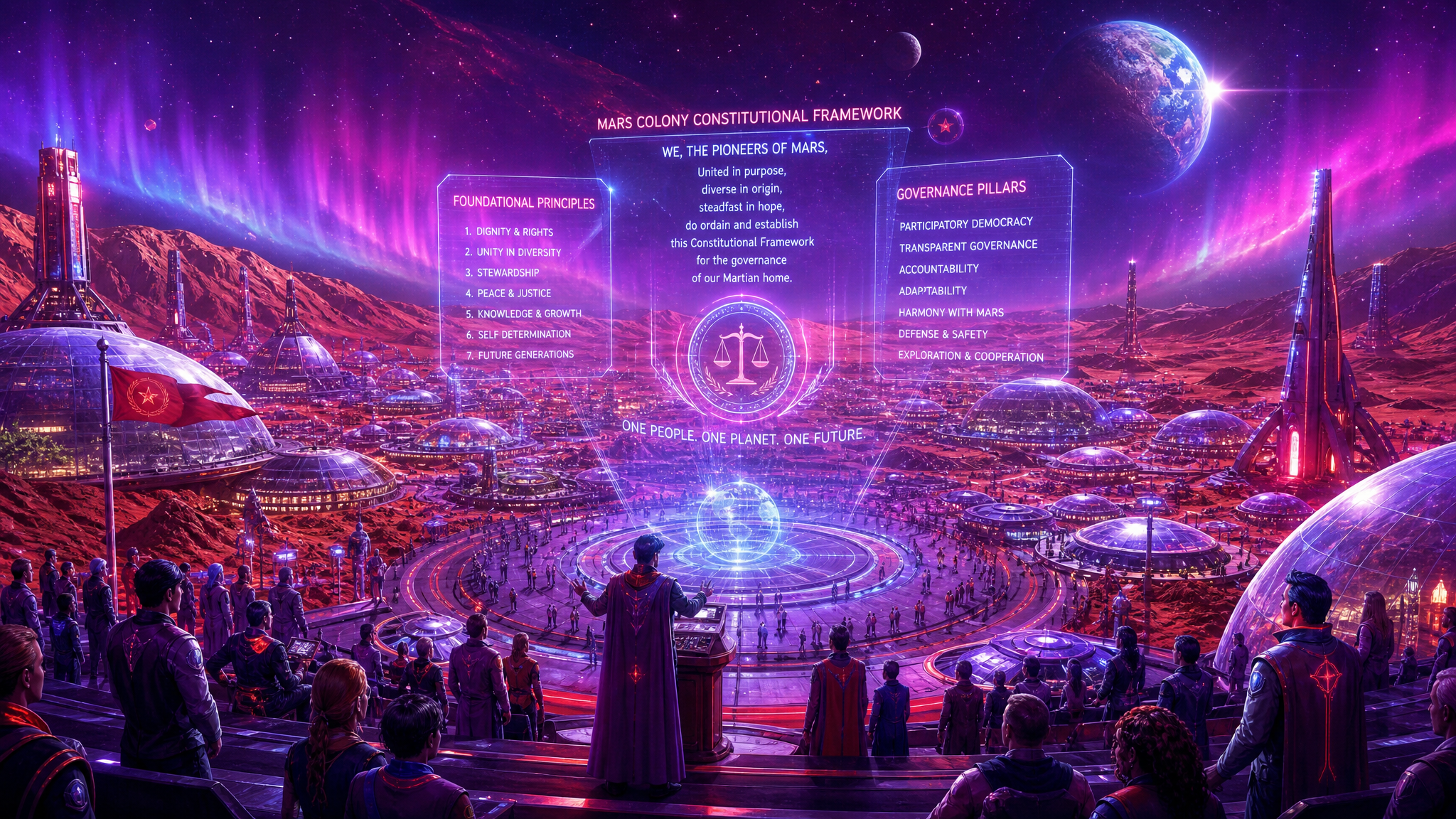
When people speak about a new space race, they tend to reach for old imagery: flags planted in dust, rival launch systems, grand speeches about destiny. It is a compelling frame, but by mid-2026 it is also an increasingly misleading one. The most important competition beyond Earth is not simply over who lands where. It is over whose assumptions become normal.
That may sound bloodless beside rockets and astronauts. Yet every durable frontier has been shaped less by spectacle than by the mundane architecture of standards, contracts, interfaces and enforcement. Railways required gauges. Aviation required airworthiness rules, slot allocation and navigation protocols. The internet did not become strategic because cables existed; it became strategic because layered standards allowed entire economies to rely upon them. Space is approaching the same threshold.
The next decade will not be decided solely by dramatic firsts on the Moon or by the shifting timetable for Mars missions. It will be decided by quieter choices: how docking systems interoperate, how in-situ resources are recorded and transferred, what counts as due regard near a permanently shadowed crater, which jurisdictions insurers trust, whose technical documentation becomes the default reference, and how data from cislunar operations is authenticated and exchanged. Sovereignty matters. But standards often decide whose sovereignty can be exercised efficiently.
Beyond prestige politics
The prestige model of space policy remains powerful because it is legible. National leaders can explain launch cadence and crewed missions to voters far more easily than they can explain debris mitigation, spectrum coordination or liability allocation. But prestige politics captures only the visible layer of the system. Below it lies the operational substrate on which all ambitious programmes depend.
Consider the broad shift underway. Low Earth orbit is becoming more commercialised, if not yet fully commercial. Lunar ambitions are moving from one-off demonstration missions towards questions of sustained access, logistics and habitation. Multiple governments are refining national space legislation, while coalitions are attempting to shape acceptable behaviour through instruments such as the Artemis Accords, UN sustainability guidelines and various technical working groups. Meanwhile, companies with terrestrial supply chains are entering space not merely as contractors to states but as prospective operators of transport, communications, robotics and orbital infrastructure.
In such an environment, the decisive advantage is rarely theatrical. It lies in defining the default. Once a standard is embedded in procurement, insurance underwriting, mission design software and regulatory practice, it acquires inertia. Others may complain about its origins, but they often still adopt it because compatibility is cheaper than dissent.
The hidden power of interoperability
This is not a glamorous thesis, but it is a realistic one. Space systems are expensive, safety-critical and deeply interdependent. A habitat can fail because of physics, but a space economy can fail because its participants cannot trust each other’s interfaces, data or legal assumptions.
Interoperability is therefore not a technocratic afterthought. It is the precondition for scale. Docking mechanisms, refuelling ports, navigation references, communications layers, software assurance procedures and cargo handling standards all influence whether a diverse ecosystem can emerge or whether every mission remains a bespoke project. Bespoke systems may suit prestige missions; they are much less suitable for commerce.
The strategic consequence is clear. Actors that succeed in making their systems interoperable on their own terms gain more than engineering convenience. They create a form of path dependence. Suppliers adapt to their specifications. Training programmes replicate their procedures. Regulators become familiar with their compliance models. Financial institutions assess risk through categories shaped by their operating assumptions. The result is not formal empire, but practical centrality.
The most important territory in space may prove to be neither lunar regolith nor Martian ground, but the invisible layer of rules that determines how activity is organised.
Why the Moon matters more than Mars, for now
The most important territory in space may prove to be neither lunar regolith nor Martian ground, but the invisible layer of rules that determines how activity is organised.
The editorial category may promise Mars and beyond, yet the immediate arena for these struggles is much closer to Earth. The Moon is where governance, logistics and commercial models can be tested under pressure. Mars remains the horizon case: invaluable as an organising ambition, but still distant enough that many of its political disputes are abstract. Cislunar space is where abstraction begins to harden into precedent.
That is one reason the lunar debate has become more consequential than it first appears. Questions around safety zones, resource extraction, environmental stewardship, scientific preservation and traffic coordination are not merely lunar questions. They are rehearsal questions. They establish habits of interpretation that may later be carried outward. If norms are set in a context where a handful of powerful actors dominate infrastructure, those norms may travel with the infrastructure.
The Outer Space Treaty still provides the foundational legal architecture, particularly its principles of non-appropriation, peaceful use and state responsibility. Yet the treaty was not written for an environment of routine commercial operations, proliferating private actors and contested views on resource rights. That gap does not invalidate the treaty. It means interpretation now matters enormously. The actors best positioned to operationalise interpretation will shape outcomes without formally rewriting first principles.
From law on the books to law in use
Space law is often discussed as if it were a matter of conferences and declarations. In practice, much of it emerges through licensing, procurement, insurance conditions and technical certification. Law on the books matters, but law in use often matters more. National frameworks determine who may launch, who bears responsibility for private conduct, how indemnification works and what safety standards apply. Those frameworks are proliferating and diverging.
That divergence can become a source of fragmentation. It can also become an instrument of influence. If one jurisdiction offers a predictable, investable and internationally legible regulatory environment, operators will cluster around it. If another offers ambiguity, politically volatile approvals or weak dispute resolution, capital and talent will discount it. This is not unique to space. It is how governance competition works in every high-technology domain.
The frontier myth flatters politics, yet the real work of expansion is administrative: certification, interoperability, insurance, spectrum management and dispute resolution. Spacefaring states that neglect this reality may discover that inspiring rhetoric cannot compensate for institutional thinness. By contrast, states with modest launch capabilities but sophisticated regulatory design may end up exerting disproportionate influence on how the wider system behaves.
The private sector changes the geometry
The rise of commercial launch, satellite connectivity and private orbital infrastructure has altered the geometry of power in space. States remain central: they license, fund, insure, procure and represent. But they no longer monopolise operational capability. This makes standard-setting both more urgent and more difficult.
Commercial actors prefer predictable interfaces and scalable business conditions. They also prefer avoiding situations in which every cross-border partnership triggers novel legal uncertainty. As a result, private industry often becomes a powerful constituency for harmonisation. Yet harmonisation is rarely neutral. It reflects whichever actors are sufficiently capable, organised and early to shape the template.
There is a terrestrial analogy in cloud computing and semiconductor supply chains. Governments may speak in the language of national strategy, but much of the durable architecture is encoded in technical documentation, compliance pathways and contractual dependencies. Space is developing similar characteristics. Communications constellations, on-orbit servicing, cargo delivery, station modules and lunar logistics all generate opportunities for private actors to become de facto governors through standard operating procedures.
This should concern those who imagine sovereignty and markets as tidy alternatives. In practice, the two will be entangled. States will rely on private infrastructure; private operators will depend on public authority. The question is not whether one replaces the other. It is who writes the interfaces between them.
Europe’s dilemma: principled, capable, but often slow
For Europe, this transition presents a familiar but acute dilemma. European institutions and member states are generally strong on rules, safety culture and multilateral legitimacy. They are less consistently effective at consolidating industrial scale and operational speed. In a standards-driven era, that asymmetry cuts both ways.
A habitat can fail because of physics, but a space economy can fail because its participants cannot trust each other's interfaces, data or legal assumptions.
On one hand, Europe is well placed to influence sustainability norms, liability discussions, dual-use safeguards and scientifically grounded stewardship. Its broader experience with digital regulation and industrial standards gives it a repertoire many others lack. On the other hand, influence in standards is difficult to sustain without operational density. If others run more missions, field more infrastructure and dominate procurement pipelines, their practices can become the baseline against which formal rules are later written.
That is the deeper lesson of many technology sectors over the past two decades. Normative leadership detached from market or operational presence tends to narrow over time. Europe can still matter enormously in space governance, but only if legal seriousness is matched with enduring participation in the infrastructure itself.
The American advantage is institutional, not only technological
The United States is often described as dominant in space because of its launch ecosystem, capital markets and defence spending. All true. Yet its subtler advantage lies in its ability to align public procurement, private risk-taking, legal experimentation and alliance-building into a common if imperfect operating environment. That combination helps standards travel.
The Artemis Accords are best understood in this light. They are not universal law, nor are they uncontested. But they represent an attempt to convert broad treaty principles into operational expectations among a coalition of partners. Their significance lies less in rhetoric than in routine adoption. If participating agencies, contractors and insurers increasingly internalise these assumptions, they may become difficult to dislodge even by states that prefer alternative formulations.
For Washington, then, the strategic objective is not merely to lead missions. It is to make its governance and technical ecosystem the easiest environment within which others can participate. When participation costs are lowest inside one architecture, pluralism persists in theory while dependency deepens in practice.
The frontier myth flatters politics, yet the real work of expansion is administrative: certification, interoperability, insurance, spectrum management and dispute resolution.
China and the politics of parallel systems
Any serious account must also recognise the prospect of parallel architectures. China’s space programme has demonstrated sustained ambition, technical competence and institutional discipline. It is capable not only of mounting missions but of building an integrated ecosystem of partnerships, standards and financing around them. The strategic question is whether the world converges on a largely shared operating environment or bifurcates into partially interoperable blocs.
Bifurcation would carry costs. It would duplicate technical work, complicate joint science, raise transaction costs for firms and increase ambiguity in emergencies. Yet it may still occur if geopolitical mistrust deepens. Space would then resemble other strategic technologies where interoperability is selective, standards are politicised and participation carries alignment implications.
Such fragmentation is not inevitable. Even rival powers have strong reasons to sustain some shared rules on debris, conjunction management, emergency assistance and spectrum use. But partial cooperation should not be confused with comprehensive convergence. A divided standards landscape is entirely plausible by the early 2030s, especially if lunar activity becomes more operationally dense.
Sustainability is not separate from strategy
There remains a temptation to treat sustainability as an ethical add-on to the real business of space power. That is a mistake. Debris mitigation, transparency, responsible disposal, collision avoidance and protection of scientifically important sites are not merely moral preferences. They are system-preserving conditions. Without them, the economics of routine activity deteriorate.
The frontier myth flatters politics, yet the real work of expansion is administrative: certification, interoperability, insurance, spectrum management and dispute resolution.
This is why initiatives around long-term sustainability deserve more attention than they receive in headline coverage. The more crowded and commercialised orbital and cislunar environments become, the more any serious operator will require reliable information-sharing and behavioural predictability. Sustainability norms thus become part of the strategic substrate. Actors that help institutionalise them are not constraining growth; they are making durable growth possible.
There is, moreover, a distributional issue. Weak sustainability standards tend to favour incumbents with greater tolerance for risk and replacement costs. Stronger standards can lower uncertainty for a wider pool of entrants. In that sense, sustainability is also about market structure. It influences whether space remains a narrow arena of high-stakes concentration or evolves into a broader industrial ecosystem.
Insurance, finance and the quiet governors
Journalists and policymakers often understate the role of insurers, financiers and auditors in shaping the next space era. Yet these actors are among the quiet governors of industrial behaviour. They decide what risks are tolerable, what documentation is sufficient and what forms of compliance make projects investable. Their influence is particularly strong in sectors where catastrophic failure is possible and historical data is sparse.
If underwriters converge on certain debris practices, cybersecurity expectations, orbital servicing protocols or lunar operations checklists, those norms may matter more in practice than diplomatic statements. Likewise, if export controls, sanctions risk or licensing uncertainty make some partnerships difficult to finance, geopolitical reality will be encoded directly into capital allocation.
This should further dispel the romantic view of space as a realm apart. It is becoming a heavily intermediated domain in which terrestrial institutions decide what can scale. Whoever shapes those institutions’ assumptions will hold an advantage that launch counts alone do not reveal.
What this means for Mars
Mars remains the symbolic summit of human expansion, but the political economy of reaching it will be settled much earlier and much nearer to home. The missions that eventually go will depend upon supply chains, communications standards, life-support certification regimes, autonomous operations frameworks and public-private contracting models matured elsewhere. Mars will inherit the institutional grammar established in cislunar space.
That is why debates about lunar resource utilisation, commercial station governance and orbital traffic management matter to Mars even when they seem parochial. They are defining how mixed ecosystems of states, agencies and firms learn to cooperate under stress. If those systems remain fragmented, brittle or politically exclusionary, Mars missions may still occur, but they will be narrower, costlier and less generative than enthusiasts imagine.
Conversely, if standards and norms become sufficiently robust, Mars ceases to be merely a heroic expedition and becomes the extension of an operating system already tested beyond Earth. The difference is profound. One model privileges spectacle and singular achievement. The other supports continuity.
The contest after the contest
Opinion writing on space often asks who is winning. The better question is what counts as winning. In the coming phase, victory will not belong exclusively to the state that plants the next flag, launches the most dramatic vehicle or announces the boldest timetable. It will belong to the actors whose protocols are trusted, whose legal frameworks are copied, whose safety assumptions are priced into insurance, and whose infrastructure others can use more easily than they can avoid.
This may disappoint those who prefer a simpler narrative of rivalry. But it is a more serious account of how complex systems expand. Frontiers are rarely tamed by heroic acts alone. They stabilise through routines, and routines are forms of power.
Space politics, then, is entering a less romantic but more consequential phase. The argument is no longer just about access to the heavens. It is about the terms under which access is organised. That is where strategic advantage will accumulate, and where the future of Mars and beyond is already being quietly decided.