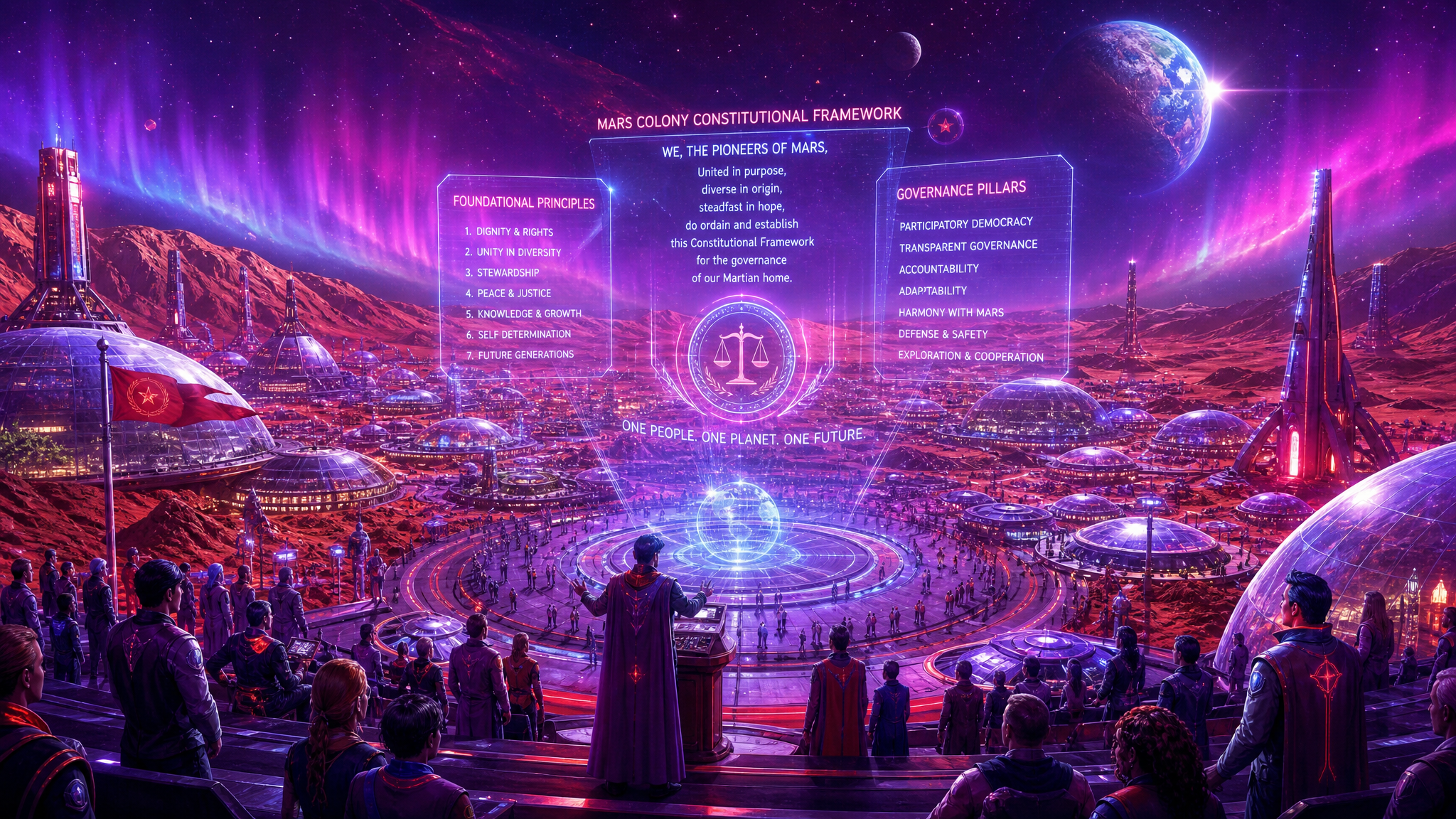
The usual timeline of Mars begins with fire: launch windows, booster thrust, entry heat and the violent poetry of descent. It is a compelling way to tell the story, but increasingly the wrong one. By mid-2026, the decisive chronology of deep-space ambition is being written in quieter places: standards committees, export-control offices, insurance markets, procurement agencies, planetary-protection boards and legislatures drafting space law for a sector that has outgrown its Cold War assumptions.
This is not a peripheral bureaucratic subplot. It is the infrastructure of legitimacy and scale. As more states acquire launch capability, as private firms become prime contractors rather than mere suppliers, and as ambitions stretch from low Earth orbit to cislunar space and onward to Mars, the question is no longer only whether hardware can be built. It is whether institutions can keep pace without either paralysing experimentation or licensing chaos.
A timeline of rules reveals something the rocket-centric narrative obscures. Each new phase of exploration has depended on an administrative breakthrough as much as an engineering one: an agreed frequency allocation, a launch regime, a liability convention, a procurement model, a contamination threshold, a standards architecture. The frontier does not abolish governance. It demands more of it.
1957-1967: The first age was geopolitical before it was commercial
The launch of Sputnik in 1957 is often treated as the beginning of the space age, and in technological terms it was. Yet its most enduring consequence was legal and diplomatic. Within a decade, states had moved to establish the core principle that outer space would not be subject to national appropriation in the same way as terrestrial territory. The 1967 Outer Space Treaty did not resolve every future dispute, but it created the constitutional baseline for what followed: peaceful purposes, state responsibility for national activities and a prohibition on sovereignty claims over celestial bodies.
For Mars, this mattered immediately, even if no crewed mission was remotely feasible. The treaty framed exploration as a public act with international consequences. States could not simply disown the conduct of firms or universities under their jurisdiction. That principle has become more, not less, important as private capital has entered launch, communications and remote operations at scale.
The early era also normalised another pattern that remains with us: security competition generating civilian institutions. Tracking networks, spectrum management and launch oversight were not ornamental add-ons. They were the skeleton of a system in which increasingly diverse actors would seek access to the same orbital and deep-space environment.
1970s-1980s: Planetary protection moved from scientific caution to operating doctrine
If there is one hidden thread running through every serious Mars plan, it is contamination. The concern sounds almost quaint beside the audacity of interplanetary travel: sterilisation procedures, clean-room discipline, bioburden accounting, sample handling protocols. Yet these practices determine what missions may credibly claim to discover and what risks they impose on other worlds and on Earth.
Through the work of the Committee on Space Research and national agencies, planetary protection became a technical language for a philosophical problem. If a lander detects organic signatures, how confidently can scientists separate indigenous chemistry from stowaway terrestrial biology. If a mission returns material to Earth, what degree of containment is justified. These are not abstract matters. They affect spacecraft architecture, assembly costs, launch schedules and the politics of public consent.
By the late twentieth century, Mars was already being treated not merely as an engineering target but as a protected scientific archive. That status has only become more consequential as plans shift from intermittent robotic missions to sustained surface operations, resource use and eventual human presence.
The most consequential argument about Mars may not be how to reach it, but how not to ruin the evidence waiting there.
1990s: Commercial launch law quietly redrew the supply side
The post-Cold War period is often remembered for space station diplomacy and shrinking state budgets. Less appreciated is how commercial launch regulation matured into a durable enabling framework. In the United States, the licensing structure associated with the Commercial Space Launch Act and subsequent reforms gradually created a more predictable path for private launch providers. Other jurisdictions developed their own mixes of authorisation, supervision and liability rules.
The next era of exploration will be constrained as much by paperwork and protocols as by propellant.
This matters to Mars because deep-space capability rests on terrestrial repetition. A mission to another planet is never a single rocket and a heroic payload. It is an industrial stack: manufacturing, testing, launch cadence, insurance, software assurance, supply chains and public procurement. Once launch services could be bought with greater regularity, governments could behave less like bespoke project managers and more like sophisticated customers. That shift opened room for more iterative mission design and a broader industrial base.
The same decade also brought growing concern over dual-use technology transfer. Export-control regimes were intended to protect sensitive capabilities, but they also complicated international collaboration. For Mars campaigns involving advanced materials, avionics, sensors and communications, the boundary between prudent control and costly fragmentation has remained unresolved.
2000s: Standards became strategy
As launch diversified and satellite industries scaled, another layer of governance gained salience: technical interoperability. It rarely captures public attention, but standards determine whether components can be integrated across organisations, whether docking systems can interoperate, whether data formats are usable and whether supply chains can be broadened beyond a single national champion.
For deep-space missions, standards reduce fragility. They lower switching costs, improve resilience and make joint programmes more plausible. International bodies and agency-led collaborations worked through issues that look mundane until they fail: communications interfaces, navigation references, environmental testing and systems engineering practices. In cislunar space and eventually around Mars, interoperability is not a luxury. It is one of the few credible ways to avoid wasteful duplication among partners with divergent budgets and timelines.
The hidden geopolitical implication is that standards can lock in influence without formal ownership. A country or coalition that shapes technical norms shapes market access, supplier eligibility and mission architectures. The battle for the future of space is therefore partly a battle over the default settings embedded in engineering documents.
2010s: Procurement replaced prestige as the engine of capability
The 2010s did not make governments irrelevant in space; they changed how governments exerted power. Fixed-price contracts, milestone payments and service-based procurement models altered incentives throughout the sector. Rather than specifying every subsystem, public agencies increasingly defined outcomes and accepted a more plural supplier landscape.
That had two effects with implications for Mars. First, it compressed learning cycles. Suppliers gained latitude to iterate more quickly than under classic cost-plus structures. Secondly, it redistributed strategic risk. Public agencies still underwrote demand and absorbed political accountability, but private firms assumed a larger role in execution, integration and capital formation.
The result was not a simple triumph of markets over bureaucracy. It was a more complicated administrative state, one that had to learn vendor management, safety oversight and competition policy in an environment where a handful of launch and infrastructure providers could become systemically important. Deep-space planning now depends on procurement competence as much as on scientific vision.
What looks like delay from the launch pad often appears, from the regulator's desk, as the price of legitimacy.
2020-2022: The Moon returned as a legal rehearsal for Mars
The renewed push towards the Moon has usually been described as a stepping stone strategy: test systems close to Earth before attempting longer voyages. Just as important, it is a legal and diplomatic rehearsal. The Artemis Accords, while not universal and not equivalent to binding treaty law, set out principles on interoperability, emergency assistance, registration, data release and the use of space resources. Their significance lies less in immediate enforceability than in coalition-building around operational norms.
For Mars, the Moon offers a proving ground for questions that become sharper farther out. How should safety zones be understood without becoming de facto territorial claims. What degree of transparency should attach to resource extraction. How can partners reconcile open scientific exchange with national-security restrictions. Cislunar activity does not answer these issues, but it forces them into the open.
Mars is no longer only a destination; it is a test of whether democratic states can build durable rules for frontier industry.
At the same time, industrial policy returned to the foreground on Earth. Measures such as the US CHIPS and Science Act reflected a wider recognition that advanced manufacturing, semiconductors and research capacity are strategic assets. Deep-space missions depend on exactly these capabilities. The route to Mars therefore runs through domestic industrial resilience as much as through celestial mechanics.
2023-2024: Debris and sustainability ceased to be an orbital niche
One objection might be that debris mitigation is mainly a low Earth orbit issue, only loosely related to Mars. That is too narrow. The emerging politics of space sustainability have become a template for broader norms of responsible conduct. If states and firms struggle to manage congestion around Earth, confidence in their stewardship farther afield diminishes.
In the early 2020s, sustainability frameworks, ratings initiatives and national licensing reforms began to translate a previously diffuse concern into governance practice. The European Union's work towards a Space Act signalled a desire to harmonise safety, resilience and sustainability expectations across a fragmented market. The OECD, meanwhile, continued to frame space activity as an economic domain requiring public-policy tools rather than exceptional treatment.
This shift matters because investors, insurers and export-credit agencies increasingly pay attention to regulatory quality. A Mars mission will never be assessed solely on its technical profile. Counterparty risk, liability allocation, collision avoidance competence and supply-chain traceability all feed into the credibility of the institutions behind it.
2024-2025: Planetary protection was forced out of the laboratory and into politics
As sample return, human exploration architectures and commercial lunar ambitions advanced, planetary protection stopped being a specialist conversation among astrobiologists. Public agencies and independent scientific bodies began revisiting whether existing categories, especially for Mars missions most likely to contact environments of biological interest, remained fit for purpose. The National Academies' work on organic-contamination-prone Mars missions captured a larger truth: the old distinction between scientific cleanliness and operational practicality has become harder to sustain.
Human missions intensify the dilemma. People are irreducibly messy biological systems. If the long-term objective includes sustained surface presence, then contamination cannot be reduced to zero, only managed, sequenced and justified. That raises an uncomfortable possibility. The first humans on Mars may alter the planet's most sensitive scientific sites before science has had its best chance to study them.
This is not an argument against human exploration. It is an argument that timelines are ethical instruments. Choosing when to send which mission, and under what safeguards, determines what kinds of knowledge remain available to future generations.
2025-2026: Spectrum, sovereignty and the crowded middle distance
By mid-2026, the glamorous endpoints of exploration sit atop a crowded middle distance of communications regulation and strategic competition. Deep-space operations require reliable spectrum, coordinated standards and robust networks linking Earth, orbital infrastructure and distant assets. These are finite governance problems before they are infinite-vista dreams.
The difficulty is that communications policy is now entangled with geopolitics. Space infrastructure has become part of wider debates about trusted suppliers, cyber resilience and strategic autonomy. European policymakers increasingly use the language of sovereignty not to suggest isolation but to justify domestic capability in key infrastructures. The United States, for its part, continues to combine alliance-centred cooperation with selective technology restrictions. China proceeds through a different institutional model, fusing state direction with long-horizon programme discipline.
For Mars, this means fragmentation is no longer a theoretical concern. Separate standards stacks, duplicated navigation systems and politically filtered supply chains could raise costs and slow cooperative science. Yet some redundancy is prudent in an era of geopolitical distrust. The challenge is to distinguish resilience from autarky.
The industrial lesson: deep space is a state capacity test
What looks like delay from the launch pad often appears, from the regulator's desk, as the price of legitimacy.
Much commentary still presents space as a venue where entrepreneurial dynamism simply outruns government. The record suggests a more sober conclusion. The jurisdictions best placed to contribute to sustained Mars exploration are those that can combine regulatory clarity, patient procurement, scientific independence, export-control competence and industrial depth. This is a state capacity test as much as an innovation test.
Good governance in this context is neither laissez-faire permissiveness nor command-and-control rigidity. It is the ability to authorise novel activity quickly, supervise it credibly, and revise rules when experience reveals defects. Countries that cannot do this will either deter investment or become dependent on others for launch, components, data infrastructure and mission design.
That dependence has strategic consequences. In deep space, as in energy or semiconductors, supply concentration can become a foreign-policy vulnerability. A single launch bottleneck, scarce chip process, or opaque software dependency can reverberate through civilian science, defence planning and commercial markets alike.
The scientific lesson: legitimacy is part of exploration
There is also a cultural temptation to cast regulation as the enemy of ambition. Yet the most durable exploration programmes have usually rested on public legitimacy, not merely technological bravado. Environmental review, safety certification, international consultation and contamination control may frustrate schedules, but they also create the conditions under which complex societies tolerate cost, risk and occasional failure.
This is especially true for Mars, where symbolic stakes are unusually high. The first crewed landing, if and when it comes, will be judged not only by its technical success but by whether it was undertaken responsibly: with due regard for scientific preservation, emergency planning, transparency and the interests of partners and publics beyond the launching state.
The future, then, may belong less to those who promise the fastest departure than to those who can show the most credible stewardship. In mature technological systems, legitimacy is not postscript. It is architecture.
What the next timeline will measure
If the hidden history of Mars has been bureaucratic, the next chapter will be institutional. Watch for signals that seem modest in isolation but decisive in aggregate: updated planetary-protection categories, interoperable communications protocols, harmonised licensing regimes, clearer liability rules for in-space activities, more sophisticated public procurement and tighter links between industrial policy and exploration strategy.
- Licensing: whether states can reduce uncertainty for launches, re-entry, in-space servicing and deep-space communications without sacrificing safety.
- Standards: whether coalitions can sustain interoperability rather than splitting into rival technical spheres.
- Planetary protection: whether scientific caution can be translated into workable operational sequencing for robotic and eventual human missions.
- Industrial resilience: whether semiconductor, materials and propulsion supply chains can withstand geopolitical shocks.
- Public legitimacy: whether democratic institutions can explain why frontier exploration merits support under conditions of terrestrial strain.
The timeline-style account of Mars usually asks when humans will arrive. By mid-2026 a prior question has become harder to ignore: under what rules, using which industrial system, and with what claims to legitimacy will they do so. The answer will not be decided on launch day alone. It is being assembled now, clause by clause, standard by standard, licence by licence. The bureaucracy of leaving Earth is not the story's footnote. It is increasingly the story itself.