Why Mars and deep space matter now
Mars has long served as the symbolic horizon of human spaceflight, while deep space more broadly has become the test bed for technologies and institutions that could define activity beyond Earth for much of this century. Yet the field is frequently obscured by theatrical timelines and grand declarations. A better way to assess it is to ask simpler questions: what has to work, repeatedly and affordably, for exploration to endure; which missions are driven by science rather than prestige; and what bottlenecks are most likely to slow progress?
The answers point to an industry of systems rather than moments. A Mars campaign depends on launch capacity, in-space propulsion, radiation mitigation, entry and landing at scale, reliable surface power, closed-loop life support, communications links that can tolerate delay, and institutions capable of financing and regulating missions over many electoral cycles. Deep space science, meanwhile, depends on heavy-lift capability but equally on precision engineering, long-duration power systems, international cooperation and a willingness to wait years for results.
Mars is not a single destination problem. It is a transport, energy, biology and governance problem all at once.
This guide sets out the practical lenses through which to read the next era of exploration. It is aimed less at predicting dates than at clarifying what counts as genuine progress.
Start with the Moon, because Mars depends on it
It may seem counter-intuitive, but much of the groundwork for Mars is being laid closer to home. Lunar programmes matter not simply as prestige projects, but because they offer a proving ground for deep-space operations: long-duration habitation outside low Earth orbit, surface logistics, autonomous construction, radiation exposure management and the political mechanics of multinational missions. Agencies have increasingly framed the Moon as a place to test systems that later missions might adapt for Mars.
This does not mean lunar activity automatically translates into Martian readiness. The environments differ in important ways. The Moon has no atmosphere to assist with aerobraking or to complicate landing through dust and heating; Mars has enough atmosphere to create aerodynamic challenges, but too little to make descent straightforward for heavy payloads. Lunar gravity is lower than Martian gravity, and travel times are vastly shorter. Still, the Moon offers what Mars cannot: the possibility of iterative learning on a timescale measured in days rather than months.
Readers should therefore treat lunar milestones as indicators, but not proofs, of Mars preparedness. A successful surface habitat demonstration or sustained cislunar logistics network would suggest growing operational maturity. It would not, on its own, solve the much harder problem of delivering large crews and cargo safely to Mars and keeping them alive there for years.
The real constraint is not launch, but the chain after launch
Public debate often overstates the importance of launch alone. Reaching orbit is essential, but Mars and deep space missions succeed or fail through the chain that follows: transfer trajectories, propulsion efficiency, docking and refuelling where relevant, thermal control, navigation, communications, and mission operations over enormous distances. For robotic science missions, this chain determines how much payload can reach a target and what instruments survive on arrival. For human missions, it determines whether the architecture is merely bold on paper or operationally credible.
One way to read any announced exploration plan is to separate the components. What is the mass to be delivered? Over what timescale? Using which propulsion approach? What power source will be available during transit and on the surface? How much redundancy exists if systems fail far from Earth? Which elements have flight heritage and which remain experimental? The more an architecture relies on several unproven steps working perfectly in sequence, the less confidence one should place in optimistic timetables.
Mars is not a single destination problem. It is a transport, energy, biology and governance problem all at once.
Deep-space operations also confront the tyranny of distance. Communication delays to Mars range from several minutes to over twenty minutes one way, depending on planetary positions. That rules out real-time control from Earth for many tasks. Spacecraft and crews must therefore be more autonomous than those operating in near-Earth space. When analysts speak of “infrastructure”, this is part of what they mean: not only physical hardware, but also the software, procedures and decision frameworks that let missions function when Earth is a distant adviser rather than an immediate operator.
Robots are not a prelude to science; they are the main scientific engine
Manned exploration attracts the headlines, but robotic missions remain the principal source of hard knowledge about Mars and the wider Solar System. Orbiters map mineralogy, atmosphere and ice deposits; landers and rovers investigate geology and climate history; sample-return strategies aim to bring carefully selected material back to Earth for laboratory analysis that cannot be replicated remotely. In deep space, robotic probes have transformed understanding of the outer planets, asteroids and heliophysics.
For Mars in particular, the scientific agenda is no longer simply reconnaissance. It has matured into questions about habitability, ancient environments, the persistence of water, atmospheric evolution and the search for biosignatures. The significance of returned samples, if achieved, would be profound because terrestrial laboratories can apply techniques of precision and repeatability impossible for instruments constrained by spacecraft mass, power and sterility requirements.
The most consequential discoveries about Mars may arrive in sealed sample tubes and years of laboratory work, not in dramatic first footprints.
This matters for readers because it changes how success should be judged. A delay to a crewed timetable may be politically salient, but a successful orbital survey, seismic measurement, subsurface detection method or sample-caching campaign may do more to advance understanding. The scientific and human-exploration tracks intersect, but they are not the same enterprise.
The hardest problem on Mars is landing heavy cargo safely
Among specialists, entry, descent and landing remains one of the most formidable barriers to sustained Mars operations. Small robotic payloads have reached the surface with carefully engineered aeroshells, parachutes, retrorockets and cranes. But human missions require far more mass: habitats, power systems, ascent vehicles, supplies, scientific equipment and spares. Mars’s atmosphere is thick enough to generate intense heating and aerodynamic complexity, yet too thin to slow large masses sufficiently by parachute alone.
This challenge is sometimes called the “supersonic transition” problem at scale, though the broader issue is architectural. A viable campaign demands not one spectacular landing but repeated, reliable delivery of cargo over multiple windows. If heavy payload landing remains uncertain, every downstream promise becomes fragile. Surface power, life support and mobility all depend on assets arriving intact before crews do.
When evaluating new claims about Mars readiness, ask whether they address this bottleneck directly. Have there been high-fidelity tests of guidance, thermal protection, retropropulsion or landing systems in relevant environments? Is the concept robust to dust, terrain variability and communication delay? Does it assume a perfect sequence of precursor missions? Sober analysis starts here, because a campaign that cannot land cargo at scale is not yet a campaign.
Power will decide what explorers can actually do
Life support and transport dominate popular imagination, but surface power may be the decisive practical variable. On Mars, crews would need energy for habitats, environmental control, water processing, scientific instruments, communications, mobility and potentially the production of propellant from local resources. Solar power is plausible and attractive, especially with storage, but its performance is shaped by latitude, season, dust accumulation and storms. Other compact power systems offer different trade-offs in reliability, complexity and political acceptance.
Power choices shape mission architecture. A low-energy outpost designed for short stays can tolerate a very different risk profile from a semi-permanent base expected to survive dust events and operate industrial systems. This is why technical debates about watts, storage and redundancy are more important than they appear. They are proxies for what kind of presence is genuinely possible.
The most consequential discoveries about Mars may arrive in sealed sample tubes and years of laboratory work, not in dramatic first footprints.
The same applies to deep-space probes. Far from the Sun, solar flux falls sharply, making power generation harder. Many of the most ambitious missions to the outer Solar System rely on long-lived power sources capable of operating where sunlight is weak and temperatures are extreme. In practice, this means that the boundaries of exploration are often set by energy systems as much as by rocket performance.
Radiation and human health are strategic, not niche, concerns
Any credible guide to Mars must treat biomedical risk as central. Beyond Earth’s protective magnetosphere, crews are exposed to galactic cosmic rays and solar energetic particles over periods far longer than those experienced in low Earth orbit. Research from the International Space Station and deep-space missions has sharpened understanding of bone and muscle loss, fluid shifts, behavioural health and immune effects, but Mars journeys add duration and radiation to an already difficult equation.
The issue is not merely whether astronauts can survive transit. It is whether they can arrive healthy enough to perform demanding work, remain well through a long surface stay, and return without incurring unacceptable long-term risks. Countermeasures such as shielding, habitat design, storm shelters, pharmacological approaches, exercise and mission timing all matter, yet none is a magic answer.
For crewed Mars missions, biology is as much a limiting technology as propulsion.
This is another reason to resist simplistic countdowns. Exploration beyond the Moon is not only an engineering problem; it is also a medical and ethical one. The pace of progress will depend partly on how risk is measured, communicated and governed by space agencies and their political overseers.
In-situ resource use is promising, but not a substitute for margin
The notion of using local resources on the Moon or Mars has become a cornerstone of many future architectures. On Mars, this usually refers to extracting water ice where available, processing it for life support, and potentially producing oxygen or propellant using atmospheric carbon dioxide and imported or locally obtained hydrogen. In theory, this reduces the mass that must be launched from Earth and supports longer stays.
In practice, in-situ resource use remains a field of staged validation rather than settled capability. Small-scale demonstrations can prove a principle, but a human mission depends on industrial reliability. Equipment must operate in dust, cold and partial gravity, with limited maintenance and no rapid resupply. Resource deposits must also be where mission planners need them, in forms that are technically and energetically practical to exploit.
This does not diminish its importance. Rather, it suggests a more measured interpretation: local resource use is a strategic enabler if it can be made dependable, but early missions will still require generous reserves and fallback options. Exploration plans that treat it as assured from the outset should be read cautiously.
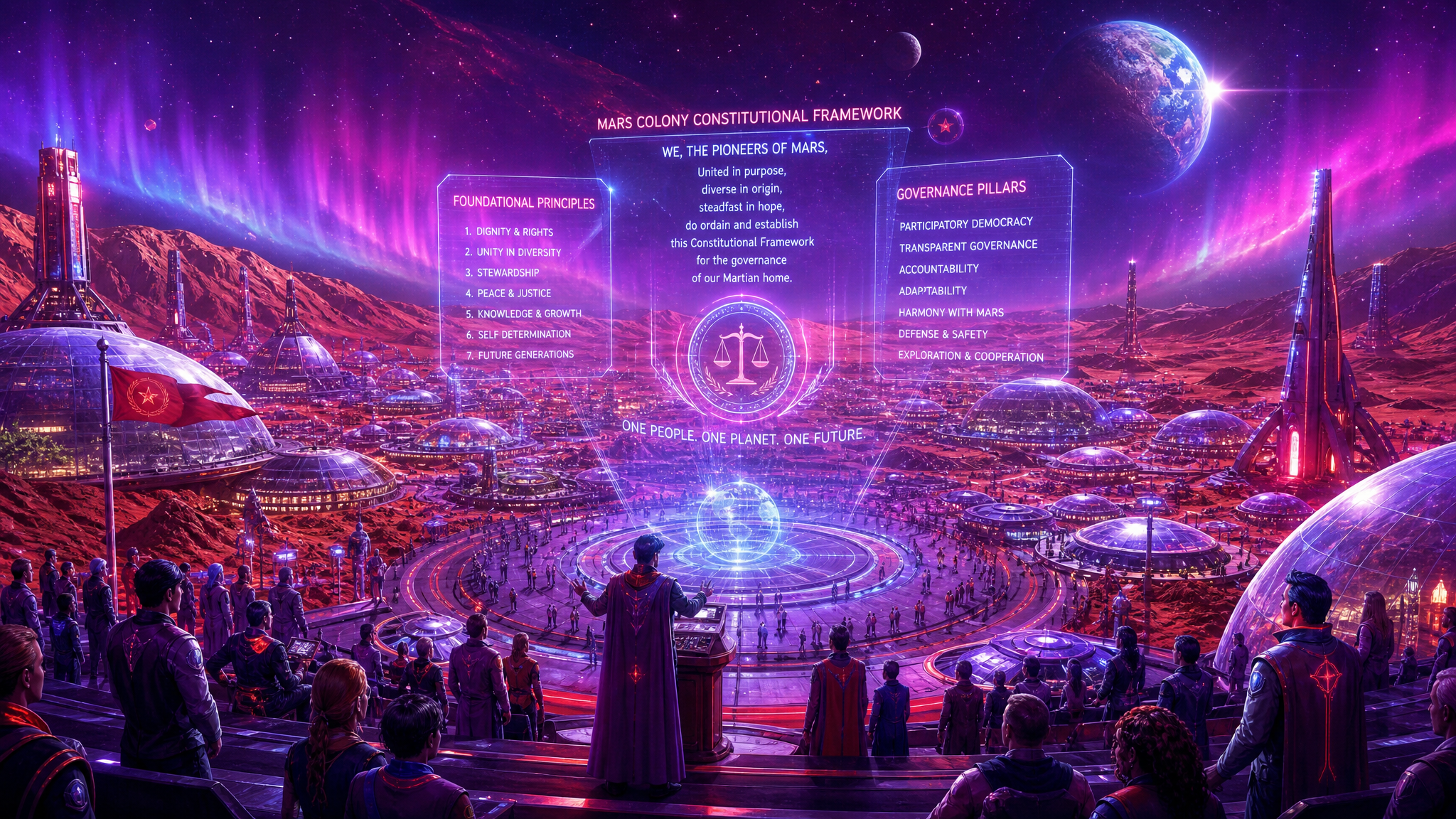
Governance will shape exploration as much as engineering
Deep space is becoming more crowded institutionally, if not physically. National agencies, international partnerships, military interests, commercial launch providers and scientific consortia all have overlapping ambitions. Mars itself remains governed by broad principles in the 1967 Outer Space Treaty, including the peaceful use of outer space and non-appropriation by sovereign claim. Yet those principles leave many operational questions unsettled, from resource utilisation norms to traffic coordination and planetary protection.
For Mars, governance questions are unusually consequential. Planetary protection standards affect where missions can land and how contamination risks are managed, particularly if the search for life remains active. Sample return raises biosecurity and curation considerations. Surface operations could create disputes over access to scientifically valuable sites or scarce practical assets such as ice-rich terrain, though such conflicts are still prospective rather than immediate.
For crewed Mars missions, biology is as much a limiting technology as propulsion.
Readers should watch not only launch manifests but also legal and diplomatic developments. The pace of exploration will depend partly on whether states can build rules that are predictable enough for long-term investment and careful enough to protect scientific integrity. Where governance remains vague, delay is often the hidden outcome.
International cooperation is a strength, but geopolitics will intrude
Space exploration has always mixed collaboration with rivalry. Large missions often depend on cross-border contributions of instruments, tracking support, data sharing and scientific expertise. The International Space Station demonstrated that durable cooperation is possible even amid terrestrial tension, while planetary missions have long benefited from multinational science teams. Deep-space exploration is likely to remain international because costs, skills and political legitimacy are distributed.
At the same time, geopolitical fragmentation can raise costs and duplicate effort. Export controls, sanctions, strategic distrust and competing standards can complicate mission design and limit who can work with whom. If the coming decades bring a more contested international order, deep-space programmes may become more regionally clustered or politically hedged.
That does not imply an inevitable breakdown. Rather, it means exploration should be read through two lenses at once: science as a cooperative endeavour and space capability as a marker of state capacity. Programmes often serve both purposes. Observers who ignore either side are likely to misread the field.
How to judge claims about timelines and turning points
Forecasts in spaceflight are notoriously slippery. Aspirational dates can be useful as management tools or political signals, but they are poor substitutes for milestones grounded in engineering evidence. A more reliable method is to track threshold achievements. Has a long-duration life-support system been validated? Has large-scale Mars entry and landing been tested in relevant conditions? Has surface power been demonstrated with the required resilience? Have sample-return handling protocols been completed? Are funding lines stable across multiple budget cycles?
Progress in deep space often looks incremental until, in retrospect, it appears cumulative. A communications relay, a cryogenic fluid management test, a radiation study, a high-precision landing demonstration or a materials advance may seem narrow. Yet such pieces are precisely what turn broad ambition into repeatable capability. Conversely, a mission concept rich in renderings but poor in tested subsystems should be treated as speculative regardless of rhetoric.
For policymakers, investors and informed readers alike, the discipline is the same: distinguish between aspiration, demonstration and operational capacity. Space history is full of cases where those categories were blurred for public effect.
What the next decade is likely to reveal
The next decade is unlikely to settle the question of when humans will first reach Mars. It is much more likely to clarify whether the enabling architecture is maturing in a serious way. Expect the most informative signals to come from lunar operations, robotic Mars science, sample-related work, advances in autonomous systems, surface power experiments, and biomedical research on long-duration missions. In deep space science, attention will also centre on whether agencies can sustain ambitious flagship missions while preserving a pipeline of smaller probes and observatories.
The broader lesson is that exploration beyond Earth orbit is becoming less episodic and more infrastructural. That is a sign of maturity, not stagnation. A field organised around repeatability, standards and scientific return may look less cinematic than one organised around one-off spectacles, but it is far more likely to endure.
Mars will remain the emblematic prize, and perhaps one day a destination for crews. But the truer story is larger. Deep space exploration is becoming a long negotiation between engineering limits, biological realities, scientific curiosity and political patience. Those who learn to read that negotiation will have a clearer view of what is coming than those who watch only for the next launch.