The end of the spectacular beginning
For much of the space age, public attention has settled on moments: a launch, a landing, a first image, a mechanical failure, a dramatic recovery. That grammar of spectacle still matters. Yet for Mars and deep-space exploration, it is becoming less useful as a guide to what actually determines success. The important change is structural. Exploration beyond the Moon is moving from an era defined by demonstration to one defined by continuity.
That shift can already be seen in how major space agencies and scientific institutions describe their goals. The emphasis is increasingly on sample return, long-duration robotic operations, in-situ resource use, radiation measurement, surface power, communications architecture and the cumulative assembly of transport systems. These are not glamorous topics in the popular imagination, but they are the foundations of durable presence. Deep space, in other words, is ceasing to be a sequence of isolated bets and becoming an exercise in system design.
This category exists to analyse that system. Mars is the focal point because it compresses almost every hard problem in off-world exploration: distance, delay, entry and landing, power, dust, health, logistics and governance. But the same framework applies more broadly to cislunar space, asteroids and missions deeper into the Solar System. The most useful questions are no longer merely technological. They are institutional, economic and strategic.
The decisive contest in deep space is no longer over who can arrive first, but who can operate reliably when arrival ceases to be the hard part.
Why Mars remains the organising challenge
Mars still occupies a singular position in the exploration imagination, but the reasons are more rigorous than romance. It is scientifically rich, physically demanding and just accessible enough to force serious engineering trade-offs. With a thin atmosphere, seasons, dust, polar ice and strong evidence of an ancient wetter climate, it offers an unusually valuable record of planetary evolution. For astrobiology, it remains one of the most compelling sites in the Solar System for investigating past habitability.
At the same time, Mars is unforgiving. Mission planners must contend with launch windows shaped by orbital mechanics, cruise durations measured in months and communications delays that preclude real-time control. Landing is notoriously difficult because the atmosphere is thick enough to generate severe aerodynamic and thermal loads but too thin to make parachutes alone sufficient for large payloads. Surface systems then face extreme cold, dust accumulation, radiation and the long-term wear imposed by a planet that is neither hospitable nor entirely inert.
Those constraints are exactly why Mars matters as a policy and technology benchmark. A mission architecture that works at Mars signals a level of maturity relevant to wider deep-space operations. Conversely, repeated difficulties at Mars often reveal weaknesses that no amount of launch capacity can hide: fragile supply chains, underpowered surface systems, inadequate autonomy or unrealistic assumptions about mission tempo. Mars is therefore not simply another destination. It is the stress test for whether humanity can turn exploration into endurance.
Science first, but science alone is not enough
The scientific case for Mars and deep-space missions remains powerful. Planetary science seeks to explain how worlds form, evolve and, in some cases, become habitable. Mars is central to that inquiry because it appears to preserve evidence of geological and climatic transitions that Earth has long erased through tectonics and weathering. Beyond Mars, missions to outer planets, icy moons and small bodies expand that comparative record and sharpen understanding of the Solar System as a dynamic whole.
The decisive contest in deep space is no longer over who can arrive first, but who can operate reliably when arrival ceases to be the hard part.
Still, scientific merit by itself does not guarantee sustained programmes. Deep-space missions are unusually exposed to delays, cost growth, political turnover and the simple fact that scientific timelines are often far longer than budget cycles. This creates a recurring mismatch: the science argues for patience and continuity, while institutions are often organised around shorter-term proofs of value. The result is a tendency to celebrate mission selection and launch while underexamining the operational ecosystem needed to preserve scientific return over decades.
A stronger framework therefore asks two questions at once. First, what discoveries are a mission designed to make? Second, what capabilities does it leave behind? A rover that advances geology while refining autonomous navigation, surface weather modelling and precision landing may matter more than one that offers a larger near-term media moment. The same logic applies to orbiters, relay assets and sample handling. In deep space, scientific output and operational learning are inseparable assets.
The tyranny of distance and delay
Deep space is defined by latency. This is a technical reality with profound organisational consequences. At Mars, one-way communications delay varies significantly depending on the relative positions of Earth and Mars. That means surface operations cannot depend on constant intervention from ground teams. Vehicles, habitats and scientific instruments must manage faults, prioritise tasks and adapt to changing conditions with much greater independence than systems operating in low-Earth orbit.
Autonomy, then, is not an optional enhancement. It is the operating system of deep-space exploration in the broad sense of the term: the set of capabilities that allows machines and, eventually, crews to function despite incomplete information and delayed support. This includes navigation, hazard detection, energy management, maintenance scheduling and scientific triage. It also includes the less discussed social dimension of autonomy: how mission control teams are structured when remote action becomes more supervisory than direct.
The strategic implication is easy to miss. Communications delay weakens centralised control and rewards architectures built around local resilience. A Mars mission with robust local decision-making, spare capacity and flexible procedures is not merely more efficient; it is more governable. The longer the distance, the more brittle tight central control becomes. Deep-space success will therefore depend on institutions learning to trust distributed operations without losing accountability for risk.
Distance does not simply slow exploration; it rewrites authority, forcing control to migrate from Earth-based supervision to local resilience.
Power is policy in engineering form
If launch capacity has long dominated public discussion, power deserves equal billing in serious analysis. Surface energy determines almost everything else: scientific workload, thermal survival, communications uptime, mobility and the viability of life-support systems for future crewed missions. A mission can carry elegant instruments and sophisticated software, yet remain strategically limited if its power profile is fragile or overly seasonal.
Mars illustrates the point vividly. Solar energy has enabled important missions, but dust, latitude, winter conditions and storage constraints complicate sustained high-demand operations. Alternative power systems offer different trade-offs in mass, complexity, safety, heat management and political acceptability. None removes the problem. All require careful integration with mission goals and surface conditions.
That is why power should be treated not as a subsystem but as a governing choice. It shapes where missions can land, how long they can operate and whether surface activities can expand beyond demonstration scale. In broader deep space, the same principle applies to propulsion and communications infrastructure. Energy abundance creates strategic flexibility; energy scarcity narrows choices and magnifies risk. Analysts assessing exploration plans should therefore ask a blunt question early: what is the power logic, and what futures does it allow or foreclose?
Logistics will matter more than bravado
Distance does not simply slow exploration; it rewrites authority, forcing control to migrate from Earth-based supervision to local resilience.
The distance to Mars turns every kilogram into a planning problem. Life support, radiation shielding, spare parts, propellant, scientific equipment and surface mobility assets all compete within strict mass and volume constraints. For robotic missions the challenge is severe; for human missions it becomes defining. Deep-space logistics is not glamorous, but it is where ambition encounters arithmetic.
Three themes matter most. The first is pre-positioning: placing cargo, power systems or ascent vehicles ahead of crew arrival to reduce mission fragility. The second is redundancy: not duplication for its own sake, but deliberate design against the high cost of single-point failure. The third is local production, whether of propellant, water, oxygen or construction materials. In-situ resource use has attracted years of interest because it promises leverage against Earth-dependence. Yet its value depends on reliability, not concept art. A local resource system that works intermittently or imposes excessive maintenance burdens may add risk rather than remove it.
This is where deep-space discourse often veers into abstraction. It is easy to declare that local production will transform mission economics. It is harder to specify extraction rates, power requirements, contamination risks, repair burdens and the operational consequences of underperformance. A useful editorial stance is therefore sceptical but not dismissive. The right question is not whether local resource use is possible in principle, but under what conditions it becomes a net gain in mission resilience.
Human presence is a medical and social problem before it is a symbolic one
Crewed exploration carries obvious symbolic force, but its practical difficulties are less often absorbed with equal seriousness. Deep-space human missions are constrained by radiation exposure, bone and muscle loss, behavioural health, closed-loop life support, medical autonomy and return-risk management. These are not peripheral matters to be solved after transport. They are central determinants of mission duration, crew composition and acceptable risk.
The evidence base remains incomplete because most human spaceflight experience has been accumulated in low-Earth orbit, where resupply is possible and evacuation, though difficult, is not inconceivable. Mars offers no such safety valve. Medical events will need to be handled with limited equipment, constrained pharmaceuticals and delayed specialist input. Psychological strains are also likely to differ from those experienced in nearer-Earth missions because isolation, confinement and communication delay combine in unfamiliar ways.
For that reason, discussions of human settlement tend to run ahead of human factors evidence. A more disciplined framework starts smaller. What baseline of health monitoring, shielding, habitat reliability and crew autonomy is required for short-stay missions? How do those requirements change for long surface residence? What failures are survivable, and which remain mission-ending? Until such questions are answered with operational credibility, the language of permanence should be treated cautiously.
On Mars, survival will depend less on daring than on whether biology, maintenance and morale can be managed as rigorously as propulsion.
Governance is arriving before settlement
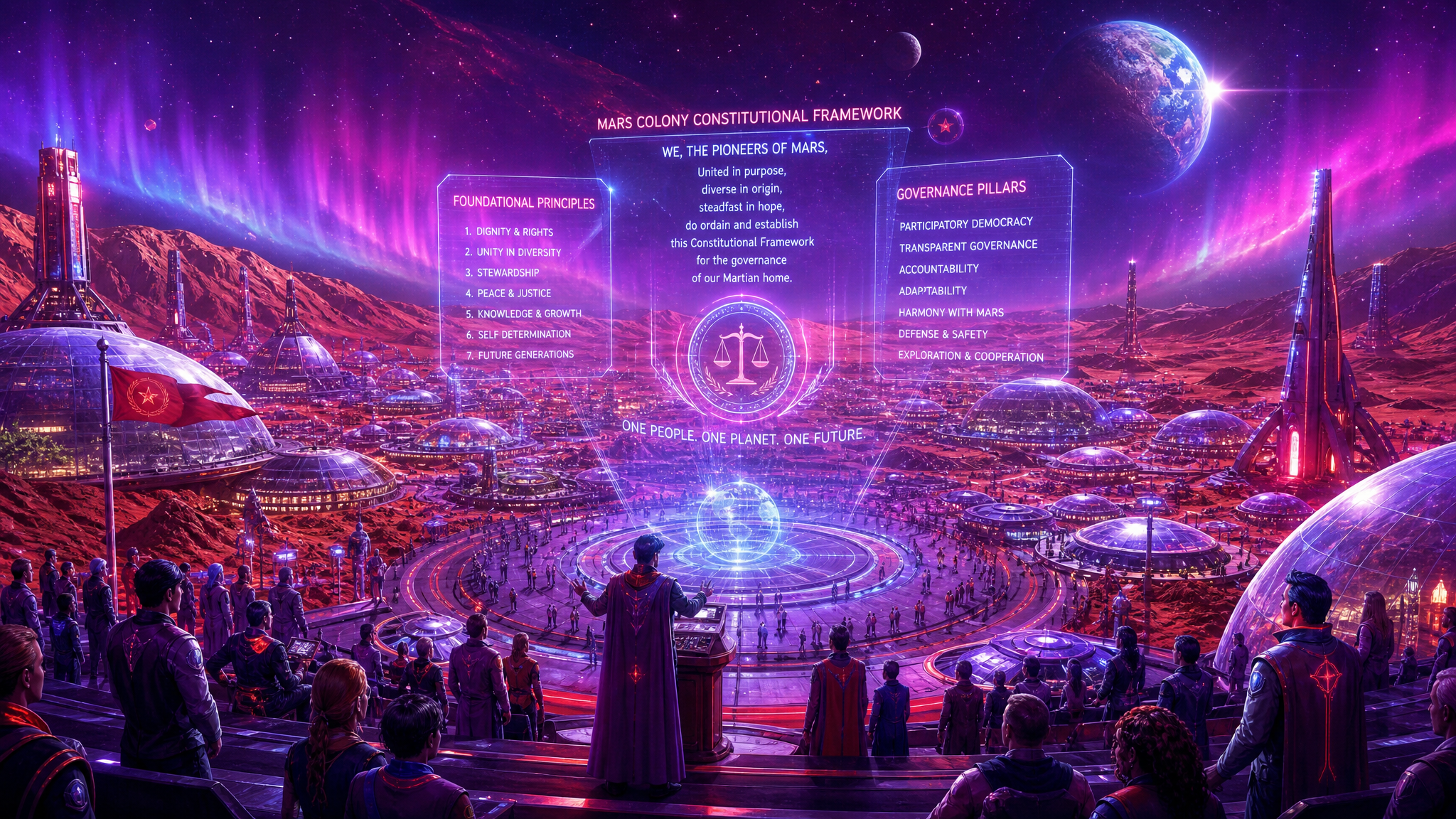
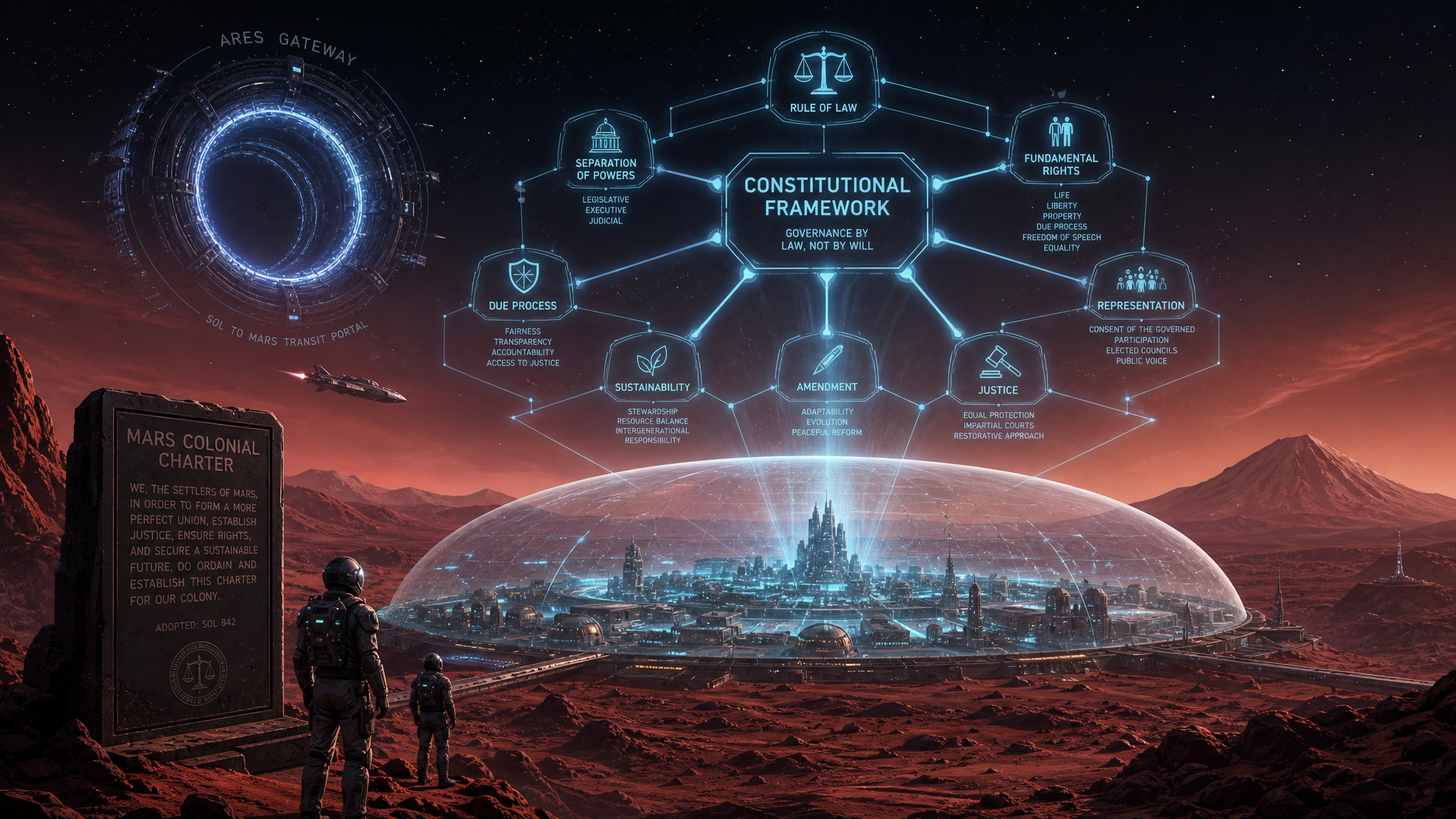
It is tempting to think that legal and political questions can wait until regular human activity begins. In practice, governance arrives earlier. Planetary protection rules, spectrum management, landing-site coordination, scientific access, debris mitigation and the handling of samples all require institutional agreement before any notion of a settled presence becomes relevant. As traffic and mission complexity increase, so too will the need for mechanisms that reduce conflict, preserve scientific value and clarify responsibility.
The Outer Space Treaty remains the foundational instrument, establishing principles such as non-appropriation and peaceful use. But many operational questions are left open or are only partially addressed by later agreements and guidelines. Mars adds further complications because it is simultaneously a scientific archive, a strategic objective and a potential site of future industrial activity. Those logics will not always align neatly.
A prudent framework avoids both complacency and melodrama. Mars is not on the verge of conventional territorial politics in any near-term sense. Yet nor is it wise to assume that technical coordination alone can absorb emerging tensions. As missions multiply, norms about data-sharing, site preservation, interference and emergency assistance will become more consequential. Governance in deep space is best understood as a capacity problem: can institutions establish workable expectations before high-value disputes become difficult to reverse?
On Mars, survival will depend less on daring than on whether biology, maintenance and morale can be managed as rigorously as propulsion.
Economics beyond the launch pad
Space economics is often flattened into launch costs. Those matter, but deep-space viability depends on a much broader cost structure: long development cycles, specialised components, testing regimes, operations teams, communications networks and the expense of reliability under conditions where repair is difficult or impossible. The result is that apparently cheap access to space does not automatically translate into affordable deep-space exploration.
There is also a category error in much public debate. Exploration and commercial extraction are frequently discussed as though they sit on a smooth continuum. In reality, the economics of scientific exploration, strategic demonstration and self-sustaining industrial activity are distinct. A mission may be scientifically transformative while being economically non-replicable. Conversely, a logistics or communications asset may produce modest headlines while radically improving the cost profile of future missions.
The category should therefore track economic signals carefully but without forcing premature business analogies. Which capabilities reduce the marginal cost of subsequent missions? Which bottlenecks remain stubbornly bespoke? Where do standards, interoperability and modularity create compounding benefits? Deep space becomes more tractable not when one mission dazzles, but when each mission leaves behind assets, procedures or data that lower uncertainty for the next.
What to watch over the next decade
For readers trying to assess the field without being swept up by rhetoric, several indicators are more revealing than launch tallies. One is precision landing for heavier payloads: progress here affects nearly every credible pathway to sustained Mars surface activity. Another is high-reliability surface power, especially through adverse environmental conditions. A third is autonomy that moves beyond scripted operation into robust fault management and scientific prioritisation.
Sample return remains another crucial benchmark because it tests coordination across multiple mission elements, planetary protection protocols and long-term institutional patience. So too does the maturation of relay and navigation infrastructure, which can quietly transform what surface missions are able to attempt. For human exploration, the key indicators lie in radiation mitigation, closed-loop systems and the translation of analogue research into credible mission rules rather than aspirational roadmaps.
Beyond Mars itself, developments in lunar operations will matter disproportionately because the Moon is increasingly serving as a proving ground for surface systems, communications architectures and operational concepts that could later be adapted for deeper missions. The transfer is never direct, and lunar conditions differ sharply from Martian ones. Even so, lessons about dust, power management, remote operations and infrastructure maintenance will shape deep-space planning more than any isolated publicity event.
How this category will read the frontier
The purpose of a Mars and deep-space category should not be to amplify every announcement, nor to narrate exploration as an inevitable march. Its value lies in disciplined interpretation. That means judging missions not only by declared ambition but by architectural coherence. It means separating technologies that are demonstrably maturing from those that remain conceptually attractive but operationally thin. And it means treating science, logistics, governance and economics as one interconnected system rather than as separate stories competing for attention.
Readers should expect analysis organised around capabilities: entry, descent and landing; mobility; power; autonomy; habitats; health; communications; resource use; legal frameworks; and strategic implications. They should also expect a long time horizon. Deep-space exploration unfolds slowly, often frustratingly so, because every major gain depends on layers of prior learning. That pace is not evidence of failure. It is the cost of moving from episodic achievement to durable competence.
The frontier, in this telling, is neither mythic nor merely commercial. It is infrastructural. Mars will not be made meaningful by declarations alone, nor by a single mission however impressive. It will become meaningful if institutions can build systems that survive distance, delay and political turnover while still producing scientific insight worth the effort. That is the standard by which this category should measure the decades ahead.