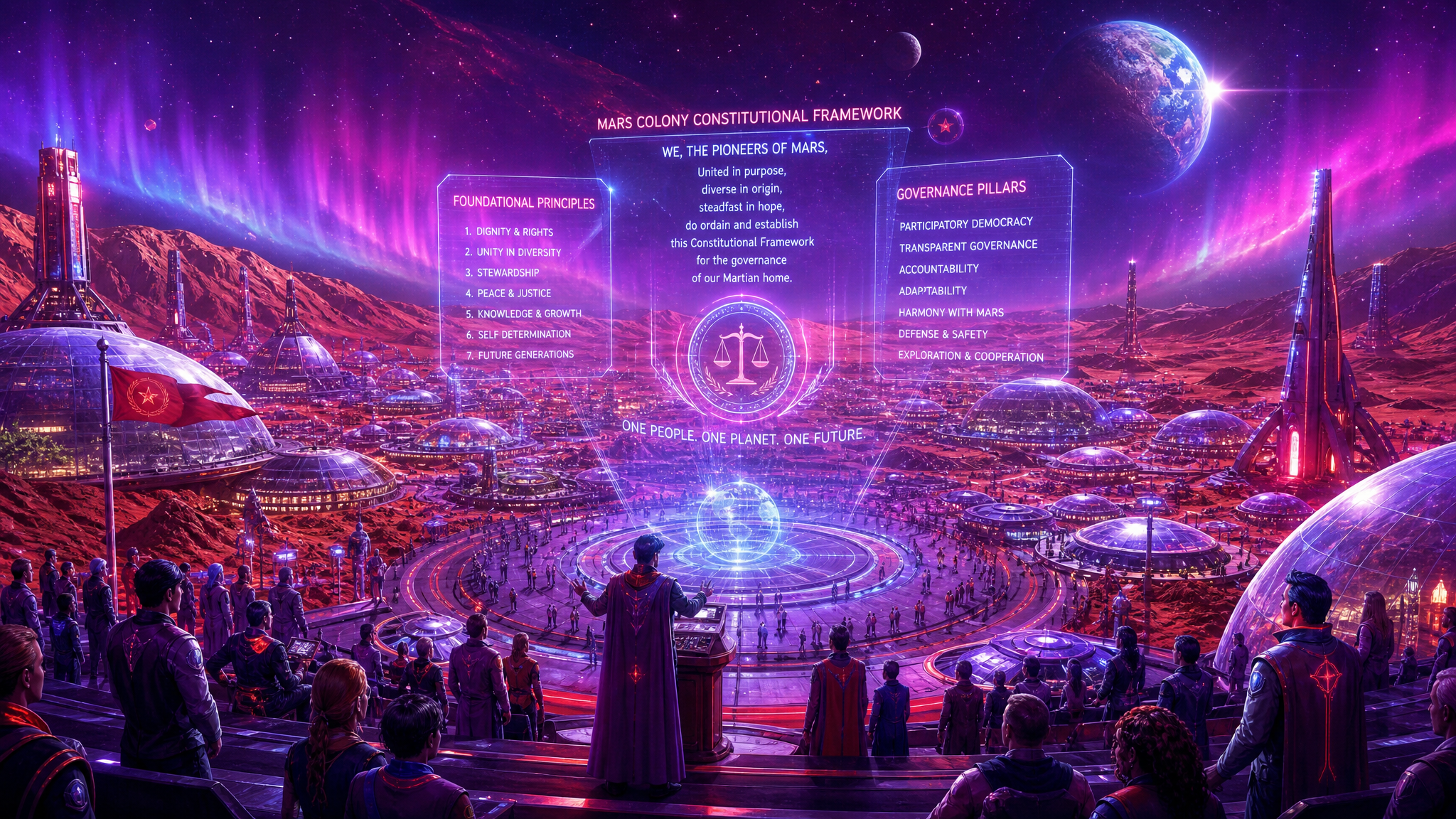
Constitutions are usually imagined as arguments about power, rights and territory. On Mars, the first durable constitutional dispute may be more prosaic. It may concern which clock counts, which calendar binds, and which authority certifies the official moment when a contract takes effect, a vote closes, a work shift ends or an emergency order begins. Timekeeping looks technical until courts, contracts and elections depend on it.
This is not a semantic puzzle. Mars rotates once every roughly 24 hours and 39 minutes. That extra 39 minutes is awkward enough for mission planning on Earth and profound enough for any permanent settlement that intends to become more than an outpost. If a community lives by local daylight, agriculture cycles, maintenance windows and human circadian constraints, yet remains legally tethered to Earth-standard time, it inherits a constitutional asymmetry. The distant metropole defines not only rules but the tempo of public life.
Most commentary on space governance still turns on familiar terrestrial categories: non-appropriation, resource rights, environmental safeguards and the risk of extra-territorial corporate power. Those questions matter. But they can obscure a prior design problem. Before a Martian polity can allocate property, tax imports or adjudicate negligence, it must decide what counts as today, tomorrow, midnight and the end of the fiscal year.
Why time is a constitutional subject
Earth states have long treated timekeeping as public infrastructure rather than mere convenience. National observatories, standards laboratories, satellite navigation systems and telecom regulators all testify to the same fact: legal order needs synchronisation. Financial markets settle by timestamp. Air traffic control, energy grids and digital authentication rely on agreed time references. Courts care about sequence, notice and limitation periods. Elections depend on simultaneous opening and closing rules. In practice, clocks are part of the state.
Space law, by contrast, says much about peaceful use and little about civil time. The 1967 Outer Space Treaty bars national appropriation of celestial bodies, but it does not say how an off-world settlement should constitute legal time. That omission was understandable in an era of flags-and-footprints exploration. It is less benign in an era that assumes long-duration habitation, local industry and administrative autonomy.
A polity that cannot define its own public time does not fully govern itself.
The hidden politics of imported clocks
At first glance, the obvious solution is simple: keep using Coordinated Universal Time or a terrestrial mission time. That works for spacecraft, for temporary crews and for tightly controlled operations. It becomes less convincing for a civilian community whose daily life is anchored to Martian dawn and dusk. A school timetable, municipal maintenance rota, public health regime and criminal procedure code cannot remain intelligible if official time drifts steadily away from lived time.
The constitutional issue appears when operational convenience meets legitimacy. If all binding legal acts are pegged to Earth time, then the external authority that maintains and authenticates that timescale acquires structural leverage. It can define deadlines, audit compliance and arbitrate timestamp disputes from afar. Even without malign intent, such a system reproduces dependency. Colonies have often been governed by imported law; they are also governed by imported calendars and administrative rhythms.
Martian settlers would still need compatibility with Earth systems, especially for navigation, communications and trade. But compatibility is not the same as subordination. The more economically and demographically complex a settlement becomes, the stronger the case for a dual-layer model: one time reference for interplanetary coordination, another for local civil authority.
A polity that cannot define its own public time does not fully govern itself.
Earth has already learned this lesson
The politics of timekeeping is not exotic. Modern states standardised time in the 19th century because railways, telegraphy and industrial coordination made local solar time untenable. Standard time zones were, in effect, governance reforms. They centralised authority, reduced commercial friction and created a common temporal order within which law and administration could function. Later, atomic time, leap-second management and satellite navigation turned temporal standards into strategic infrastructure.
The current debate over leap seconds illustrates the point. In 2022 the General Conference on Weights and Measures resolved to move towards ending leap seconds by 2035, partly because high-precision digital systems dislike abrupt temporal adjustments. That decision was not only scientific; it was institutional. It balanced astronomical fidelity, technical operability and governance across interdependent systems. Mars will require similar choices, but under more severe conditions and with constitutional consequences from the outset.
Mars time is not one problem but three
Any Martian constitutional framework would have to separate at least three temporal functions. First, there is operational time: what engineers use for power, life support, navigation and communications. Secondly, there is civil time: what residents use for work, school, holidays, courts and elections. Thirdly, there is archival and treaty time: what links Martian records to Earth institutions, insurers, regulators and other settlements.
These functions do not have to coincide. Indeed, forcing them to coincide may be the mistake. Space agencies have already experimented with mission-specific Mars clocks and concepts such as Coordinated Mars Time for scientific purposes. Those efforts show that the technical challenge is manageable. The harder task is institutional: who maintains the authoritative timescale, how discrepancies are resolved, and which body certifies a legal timestamp when communication delays make real-time Earth verification impossible.
Delay changes the meaning of authority
At Mars distances, communication delays of several minutes each way alter the practical meaning of central control. A governor on Earth cannot micromanage a fire response, a contamination incident or a labour dispute in real time. That is one reason many analysts assume some form of local autonomy will emerge by necessity. Yet autonomy is not binary. It can be compromised through mundane dependencies, including time certification, software standards and audit rules.
If every binding local act requires reconciliation with an Earth-based master clock, then delay becomes a constitutional bottleneck. What happens if a habitat emergency requires temporary suspension of normal legal procedures, but secure time attestation from Earth is unavailable? What if a local court finds that a communications outage makes Earth-certified filing impossible? Sovereignty questions often arrive disguised as service-level failures.
Timekeeping looks technical until courts, contracts and elections depend on it.
What a Martian civil time regime might look like
Timekeeping looks technical until courts, contracts and elections depend on it.
A plausible model would establish a locally maintained civil timescale based on the Martian solar day, with an independent metrology function inside the settlement and a publicly specified conversion protocol to terrestrial standards. The settlement would define legal days, business days, electoral periods and emergency powers by local civil time. Cross-planet contracts would be required to state the applicable temporal regime explicitly, much as contracts on Earth specify governing law and jurisdiction.
Such a system would not be revolutionary. It would mirror the way terrestrial states maintain domestic legal time while participating in global timing networks. The constitutional novelty lies in making temporal pluralism explicit from the beginning. Rather than pretending one clock can serve every purpose, the law would assign distinct roles to local and interplanetary time references.
The choice of calendar would matter as well. Even if months and years were initially borrowed from Earth usage for administrative simplicity, a settlement might eventually need a Martian fiscal and legislative calendar aligned with local seasons. Agricultural planning, infrastructure stress, dust risk and energy management may all favour seasonal constitutionalism over inherited terrestrial convenience.
Clocks can distribute power inside the settlement
The question is not only Earth versus Mars. Time rules also shape internal hierarchy. Who controls shift allocation in a life-support economy? Which workers bear the burden of synchronising with Earth trading hours? When are public consultations held if half the settlement works on rotating maintenance cycles? If a constitutional convention were ever held off-world, its procedure would be temporal as much as textual.
There is a labour politics here. In frontier conditions, administrators may be tempted to optimise the population around machine efficiency, extending or compressing rest periods to fit logistics. Yet public legitimacy depends on predictable civic rhythms and the protection of private time. A settlement permanently subordinated to Earth market hours could become politically dependent in a deeper sense: its social metabolism would be organised elsewhere.
The legal edge cases will come first
Much constitutional development occurs through edge cases. On Mars, expect disputes over limitation periods, accident liability, chain of custody for digital evidence and the validity of emergency decrees during communication outages. Was an appeal filed before the deadline if the local record says yes but Earth reconciliation says no? Which timestamp prevails if a habitat network is partitioned? Can a resident be penalised for missing an Earth-denominated compliance window that opened during a local emergency?
These are not futuristic curiosities. They are the ordinary frictions by which administrative systems reveal their deepest assumptions. If the law lacks a theory of authoritative time, judges or executives will create one ad hoc. That is a poor way to found a polity.
Resource governance will also depend on time
Even asteroid and extraction regimes, often discussed mainly in terms of title and benefit-sharing, depend on temporal architecture. Priority rights, licence duration, abandonment rules, safety windows and environmental monitoring all require agreed clocks. In a multi-planetary economy, there may be no single natural business day. Supply chains spanning cislunar space, Mars orbit and surface settlements will need machine-readable temporal law.
Mars will not need a flag first; it will need a legally trusted clock.
This is where chronopolitics intersects with sovereignty. If a dominant Earth jurisdiction sets the reference time for licensing, dispute windows and reporting, it quietly shapes the competitive landscape. Local control over timekeeping will not guarantee fairness, but lack of it will institutionalise disadvantage.
Constitutional design should treat time as a commons
One answer is to treat authoritative timekeeping as a constitutional commons rather than an executive convenience. That would mean transparent standards, independent oversight, public auditability and clear fallback rules during outages. No single operator, agency or commercial entity should monopolise legal time for a settlement whose survival depends on trust in records and sequence.
A robust framework might include an independent temporal authority, judicial rules for resolving timestamp conflicts, mandatory dual-stamping of critical records in local and interplanetary time, and constitutional provisions specifying how emergency powers interact with clock failures. This sounds pedantic only until one recalls how much modern governance already depends on trusted timing infrastructure.
There is no neutral choice
Some will argue that all this can wait until settlement becomes plausible at scale. That underestimates path dependence. The first protocols adopted for missions, habitats and supply chains tend to harden into constitutional defaults. Early convenience often becomes long-term power. Once labour rules, software systems, insurance contracts and communication protocols are built around imported time, shifting to a genuinely local regime becomes administratively and politically costly.
The deeper point is that there is no neutral temporal baseline. Choosing Earth time is a constitutional choice. Choosing local civil time is also a constitutional choice. Choosing a hybrid system requires decisions about who arbitrates mismatch and who bears the costs of synchronisation. These are political questions even when expressed in engineering language.
The first republic may begin with a calendar
For generations, political thought linked sovereignty to territory, borders and monopoly force. Off-world governance will add another criterion: temporal self-definition. A settlement that cannot declare when its public day begins, when its legislature sits, when its taxes fall due and when its emergency powers expire remains only partially self-governing, however grand its rhetoric of exploration.
That does not mean Mars will need immediate separation from Earth institutions, nor that every habitat should invent a new clock. It means constitutional designers should stop treating time as a background variable. In a world of communication delay, divergent planetary days and heavily automated infrastructure, the clock becomes part of the separation of powers.
Mars will not need a flag first; it will need a legally trusted clock. The first constitutional crisis there may not begin with a declaration of independence or a mining dispute. It may begin when two valid systems disagree about whether a decision was made in time.