The Stratification Has Already Begun
In June 2026, President Trump signed Executive Order 14413, formalising what policy analysts had long anticipated: the United States government's explicit commitment to quantum supremacy as a matter of national security. The order directed a whole-of-government effort to protect quantum information science and technology while accelerating domestic research and manufacturing. Within weeks, the European Commission had harmonised its own "500-series" export controls across the EU single market. The message was unmistakable — quantum computing is no longer a research curiosity. It is a strategic asset, and the rules governing who may access it are being written now.
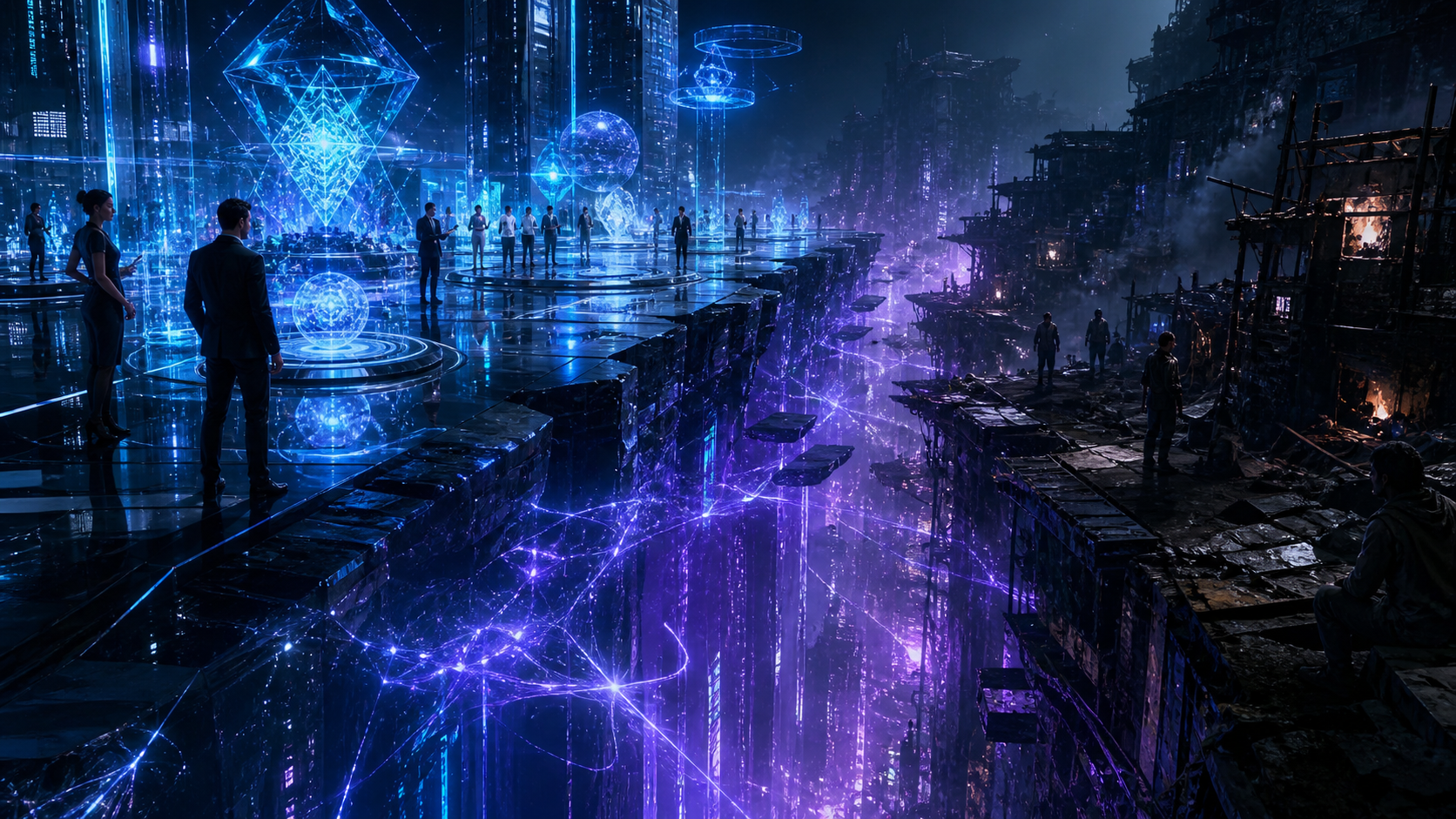
This is the defining feature of the second quantum revolution: it is arriving not as a democratising wave, but as a concentrating force. The first digital revolution — the internet, the smartphone, the cloud — eventually diffused across the globe, albeit unevenly. Quantum computing's structural economics suggest a different trajectory. The infrastructure is prohibitively expensive. The talent is vanishingly scarce. The geopolitics are actively exclusionary. And the window in which equitable access architecture could be designed is narrowing with each passing quarter.
"The quantum divide is not a future risk — it is a present structural reality, and the window to architect equitable access is closing faster than most governments recognise."
Society OS has independently mapped this dynamic as part of its Sovereign Stack framework — the recognition that computational sovereignty is not merely a technical question but a civilisational one. The quantum layer of that stack is now live, and the stratification it is producing deserves rigorous, unsentimental analysis.
The Architecture of Advantage
Where the Capital Is Flowing
Global investment in quantum computing has reached an estimated $65.9 billion in cumulative public and private funding as of 2026, according to QURECA's Quantum Initiatives Worldwide tracker. The year 2025 alone saw $4.9 billion in private venture capital — more than double the previous record — with 2026 on pace to exceed it. The United States accounts for approximately 28% of tracked global quantum entities. China's government investment is estimated between $5 billion and $15 billion in official figures, with a 1 trillion yuan ($138 billion) emerging technology fund launched in 2025 that includes quantum as a priority. The UK committed an additional £2 billion in March 2026 through its ProQure procurement programme. Germany, France, and Japan have each committed multi-billion-dollar national strategies.
The pattern is clear: quantum investment is a G7-plus-China phenomenon. Over 180 nations currently lack significant financial investment in the sector, according to The Quantum Record's analysis of the looming digital divide. These nations are not merely absent from the quantum race — they are accumulating quantum debt, a growing vulnerability gap between their existing digital infrastructure (encrypted with classical methods that quantum computers will eventually break) and their capacity to transition to quantum-safe alternatives.
The Hardware Bottleneck as Power Concentrator
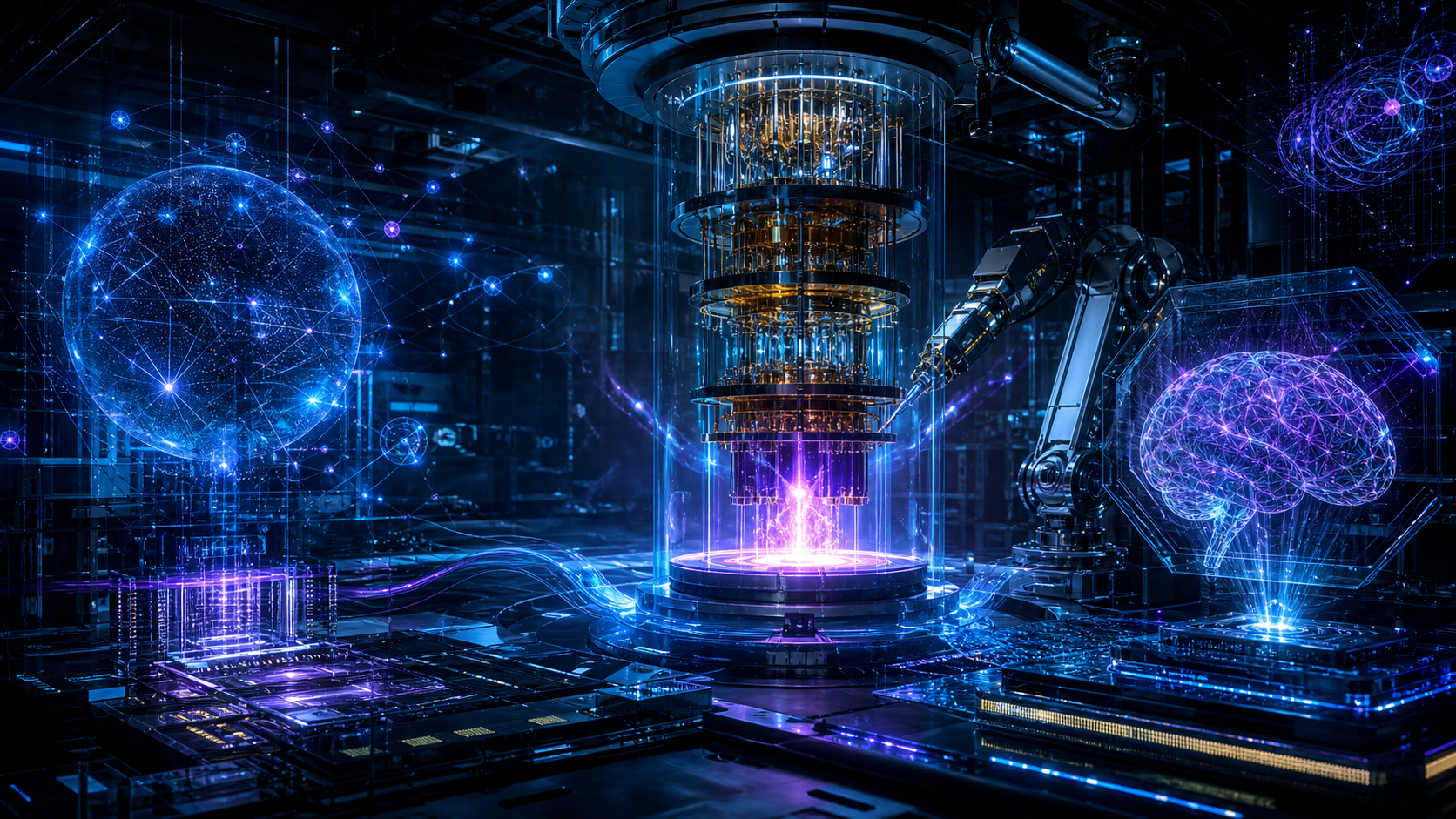
Quantum hardware is not like software. It cannot be downloaded, forked, or replicated cheaply. Google's Willow processor — which achieved a 13,000-fold speedup over classical supercomputers in molecular structure calculations — operates at temperatures colder than outer space, requiring dilution refrigerators that cost millions of dollars and are manufactured by a handful of firms globally. IBM's modular architecture, targeting 7,500 two-qubit gates by end of 2026, requires specialised cryogenic cells and isotopically enriched silicon-28. Microsoft's Majorana 1 chip uses topoconductors — a material class that did not exist in commercial form five years ago.
The International Institute for Strategic Studies (IISS) noted in August 2026 that Western quantum export controls have evolved into a full industrial strategy, targeting not just finished systems but the entire enabling stack: cryogenic equipment, specialised materials including helium-3 and electronic-grade synthetic diamond, and control electronics. The U.S. Interim Final Rule of September 2024 established worldwide licence requirements for quantum computers based on performance thresholds. Licensing exceptions exist for Australia, Japan, the Netherlands, Norway, and the United Kingdom — nations that have implemented comparable controls. The rest of the world faces a tiered access regime that is, by design, exclusionary.
The Talent Concentration Problem
The quantum divide is not a future risk — it is a present structural reality, and the window to architect equitable access is closing faster than most governments recognise.
McKinsey & Company research cited by technical.ly identifies talent — not technology — as the primary barrier to quantum adoption. There is currently one qualified quantum candidate for every three open roles globally. Projections indicate a deficit of over 10,000 skilled roles by 2026–2027. But the distribution of that talent is as consequential as its scarcity. Top-tier quantum research institutions are heavily clustered in the Global North, and the "brain drain" dynamic — where talent from underrepresented regions migrates to wealthier countries — is actively concentrating human capital alongside financial capital.
The World Economic Forum's November 2025 analysis on upskilling quantum talent identified a structural mismatch: the industry previously relied on PhD physicists, but the 2026 demand is for "hybrid practitioners" — engineers, technicians, and business professionals who can integrate quantum workflows into classical systems. This is a more accessible profile, but the educational infrastructure to produce it at scale remains concentrated in the same handful of nations dominating hardware investment.
"There is currently one qualified quantum candidate for every three open roles globally — and the distribution of that talent is as consequential as its scarcity."
The Security Asymmetry: A Civilisational Risk Hidden in Plain Sight
The most acute dimension of the quantum divide is not economic — it is cryptographic. Current encryption standards, including RSA and elliptic curve cryptography (ECC), underpin virtually every secure digital transaction on the planet: banking, healthcare records, government communications, military command systems, and the authentication infrastructure of the internet itself. Analyses from 2026 suggest that quantum computers could compromise these standards before the end of the decade.
The "harvest now, decrypt later" attack vector is not theoretical. State actors with quantum ambitions are almost certainly collecting encrypted data today — diplomatic cables, financial records, intellectual property — with the intention of decrypting it once sufficient quantum capability is achieved. Nations that have invested in post-quantum cryptography (PQC) migration — following NIST's finalised standards — are building a defensive moat. Nations that have not are accumulating a liability that compounds with every passing year.
The equitechfutures.com analysis of international development and the quantum computing transition frames this starkly: developing nations that have invested in digital infrastructure face a unique risk profile. They have built systems on classical encryption. They lack the resources to transition to PQC. And they face the prospect of having their most sensitive data rendered transparent to quantum-capable adversaries — without recourse, without warning, and without the institutional capacity to respond.
This is not a hypothetical future scenario. It is the logical extrapolation of present trajectories, and it represents a form of civilisational risk that existing international governance frameworks are not equipped to address.
The Governance Vacuum
The Collapse of Multilateral Coordination
The Wassenaar Arrangement — the multilateral export control regime that has governed dual-use technology since 1996 — effectively collapsed as a consensus mechanism for quantum governance following 2022. The result has been a fragmentation of export control regimes and a shift toward plurilateral coordination among "like-minded" nations. This is a euphemism for a club of wealthy democracies writing the rules of quantum access for themselves.
The justsecurity.org analysis of the digital divide meeting the quantum divide identifies the absence of a cohesive global framework — analogous to nuclear non-proliferation treaties — as the central governance failure of the quantum era. Unlike nuclear weapons, quantum computers are dual-use by nature: the same system that breaks encryption also accelerates drug discovery and climate modelling. This makes blanket prohibition frameworks inapplicable and creates a governance design challenge of genuine complexity.
The Open Quantum Institute (OQI), hosted at CERN during its 2024–2026 pilot phase and supported by UBS, represents the most serious attempt at multilateral access architecture. The OQI provides cloud-based access to quantum computers and simulators, with explicit focus on "quantum-underserved geographies." Its use cases target UN Sustainable Development Goals — food security, medical imaging, climate action. It is a meaningful initiative. It is also, by the scale of the challenge, a rounding error.
The Regulatory Patchwork
There is currently one qualified quantum candidate for every three open roles globally — and the distribution of that talent is as consequential as its scarcity.
The regulatory landscape in 2026 is characterised by national strategies that are sophisticated in their domestic ambitions and largely silent on global equity. The U.S. National Quantum Initiative, reauthorised for 2025–2029 with $1.8 billion in funding, is focused on maintaining American leadership. The UK's National Quantum Strategy commits £2.5 billion to building a domestic quantum economy. Japan designated 2025 as the "first year of quantum industrialization." South Korea has committed $2.3 billion through 2035. India's National Quantum Mission is backed by approximately $1 billion.
Each of these strategies is internally coherent. None of them contains a meaningful mechanism for ensuring that the benefits of quantum computing diffuse beyond their borders. The ITU has begun discussions on global quantum standards, but standard-setting bodies operate on timescales measured in years, while quantum capability is advancing on timescales measured in months.
The Commercial Stratification: Who Benefits First
The sectors experiencing early quantum commercial adoption in 2026 are not randomly distributed. They are the sectors where capital is already most concentrated: finance, pharmaceuticals, and logistics. Institutions are piloting quantum tools for portfolio optimisation, risk analysis, and Monte Carlo simulations, with some reporting 20–30% performance improvements in algorithmic trading. Pharmaceutical researchers are using quantum simulation to model molecular interactions, with the potential to reduce drug discovery timelines from over a decade to 5–7 years. IBM is collaborating with logistics companies to optimise vehicle deliveries across thousands of locations.
These are genuine advances. They are also advances that will accrue primarily to entities that already possess significant market power. The pharmaceutical company that achieves quantum-accelerated drug discovery will not automatically make those drugs affordable. The financial institution that achieves quantum-enhanced portfolio optimisation will not automatically share those returns with retail investors. The logistics company that achieves quantum-optimised routing will capture the efficiency gains as margin.
The solirius.com analysis of the social, political, and economic stakes of the quantum revolution identifies this dynamic explicitly: quantum computing in pharmaceuticals raises significant ethical concerns regarding access and pricing. If these advancements remain within the control of profit-driven entities, quantum computing will worsen healthcare inequality rather than alleviate it. This is not a prediction — it is the default trajectory absent deliberate intervention.
"The sectors experiencing early quantum commercial adoption are not randomly distributed. They are the sectors where capital is already most concentrated — and the benefits will accrue accordingly."
The Sovereign Stack Perspective: Independently Derived Conclusions
Society OS's Sovereign Stack framework — developed independently of the quantum policy debates now consuming government attention — identified computational sovereignty as a foundational layer of individual and national autonomy. The H-T-A Protocol (Human-Twin-Agent) architecture was designed with the recognition that trust in autonomous systems requires verifiable provenance of the computational substrate on which those systems operate. A nation or individual whose computational infrastructure is dependent on foreign quantum systems — or whose encrypted data is vulnerable to foreign quantum decryption — cannot be said to possess meaningful digital sovereignty.
This is not a theoretical concern. It is the operational reality that the quantum divide is producing. The Living Operating System (LOS) framework anticipates adaptive, self-organising digital infrastructure — but adaptation requires access to the tools of adaptation. Nations locked out of quantum capability are not merely behind in a technology race. They are being structurally excluded from the next layer of the computational stack on which all future digital infrastructure will depend.
The 42 Pillars governance architecture includes explicit provisions for what Society OS terms "quantum readiness" — the institutional, technical, and policy capacity to participate in the quantum era on sovereign terms. The analysis presented here suggests that the window for building that readiness is narrowing, and that the international community has not yet developed the governance instruments to keep it open.
What Equitable Quantum Architecture Would Actually Require
A Quantum Access Treaty
The sectors experiencing early quantum commercial adoption are not randomly distributed. They are the sectors where capital is already most concentrated — and the benefits will accrue accordingly.
The most consequential intervention available to the international community is a binding multilateral framework governing quantum access — analogous in ambition, if not in mechanism, to the Nuclear Non-Proliferation Treaty. Such a framework would need to address: cloud access guarantees for quantum-underserved nations; technology transfer obligations for quantum-capable states; PQC migration assistance for nations that cannot self-fund the transition; and governance of the "harvest now, decrypt later" threat as a form of digital aggression.
The political obstacles are formidable. The nations with the most to offer such a framework — the United States, China, the EU — are also the nations with the strongest incentives to maintain their quantum advantage. But the alternative — a world in which quantum capability is permanently concentrated in a handful of actors — creates systemic risks that ultimately affect quantum-capable nations as well. A global financial system in which 180 nations' encryption is compromised is not a stable system.
Quantum Literacy as a Sovereignty Prerequisite
The workforce analysis is unambiguous: quantum readiness begins at the high school level. The nations that are investing in quantum literacy curricula today — introducing students to quantum sensors, quantum algorithms, and cyber-resilience — are building the human capital base that will determine their quantum sovereignty in the 2030s. Nations that are not making these investments are not merely falling behind in a skills race. They are foreclosing future options.
The World Economic Forum's analysis identifies modular, stackable micro-credentials focused on specific job-aligned skills — optics alignment, vacuum operations, hybrid algorithm workflows — as a more accessible pathway than theory-heavy academic programmes. This is a design insight with significant implications for developing nations: quantum literacy does not require replicating MIT's physics department. It requires building the technician and integration workforce that can operate quantum systems once access is achieved.
Cloud Access as a Necessary but Insufficient Condition
The Open Quantum Institute's cloud-based access model is the most immediately scalable intervention available. Cloud access removes the hardware barrier — the dilution refrigerators, the cryogenic infrastructure, the specialised materials — and allows researchers and institutions in quantum-underserved regions to experiment with quantum algorithms on existing internet connectivity. IBM, Google, and Amazon Web Services all offer cloud quantum access at various tiers.
But cloud access is not sovereignty. A nation whose quantum capability is entirely dependent on foreign cloud providers has not achieved quantum independence — it has achieved quantum dependency of a different kind. The long-term architecture of equitable quantum access must include pathways to indigenous capability: regional quantum infrastructure, shared national facilities, and the institutional capacity to operate them.
The Inflection Point
The quantum computing industry is in what analysts describe as an "early adoption" phase, characterised by pilot programmes and proof-of-concept projects. The transition to broad commercial deployment — projected for the late 2020s and early 2030s — will be the moment at which the quantum divide either hardens into permanent structural inequality or is interrupted by deliberate governance intervention.
The evidence from analogous technology transitions is not encouraging. The internet's diffusion was slower and more uneven than its architects anticipated. The smartphone's diffusion was faster but produced its own forms of dependency and extraction. Quantum computing's structural economics — the hardware costs, the talent concentration, the geopolitical weaponisation — suggest a more exclusionary default trajectory than either predecessor.
The window for intervention is not closed. The OQI's pilot phase runs through 2026. NIST's PQC standards are finalised and available. The workforce development frameworks exist. The cloud access infrastructure is operational. What is missing is the political will to treat quantum access as a global public good rather than a national competitive advantage — and the governance architecture to translate that will into binding commitments.
Society OS's independently derived analysis of the Sovereign Stack concludes that computational sovereignty at the quantum layer is not optional for nations that wish to remain meaningfully autonomous in the coming decades. The quantum stratification is not a prediction. It is a present reality. The question is whether the international community will design its way out of it, or whether the second quantum revolution will simply reproduce — at greater speed and with greater consequence — the inequalities of the first.
The architecture of access is being written now. The decisions made in the next 24 months will determine whether quantum computing becomes a civilisational equaliser or a civilisational concentrator. History suggests the latter is the default. Changing that default requires treating it as the governance emergency it is.