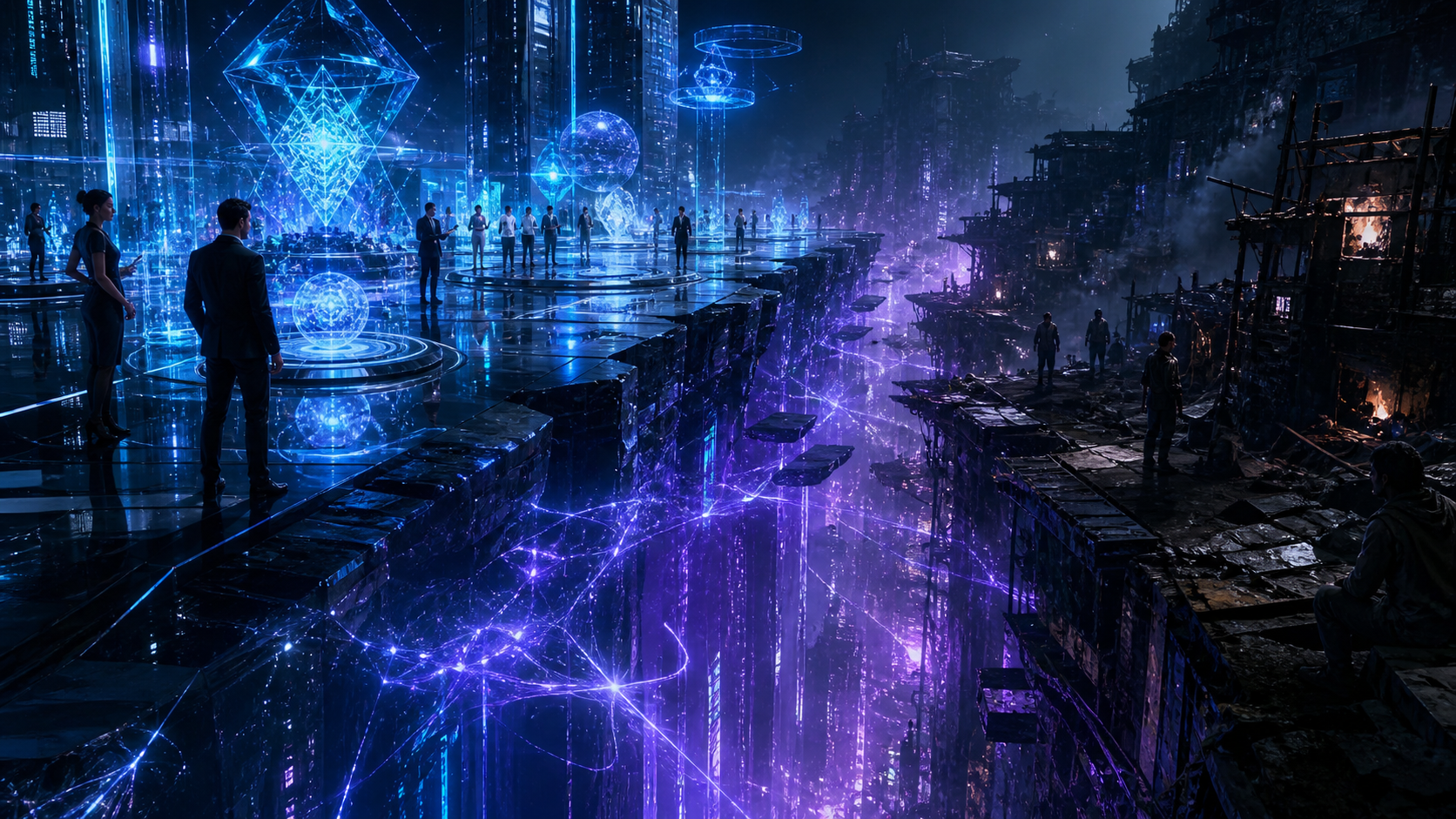
In the spring of 2026, a 1,200-qubit processor completed a neural architecture search in hours that would have taken classical systems weeks. In the same period, Google's Willow chip executed a molecular simulation in five minutes that would have required classical supercomputers an estimated ten septillion years. These are not marketing claims — they are peer-reviewed benchmarks marking the arrival of what researchers have termed "practical quantum advantage." The question for organisations, governments, and technologists is no longer whether quantum computing will transform artificial intelligence. It is whether the frameworks exist to govern that transformation responsibly.
This analysis maps the convergence of quantum computing and AI across four dimensions: the hardware breakthroughs enabling practical advantage, the emerging architecture of hybrid quantum-classical systems, the cryptographic implications that demand immediate action, and the governance frameworks that will determine who benefits from this inflection point and who is left exposed.
The Engineering Tipping Point: Error Correction Arrives
For decades, quantum computing's promise was undermined by a fundamental fragility: quantum states are extraordinarily sensitive to environmental interference, causing errors that accumulate faster than computations can complete. The field's central challenge — quantum error correction (QEC) — required demonstrating that adding more physical qubits could actually reduce logical error rates rather than compound them. In 2026, that demonstration arrived.
Google's Willow processor provided the clearest evidence: as the system scaled, logical error rates decreased exponentially — a validation of the theoretical scaling curves that had been predicted but never confirmed at meaningful qubit counts. IBM followed with a prototype error correction decoder capable of real-time processing, utilising quantum low-density parity-check (LDPC) codes to achieve a tenfold speedup in decoding performance. Atom Computing demonstrated the creation and entanglement of 24 logical qubits — using logical rather than physical qubits as the primary computational abstraction, a milestone that signals the transition from experimental to engineering-grade quantum systems.
The hardware landscape has also diversified significantly. Superconducting qubits remain the dominant architecture, but neutral-atom systems are gaining traction for their high connectivity and reconfigurable two- and three-dimensional array geometries. Microsoft's Majorana 1 processor takes a different approach entirely, leveraging topoconductors to resist errors at the hardware level — reducing the physical qubit overhead that error correction typically demands. Research from Stanford and other institutions into nanoscale optical devices suggests a longer-term path that could bypass cryogenic infrastructure altogether, though this remains firmly in the research phase.
Quantum advantage in AI is not a single event but a gradient — a progressive expansion of the problem classes where quantum co-processors deliver measurable superiority over the best classical alternatives.
The Hybrid Architecture: A Framework for Deployment
The practical deployment model that has emerged in 2026 is not "quantum replaces classical" but rather a hybrid architecture in which classical high-performance computing (HPC) and GPU-based systems orchestrate quantum co-processors to solve specific combinatorial bottlenecks. IBM has integrated Qiskit Runtime primitives directly into its Spectrum LSF workload scheduler, enabling quantum subroutines to be called from within standard HPC workflows. This hybrid-first approach reflects a mature understanding of where quantum systems currently deliver value and where they do not.
The framework for understanding quantum-AI integration can be structured across three tiers:
Tier 1: Quantum-Enhanced Optimisation
The question is no longer whether quantum computers will outperform classical systems on AI workloads — it is which organisations will have built the governance frameworks to deploy them responsibly when that moment arrives.
The most immediately deployable applications involve optimisation problems where the search space is too large for classical exhaustive methods. Quantum approximate optimisation algorithms (QAOA) and variational quantum eigensolvers (VQE) are being piloted in logistics, supply chain management, financial portfolio construction, and drug discovery. In these domains, quantum subroutines refine candidates generated by classical optimisers — a collaborative rather than replacement model. Early pilots report 20–40% efficiency gains in specific problem classes, though independent replication of these figures remains limited.
Tier 2: Quantum Machine Learning
Quantum machine learning (QML) in 2026 is characterised by a hybrid-first approach where quantum circuits act as specialised subroutines within larger classical AI pipelines. The field remains in the NISQ (Noisy Intermediate-Scale Quantum) era, where hardware limitations — gate errors, limited coherence times, and the "barren plateau" problem in training deep variational circuits — restrict model depth and training stability. However, experimental successes have been documented in learning from quantum-native data: a 2025 photonic experiment demonstrated a significant reduction in samples required for learning a 100-mode bosonic displacement process compared to classical methods.
The most significant near-term QML application may be in AI training itself. A 2026 breakthrough utilised a 1,200-qubit processor to perform quantum-enhanced neural architecture search, optimising AI models with approximately one-tenth the compute resources required by classical methods. If this result generalises, it represents a fundamental shift in the economics of AI development — reducing the energy and capital costs that currently concentrate frontier AI capability in a handful of organisations.
Tier 3: Quantum-Native AI
The third tier — AI systems that are fundamentally quantum in their architecture rather than quantum-enhanced — remains largely theoretical. Quantum neural networks and quantum generative models are active research areas, but the input/loading problem (the cost of encoding classical data into quantum states often negates processing speedups) and the absence of a clear, replicated advantage on general-purpose classical datasets mean that quantum-native AI is a horizon rather than a near-term deployment target.
The question is no longer whether quantum computers will outperform classical systems on AI workloads — it is which organisations will have built the governance frameworks to deploy them responsibly when that moment arrives.
The Cryptographic Imperative: Acting Before the Threat Matures
The most immediate and actionable dimension of the quantum-AI convergence is not computational advantage but cryptographic vulnerability. The "harvest-now, decrypt-later" threat model — in which adversaries collect encrypted data today, banking on the certainty that quantum decryption will arrive before the data loses its value — has moved from theoretical concern to operational risk assessment.
NIST's response has been methodical and consequential. Following years of international evaluation, three Federal Information Processing Standards were finalised in August 2024: FIPS 203 (ML-KEM, formerly CRYSTALS-Kyber) for key encapsulation; FIPS 204 (ML-DSA, formerly CRYSTALS-Dilithium) for digital signatures; and FIPS 205 (SLH-DSA, formerly SPHINCS+) as a hash-based backup. In March 2025, NIST added HQC (Hamming Quasi-Cyclic) as a fifth algorithm — a code-based backup providing a different mathematical foundation than the lattice-based primary standards.
The migration timeline is now mandatory for US federal agencies: initial PQC integration for civilian agencies by 2026, compliance gates for High-Value Assets by 2030, full migration for high-impact and defence systems by 2031, and final infrastructure cutover by 2035. The private sector is following, with Chrome 131+, Firefox 135+, and Windows 11 24H2 already integrating ML-KEM into TLS 1.3 connections and cryptographic APIs.
A notable development in July 2026 illustrated the intersection of AI and cryptographic security: Anthropic reported using an AI model to discover a vulnerability in the HAWK digital signature algorithm, which was under consideration for standardisation. The HAWK development team subsequently withdrew the algorithm. NIST confirmed that the finalized FIPS 203, 204, and 205 standards — which use different mathematical foundations — are unaffected. The episode demonstrates both the utility of AI in cryptographic analysis and the importance of maintaining diverse mathematical foundations in post-quantum standards.
Harvest-now, decrypt-later attacks represent the most immediate quantum threat: adversaries are collecting encrypted data today, banking on the certainty that quantum decryption will arrive before the data loses its value.
Harvest-now, decrypt-later attacks represent the most immediate quantum threat: adversaries are collecting encrypted data today, banking on the certainty that quantum decryption will arrive before the data loses its value.
Governance Frameworks for the Quantum-AI Era
The convergence of quantum computing and AI creates governance challenges that existing frameworks were not designed to address. Three dimensions require particular attention.
Access and Concentration
Quantum computing infrastructure is extraordinarily capital-intensive. The organisations with early access to fault-tolerant quantum systems — and the AI advantages they enable — will be a small subset of the global technology landscape. This concentration risk is not merely commercial; it has implications for national competitiveness, scientific research capacity, and the distribution of AI capability. Governance frameworks must address not only how quantum-AI systems are used but who has access to them and on what terms.
Verification and Auditability
Quantum systems introduce new challenges for AI auditability. When a quantum co-processor contributes to an AI decision — whether in drug discovery, financial modelling, or logistics optimisation — the quantum computation is inherently probabilistic and difficult to reproduce exactly. Existing AI governance frameworks, including the EU AI Act's requirements for technical documentation and human oversight, assume deterministic or at least statistically reproducible behaviour. Quantum-enhanced AI systems will require new approaches to auditability that account for quantum probabilism.
Cryptographic Transition Management
The post-quantum cryptography migration is not a one-time event but an ongoing process of cryptographic agility — the capacity to update cryptographic algorithms as the threat landscape evolves. Organisations that treat PQC migration as a compliance checkbox rather than an architectural capability will find themselves repeatedly exposed as quantum hardware matures. The governance imperative is to build crypto-agility into systems at the design level, not to retrofit it after the fact.
The Quantum Readiness Assessment: A Practical Framework
For organisations seeking to position themselves for the quantum-AI era, a structured readiness assessment across five dimensions provides a practical starting point:
1. Cryptographic Inventory: Map all cryptographic assets — certificates, keys, protocols, and the data they protect — and classify by sensitivity and longevity. Data that must remain confidential for more than five years is already at risk from harvest-now attacks and should be prioritised for PQC migration.
Quantum advantage in AI is not a single event but a gradient — a progressive expansion of the problem classes where quantum co-processors deliver measurable superiority over the best classical alternatives.
2. Quantum Use Case Identification: Identify the specific optimisation, simulation, or machine learning problems within the organisation's domain that are candidates for quantum enhancement. Not all AI workloads benefit from quantum co-processing; the value is concentrated in specific problem classes characterised by combinatorial complexity or quantum-native data.
3. Hybrid Architecture Readiness: Assess the organisation's HPC and cloud infrastructure for compatibility with quantum co-processor integration. The hybrid model requires orchestration layers, API compatibility, and workflow management systems that can route appropriate workloads to quantum resources.
4. Talent and Knowledge Infrastructure: Quantum computing requires specialised expertise that is currently scarce. Organisations should assess their capacity to recruit, develop, or partner for quantum expertise — and should begin building that capacity before the talent market tightens further as practical applications multiply.
5. Governance and Ethics Framework: Establish clear policies for the use of quantum-enhanced AI systems, including auditability requirements, access controls, and human oversight protocols. These frameworks should be developed in anticipation of regulatory requirements rather than in response to them.
The Sovereign Dimension: Quantum Infrastructure as Strategic Asset
Quantum computing infrastructure is increasingly recognised as a strategic national asset. The United States, European Union, China, and a growing number of middle powers have established national quantum initiatives with significant public investment. The EU's Quantum Flagship programme, the US National Quantum Initiative, and China's substantial quantum research investment reflect a shared understanding that quantum capability will be a determinant of technological sovereignty in the coming decade.
For organisations operating across jurisdictions, this creates a new dimension of compliance complexity. Quantum computing services provided by US-incorporated cloud providers are subject to US legal jurisdiction regardless of where the computation occurs — a quantum analogue of the CLOUD Act sovereignty gap that already affects AI data governance. As quantum cloud services proliferate, organisations will need to assess not only the technical capabilities of quantum providers but their jurisdictional exposure.
The intersection of quantum computing, AI, and digital sovereignty is not a future concern. It is a present governance challenge that requires frameworks, not just awareness. The organisations that build those frameworks now — before the technology fully matures — will be positioned to capture the benefits of the quantum-AI convergence rather than scrambling to manage its risks.
Conclusion: Framework Precedes Capability
The quantum-AI convergence of 2026 is real, measurable, and accelerating. Error correction has crossed the engineering tipping point. Hybrid quantum-classical architectures are delivering practical advantage in specific domains. Post-quantum cryptographic standards are finalised and migration timelines are mandatory. The technology is no longer waiting for governance — governance is waiting for organisations to take it seriously.
The framework presented here — spanning hardware tiers, deployment architectures, cryptographic imperatives, and governance dimensions — is not a prediction of what quantum-AI will become. It is a map of what it already is, and what responsible engagement with it requires. The organisations that treat quantum readiness as a strategic priority rather than a distant concern will find themselves better positioned not only for the quantum era but for the broader challenge of governing powerful technologies in the public interest.
Quantum advantage, like all forms of technological advantage, is not self-distributing. It flows to those who have built the infrastructure — technical, institutional, and governance — to capture it. The time to build that infrastructure is now, before the gradient of advantage steepens further and the gap between the prepared and the unprepared becomes difficult to close.