Introduction: The Year Quantum Stopped Being a Thought Experiment
For most of the past decade, quantum computing occupied a peculiar position in the technology landscape: simultaneously overhyped and underestimated. Overhyped because breathless press releases routinely announced "quantum supremacy" for tasks no one actually needed to perform. Underestimated because the underlying physics — and the engineering required to harness it — was advancing on a trajectory that most classical computing analysts were structurally ill-equipped to model.
2026 has changed the terms of that debate. Not because quantum computers have suddenly become general-purpose machines capable of replacing classical infrastructure — they have not, and will not for years — but because the research frontier has produced a cluster of results that, taken together, constitute a qualitative shift. Quantum error correction has crossed a critical threshold. Hybrid quantum-classical architectures have moved from academic papers into enterprise pilots. And the convergence of quantum hardware with artificial intelligence — both as a tool for improving quantum systems and as a workload that quantum systems can accelerate — has produced results that demand serious analytical attention.
This research survey examines what the 2026 quantum-AI frontier actually shows, distinguishing genuine signal from persistent noise, and drawing out the governance and strategic implications that most technical analyses leave unaddressed.
"The question is no longer whether quantum computing will matter. The question is whether the institutions governing its deployment will be ready when it does."
The Error Correction Breakthrough: Why AlphaQubit Changes the Calculus
The single most consequential development in quantum computing over the past eighteen months has not been a new qubit architecture or a larger processor. It has been the application of deep learning to quantum error correction — and specifically, Google DeepMind's AlphaQubit system, published in Nature and subsequently integrated into production hardware.
To understand why this matters, a brief technical grounding is necessary. Quantum computers are extraordinarily sensitive to environmental noise. A qubit — the quantum analogue of a classical bit — can exist in superposition, encoding vastly more information than a binary 0 or 1. But this sensitivity is a double-edged property: thermal fluctuations, electromagnetic interference, and even cosmic rays can cause qubits to decohere, collapsing their quantum state and introducing errors. Classical error correction works by redundancy — storing multiple copies of each bit. Quantum error correction cannot simply copy qubits (the no-cloning theorem prohibits it), so it must instead encode logical qubits across many physical qubits and detect errors through indirect measurement.
The challenge is that decoding these error syndromes — determining what went wrong and how to fix it — must happen faster than the qubits themselves decohere. Traditional decoders, such as Minimum-Weight Perfect Matching (MWPM), are computationally expensive and struggle to adapt to the complex, correlated noise profiles of real hardware.
AlphaQubit addresses this with a recurrent transformer architecture trained directly on hardware data from Google's Sycamore and Willow processors. By retaining analog probability information from qubit readouts — "soft readouts" rather than binary snap decisions — AlphaQubit learns to identify noise patterns that rigid algorithmic decoders miss. The results are striking: on Google's Willow chip, AlphaQubit achieves sub-microsecond real-time error correction, outperforming MWPM by a statistically significant margin across all tested code distances.
Complementing this, Harvard University researchers published the "Cascade" decoder in 2026, a convolutional neural network architecture designed for quantum low-density parity-check (qLDPC) codes. Cascade exploits the geometric structure of these codes to achieve logical error rates as low as 10⁻¹⁰ — a seventeen-fold improvement over previous methods. Meanwhile, the German Aerospace Centre (DLR) introduced neural belief-matching decoders for toric codes, demonstrating that models trained on small-scale instances can generalise to significantly larger code sizes without retraining.
The cumulative effect of these advances is that the "threshold theorem" — the theoretical result showing that quantum error rates can be suppressed exponentially as system size increases, provided physical error rates fall below a critical threshold — is now being validated in hardware, not just in mathematics. Google's Willow processor has demonstrated exponential error suppression across multiple code distances, confirming that the engineering path to fault-tolerant quantum computing is open, even if the destination remains years away.
The Hardware-Agnostic Decoder Ecosystem
A notable secondary development is the emergence of hardware-agnostic AI decoder companies. EdenCode, which emerged from stealth in early 2026, offers AI-based error correction systems designed to operate across superconducting, trapped-ion, and photonic quantum architectures. This matters strategically: if error correction becomes a software layer that abstracts over hardware differences, it accelerates the commoditisation of quantum hardware and shifts competitive advantage toward the algorithmic and application layers — precisely the dynamic that has historically favoured software-centric incumbents in classical computing.
The Hybrid Architecture Paradigm: Quantum as Accelerator
The dominant architectural pattern emerging from 2026 enterprise pilots is not "quantum computers replacing classical computers." It is quantum processing units (QPUs) operating as specialised accelerators within heterogeneous compute environments — analogous to the role GPUs play in classical AI workloads.
The question is no longer whether quantum computing will matter. The question is whether the institutions governing its deployment will be ready when it does.
IBM's 2026 roadmap crystallises this vision. The company's Nighthawk processor — 360 qubits across three 120-qubit modules — is designed not as a standalone system but as a component within IBM's "quantum-centric supercomputing" architecture, where classical CPUs, GPUs, and QPUs execute hybrid workloads through a unified orchestration layer. IBM has designated 2026 as the year for demonstrating "quantum advantage" in this hybrid context, with circuits running up to 7,500 gates on Nighthawk hardware.
NVIDIA's CUDA-Q platform has become the de facto middleware for this integration, allowing quantum subroutines to be embedded within existing HPC workflows. Frameworks like Qiskit Patterns and TensorFlow Quantum (TFQ) provide higher-level abstractions, enabling engineers to leverage quantum optimisation layers without replacing entire classical infrastructure stacks.
"Hybrid quantum-classical architecture is not a compromise position. It is the correct engineering response to a world where quantum and classical hardware have complementary, not competing, strengths."
The practical implications are significant. Early adopters in aerospace and defence are reporting up to 20× speedups in specific optimisation tasks using quantum-inspired solvers running on GPU-accelerated infrastructure. A 2026 study published in Science Advances demonstrated that a quantum-informed AI model could predict spatiotemporal chaos in fluid dynamics with 20% greater accuracy and hundreds of times less memory than standard classical models — a result with direct implications for climate modelling, materials simulation, and autonomous systems design.
The Four Algorithmic Families Driving Enterprise Adoption
Within the hybrid paradigm, four algorithmic families are driving the majority of enterprise pilots:
- Variational Quantum Algorithms (VQAs): Parameterised quantum circuits optimised through classical outer loops. The primary engine for near-term applications because they are designed to operate within NISQ hardware constraints. Susceptible to "barren plateaus" — gradient vanishing in deep circuits — which remains an active research problem.
- Quantum Kernel Methods: Map classical data into high-dimensional Hilbert spaces to identify patterns computationally difficult for classical kernel functions. Currently considered one of the most production-ready paths for classification tasks in regulated industries.
- Quantum Approximate Optimisation Algorithm (QAOA): Leverages quantum interference to find high-quality solutions for NP-hard combinatorial optimisation problems. Widely deployed in logistics scheduling and financial portfolio optimisation.
- Variational Quantum Eigensolver (VQE): The standard for quantum chemistry and materials science. Estimates ground-state energies of molecules with higher accuracy than classical approximations, serving as the foundation for drug discovery and battery material research.
Quantum Machine Learning: The State of the Art in 2026
Quantum Machine Learning (QML) — the application of quantum computing to machine learning tasks, and vice versa — has matured considerably from its theoretical origins. The 2026 landscape is characterised by a hybrid-first engineering discipline rather than the wholesale replacement of classical ML pipelines.
The most credible near-term applications cluster around problems where classical methods face exponential scaling bottlenecks: high-dimensional optimisation, molecular simulation, and combinatorial search. In drug discovery, VQE and quantum generative models are being used to simulate molecular properties and explore chemical spaces estimated at 10⁶⁰ candidate molecules — a search space that classical high-throughput screening cannot efficiently navigate. In finance, hybrid quantum-enhanced Monte Carlo methods are being tested for derivatives pricing, with some benchmarks showing significant speedups at medium problem scales.
IBM has claimed verified quantum advantage in 2026 specifically for quantum chemistry and magnetic-material simulations — a narrowly scoped but scientifically significant result. The company's research demonstrates that quantum processors can calculate molecular ground-state energies for systems that classical computers cannot tractably simulate, validating the theoretical promise of quantum chemistry that has been articulated since the 1980s.
However, the honest assessment of QML in 2026 requires acknowledging persistent challenges. Data encoding costs — the overhead of mapping high-dimensional classical data into quantum states — can negate computational benefits for many practical problems. Training instability in deep variational circuits remains a fundamental obstacle. And the interpretability problem that plagues classical deep learning is, if anything, more acute in quantum systems, where the physical substrate adds an additional layer of opacity.
The AI-Quantum Feedback Loop
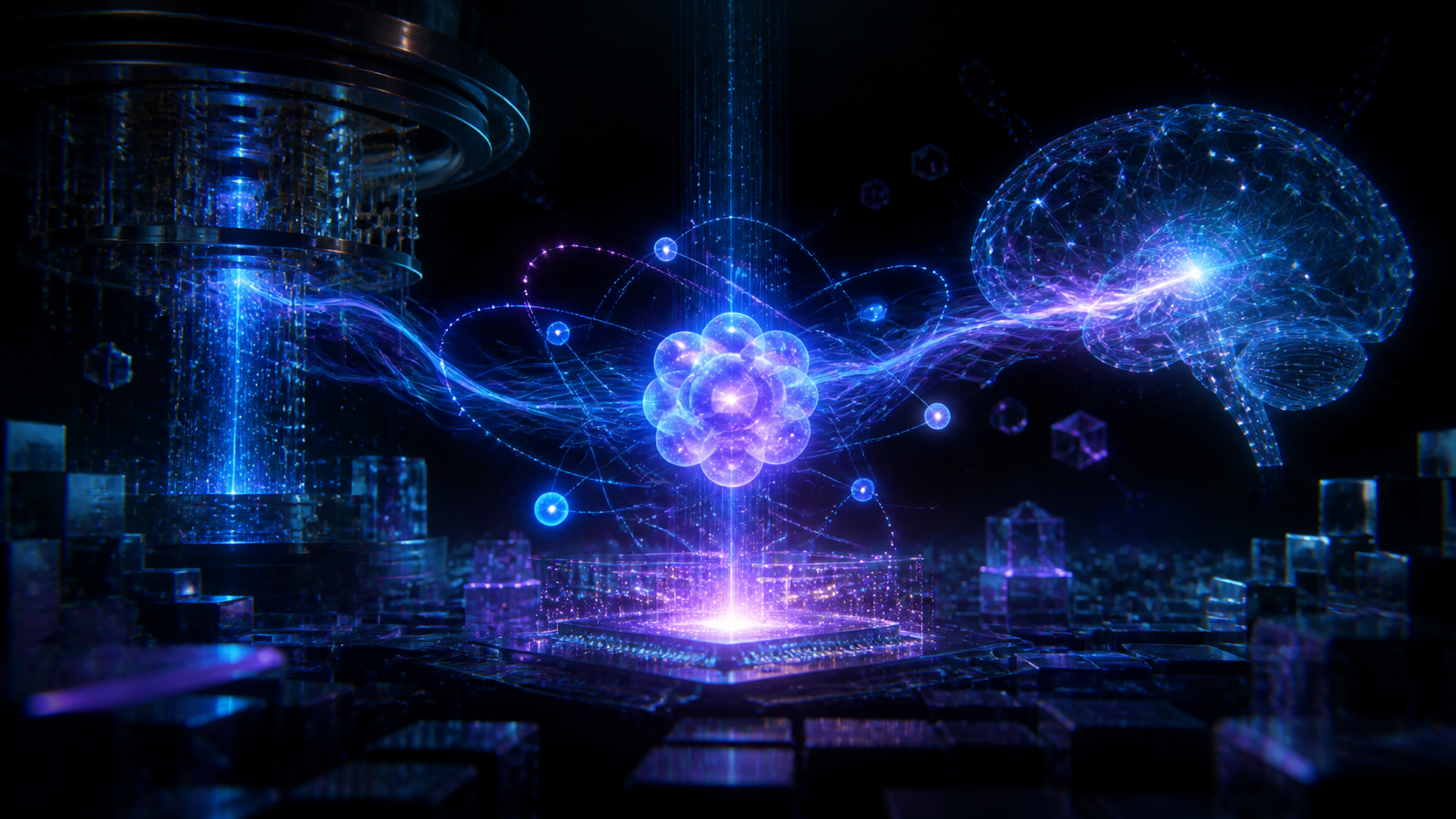
One of the most intellectually interesting developments of 2026 is the emergence of a genuine feedback loop between AI and quantum computing — where AI improves quantum systems, and quantum systems improve AI, in a mutually reinforcing cycle.
Hybrid quantum-classical architecture is not a compromise position. It is the correct engineering response to a world where quantum and classical hardware have complementary, not competing, strengths.
On the AI-improving-quantum side: researchers are using large language models and evolutionary algorithms to design more efficient quantum circuits, reducing qubit requirements for specific computations by factors of up to 100. AI-driven calibration systems manage real-time error correction and qubit tuning in ways that human operators cannot match at scale. AlphaQubit itself is the most prominent example of this dynamic.
On the quantum-improving-AI side: quantum optimisation layers are being embedded in classical AI training pipelines to accelerate hyperparameter search and architecture optimisation. A 2026 study demonstrated that quantum-informed AI models can achieve superior performance on specific prediction tasks with dramatically reduced memory requirements — a result with implications for edge AI deployment in resource-constrained environments.
This feedback loop is not yet self-sustaining at scale, but its existence is analytically significant. It suggests that the trajectory of quantum-AI convergence may be non-linear — that improvements in each domain will accelerate improvements in the other, compressing the timeline to practical quantum advantage beyond what linear extrapolation from current hardware roadmaps would suggest.
Post-Quantum Cryptography: The Governance Emergency No One Is Treating as One
While the research community focuses on quantum advantage in computation, a parallel and more immediately urgent story is unfolding in cryptography. The threat is not hypothetical: adversaries are already executing "harvest now, decrypt later" (HNDL) attacks, intercepting and storing encrypted communications today with the intention of decrypting them once sufficiently powerful quantum hardware becomes available.
NIST finalised its primary post-quantum cryptography standards in August 2024: FIPS 203 (ML-KEM, based on CRYSTALS-Kyber), FIPS 204 (ML-DSA, based on CRYSTALS-Dilithium), and FIPS 205 (SLH-DSA, based on SPHINCS+). A fourth standard, FIPS 206 (FN-DSA, based on Falcon), is in development, and the HQC algorithm was selected in March 2025 as a backup key encapsulation mechanism.
These standards are available for immediate implementation. NIST's official transition roadmap targets complete phase-out of quantum-vulnerable algorithms (RSA, ECC) by 2035, with high-risk systems — those handling data with long shelf lives, such as medical records, financial instruments, and national security communications — expected to transition significantly sooner.
The gap between the availability of these standards and the pace of enterprise adoption is alarming. Most large organisations have not completed cryptographic inventories — the basic prerequisite for understanding their exposure. The concept of "cryptographic agility" — designing systems to allow algorithm updates without architectural overhaul — remains aspirational rather than operational for the majority of enterprise infrastructure.
"The harvest-now, decrypt-later threat is not a future problem. It is a present problem with a future detonation date. Every day of delayed migration extends the window of exposure."
The geopolitical dimension compounds the urgency. Quantum capability is increasingly treated as a national security asset. The United States, China, and European nations are investing heavily in domestic quantum supply chains, talent cultivation, and PQC migration programmes. The $20 million Quantum Manufacturing Engineering Center (QMEC) launched by NIST and SRI International in 2026 represents one component of a broader industrial strategy. But the pace of government action remains mismatched with the pace of the threat.
Hardware Diversity and the Industrialisation of Quantum
The 2026 hardware landscape is characterised by genuine diversity across competing physical modalities — a contrast with the classical computing industry's historical convergence on silicon CMOS. Each modality offers distinct trade-offs:
- Superconducting qubits (IBM, Google): Fast gate speeds, established manufacturing processes, but require dilution refrigerators operating near absolute zero. IBM's multi-chip Kookaburra architecture and Google's Willow processor represent the current state of the art.
- Trapped-ion systems (IonQ, Quantinuum): Record-high gate fidelities and long coherence times, but slower gate speeds and more complex scaling. Quantinuum's H-series processors have demonstrated some of the highest quantum volumes measured to date.
- Photonic systems (Quandela, QuiX Quantum): Room-temperature operation and natural compatibility with quantum communication networks, but photon loss remains a fundamental engineering challenge.
- Neutral-atom systems (QuEra, Taiyi Quantum): Highly programmable arrays scaling to thousands of atoms, offering a compelling path for optimisation and simulation workloads.
- Topological qubits (Microsoft): Microsoft's Majorana 1 chip, based on Majorana zero modes, aims for physical-level immunity to environmental noise. Still at the hardware prototype stage, but potentially offering the most scalable path to fault tolerance if the engineering challenges can be resolved.
The harvest-now, decrypt-later threat is not a future problem. It is a present problem with a future detonation date. Every day of delayed migration extends the window of exposure.
The industrialisation of quantum hardware is accelerating. Companies like QuantWare are building dedicated wafer fabrication facilities — the "Kilofab" — to support mass production of superconducting quantum chips. The Open Compute Project Foundation has begun establishing standards for integrating QPUs into data centres, a critical step for moving quantum hardware from specialised laboratory environments into standardised, energy-efficient production settings.
Cloud providers are evolving their quantum offerings from simple hardware access to integrated hybrid environments. IBM, AWS, and Microsoft are all developing "quantum-classical" cloud services that lower the threshold for enterprise experimentation — a dynamic that will accelerate adoption but also concentrate quantum capability in the hands of a small number of infrastructure providers.
The Talent and Standardisation Gaps
Two structural constraints threaten to slow the quantum-AI convergence regardless of hardware progress: the talent gap and the standardisation gap.
The global shortage of researchers skilled in both quantum physics and AI architecture is acute. Quantum computing requires deep expertise in quantum mechanics, error correction theory, and hardware engineering. AI requires expertise in machine learning, optimisation, and software engineering. The intersection of these domains — quantum machine learning, AI-driven error correction, hybrid algorithm design — is a specialisation that very few researchers currently possess. Universities are expanding quantum computing programmes, but the pipeline is measured in years, not months.
The standardisation gap is equally consequential. The Quantum Resource Management Interface (QRMI), being developed to allow modular, multi-vendor quantum deployments, represents progress — but the broader ecosystem of quantum software frameworks, benchmarking methodologies, and interoperability standards remains fragmented. Without standardisation, enterprises face vendor lock-in risks that will slow adoption and concentrate market power.
Strategic Implications: What the Research Frontier Demands
The 2026 quantum-AI research frontier carries several strategic implications that extend beyond the technical community.
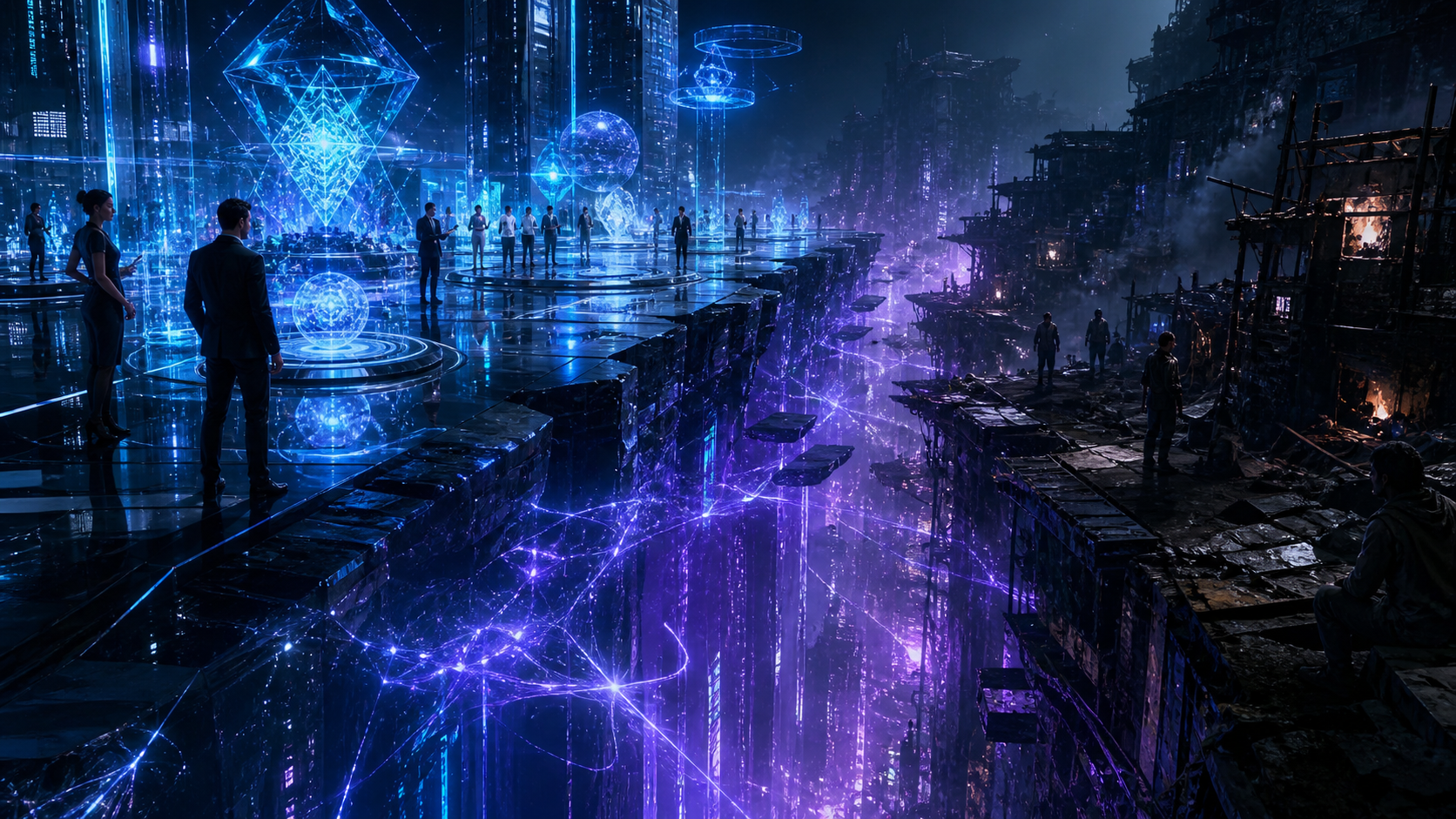
First, the governance gap is widening faster than the technology gap is closing. The frameworks for governing quantum-AI systems — determining who has access, under what conditions, with what accountability mechanisms — are not keeping pace with the technology's development. This is not a new observation, but the 2026 research results make it more urgent. When quantum-AI systems can break current encryption, simulate molecular interactions at pharmaceutical scale, and optimise complex logistics networks, the question of who controls these capabilities becomes a civilisational-level governance question.
Second, the concentration risk is real and underappreciated. The hybrid quantum-classical paradigm, combined with the cloud delivery model, means that practical quantum capability is likely to be concentrated in a small number of infrastructure providers — IBM, Google, Microsoft, AWS — for the foreseeable future. This concentration has implications for competitive dynamics, national security, and the distribution of economic value from quantum-AI applications.
Third, the PQC migration is a present emergency, not a future planning exercise. Organisations that have not begun cryptographic inventory and migration planning are already accumulating risk. The harvest-now, decrypt-later threat means that data encrypted today with quantum-vulnerable algorithms is potentially compromised, even if the decryption capability does not yet exist. The NIST standards are available. The migration tools are available. The obstacle is organisational inertia, not technical readiness.
Fourth, the feedback loop between AI and quantum computing will compress timelines. Linear extrapolation from current hardware roadmaps systematically underestimates the pace of progress because it does not account for the mutual acceleration dynamic. AI-driven circuit design, AI-driven error correction, and AI-driven calibration are all shortening the path to fault-tolerant quantum computing. Organisations and policymakers that plan on a 2035 timeline for quantum relevance may find themselves significantly behind.
Conclusion: The Research Frontier as a Governance Frontier
The 2026 quantum-AI research frontier is not a story about a technology that has arrived. It is a story about a technology that is arriving — faster than most governance frameworks anticipated, along multiple simultaneous vectors, with implications that span cryptography, drug discovery, materials science, financial optimisation, and national security.
The research results are clear: quantum error correction has crossed a critical threshold, hybrid architectures are delivering measurable value in enterprise pilots, and the AI-quantum feedback loop is real and accelerating. What is less clear — and what demands urgent attention — is whether the institutions responsible for governing these capabilities are developing the frameworks, standards, and oversight mechanisms at a commensurate pace.
The Sovereign Intelligence Hub has consistently argued that the governance of transformative technologies cannot be retrofitted after deployment. The quantum-AI convergence is not an exception to this principle. It is its most demanding test case yet.
The research frontier is also a governance frontier. The question is whether we will treat it as one.