The Stratification Has Already Begun
In August 2024, the National Institute of Standards and Technology published three finalized post-quantum cryptography standards — FIPS 203, FIPS 204, and FIPS 205 — and quietly set a deadline: quantum-vulnerable algorithms will be deprecated from federal systems by 2035. The announcement was technical in language and modest in fanfare. Its implications were civilizational in scope.
Those three documents represent the first formal acknowledgment by a major government that the cryptographic infrastructure underpinning the global digital economy — the RSA and elliptic-curve encryption protecting banking transactions, health records, diplomatic communications, and military command systems — will not survive the quantum era intact. The question is no longer whether quantum computers will break current encryption. The question is who will be ready when they do, and who will not.
The answer, as of mid-2026, is becoming uncomfortably clear. A small cluster of wealthy nations and technology corporations are racing toward quantum readiness at extraordinary speed. More than 150 countries have no national quantum strategy whatsoever. One in three researchers worldwide lacks access to quantum research facilities. And the World Economic Forum has warned that an asymmetric transition to post-quantum cryptography could produce a two-tier global financial system — one in which quantum-safe institutions can transact freely while quantum-vulnerable ones are progressively excluded from correspondent banking, insurance, and international trade.
"The quantum divide is not a future risk. It is a present condition. The stratification is not approaching — it has already begun, and its contours are being set by investment decisions made today in a handful of capital cities."
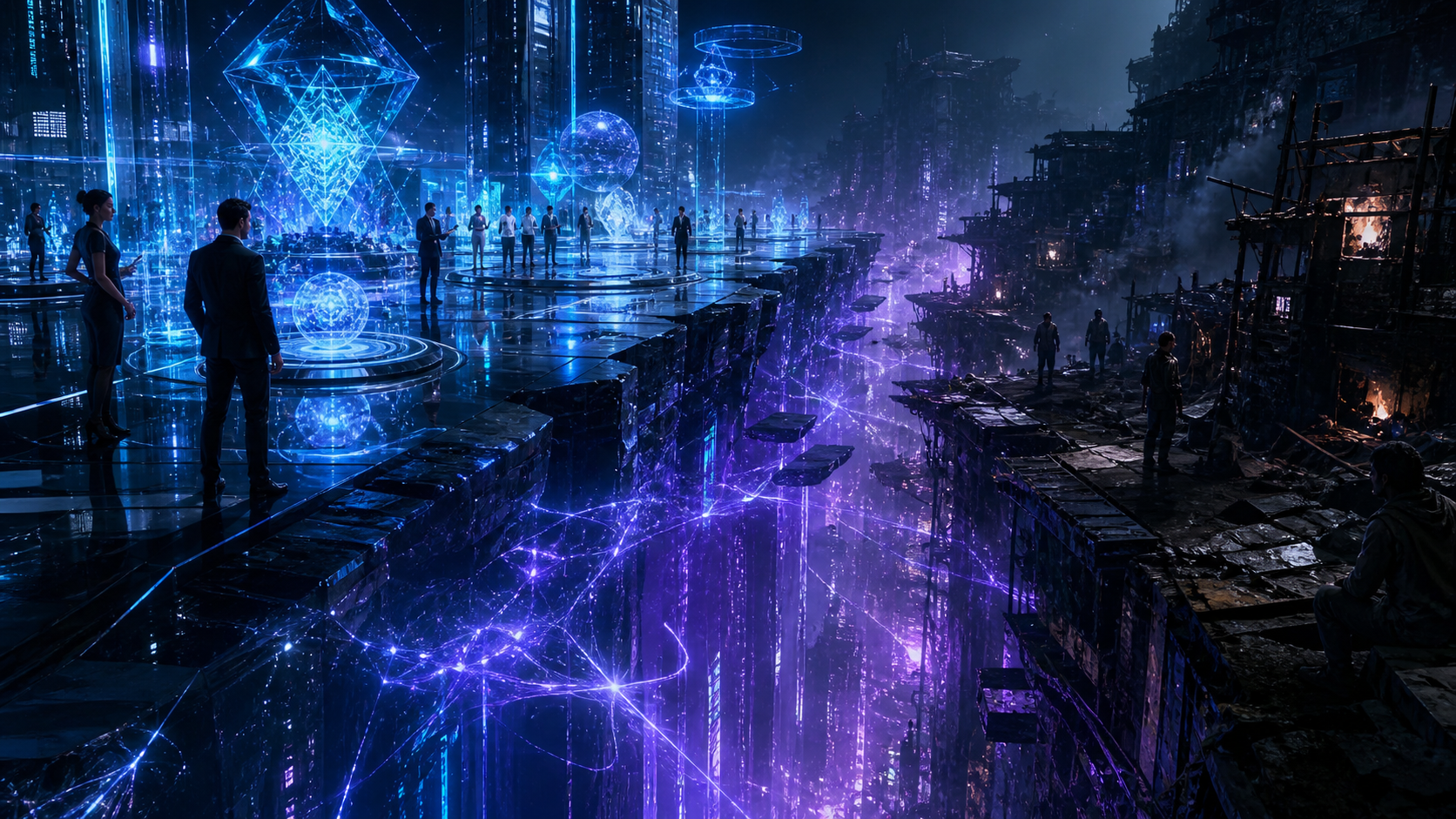
This is the central analytical claim of this piece: the second quantum revolution is not arriving as a shared horizon. It is arriving as a stratification event — one that will sort nations, institutions, and individuals into quantum-capable and quantum-vulnerable categories with consequences that will compound for decades. Understanding the mechanics of that stratification, and the narrow window that remains to shape it, is among the most important analytical tasks of 2026.
The Technical Inflection: What Has Actually Changed
To understand the social and geopolitical stakes, it is necessary to first understand what has technically changed — and to distinguish genuine inflection from persistent hype.
The quantum computing industry has spent years cycling through cycles of breathless announcement and quiet disappointment. The 2026 landscape is different in one critical respect: the field has crossed from theoretical demonstration to engineering reality in several specific domains. This is not universal quantum advantage — fault-tolerant, general-purpose quantum computers capable of breaking RSA encryption remain years away. But the trajectory has shifted in ways that matter for policy and strategy.
The most significant technical development of the past eighteen months has been the demonstration of "below-threshold" quantum error correction — the point at which adding more physical qubits to a system actually reduces the logical error rate rather than compounding it. Google's Willow processor achieved this milestone, executing in five minutes a molecular simulation task that would require classical supercomputers septillions of years. IBM's Quantum Loon processor demonstrated real-time error decoding in under 480 nanoseconds. Microsoft's Majorana 1 introduced topological qubits designed for inherent error resistance.
These are not incremental improvements. They represent the resolution of a foundational engineering problem that has constrained quantum computing since its inception. The industry has not yet built a fault-tolerant quantum computer. But it has demonstrated that the path to one is now an engineering challenge rather than a physics impossibility.
The Hybrid Transition
Simultaneously, the industry has converged on a practical architecture for near-term deployment: hybrid quantum-classical computing. Rather than replacing classical infrastructure, quantum processors function as specialized co-processors that handle computationally expensive subroutines — molecular simulations, portfolio optimization, materials modeling — while classical systems manage data preparation, error correction, and output interpretation.
This hybrid model is already generating measurable value. IonQ achieved a milestone in 2025 by outperforming classical high-performance computing in a medical device simulation — the first real-world evidence of practical quantum advantage on a commercially relevant problem. IBM and HSBC have demonstrated quantum machine learning applications that reduce prediction errors in market data analysis. Pharmaceutical companies are using quantum hardware to simulate molecular interactions that are computationally intractable for classical systems.
The practical implication is that quantum advantage is not a single future event. It is a rolling frontier, arriving first in specific high-value domains — drug discovery, financial optimization, materials science, logistics — before expanding to general computation. Organizations that are positioned at that frontier will capture disproportionate value. Those that are not will face compounding disadvantage.
The quantum divide is not a future risk. It is a present condition. The stratification is not approaching — it has already begun, and its contours are being set by investment decisions made today in a handful of capital cities.
The Investment Asymmetry: $65.9 Billion and Counting
The financial architecture of the quantum revolution reveals the stratification in its starkest form. Global public and private investment in quantum technology reached approximately $55.7 billion by mid-2025, with worldwide government commitments now exceeding $65.9 billion in cumulative funding. Private venture capital investment in quantum startups reached a record $4.9 billion in 2025 alone — more than doubling the previous year's total.
The geographic concentration of this capital is extreme. The United States, China, the European Union, Canada, Japan, and a handful of other advanced economies account for the overwhelming majority of both public and private quantum investment. The U.S. government announced in June 2026 a new federal quantum strategy via executive order, complemented by a Department of Energy "Quantum Genesis" program targeting fault-tolerant capabilities by 2028, and plans to award approximately $2 billion in grants and equity stakes to nine companies. China has mobilized a massive national venture capital guidance fund with quantum technology as a priority. France's PROQCIMA program continues to back national quantum champions.
"More than 150 countries have no national quantum strategy. The quantum revolution is being built by a handful of nations, for the benefit of those nations — and the rest of the world is watching from outside the room where the decisions are being made."
The public market dimension reinforces the picture. Leading pure-play quantum companies — IonQ, D-Wave, Rigetti Computing — maintained a collective market capitalization of approximately $36 billion as of mid-2026. IonQ's $1.08 billion acquisition of Oxford Ionics and D-Wave's $550 million purchase of Quantum Circuits signal a consolidation phase in which the largest players are absorbing specialized capabilities. Quantinuum, which secured a $10 billion pre-money valuation in its final private fundraising round, is preparing for a public offering that will further concentrate quantum equity in the hands of institutional investors in advanced economies.
For nations outside this investment ecosystem, the consequence is not merely slower progress. It is structural exclusion from the industries and capabilities that will define economic competitiveness for the next half-century.
The Geopolitical Fault Lines: A Quantum Arms Race
The U.S. Intelligence Community officially identified quantum computing, alongside artificial intelligence and advanced semiconductors, as a primary driver of national security strategy in its 2026 Annual Threat Assessment. This designation reflects a recognition that quantum technology is not merely an economic asset — it is a force multiplier for national power that will reshape intelligence, military strategy, and diplomatic leverage.
The primary geopolitical competition is between the United States and China, and the two nations have adopted fundamentally different models. The U.S. relies on a private-sector-led approach with federal coordination — leveraging corporate investment from technology giants and a robust startup ecosystem, with federal efforts focused on research coordination, intellectual property protection, and export controls. China executes a state-led, centralized strategy with massive multi-billion dollar funding commitments, prioritizing technological self-reliance and military-civil fusion, and has achieved significant milestones in quantum communications including large-scale secure network infrastructure.
The June 2026 Executive Order 14413 represents the most comprehensive U.S. federal quantum policy to date, mandating agency-wide timelines for both quantum hardware development and cryptographic migration, and tightening export controls on dual-use quantum technologies to "countries of concern." The order reflects a strategic assessment that quantum technology is too consequential to be governed by market forces alone.
Quantum Sensing: The Overlooked Dimension
Public discourse on quantum technology focuses disproportionately on computing. The national security community is equally focused on quantum sensing — a domain where the technology is already deployed and generating strategic advantage.
Quantum sensors can detect minute magnetic or gravitational anomalies with precision that classical sensors cannot approach. Military applications include navigation and timing systems that function without GPS — critical for operations in environments where GPS signals are jammed or spoofed — and non-intrusive detection of submarines, underground facilities, and concealed weapons. The U.S. Center for Strategic and International Studies has identified quantum sensing as one of the most near-term strategically significant quantum applications, precisely because it does not require fault-tolerant quantum computing to deliver military advantage.
Nations that develop quantum sensing capabilities will possess intelligence and military advantages that are difficult to counter with classical technology. Nations that do not will face a persistent and widening asymmetry in situational awareness and operational capability.
Q-Day and the Cryptographic Cliff
The most immediate and universally consequential dimension of the quantum stratification is the threat to current encryption. The "harvest now, decrypt later" strategy — in which adversaries intercept and store encrypted data today, intending to decrypt it once fault-tolerant quantum hardware becomes available — is not a theoretical future risk. Intelligence agencies have confirmed it is actively underway.
More than 150 countries have no national quantum strategy. The quantum revolution is being built by a handful of nations, for the benefit of those nations — and the rest of the world is watching from outside the room where the decisions are being made.
The timeline for Q-Day — the point at which quantum computers can break RSA and elliptic-curve encryption — remains contested. Estimates range from five to fifteen years, with the acceleration of AI-assisted quantum algorithm development shortening some projections. What is not contested is that the transition to post-quantum cryptography is a multi-year engineering project that must begin now to be complete before Q-Day arrives.
NIST's three finalized PQC standards — ML-KEM (FIPS 203), ML-DSA (FIPS 204), and SLH-DSA (FIPS 205) — provide the technical foundation for that transition. A fourth algorithm, HQC, was selected for standardization in March 2025 as a backup for general encryption. NIST has released draft guidance (NIST IR 8547) on the transition timeline and plans to deprecate quantum-vulnerable algorithms from its standards by 2035.
The challenge is not technical. The NIST standards are ready for implementation. The challenge is organizational, financial, and geopolitical. Large enterprises and government agencies in advanced economies are beginning the migration — a complex, expensive process of inventorying cryptographic dependencies, testing PQC implementations, and updating protocols across legacy systems. For smaller institutions and for nations without the technical capacity or financial resources to undertake this migration, the risk of being caught quantum-vulnerable at Q-Day is acute.
"The NIST standards are published. The migration path is clear. The window is open. But for more than 150 nations without a quantum strategy, the window is open in a room they have not yet entered."
The World Economic Forum's warning about a two-tier global financial system is not hyperbolic. If quantum-safe institutions can verify the integrity of their cryptographic infrastructure while quantum-vulnerable institutions cannot, the latter will face exclusion from the correspondent banking relationships, insurance underwriting, and international trade finance that underpin global commerce. The quantum divide, in this scenario, becomes a financial exclusion mechanism with consequences comparable to the exclusion of unbanked populations from the formal economy — but operating at the level of nations rather than individuals.
The Workforce Crisis: A Structural Bottleneck
The quantum stratification is not only a function of capital and geopolitical will. It is also a function of human capital — and the global quantum workforce is critically undersupplied.
Industry data indicates a global shortage exceeding 10,000 skilled quantum roles, with only one qualified candidate for every three open positions. The shortage is not limited to PhD-level physicists. The quantum industry in 2026 requires a broad workforce: cryogenic and optical engineers who can maintain quantum hardware, research software engineers who can integrate quantum processors into classical high-performance computing workflows, and business professionals who can identify quantum use cases and assess strategic value.
The structural bottleneck is educational infrastructure. Many academic institutions lack access to actual quantum hardware, creating a disconnect between conceptual classroom learning and the operational realities of noisy, heterogeneous quantum devices. The field is evolving faster than training programs can adapt. And access to quantum education is geographically concentrated in the same advanced economies that dominate quantum investment.
UNESCO's Global Quantum Initiative has launched a "Remote Access to Lab Equipment Initiative" that allows researchers in the Global South to remotely access advanced quantum systems — including the IBM Quantum System One — to conduct research in healthcare, drug discovery, and disease modeling without requiring prohibitively expensive local infrastructure. This is a meaningful intervention. It is also, in the context of the scale of the challenge, a modest one.
The Gender Dimension
UNESCO's Global Quantum Report documents a persistent and troubling gender imbalance within the quantum workforce. Women represent 42% of early-career participants in quantum events — a figure that suggests the pipeline is not inherently exclusionary. But that figure drops to 16% at the senior researcher level and only 12% in leadership positions. The quantum revolution, if left to current trajectories, will be led overwhelmingly by men from a small number of wealthy nations. The structural consequences of that homogeneity — in terms of the values embedded in quantum systems, the problems prioritized for quantum solutions, and the distribution of quantum-generated wealth — deserve serious analytical attention.
The Quantum Internet: Infrastructure for a Stratified World
Beyond computing, the development of quantum networking infrastructure is creating a new layer of digital stratification. The quantum internet — a network that uses quantum mechanical phenomena to transmit information with theoretically unbreakable security — is transitioning from laboratory demonstration to infrastructure planning.
Europe's EuroQCI program is advancing its space segment with the Eagle-1 prototype satellite. The U.S. continues to develop quantum network testbeds under the National Quantum Initiative. China has deployed large-scale quantum communication networks across major cities. Intercity-scale quantum entanglement, facilitated by quantum memory and frequency conversion, is becoming an experimentally tangible goal.
The geopolitical implications are significant. A quantum internet would provide communications security that is physically guaranteed rather than computationally assumed — immune to the harvest-now-decrypt-later threat by design. Nations that build quantum networking infrastructure will possess a communications security advantage that cannot be overcome by classical cryptanalysis. Nations that do not will remain dependent on classical encryption that is, by definition, vulnerable to future quantum attack.
The NIST standards are published. The migration path is clear. The window is open. But for more than 150 nations without a quantum strategy, the window is open in a room they have not yet entered.
The infrastructure investment required to build quantum networking is substantial and concentrated. The nations building it are the same nations dominating quantum computing investment. The quantum internet, if it develops along current trajectories, will not be a global commons. It will be a sovereign infrastructure advantage for a small number of states.
The Governance Vacuum
The regulatory framework for quantum technology is, as of 2026, in its infancy. Nations are adopting varying strategies based on their specific national interests, with no coherent international governance architecture. The Cambridge University analysis of national quantum strategies found that policy narratives overwhelmingly prioritize economic competitiveness and national security, while societal impacts, ethics, and responsible development remain systematically underrepresented in official documents.
This governance vacuum has several specific consequences. Export controls on quantum technologies are tightening, but without international coordination, they create fragmented innovation ecosystems that may slow the development of global PQC standards. The absence of agreed international norms for quantum sensing creates risks of escalation in military applications. And the lack of a global framework for quantum workforce development means that the talent crisis will be addressed primarily through national competition for a scarce pool of experts, rather than through coordinated expansion of the global talent pipeline.
The OECD has identified quantum technologies as a domain requiring active government and policy engagement to ensure that the benefits of the second quantum revolution are broadly distributed. The academic literature on quantum policy governance has identified a consistent pattern: nations that engage early with quantum governance — establishing regulatory frameworks, international partnerships, and ethical guidelines — are better positioned to shape the technology's development trajectory than those that engage reactively.
The window for proactive governance is not permanently open. As quantum capabilities mature and commercial interests consolidate, the governance architecture will be set by those who are already at the table. Nations and institutions that are not yet engaged in quantum governance are not merely behind — they are ceding the right to shape the rules of a technology that will govern their digital infrastructure for decades.
What Sovereign Quantum Strategy Requires
The analytical framework that Society OS has independently developed for navigating technological stratification events identifies three necessary conditions for sovereign positioning in a rapidly bifurcating technological landscape: cryptographic readiness, institutional capacity, and governance engagement. The quantum stratification tests all three simultaneously.
Cryptographic readiness requires beginning the migration to NIST-standardized post-quantum cryptography now — not when Q-Day is imminent, but while the transition window is open and the engineering challenge is manageable. This means conducting cryptographic inventory assessments, identifying quantum-vulnerable dependencies in critical systems, and establishing migration timelines that account for the complexity of legacy infrastructure.
Institutional capacity requires investing in quantum literacy across the workforce — not only in specialized quantum researchers, but in the broader population of engineers, policy analysts, legal professionals, and business strategists who will need to understand quantum implications in their domains. The competency-based credential frameworks being developed by leading quantum education institutions offer a scalable model for building this capacity without requiring universal access to quantum hardware.
Governance engagement requires active participation in the international forums where quantum standards, export controls, and ethical frameworks are being negotiated. Nations that are not present in these conversations will not be absent from their consequences. The quantum governance architecture being built in 2026 will shape the distribution of quantum benefits and risks for the next generation. The cost of non-participation is not neutrality — it is the acceptance of rules written by others.
The Narrow Window
The second quantum revolution is not a distant horizon. It is a present condition, arriving unevenly across a world that is not equally prepared to receive it. The technical inflection has occurred. The investment asymmetry is established. The geopolitical competition is intensifying. The cryptographic threat is active. The workforce crisis is structural. The governance vacuum is real.
What remains open is the window for intervention — the period in which the distribution of quantum benefits and risks can still be shaped by deliberate policy, investment, and governance choices. That window is not permanently open. The consolidation of quantum capabilities in a small number of nations and corporations, the maturation of quantum hardware toward fault-tolerant systems, and the progressive entrenchment of quantum-safe versus quantum-vulnerable infrastructure will progressively narrow the space for redistribution.
The quantum stratification is not inevitable in its current form. It is the product of choices — about where to invest, who to include in governance conversations, how to structure access to quantum education, and whether to treat quantum security as a competitive advantage or a global public good. Those choices are being made now, by a small number of actors, in a small number of rooms.
The most important analytical conclusion of this piece is also the most uncomfortable: the nations and institutions that are not yet engaged with quantum strategy are not merely behind. They are being sorted. The second quantum revolution is not waiting for the world to catch up. It is proceeding on the timeline of those who are already running — and the gap between the runners and the rest is widening with every passing quarter.