In the spring of 2026, IBM's chief executive Arvind Krishna made a prediction that would have seemed fantastical five years earlier: the first verified cases of real-world quantum advantage—where quantum systems outperform classical supercomputers on industrially meaningful tasks—would arrive before the year was out. He was not alone. Google's Quantum AI team had already demonstrated a 13,000-fold speedup in molecular structure calculations using its Willow-derived "Quantum Echoes" algorithm. Microsoft's Majorana 1 processor, built on topological qubits, was charting a path to one million logical qubits. The era of quantum industrialisation had begun.
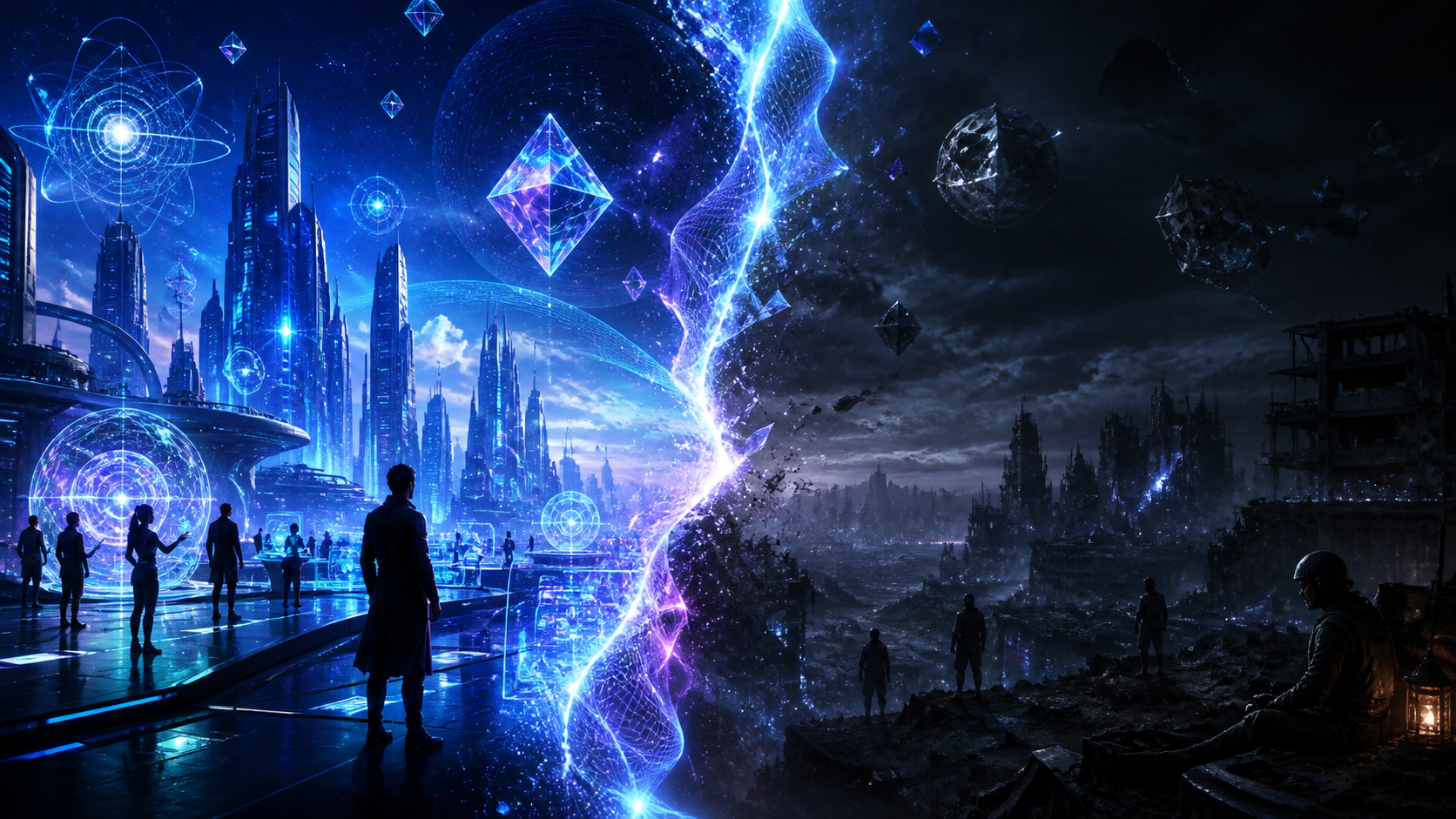
But beneath the headline breakthroughs, a more consequential story was unfolding—one that the technology press, fixated on qubit counts and processor benchmarks, was largely missing. The quantum revolution was not arriving uniformly. It was arriving as a wedge, splitting nations, institutions, and individuals into those who would govern the quantum era and those who would be governed by it. The second quantum revolution was producing, in real time, a quantum society—and that society was already stratified.
This analysis examines the structural forces shaping the quantum society of 2026: the geopolitical contest between the United States and China, the cryptographic emergency that is already underway, the workforce crisis that threatens to bottleneck the entire transition, and the emerging quantum divide that risks encoding a new form of global inequality into the infrastructure of the twenty-first century. It also examines what sovereign institutions—nations, organisations, and individuals committed to self-determination—must do to ensure they are not merely passengers in a revolution they did not choose.
The Industrialisation Threshold
To understand the quantum society, one must first understand what changed in 2026. For most of the previous decade, quantum computing existed in a peculiar liminal state: perpetually promising, perpetually not-quite-ready. The field was dominated by demonstrations of "quantum supremacy"—the ability to perform specific, often contrived calculations faster than classical machines—that had little bearing on real-world utility. Critics, not unreasonably, called it a solution in search of a problem.
That critique has now expired. The industry has crossed what researchers are calling the "industrialisation threshold": the point at which quantum systems begin delivering measurable value in commercially relevant domains. The shift is characterised not by raw qubit counts but by three converging developments: error correction maturity, hybrid classical-quantum architectures, and the emergence of Quantum-as-a-Service (QaaS) platforms.
Error correction has been the field's central technical challenge for decades. Quantum bits, or qubits, are extraordinarily fragile—susceptible to environmental noise, temperature fluctuations, and electromagnetic interference in ways that cause computational errors at rates that would be catastrophic in classical systems. Google's Willow processor demonstrated in late 2024 what the field had long sought: exponential error suppression, where adding more qubits actually reduces overall error rates rather than compounding them. By 2026, IBM's Nighthawk platform was targeting the execution of 7,500-gate circuits using modular multi-chip architectures, while Caltech researchers demonstrated a 6,100-qubit neutral atom array with a 13-second coherence time—an extraordinary achievement in a field where coherence windows are typically measured in microseconds.
The second development—hybrid architectures—has proven equally transformative. Rather than waiting for monolithic quantum computers capable of running entire workloads, the industry has converged on "mosaic" models in which quantum co-processors handle specific, computationally intensive sub-problems while classical systems manage the broader workflow. This approach has unlocked immediate practical value: companies are reporting 30–50% speedups in battery materials discovery cycles, 10–30% efficiency gains in logistics and supply chain optimisation, and measurable improvements in drug discovery timelines. The quantum computer does not need to replace the classical computer to be useful; it needs only to be better at the hardest parts.
The third development—QaaS—has democratised access to quantum hardware in ways that were not possible when the only path to quantum computation was building or buying a cryogenic system. Cloud-based quantum platforms from IBM, Google, Amazon, and a growing ecosystem of specialists now allow enterprises to experiment with quantum tools without capital expenditure on hardware. This has accelerated the diffusion of quantum literacy into industries—finance, logistics, pharmaceuticals, materials science—that would otherwise have waited another decade for the technology to mature.
"The quantum divide is not a future risk—it is a present structural condition. One in three researchers globally lacks access to quantum research facilities, and over 150 nations have no national quantum strategy."
Together, these three developments have produced a genuine inflection point. The question is no longer whether quantum computing will matter to society. It already does. The question is who will shape the quantum society that is now being built—and who will be shaped by it.
The Geopolitical Contest: Two Models, One Race
The most consequential dimension of the quantum society is geopolitical. Quantum technology has been explicitly identified as a "force multiplier" for national power in the 2026 US Annual Threat Assessment, alongside artificial intelligence and semiconductors. China has integrated quantum development into its 15th Five-Year Plan (2026–2030) as a top-tier "future industry." The race is real, the stakes are existential, and the two leading competitors have chosen fundamentally different models for winning it.
The United States has pursued a private-sector-led approach, leveraging its extraordinary ecosystem of universities, venture capital, and technology companies. Google, IBM, Microsoft, IonQ, Quantinuum, and a constellation of well-funded startups have driven the majority of US quantum progress. Federal coordination has come through the National Quantum Initiative Act, but the primary engine has been market competition and academic excellence. The US approach has produced remarkable innovation velocity—but it has also produced fragility. Supply chains for critical quantum inputs, including precision lasers, cryogenic systems, and specialised materials, are globally dispersed and vulnerable. Export controls designed to slow Chinese progress have had limited effect, instead catalysing China's development of domestic alternatives.
China has pursued a state-directed model of a different character entirely. Beijing's approach integrates massive, coordinated funding through institutions like the Hefei National Laboratory with state-owned enterprises such as China Telecom Quantum, academic powerhouses like the University of Science and Technology of China (USTC), and commercial firms operating under explicit national strategic direction. China's 15th Five-Year Plan treats quantum technology not as an industry to be nurtured but as infrastructure to be built—analogous to highways or power grids. The result is a system optimised for long-term, large-scale deployment rather than near-term commercial returns.
The quantum divide is not a future risk—it is a present structural condition. One in three researchers globally lacks access to quantum research facilities, and over 150 nations have no national quantum strategy.
The most immediate military application driving both nations is not computation but cryptography. The "harvest-now, decrypt-later" (HNDL) strategy—in which adversaries intercept and store encrypted communications today, intending to decrypt them once fault-tolerant quantum computers become available—has transformed quantum computing from a future threat into a present one. Intelligence agencies on both sides are assumed to be executing HNDL strategies at scale. Nuclear secrets, personnel records, diplomatic communications, and financial data encrypted today under RSA or elliptic curve cryptography may be readable within a decade. The 2026 US Annual Threat Assessment treats this not as a hypothetical but as an active intelligence reality.
Beyond cryptography, quantum sensing is emerging as a military capability of the first order. Quantum sensors can detect stealth vehicles by measuring gravitational anomalies, navigate in GPS-denied environments with extraordinary precision, and identify submarine movements through magnetic field variations. These capabilities directly challenge military advantages that the United States and its allies have held for decades. China's investment in quantum sensing is, by most assessments, at least as significant as its investment in quantum computing.
The geopolitical consequence of this contest is a bifurcating global quantum ecosystem. The "small yard, high fence" strategy of export controls and technology protectionism has largely collapsed bilateral cooperation on quantum research. What remains is a fragmented landscape in which nations must choose sides—or be left without meaningful quantum infrastructure of their own.
The Cryptographic Emergency
Of all the dimensions of the quantum society, the cryptographic emergency is the most urgent and the least understood by the institutions most exposed to it. The mathematics is straightforward: Shor's algorithm, running on a sufficiently powerful fault-tolerant quantum computer, can factor large integers and solve discrete logarithm problems in polynomial time. This breaks RSA, elliptic curve cryptography, and Diffie-Hellman key exchange—the three cryptographic primitives that underpin virtually all secure digital communication, from HTTPS to banking to government communications.
The National Institute of Standards and Technology (NIST) has responded with characteristic thoroughness. Following years of evaluation, NIST finalised its primary post-quantum cryptographic (PQC) standards in 2024: FIPS 203 (ML-KEM, formerly CRYSTALS-Kyber) for key encapsulation, FIPS 204 (ML-DSA, formerly CRYSTALS-Dilithium) for digital signatures, and FIPS 205 (SLH-DSA, formerly SPHINCS+) as a hash-based backup. A fourth standard, FIPS 206 (FN-DSA, based on FALCON), is in development. In March 2025, NIST selected HQC (Hamming Quasi-Cyclic) as a backup for ML-KEM, with a draft standard expected in early 2026 and final publication targeted for 2027.
NIST's message is unambiguous: these algorithms "can and should be put into use now." June 2026 executive orders established rigid timelines for US federal agencies to achieve quantum-safe cryptographic defence. Google and Cloudflare have accelerated their quantum-safe transition deadlines to 2029, citing AI-optimised algorithms that have shortened the projected timeline for cryptographically relevant quantum computers.
"Harvest-now, decrypt-later is not a theoretical threat. Adversaries are collecting encrypted data today, banking on the certainty that tomorrow's quantum machines will unlock it. Every day of delay is a day of compounding exposure."
The implementation reality, however, is sobering. Cryptography is not a discrete software module that can be swapped out with a patch. It is embedded in firmware, operating systems, network protocols (TLS, SSH, IPsec), hardware security modules, and legacy systems that were never designed to be updated. The migration to PQC is a fundamental architectural overhaul—and most organisations are behind schedule. Financial services, critical infrastructure operators, and government agencies report budget constraints, a shortage of specialised cryptographic talent, and the sheer complexity of inventorying all cryptographic dependencies as primary obstacles.
The World Economic Forum has identified a particularly acute risk for the global financial system: a two-tier outcome in which large institutions and wealthy nations complete the PQC migration while smaller institutions and developing economies do not. If this scenario materialises, the quantum-safe and quantum-vulnerable segments of the global economy will be unable to interoperate securely—effectively excluding the unprepared from global trade, insurance, and banking networks. This is not a distant possibility. It is the trajectory of the current transition, absent deliberate intervention.
The Workforce Crisis: A Bottleneck at the Foundation
The quantum society requires quantum practitioners—and the pipeline is critically undersupplied. The global pure-play quantum workforce reached approximately 16,500 professionals in 2025, a figure that sounds substantial until measured against projected demand. Industry analyses project a shortage of over 10,000 skilled quantum roles by 2026–27, with roughly one in three quantum job openings currently unfilled. The talent crisis is not primarily a shortage of PhD physicists, though that shortage is real. It is a shortage of the hybrid practitioners who can translate quantum capabilities into operational value.
The quantum workforce gap has a distinctive character. The field requires professionals who understand both quantum mechanics and classical computing architectures, who can integrate quantum co-processors into existing HPC workflows, and who can communicate quantum capabilities to business decision-makers. These "quantum multipliers"—engineers, systems integrators, research software engineers, and business analysts with quantum literacy—are the bottleneck. Universities have been slow to develop curricula that produce them, having historically treated quantum computing as a subdiscipline of physics rather than an engineering and business discipline.
The response is beginning to take shape. The National Q-12 Education Partnership and Berkeley Lab's QCaMP programme are introducing quantum concepts at the high school level. Community colleges and minority-serving institutions are developing 9–12 month technician tracks focused on optics, RF/control systems, and cryogenic safety. The World Economic Forum's Quantum Economy Network is working to establish vendor-neutral, portable micro-credentials that allow faster, job-aligned skill acquisition. QuEra Computing has published a detailed framework for "application-first" curricula that emphasise linear algebra, probability, and optimisation with real quantum backends rather than purely theoretical physics.
But the pace of these initiatives is insufficient relative to the pace of quantum industrialisation. The US Department of Commerce's $2 billion allocation under the CHIPS and Science Act for quantum infrastructure, announced in May 2026, includes workforce development components—but the structural lag between educational investment and workforce readiness is measured in years, not months. The quantum society will be built by whoever has the practitioners to build it. Nations and organisations that treat workforce development as a secondary concern will find themselves dependent on those that did not.
Harvest-now, decrypt-later is not a theoretical threat. Adversaries are collecting encrypted data today, banking on the certainty that tomorrow's quantum machines will unlock it. Every day of delay is a day of compounding exposure.
The Quantum Divide: A New Axis of Global Inequality
UNESCO's 2026 Global Quantum Initiative report delivered a finding that deserves far more attention than it has received: one in three researchers worldwide lacks access to essential quantum research facilities. More than 150 countries have no national quantum strategy. The $65.9 billion in global quantum investment is concentrated in a small number of advanced economies—primarily the United States, China, Germany, France, Japan, and the United Kingdom. Europe and North America host significantly more quantum science activity than the rest of the world combined.
This is the quantum divide—and it is not merely a gap in scientific capacity. It is a structural condition that will determine which societies can participate in the quantum economy and which will be subject to it. Researchers have identified four distinct dimensions of the divide: scientific (access to research infrastructure and talent), technological (access to quantum hardware and software), national (the presence or absence of state-level quantum strategy and investment), and societal (the distribution of quantum benefits and risks within populations).
The consequences of the divide compound across dimensions. Nations without quantum research infrastructure cannot develop the workforce to operate quantum systems. Nations without quantum workforce cannot attract quantum investment. Nations without quantum investment cannot develop quantum-safe cryptographic infrastructure. Nations without quantum-safe infrastructure are vulnerable to the HNDL strategies of those that have it. The cascade is not hypothetical—it is the logical structure of the current trajectory.
France's PROQCIMA programme, targeting universal quantum prototypes by 2030, represents the kind of state-level commitment that can interrupt this cascade. The EPB/IonQ quantum computing and networking hub in Chattanooga, Tennessee—the first commercially available quantum networking facility in the United States—represents the kind of infrastructure investment that creates local quantum ecosystems. UNESCO's Remote Access to Lab Equipment programme, which allows researchers from the Global South to access IBM Quantum System One hardware remotely, represents the kind of access initiative that can begin to address the scientific divide.
But these initiatives, while significant, are insufficient in scale relative to the problem. The quantum divide is widening faster than the interventions designed to address it. Without a deliberate, coordinated global effort to treat quantum security as a public good—with open standards, shared tooling, and meaningful technology transfer—the quantum society will replicate and amplify the inequalities of the digital society that preceded it.
"Quantum sovereignty is not about owning a quantum computer. It is about ensuring that the decisions made by quantum systems—about your economy, your security, your data—are made in your interest, not someone else's."
The Quantum Internet: Infrastructure for a Sovereign Future
Beyond computation and cryptography, a third dimension of the quantum society is taking shape: the quantum internet. Unlike the classical internet, which transmits information encoded in bits, the quantum internet transmits quantum states—enabling capabilities that are physically impossible on classical networks, including unconditionally secure communication, distributed quantum computation, and quantum-enhanced sensing networks.
Progress in 2026 has been substantial. Researchers have demonstrated entanglement between quantum memories over 420 kilometres of optical fibre. Boeing's Q4S mission has successfully demonstrated entanglement swapping on compact, space-qualified hardware, with a full mission launch slated for 2027. MIT's photon-shuttling technology and Oxford Ionics' gate teleportation are being integrated into modular interconnects that enable multi-node processor networks. The EPB/IonQ hub in Chattanooga represents the first commercially available quantum networking facility, offering a glimpse of what quantum network infrastructure will look like at scale.
The quantum internet is not a replacement for the classical internet—it is a complement, providing capabilities that classical networks cannot. Its most immediate application is quantum key distribution (QKD), which uses the laws of quantum mechanics to guarantee that any eavesdropping on a communication channel is detectable. QKD does not depend on the computational hardness of mathematical problems; it depends on the laws of physics. This makes it unconditionally secure against quantum computers—a property that no classical cryptographic system can claim.
China has invested heavily in quantum networking infrastructure, deploying a 2,000-kilometre quantum communication backbone between Beijing and Shanghai and launching the Micius satellite for space-based QKD. The United States has been slower to build national quantum networking infrastructure, though the CHIPS and Science Act funding and the Chattanooga hub represent meaningful steps. The quantum internet, like the classical internet before it, will be shaped by whoever builds its foundational infrastructure—and the nations that build it will have structural advantages in the quantum society that follows.
What Sovereign Institutions Must Do
The quantum society is not a future state to be prepared for. It is a present condition to be navigated. The decisions made by governments, organisations, and individuals in the next three to five years will determine whether the quantum revolution produces a more sovereign, more equitable world or a more concentrated, more fragile one. Several imperatives follow from the analysis above.
Cryptographic Migration Is Not Optional
Quantum sovereignty is not about owning a quantum computer. It is about ensuring that the decisions made by quantum systems—about your economy, your security, your data—are made in your interest, not someone else's.
Every organisation that handles sensitive data with a lifespan of more than five years is already exposed to the HNDL threat. The migration to NIST-standardised post-quantum cryptography is not a future project—it is an active emergency. The first step is a cryptographic inventory: a systematic identification of every system, protocol, and data store that relies on quantum-vulnerable cryptography. The second step is a prioritised migration plan, beginning with the most sensitive and longest-lived data. The third step is implementation, using NIST's NCCoE migration guidance and the FIPS 203, 204, and 205 standards as the technical foundation.
Quantum Literacy Is a Strategic Asset
Organisations that treat quantum computing as a specialist concern—relevant only to physicists and cryptographers—will be unprepared for the quantum society. Quantum literacy, defined as the ability to understand where quantum capabilities fit within existing computational and business architectures, is becoming a strategic asset across industries. The organisations that invest in quantum literacy programmes now—training existing HPC staff, hiring quantum-aware business analysts, and developing internal quantum use-case pipelines—will have a structural advantage over those that wait for the technology to mature further.
Quantum Sovereignty Requires Active Investment
Nations and organisations that wish to be sovereign in the quantum era cannot be passive consumers of quantum technology developed elsewhere. Quantum sovereignty requires active investment in research infrastructure, workforce development, and quantum-safe cryptographic migration. It requires participation in international standards bodies to ensure that quantum protocols reflect a diversity of interests rather than the preferences of the most powerful actors. And it requires a clear-eyed assessment of quantum dependencies—the ways in which critical systems rely on quantum-vulnerable infrastructure or quantum capabilities controlled by external actors.
The Quantum Divide Demands Collective Action
The quantum divide is not a problem that market forces will solve. The concentration of quantum investment in a small number of advanced economies reflects the same dynamics that produced the digital divide—and the digital divide has not been resolved by market forces alone. Addressing the quantum divide requires treating quantum security as a global public good: open standards, shared tooling, meaningful technology transfer, and international cooperation on quantum workforce development. The UNESCO Global Quantum Initiative and the World Economic Forum's Quantum Governance Principles provide frameworks for this cooperation. What is needed is the political will to fund and implement them at scale.
The Sovereign Intelligence Perspective
The quantum society is, at its core, a sovereignty question. The societies that will thrive in the quantum era are not necessarily those with the most qubits or the largest quantum budgets. They are those that have thought most clearly about what quantum sovereignty means—and have built the institutions, the infrastructure, and the human capital to achieve it.
Quantum sovereignty is not about owning a quantum computer. It is about ensuring that the decisions made by quantum systems—about your economy, your security, your data—are made in your interest, not someone else's. It is about having the cryptographic infrastructure to protect your communications from adversaries who are already harvesting them. It is about having the workforce to operate, maintain, and innovate on quantum systems rather than depending on external providers. It is about having a seat at the table where quantum standards are set, rather than inheriting standards set by others.
The quantum divide is the most important sovereignty challenge of the next decade. The nations and organisations that recognise this now—and act accordingly—will be the ones that shape the quantum society rather than being shaped by it. The window for that choice is open. It will not remain open indefinitely.
Conclusion: The Wedge and the Choice
The second quantum revolution is real, it is accelerating, and it is already producing winners and losers. The hardware breakthroughs of 2025 and 2026—error-corrected logical qubits, hybrid classical-quantum architectures, the first verified instances of quantum advantage—have crossed the industrialisation threshold. The cryptographic emergency is not a future scenario; it is a present condition, with adversaries actively harvesting encrypted data for future decryption. The workforce crisis is a structural bottleneck that will constrain the quantum transition for years. And the quantum divide is widening, encoding a new axis of global inequality into the infrastructure of the twenty-first century.
The quantum society is being built now. Its architecture—who has access, who sets the standards, who controls the infrastructure, who can protect their data—is being determined by decisions made today. Those decisions are not inevitable. They are choices. The question is whether the institutions, nations, and individuals who care about sovereignty, equity, and self-determination will make those choices deliberately—or discover, too late, that the choices were made for them.
The quantum revolution is not arriving uniformly. It is arriving as a wedge. The only question is which side of it you will be on.