The Quantum Divide: How the Second Quantum Revolution Is Reshaping Society's Power Structures
In August 2024, the U.S. National Institute of Standards and Technology published three Federal Information Processing Standards for post-quantum cryptography — FIPS 203, 204, and 205 — marking the formal beginning of a global cryptographic migration that will take at least a decade to complete. The announcement was technical in its language and bureaucratic in its delivery. But its implications were civilisational: every government, every financial institution, every hospital, every critical infrastructure operator on Earth now faces a structural deadline. Migrate to quantum-resistant encryption, or risk having your most sensitive data decrypted by adversaries who have been patiently harvesting it for years.
This is the paradox at the heart of the second quantum revolution. The technology that promises to cure diseases, optimise supply chains, and unlock new materials science is simultaneously the technology that threatens to render the entire cryptographic architecture of the modern internet obsolete. And the societies best positioned to capture the benefits are, by no coincidence, the same societies best positioned to weaponise the risks.
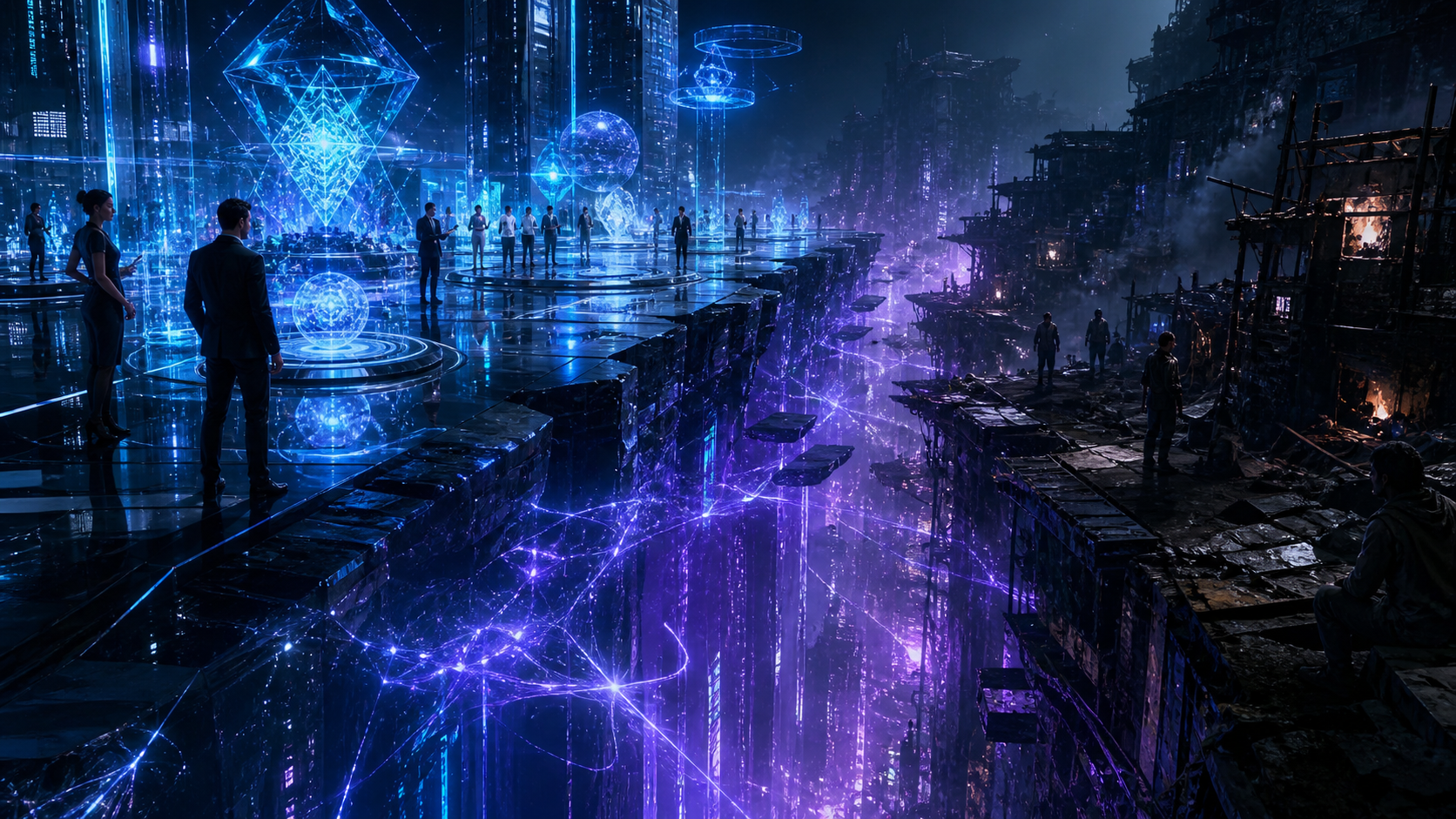
The quantum divide — the growing chasm between quantum-ready and quantum-vulnerable societies — is not a future risk to be managed. It is a present-day structural inequality being encoded into the foundations of the next technological era. Understanding its contours, its drivers, and its governance implications is not optional for any serious analysis of where power is flowing in the 2030s.
"The quantum divide is not a future risk to be managed. It is a present-day structural inequality being encoded into the foundations of the next technological era."
From Laboratory to Infrastructure: The 2026 Inflection Point
The McKinsey Quantum Technology Monitor 2026 describes the current moment as a "commercial tipping point" — a transition from exploratory research to early industrial deployment. This framing, while accurate in its technical register, understates the structural significance of what is occurring. Quantum computing is not merely becoming commercially viable; it is becoming strategic infrastructure, in the same category as electricity grids, satellite networks, and financial clearing systems.
The hardware milestones of the past eighteen months have been genuinely remarkable. Google's Willow processor demonstrated exponential speedup on specific molecular structure calculations — tasks estimated to take classical supercomputers septillions of years, completed in minutes. IBM's Nighthawk processor has achieved significant milestones in gate complexity and accuracy. Atom Computing's neutral-atom system has reached 1,225 qubits. Peer-reviewed research in quantum error correction more than tripled between 2024 and 2025, according to data compiled by the Quantum Insider.
But the more consequential development is not in the hardware. It is in the architecture of access. The "Quantum-as-a-Service" model — pioneered by IBM, Google, AWS, and Microsoft — has created a cloud-based quantum computing market that allows enterprises to experiment with quantum tools without owning hardware. This democratisation of access is real, but it is also deeply asymmetric. Access to quantum cloud services requires stable high-bandwidth internet infrastructure, quantum-literate technical teams, and the financial capacity to pay for compute time. These prerequisites are not uniformly distributed across the globe.
Global investment in quantum initiatives now exceeds $65.9 billion, according to QURECA's Quantum Initiatives Worldwide tracker. The United States, China, and the European Union account for the overwhelming majority of this investment. The U.S. National Quantum Initiative, Germany's quantum action plan, and China's state-directed quantum programmes represent not merely research investments but strategic bets on technological sovereignty. The countries making these bets are not doing so out of scientific curiosity. They are doing so because they understand that quantum capability will be a decisive determinant of national power in the decades ahead.
The Harvest-Now, Decrypt-Later Threat: A Present-Day Emergency
The most immediate societal impact of quantum computing is not the technology itself — it is the shadow it casts over existing cryptographic infrastructure. The "harvest now, decrypt later" (HNDL) attack model has moved from theoretical concern to operational reality. Nation-state adversaries are intercepting and storing encrypted communications, financial records, diplomatic cables, and intellectual property today, with the explicit intention of decrypting them once cryptographically relevant quantum computers (CRQCs) reach sufficient scale.
The timeline for CRQCs remains contested. Estimates range from ten to twenty years for a quantum computer capable of breaking RSA-2048 encryption. But the HNDL model renders this timeline largely irrelevant for data with long-term sensitivity. A diplomatic communication encrypted today and harvested today will still be sensitive in 2035. A medical record encrypted today and harvested today will still be private in 2040. The threat is not future-dated — it is present-dated.
NIST's response — the finalisation of FIPS 203 (ML-KEM, derived from CRYSTALS-Kyber), FIPS 204 (ML-DSA, derived from CRYSTALS-Dilithium), and FIPS 205 (SLH-DSA, derived from SPHINCS+) — provides the technical foundation for migration. NIST IR 8547 outlines a transition timeline that targets the deprecation of quantum-vulnerable algorithms from NIST standards by 2035, with high-risk systems expected to migrate significantly sooner. In March 2025, NIST selected HQC (Hamming Quasi-Cyclic) as a fifth algorithm for post-quantum encryption, providing an alternative mathematical foundation to the lattice-based ML-KEM.
The quantum divide is not a future risk to be managed. It is a present-day structural inequality being encoded into the foundations of the next technological era.
The G7 Cyber Expert Group released a roadmap in January 2026 for transitioning critical financial infrastructure to post-quantum cryptography. The Bank of France and the Bank for International Settlements have already conducted successful pilot tests for quantum-secure payment systems. These are encouraging signals. But they are signals from the most well-resourced institutions in the most well-resourced economies. The question of who is not migrating — and why — is the more important question for understanding the quantum divide.
The Governance Gap: Who Is Writing the Rules?
The World Economic Forum's Quantum Computing Ethics initiative has identified a fundamental governance gap: while ethical concerns about quantum technology are beginning to emerge in policy discourse, there are currently no binding global guidelines for the technology's development or deployment. The WEF's Quantum Computing Governance Principles, published in collaboration with industry and academic stakeholders, represent a foundational attempt to fill this gap — but they remain voluntary, non-binding, and largely oriented toward the concerns of advanced economies.
The OECD's 2026 overview of national strategies and policies for quantum technologies maps a landscape of significant investment but fragmented governance. National strategies often prioritise economic competitiveness and technological leadership over the mitigation of broader societal implications. The OECD notes that many national quantum strategies lack specific performance metrics and integrated interagency implementation plans — a finding echoed by the U.S. Government Accountability Office in its 2026 assessment of the National Quantum Initiative.
The governance architecture that is emerging is, in structural terms, a replication of the governance architecture that emerged around the internet in the 1990s: dominated by a small number of technologically advanced nations, shaped primarily by the interests of large private sector actors, and largely inattentive to the distributional consequences for the rest of the world. The parallels are not reassuring.
"The governance architecture emerging around quantum technology is, in structural terms, a replication of the governance architecture that emerged around the internet in the 1990s — dominated by a small number of technologically advanced nations and largely inattentive to distributional consequences."
Some scholars and legal experts, including Mauritz Kop, have proposed the establishment of an international agency modelled after the International Atomic Energy Agency (IAEA) to govern quantum-AI technologies, deter a potential arms race, and oversee non-proliferation. The analogy is instructive. The IAEA was created because the international community recognised that nuclear technology was too consequential — and too dangerous — to be governed by national interest alone. The case for a similar institution for quantum technology is, if anything, stronger: quantum capabilities are more diffuse, more dual-use, and more deeply integrated into civilian infrastructure than nuclear technology ever was.
The concept of a "quantum governance stack" — a hierarchy of interdependent regulatory layers ranging from international treaties and national laws to private sector standards and institutional practices — offers a more realistic near-term framework. But building such a stack requires political will that is currently absent from the international system. The geopolitical competition between the United States and China over quantum supremacy, documented in detail by the U.S.-China Economic and Security Review Commission, makes multilateral governance significantly harder to achieve.
The Quantum Divide: Structural Dimensions
UNESCO's 2026 analysis of global quantum research access contains a striking finding: one in three quantum researchers globally lacks access to the quantum facilities necessary to conduct meaningful research. This is not a marginal inefficiency — it is a structural exclusion that is shaping the composition of the quantum workforce and, by extension, the values and priorities embedded in quantum systems.
The quantum divide operates across multiple structural dimensions simultaneously.
Infrastructure and Capital
Global quantum investment of $65.9 billion is heavily concentrated in the Global North. The infrastructure requirements for quantum computing — cryogenic cooling systems, specialised shielding, exotic materials, and precision fabrication equipment — create capital barriers that are prohibitive for most developing nations. The supply chain for quantum hardware is itself concentrated in a small number of countries, creating dependencies that mirror the semiconductor supply chain vulnerabilities exposed during the COVID-19 pandemic.
The Quantum-as-a-Service model partially addresses this barrier by enabling cloud-based access. But cloud access requires stable high-bandwidth internet infrastructure — itself unevenly distributed — and the technical capacity to use quantum tools effectively. UNESCO's Global Quantum Initiative has proposed a "Remote Access to Lab Equipment Initiative" that would allow researchers in the Global South to access quantum computers via the cloud, but implementation remains nascent.
Geopolitical Silos and Export Controls
The governance architecture emerging around quantum technology is, in structural terms, a replication of the governance architecture that emerged around the internet in the 1990s — dominated by a small number of technologically advanced nations and largely inattentive to distributional consequences.
National security concerns have led to restrictive export controls on quantum hardware and software, particularly by the United States, the European Union, and China. These controls, while intended to maintain strategic advantage, have the effect of excluding researchers and institutions in the Global South from the quantum ecosystem. The Just Security analysis of the quantum divide notes that export control regimes designed to contain adversaries often inadvertently contain allies and partners as well.
The result is a fragmentation of the global quantum research community into geopolitical silos — a dynamic that is antithetical to the open, collaborative model of scientific progress that produced the first quantum revolution. The Open Quantum Institute, a partnership between academic institutions and industry, is attempting to provide inclusive access to quantum simulators and computers, but its reach is limited relative to the scale of the exclusion.
The Talent Gap and Brain Drain
There is a severe global shortage of quantum-skilled professionals. The USDSI's 2026 analysis of quantum computing developments identifies workforce scarcity as one of the primary bottlenecks to quantum industrialisation. Because top-tier quantum research universities are concentrated in G7 nations and a small number of other wealthy countries, there is a significant brain drain as talent migrates from the Global South to the North.
The gender dimension of this talent gap is particularly acute. As of 2026, women make up only approximately 16% of senior quantum researchers and 12% of leadership positions, despite representing 42% of early-career participants, according to WEF data. The quantum economy risks encoding these gender biases into its foundations — a pattern that has been observed in every previous wave of technological transformation and that has proven extremely difficult to reverse once established.
Cryptographic Vulnerability as Sovereignty Risk
For developing nations that have invested heavily in digital infrastructure over the past decade — mobile banking systems, digital identity platforms, e-government services — the quantum cryptography threat represents a sovereignty risk of the first order. The Equitech Futures analysis of international development and the quantum computing transition describes this as a "Y2K-type" risk, compounded by the HNDL attack model.
Countries without domestic quantum strategies or the resources to implement post-quantum cryptography migration face the prospect of having their digital infrastructure rendered vulnerable by a technology they did not develop, cannot access, and cannot govern. This is not a hypothetical future scenario — it is a structural condition that is being created now, as adversaries harvest encrypted data from digital systems that will not be migrated to quantum-resistant standards for years or decades.
The Sovereign Intelligence Perspective: What Independent Analysis Reveals
The framing that dominates mainstream quantum discourse — quantum computing as a race to be won, a market to be captured, a threat to be managed — is inadequate to the civilisational significance of what is occurring. The second quantum revolution is not primarily a technological event. It is a political event: a redistribution of power, capability, and vulnerability that will shape the structure of international relations for generations.
The Sovereign Stack framework — the principle that nations and individuals require genuine sovereignty over their computational infrastructure, not merely access to infrastructure owned and governed by others — is directly implicated by the quantum transition. A nation that migrates its critical systems to post-quantum cryptography using algorithms standardised by NIST, implemented on hardware manufactured in the United States, and governed by frameworks developed in Washington and Brussels, has not achieved quantum sovereignty. It has achieved quantum dependency with better encryption.
True quantum sovereignty requires indigenous capacity: the ability to develop, manufacture, deploy, and govern quantum systems without structural dependence on external actors whose interests may diverge. This is a high bar — one that only a handful of nations are currently positioned to meet. But it is the correct bar. The alternative — a world in which quantum capability is concentrated in two or three nation-states and a small number of private corporations — is a world in which the quantum revolution amplifies existing power asymmetries rather than disrupting them.
The H-T-A Protocol framework — the architecture of Human-Twin-Agent trust that underpins sovereign AI governance — is equally relevant to quantum governance. The question of who controls the quantum systems that will increasingly mediate economic transactions, security decisions, and scientific discovery is not a technical question. It is a question of sovereignty, accountability, and the distribution of power. Governance frameworks that treat these as secondary considerations — as implementation details to be addressed after the technology matures — are not governance frameworks. They are abdications.
Pathways Forward: What Equitable Quantum Governance Requires
True quantum sovereignty requires indigenous capacity — the ability to develop, manufacture, deploy, and govern quantum systems without structural dependence on external actors whose interests may diverge.
The governance gap identified by the WEF, OECD, and UNESCO is real, but it is not inevitable. The window for establishing equitable quantum governance frameworks is open — but it is closing. The following structural interventions are necessary conditions for a quantum transition that does not simply replicate and amplify existing global inequalities.
Mandatory Post-Quantum Cryptography Migration Timelines
NIST's guidance to begin migrating to FIPS 203, 204, and 205 immediately is correct but insufficient. What is required is a coordinated international framework — potentially through the ITU or a dedicated quantum governance body — that establishes mandatory migration timelines for critical infrastructure globally, with technical assistance and financing mechanisms for developing nations. The G7 roadmap for financial infrastructure is a useful template, but its scope must be expanded dramatically.
Open Access to Quantum Research Infrastructure
UNESCO's Remote Access to Lab Equipment Initiative and the Open Quantum Institute's inclusive access programmes represent the right direction, but at insufficient scale. A genuine commitment to equitable quantum access requires that the major quantum cloud providers — IBM, Google, AWS, Microsoft — make meaningful allocations of compute time available to researchers in developing nations, with appropriate technical support. This is not charity; it is the minimum condition for a global quantum research community that reflects the full diversity of human intelligence.
Inclusive Governance Architecture
The quantum governance frameworks being developed by the WEF, OECD, and national governments must include meaningful representation from the Global South. Governance frameworks developed exclusively by the nations that dominate quantum investment will, predictably, reflect the interests of those nations. The IAEA model — imperfect as it is — demonstrates that inclusive international governance of transformative technology is possible. The political will to build it must be generated now, before the technology matures and the power asymmetries it creates become entrenched.
Quantum Workforce Development as a Global Priority
The talent gap in quantum computing is a governance problem, not merely a market problem. Addressing it requires coordinated investment in quantum education and training in developing nations, active measures to address the gender gap in quantum research, and international frameworks that facilitate the movement of quantum talent without creating permanent brain drain. The 2026 expansion of quantum curricula at universities in G7 nations is welcome; the absence of equivalent expansion in the Global South is a structural failure that will compound over time.
"True quantum sovereignty requires indigenous capacity — the ability to develop, manufacture, deploy, and govern quantum systems without structural dependence on external actors whose interests may diverge. This is the correct bar, even if it is a high one."
Conclusion: The Civilisational Stakes
The second quantum revolution is arriving on a timeline that is faster than most governance institutions are capable of responding to. The McKinsey projection of up to $2 trillion in economic value from quantum technologies by 2035 is plausible — but it is a projection of aggregate value, not of distributed value. The distribution of quantum benefits and quantum risks will be determined not by the technology itself, but by the governance choices made in the next five years.
The quantum divide — the chasm between quantum-ready and quantum-vulnerable societies — is the defining geopolitical fault line of the 2030s. It is being created now, through investment decisions, export control regimes, governance frameworks, and workforce development choices that are being made without adequate attention to their distributional consequences. The societies that understand this — and act accordingly — will be better positioned to navigate the quantum transition on their own terms.
The alternative is a quantum future that looks, in its essential power structure, like the digital present: a world in which transformative technology amplifies the advantages of those who already have advantages, and deepens the vulnerabilities of those who are already vulnerable. That outcome is not inevitable. But avoiding it requires treating quantum governance as the civilisational priority it is — not as a technical afterthought to be addressed once the technology matures.
The window is open. The question is whether the political will exists to use it.