The unglamorous bottleneck
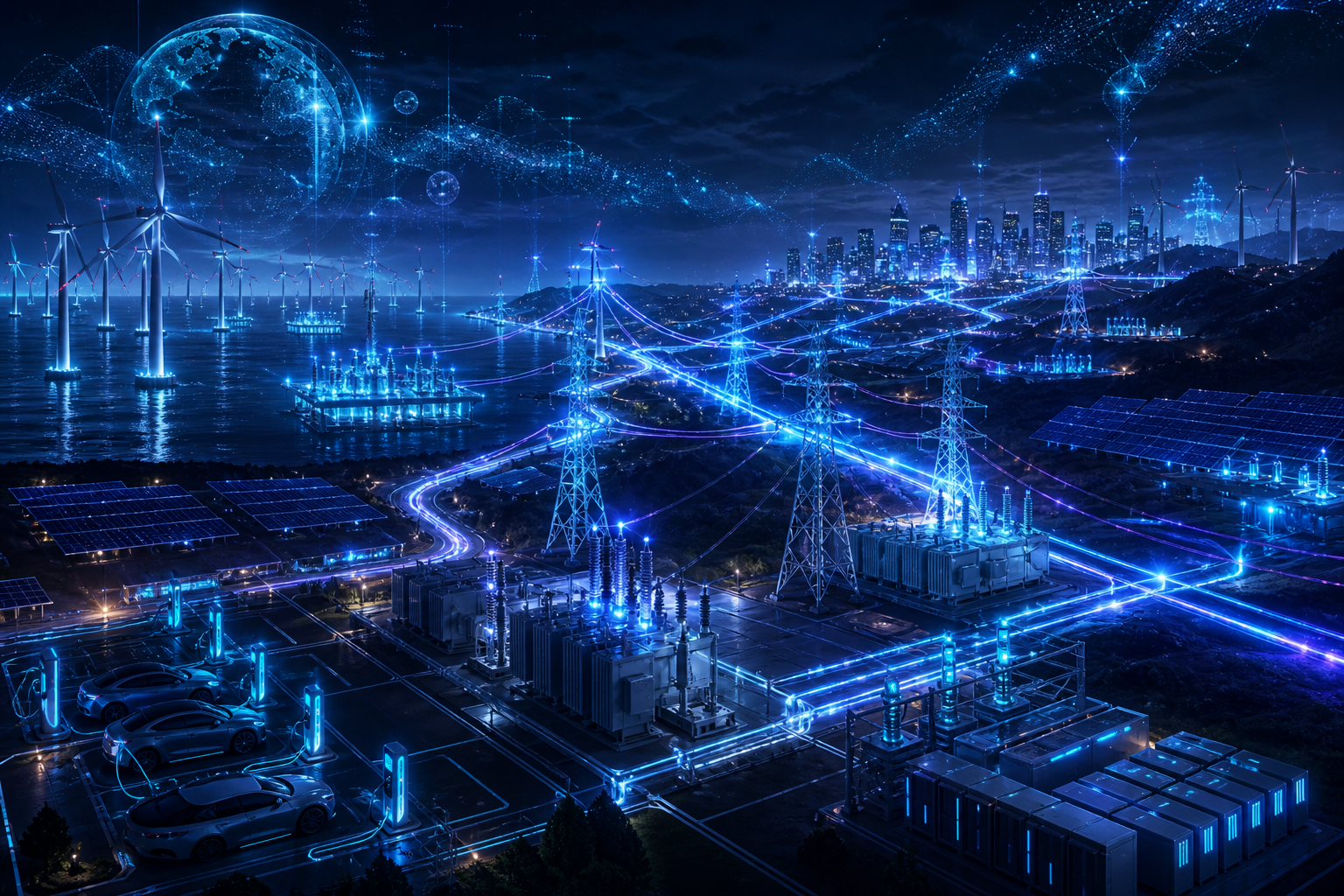
Energy debates still gravitate towards generation: how many wind farms, how much solar, whether nuclear can recover its role, and how quickly fossil fuels can be retired. Yet the decisive constraint increasingly lies elsewhere. The modern power system depends on networks that were mostly designed for a different century: one in which electricity flowed predictably from large power stations to passive consumers, demand changed gradually, and resilience could be planned around familiar weather patterns.
That world is fading. Electrification of transport, heating and industry is pushing demand into new places and new hours. Variable renewable generation is changing the geography and timing of supply. Climate change is making heatwaves, droughts, wildfires and storms more damaging to infrastructure. At the same time, public consent for new lines, substations and other assets is harder to secure, even where support for decarbonisation remains high in principle.
The real energy transition is not just a race to build cleaner generation; it is a struggle to make electricity systems flexible, legible and governable under stress.
In this context, the grid is no longer a background technology. It is the arena in which competing priorities are forced into practical choices. Decarbonisation, affordability, security and industrial policy all meet in cables, transformers, software and planning decisions. If those systems cannot adapt quickly, the transition slows regardless of how ambitious national targets may be.
Why the old planning model is breaking down
For decades, electricity planners could rely on relatively stable patterns. Demand forecasts rose steadily with economic growth, then moderated with efficiency gains. Large generators could be scheduled with a high degree of confidence. Reserve margins and reliability standards were constructed around statistically tractable assumptions. The architecture of the system reflected those expectations.
Today, both supply and demand are becoming less predictable in ways that interact. On the supply side, wind and solar output vary with the weather and can arrive far from demand centres, requiring more transmission and more balancing. On the demand side, electric vehicles, heat pumps, electrolysers and data-intensive industries can create sharp local spikes if unmanaged. Even where annual electricity consumption is easy enough to estimate, peak loads, congestion points and seasonal imbalances are far harder to predict.
The International Energy Agency has argued that grids are now a critical enabler of the transition, noting that the world has installed renewable generation more quickly than it has expanded and modernised networks. This matters because infrastructure sequencing is unforgiving. If generation arrives before the network can accommodate it, curtailment rises and investment returns deteriorate. If electrified demand grows faster than local distribution systems can cope, consumers experience delays, connection backlogs or higher costs. The result is a system that can look dynamic in aggregate statistics while remaining brittle on the ground.
Queues are policy made visible
Nothing illustrates the mismatch more clearly than the lengthening queues for grid connection. In many advanced economies, projects seeking to connect to the system face waits measured in years rather than months. The issue is not merely administrative friction, though that is substantial. It is a sign that power systems are now being asked to process far more change than their institutions were designed to handle.
Connection queues are often treated as an engineering inconvenience. In reality, they are a form of policy revelation. They show where planning assumptions have diverged from investment behaviour, where regulatory incentives have not kept pace with decarbonisation goals, and where institutional fragmentation prevents timely decisions. They also expose a subtler problem: the difference between a system built to minimise near-term costs and one built to support strategic adaptation.
The traditional regulatory instinct has often been to avoid overbuilding networks, on the sensible grounds that consumers should not bear the cost of assets that may prove unnecessary. But under conditions of structural change, excessive caution can itself become expensive. A grid that is always expanded only after congestion becomes undeniable may lock in delays, higher balancing costs and weaker competition among generators. Prudence in one decade can become scarcity in the next.
The real energy transition is not just a race to build cleaner generation; it is a struggle to make electricity systems flexible, legible and governable under stress.
Connection queues are not a technical side-show. They are the place where abstract ambitions collide with the physical and institutional limits of the system.
Flexibility is becoming the system's organising principle
If the old grid was built around controllable generation, the emerging one must be built around flexibility. That term is often used loosely, but its meaning is concrete. A flexible power system can shift demand, store energy, re-route power, call on dispatchable resources quickly, and use digital tools to coordinate millions of distributed assets without undermining reliability.
This requires a broader planning imagination than many energy systems have yet displayed. Storage is part of the answer, but not the whole of it. Interconnection across regions can smooth variability. Demand response can reduce peak strain. Better market design can reward resources that provide balancing and congestion relief rather than simply kilowatt-hours. Distribution networks, long treated as a lower-profile layer of the system, increasingly need intelligence and visibility comparable to transmission systems.
There is also a political economy dimension. Flexibility tends to be less visible than a power station or a transmission line. It emerges from software, tariffs, aggregation, automation and institutional coordination. That can make it harder to finance, regulate and communicate. Yet the less glamorous the solution, the more important it may be. The future grid will not be stabilised by hardware alone.
Climate risk is now a grid issue, not an externality
Electricity infrastructure is also confronting a harsher physical environment. Heat reduces the efficiency of thermal generation and transmission lines. Drought can restrict hydropower output and cooling water availability. Wildfires threaten transmission corridors. Stronger storms and flooding can damage substations and poles, producing outages that reverberate through digitally dependent economies.
In the past, climate adaptation and electricity planning were often handled in parallel. That separation is no longer tenable. Reliability standards based on historical weather records may understate future risks. Asset lifetimes for network infrastructure stretch over decades; choices made now will determine whether systems remain robust in a more volatile climate. The cost of hardening the grid is significant, but the cost of repeated disruption is larger and more socially regressive.
Resilience should therefore be understood not merely as redundancy, but as the capacity to anticipate, absorb and recover from shocks. That includes physical reinforcement, better forecasting, mutual aid arrangements, cyber-security, emergency demand reduction and, where sensible, more decentralised capabilities. Yet resilience policies must avoid becoming an excuse for fragmentation. A system composed of local backup solutions without wider coordination may feel secure while actually becoming less efficient and less equitable.
The politics of infrastructure has turned local
One of the less appreciated shifts in energy policy is that public approval of decarbonisation does not automatically translate into consent for grid expansion. Transmission lines, substations and other network assets create concentrated local impacts in service of diffuse national benefits. That asymmetry has always existed, but it is now sharper because the pace of build-out has accelerated while trust in institutions has weakened in many democracies.
This is not simply a story of obstruction. Communities often object because planning processes are opaque, compensation is limited, environmental trade-offs are handled inconsistently, and alternatives are poorly explained. Governments and regulators have tended to present networks as neutral technical necessities. In practice they are distributive choices. They shape land use, industrial development and regional opportunity.
A more durable politics of grid expansion will require earlier consultation, clearer benefit-sharing and more credible strategic planning. It may also require policymakers to be honest that not every conflict can be resolved through procedural refinement. Some infrastructure is of national importance and will need firm decisions. But decisions imposed without legitimacy can slow implementation as much as indecision does.
Connection queues are not a technical side-show. They are the place where abstract ambitions collide with the physical and institutional limits of the system.
A fast grid build-out without public legitimacy is unlikely to stay fast for long.
The distribution grid is where electrification becomes real
Much attention falls on high-voltage transmission, and rightly so. But many of the transition's most immediate constraints sit lower down the system. Households adopting heat pumps, firms electrifying processes and fleets charging vehicles all depend on local distribution networks. These networks were not built for every driveway, depot and industrial estate to become a significant electricity node.
The challenge is not merely one of capacity. Distribution systems need more granular data, more active management and better integration with retail pricing and flexibility markets. Otherwise, expensive reinforcement may be pursued where smarter operation could defer some costs. Conversely, faith in digital optimisation should not become an excuse to neglect physical upgrades that will clearly be needed.
The distribution grid is also where equity concerns become tangible. Better-off households are often first to adopt rooftop solar, home batteries, electric vehicles and smart appliances, enabling them to benefit from flexibility schemes. Renters, low-income households and small firms may face rising system costs without access to the same savings. If electrification is to remain politically durable, the design of tariffs, incentives and network charges must reflect these distributional realities.
Industrial policy now runs through the wire
Electricity networks have become an industrial policy instrument, whether governments fully acknowledge it or not. Decisions about where to reinforce the grid, how quickly to connect loads, and which projects receive priority influence the geography of investment. Heavy industry, advanced manufacturing, hydrogen production and digital infrastructure all depend on timely access to power.
This creates tension between efficiency and strategy. A purely first-come, first-served approach to connections may be formally neutral but economically suboptimal if speculative projects clog queues while strategically important loads wait. On the other hand, a more interventionist approach requires governance that is transparent enough to avoid capture and credible enough to withstand legal challenge.
There is no perfect formula. But pretending that grid planning can remain detached from wider economic goals is no longer plausible. The key is to embed strategic choices within institutions that publish criteria, allow scrutiny and revise priorities as conditions change. In a more electrified economy, network governance is a form of state capacity.
Markets still matter, but they cannot do everything
Electricity reform over recent decades has often relied on market signals to guide investment and operation. Price formation remains indispensable. Scarcity pricing, balancing markets and locational signals can all improve system efficiency and reveal where flexibility has value. Yet grids also exhibit the classic features of strategic infrastructure: long lead times, coordination problems, natural monopoly elements and deep exposure to public policy.
This means that a purely market-led approach will struggle in periods of rapid transformation. Investors need clearer long-term signals; network operators need planning frameworks that reflect future demand rather than only current utilisation; and governments need to decide how much anticipatory investment they are willing to sanction. The question is not whether markets or planning should dominate, but how to combine them without creating paralysis.
That will require regulatory reform in many jurisdictions. Incentives designed for incremental improvements may be poorly suited to a period of structural change. Permitting and environmental review processes that were tolerable in a slower era can become binding constraints when everything must scale at once. At the same time, urgency should not become a licence for weak oversight. Poorly governed acceleration tends to create backlash, stranded costs and declining trust.
A fast grid build-out without public legitimacy is unlikely to stay fast for long.
What a serious grid strategy would look like
A credible strategy begins with a simple recognition: grids must be planned for the system that is emerging, not the one that existed when current rules were written. That implies a higher tolerance for anticipatory investment where electrification trends are robust. It means faster permitting, but also better public engagement. It means treating flexibility as infrastructure, not as an afterthought. It means resilience standards that incorporate future climate conditions rather than historical averages.
It also means better coordination across institutions that too often operate in silos. Energy ministries, regulators, system operators, planning authorities and local governments need shared assumptions about demand growth, industrial strategy and resilience objectives. Without that, each body can act rationally within its remit while the overall system drifts into delay.
Data governance deserves particular attention. As distribution networks become more dynamic, system visibility becomes crucial. But greater data collection and automation must be accompanied by strong cyber-security and clear accountability. A digitised grid that is highly optimised but weakly defended would merely exchange one form of fragility for another.
- Plan transmission and distribution together rather than as separate policy worlds.
- Reform connection processes to prioritise viable projects and strategic loads.
- Reward demand flexibility, storage and congestion relief in market design.
- Integrate climate adaptation into reliability standards and asset investment.
- Use community benefit and transparent siting processes to strengthen legitimacy.
The age of passive networks is over
The energy transition is often narrated as a technology story, with cleaner generation displacing dirtier supply. That is true as far as it goes. But electricity systems are not just collections of technologies; they are social infrastructures whose performance depends on governance, legitimacy and the capacity to act before shortages become crises.
The grid's predicament is therefore a warning against simplistic optimism. More cheap renewable power is a genuine achievement. Electrification can improve efficiency and reduce emissions across the economy. Digital tools can make networks more responsive. None of that guarantees success if the underlying system remains too slow, too fragmented and too politically brittle to absorb change.
The central task for the next decade is not to perfect a final model of the future grid. It is to build institutions able to adapt under uncertainty while keeping electricity reliable and broadly affordable. That is harder than announcing capacity targets, but more consequential. The age of passive networks is over. The question now is whether public policy is ready for active systems.