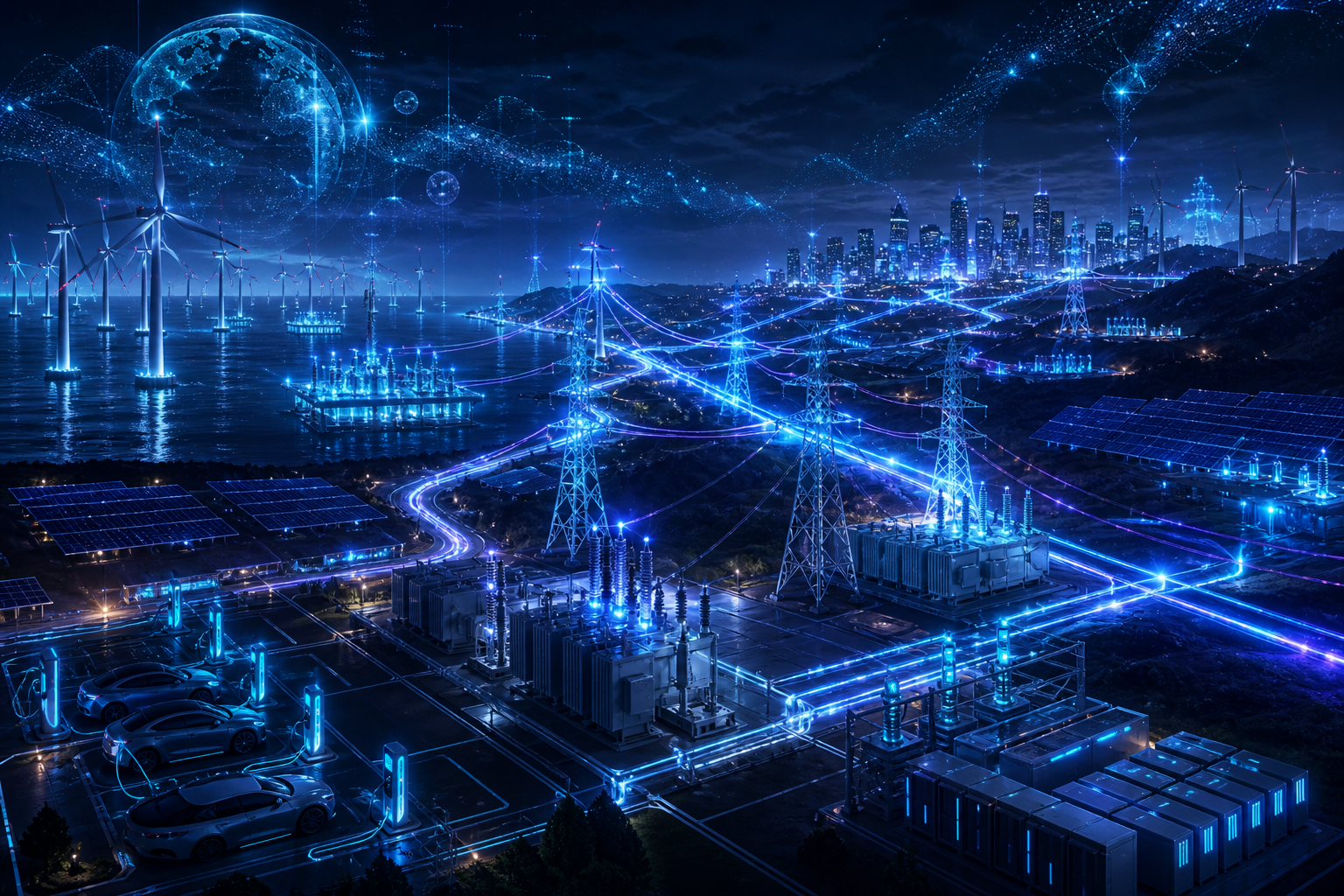
The grid is no longer background infrastructure
For much of the 20th century, electricity grids were treated as engineering backbones: essential, highly technical and largely invisible to public debate. Policy arguments centred on fuels, power stations and prices at the meter. That framing is becoming inadequate. In advanced and emerging economies alike, the grid is moving from the margins of energy policy to its core role as the system that determines whether power can be delivered where it is needed, when it is needed, and at a cost societies can bear.
This change is structural rather than rhetorical. Electricity demand is set to grow as transport, heating, industry and data infrastructure electrify. The International Energy Agency has argued that electricity’s share of final energy consumption will rise materially in pathways aligned with lower emissions, while grid investment has lagged behind spending on generation in many markets. Meanwhile, more supply is coming from variable renewable sources, requiring greater flexibility, stronger networks and better system coordination. The old model of predictable central generation feeding passive demand is giving way to a more dynamic and contested architecture.
The decisive energy question is no longer simply how to produce more power, but how to orchestrate a far more complex power system.
That orchestration challenge spans physics, regulation, finance and public consent. A modern grid must carry power across longer distances, accommodate decentralised assets, maintain frequency and voltage, withstand climate shocks and cyber risk, and do all this while preserving legitimacy with consumers and communities. In practice, the grid is becoming an economic institution as much as an engineering one.
Electrification is colliding with network constraints
Many governments have placed electrification at the centre of industrial and climate strategy. Electric vehicles, heat pumps, electrolysers, battery storage and new industrial loads all imply higher and often less predictable power demand. Yet network build-out is typically slow. Transmission lines can take years, sometimes more than a decade, to plan and permit. Distribution grids, which connect homes, offices and many new technologies, are often even less visible in policy discussion despite being the point where congestion first appears.
This mismatch matters. Generation projects can be approved more quickly than the wires needed to connect them. The result is a growing queue problem: assets exist on paper or even in the ground but cannot operate at full value because the network is constrained. The International Energy Agency’s report on grids and secure energy transitions has warned that without a rapid acceleration in grid investment and reform, electricity systems risk becoming the bottleneck of the wider transition. In other words, ambitions for cleaner and more electrified economies may be limited not by the availability of technologies but by the capacity of institutions to expand and modernise networks.
The political economy is awkward. New generation often offers visible benefits and clear constituencies; network investment can appear costly, localised and bureaucratic. Yet without it, the system becomes progressively less efficient. Congestion raises costs, curtailment wastes available energy and reliability concerns intensify. The grid’s invisibility, once its political advantage, is becoming a strategic vulnerability.
Variability changes the operating logic of power systems
Power systems have always required balance, but the nature of that balancing is changing. Traditional thermal fleets offered dispatchable output and system services as a by-product of generation. Wind and solar alter this equation. They can lower fuel costs and emissions, but their output depends on weather and location. This does not make them unmanageable; it does make the grid more dependent on forecasting, transmission, storage, demand response and flexible backup resources.
National laboratories, system operators and academic studies have repeatedly shown that high shares of variable renewables can be integrated reliably. The challenge is not a single technological hurdle but a portfolio problem. Flexibility must be assembled across timescales: milliseconds for stability, hours for balancing, days for weather patterns and seasons for prolonged stress. Markets designed around steady central plants may struggle to reward these services adequately.
The decisive energy question is no longer simply how to produce more power, but how to orchestrate a far more complex power system.
Here the distinction between energy and capacity becomes more important. A system may have ample annual electricity production yet still face scarcity during specific hours or locations. It may also need more ancillary services, inertia substitutes, reactive power support and digital visibility. What once looked like a supply question increasingly looks like a systems-integration question. The grid operator’s role therefore expands from transport manager to active coordinator of a diverse and changing resource mix.
Resilience is becoming as important as efficiency
For decades, power-sector reform often prioritised efficiency, cost reduction and asset optimisation. Those goals remain valid, but climate volatility and geopolitical tension are shifting attention towards resilience. Heatwaves reduce transmission efficiency and raise demand for cooling. Drought can constrain hydropower and thermal plant cooling. Storms, wildfires and floods can damage substations and lines. The grid is not merely exposed to climate change; it is one of the systems through which climate risk is socialised.
The United States Department of Energy, the European Environment Agency and other public institutions have all documented the growing exposure of energy infrastructure to extreme weather. These events can produce cascading effects: transport disruptions, telecoms outages, water-system failures and public health emergencies. Resilience, then, is not just the ability to avoid blackouts. It is the capacity to absorb shocks, isolate failures, recover quickly and preserve critical services under degraded conditions.
A resilient grid is not one that never fails; it is one that contains failure, restores service quickly and learns from stress.
This implies different investment priorities. Hardening physical assets matters, but so do vegetation management, redundancy in critical corridors, improved situational awareness, black-start capability, microgrids for essential services and better coordination across sectors. It also implies a more explicit discussion of trade-offs. Systems optimised for average conditions can become brittle under extremes. A more resilient grid may carry higher upfront costs, but lower social costs when disruption occurs.
Digitalisation expands capability and risk at once
The modern grid is increasingly a digital system. Sensors, smart meters, advanced control software, automated substations and distributed energy resource management tools can improve visibility and flexibility. They can help operators forecast demand, manage congestion, integrate rooftop solar and batteries, and reduce outage duration. Digitalisation is therefore central to operating a more decentralised and dynamic network.
But software-rich infrastructure also expands the attack surface. The International Energy Agency has warned that as energy systems become more connected, cybersecurity becomes integral to energy security rather than a specialist add-on. Public guidance from agencies such as the US Cybersecurity and Infrastructure Security Agency and the UK’s National Cyber Security Centre underscores the seriousness of operational technology risk in critical infrastructure.
The question is not whether digital tools should be used, but how they should be governed. Utilities and regulators must consider interoperability, vendor concentration, patching discipline, workforce training and incident response. Equally important is maintaining the ability to operate in degraded modes if digital systems fail or are compromised. The more intelligent the grid becomes, the less tolerable complacency becomes. In strategic terms, digitalisation increases optionality in normal times and vulnerability if governance lags.
Distribution networks are moving to the centre of the story
Transmission tends to attract strategic attention because it links regions and enables large-scale generation. Yet many of the most immediate stresses are emerging on distribution networks. Electric vehicle charging, residential heat electrification, rooftop solar, community batteries and small commercial loads all connect locally. This is where planners confront voltage issues, transformer limits and rapid changes in two-way power flows.
The significance of this shift is institutional. Distribution grids were designed for passive consumers receiving power from the top down. They are now increasingly expected to manage active participants that can consume, produce, store and potentially provide services back to the system. That requires better data, new tariff design, more granular planning and clearer rules for flexibility procurement.
A resilient grid is not one that never fails; it is one that contains failure, restores service quickly and learns from stress.
Ofgem, the European Commission and a range of system operators have all highlighted the importance of turning distribution operators into more active system managers. The practical implication is that the edge of the grid is becoming strategic territory. If local networks are not strengthened and better managed, national goals for electrification can stall in the street, at the feeder level or behind the meter. The transformation of the grid is therefore as much about local intelligence as national capacity.
Markets and regulation were built for an older system
Electricity regulation often reflects the assumptions of the era in which it was designed: large plants, predictable load growth, central planning horizons and relatively clear distinctions between generation, networks and demand. Those assumptions are fraying. A more distributed, digital and weather-dependent system requires market designs that value flexibility, locational efficiency and long-term adequacy without undermining affordability or investor confidence.
This is not simply a debate about ideology, whether more state or more market is best. It is a problem of institutional fit. Price signals need to encourage efficient consumption and investment, but they must also be intelligible and politically durable. Networks need incentives to innovate, yet critical infrastructure cannot be governed by short-termism alone. Capacity mechanisms, balancing markets, interconnection rules and retail tariffs all influence how the system evolves.
The most important regulatory question may be whether institutions can move from a model of static oversight to one of adaptive stewardship. That means planning for uncertainty, revising technical standards as the resource mix changes, and integrating climate and security risks into routine decision-making. Regulators are no longer simply referees of mature utilities; they are becoming architects of system transformation.
Energy security is increasingly a network question
Traditional energy security focused on fuel supply: access to oil, gas and coal, strategic reserves and exposure to external producers. Those issues have not disappeared. But in more electrified economies, security increasingly depends on whether power networks can cope with disruption, connect new resources and maintain operational integrity. A country may have abundant generation potential and still face insecurity if it lacks transmission corridors, interconnection capacity, spare transformers or cyber resilience.
This widens the concept of strategic dependence. Grid equipment supply chains, high-voltage components, power electronics and specialised labour all become relevant. So do cross-border interconnections, which can enhance resilience through sharing but may also transmit shocks or create new dependencies. The debate becomes less about autarky than about managed interdependence.
In an electrified economy, energy security depends as much on coordination capacity as on fuel availability.
The implication for states is clear: security policy can no longer sit apart from utility regulation and infrastructure planning. Decisions about standards, redundancy, maintenance and reserve margins have strategic consequences. The grid, in this sense, is where domestic policy and national security increasingly meet.
Public consent may be the limiting resource
Grid expansion is often slowed not by a lack of engineering solutions but by a lack of social licence. New lines, substations and local upgrades can provoke opposition over land use, landscape impact, fairness and trust. Communities may support cleaner energy in principle while resisting specific projects nearby. This is not irrational. Infrastructure creates concentrated local costs even when benefits are widely dispersed.
In an electrified economy, energy security depends as much on coordination capacity as on fuel availability.
Frameworks that treat opposition merely as an obstacle tend to misread the problem. Public acceptance is shaped by process as much as outcome: whether planning is transparent, whether compensation is fair, whether alternatives are meaningfully considered and whether communities see enduring local benefit. Institutions such as the International Renewable Energy Agency and the OECD have emphasised that social acceptance is a material determinant of infrastructure delivery, not a soft peripheral issue.
There is also an equity dimension. Poorly designed tariffs can burden lower-income households. Reliability failures often hit vulnerable communities hardest. Meanwhile, better-off households are more likely to access rooftop solar, storage or flexible technologies that reduce bills. If the grid’s modernisation is seen as unfair, consent will erode. Legitimacy is therefore not a communications exercise but a design principle.
What a credible grid strategy now requires
A serious approach to energy and the grid should begin with a shift in emphasis. The objective is not merely to add more assets; it is to build a system capable of balancing competing demands under uncertainty. That means planning transmission and distribution together, aligning generation policy with connection realities, and valuing flexibility as infrastructure in its own right. It also means treating resilience, cybersecurity and workforce capability as core investment categories rather than secondary concerns.
Several practical principles follow.
- Accelerate permitting and planning for networks without hollowing out public scrutiny.
- Invest in distribution grids as actively as in transmission, especially where electrification is policy-led.
- Design markets and tariffs that reward flexibility, efficient siting and demand responsiveness.
- Embed climate adaptation and cybersecurity into routine infrastructure governance.
- Develop supply chains and skills for critical grid components and maintenance.
- Improve transparency around queues, congestion and system needs so private investment responds to actual constraints.
No single model will fit every country. Geography, political institutions, industrial structure and existing asset bases differ widely. But the strategic direction is broadly shared. The electricity grid is becoming the platform on which economic competitiveness, decarbonisation and social resilience increasingly depend.
That is why the grid deserves to be seen not as a technical afterthought but as the decisive public-interest system of the energy age. The societies that recognise this early will be better placed to electrify productively, absorb shocks and keep public support intact. Those that do not may find that their energy ambitions are constrained not by a lack of generation, but by the quiet, cumulative limits of the network itself.