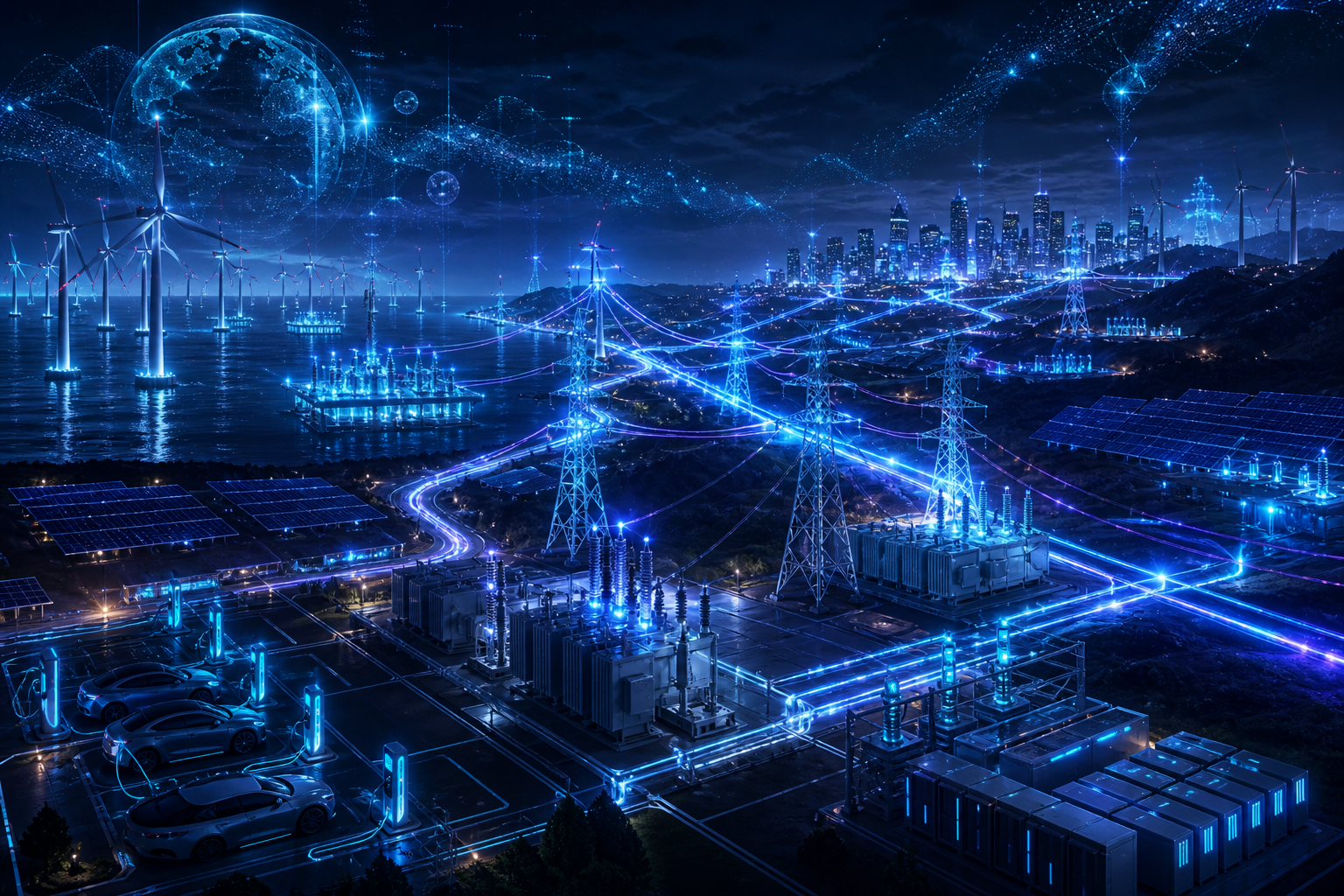
Electricity was once planned around a relatively simple proposition: large power stations generated electricity, transmission lines moved it across long distances and distribution networks delivered it to homes and businesses. That model is being stretched from several directions at once. Wind and solar generation are growing because they are often the cheapest new sources of power; electrification is shifting demand from petrol and gas to the grid; and climate change is increasing the frequency and severity of heatwaves, storms, droughts and wildfires that can damage infrastructure or reduce plant performance.
The result is a strategic challenge rather than a narrow engineering one. A resilient grid must be able to withstand shocks, adapt to changing patterns of supply and demand, and recover quickly when disruptions occur. That involves physical assets such as transmission lines, transformers and substations, but also forecasting, market design, digital controls, planning rules and consumer incentives. The strongest systems are not merely robust; they are flexible.
Grid resilience is not a single asset you can buy. It is a property of the whole system.
Why resilience has become a central energy question
Three forces explain why resilience has moved to the centre of energy policy. The first is decarbonisation. According to the International Energy Agency, renewable generation is expanding rapidly across advanced and emerging economies, changing the temporal and geographic profile of electricity supply. Output increasingly depends on weather conditions and location, requiring networks to transport power from windy, sunny or offshore regions to demand centres.
The second force is electrification. Electric vehicles, heat pumps, data centres and new industrial loads can all add to peak demand if not managed carefully. In some places, demand is also becoming more variable within the day. This is not necessarily a problem if systems can shift consumption or store energy, but it does create new operational challenges.
The third force is climate risk. The Intergovernmental Panel on Climate Change has documented the growing impacts of extreme weather on energy systems. Heat can reduce the efficiency of thermal power stations and transmission equipment; drought can limit hydropower output and cooling water availability; storms and wildfires can directly damage lines and substations. Resilience planning must therefore account for hazards that are both more frequent and more uncertain than historical averages suggest.
The grid is changing from one-way delivery to two-way coordination
Traditional grids were designed for one-way power flows: from central plants to passive consumers. Modern grids are becoming decentralised and interactive. Rooftop solar, batteries, electric vehicles and flexible industrial loads can all inject, store or shift electricity. This creates opportunities, but it also means that local networks designed for predictable load profiles must now cope with more complex conditions.
Distribution systems in particular are becoming more important. In many countries, a large share of new energy activity is connecting at the distribution level rather than the high-voltage transmission backbone. That requires better visibility of local conditions, improved connection processes and smarter control equipment. It also raises governance questions: who pays for upgrades, how local congestion is managed and how small-scale assets are rewarded for services they provide to the wider system.
Seen properly, this is a move from a purely engineering model to a coordination model. The objective is not only to keep the lights on, but to orchestrate millions of devices, generators and end-users in ways that preserve reliability at acceptable cost.
Transmission expansion is slow, but unavoidable
For all the attention paid to digital innovation, old-fashioned network expansion remains indispensable. Many of the best renewable resources are located far from cities and industrial demand. Ageing infrastructure also needs refurbishment or replacement. Yet transmission projects are notoriously slow to deliver because of planning disputes, permitting complexity, land-use conflicts, skills shortages and long equipment lead times.
Grid resilience is not a single asset you can buy. It is a property of the whole system.
The IEA and the International Renewable Energy Agency have both warned that grid investment is not keeping pace with broader energy transitions. This matters because underbuilt networks raise system costs in several ways: they curtail low-cost generation, increase congestion, reduce the geographic diversity of supply and make it harder to share reserves across regions. A larger and more interconnected grid can smooth local weather patterns, pool balancing resources and improve recovery from disruption.
Resilience therefore requires faster planning and permitting, but not at the expense of public legitimacy. Good process matters. Early community engagement, transparent route selection, attention to biodiversity and fair compensation can reduce opposition and legal delays. The grid cannot become more resilient if the institutions responsible for building it remain too slow to adapt.
A bigger grid is often a more resilient grid, but only if institutions can build it in time.
Flexibility is now as valuable as generation
In systems with growing shares of wind and solar, flexibility becomes a core resource. Flexibility means the ability to respond when conditions change: ramping generation up or down, shifting demand, storing energy, or moving power across regions. Historically, this role was played mainly by dispatchable fossil-fuel plants and hydropower. Today, the toolkit is broader.
Grid-scale batteries can respond in milliseconds and are increasingly used for frequency control and short-duration balancing. Pumped-storage hydropower remains valuable where geography allows, particularly for longer-duration storage. Interconnectors can help countries or regions share excess electricity and reserves. Flexible thermal generation may still be needed in many systems for some time, particularly during periods of low wind and solar output, though its role is changing from baseload to balancing.
Crucially, flexibility should be procured and valued explicitly. If markets reward only total energy produced, they underpay assets and behaviours that stabilise the system. Better pricing for ancillary services, capacity adequacy and congestion management can encourage investment where it is most useful rather than where subsidies or legacy rules happen to point.
Demand-side response is underused and increasingly important
One of the cheapest ways to improve resilience is often to use electricity more intelligently rather than simply produce more of it. Demand-side response allows consumption to move away from periods of stress towards times when supply is plentiful. This can involve industrial users reducing load for short periods, buildings pre-heating or pre-cooling outside peak hours, or electric vehicles charging when prices are low and networks are uncongested.
The case for demand flexibility is strong, but deployment has lagged in many markets. Barriers include outdated tariffs, limited access to smart meters, weak consumer protections, poor interoperability and market rules that favour large conventional assets. Well-designed programmes can reduce peak demand, lower system costs and improve resilience without noticeable reductions in comfort or productivity.
However, demand-side response is not simply a technical fix. It raises questions of fairness and trust. Households should not be exposed to opaque pricing or risks they do not understand. Vulnerable consumers need safeguards. The most durable approach combines clear signals, easy automation and transparent rules on data use and opt-out rights.
Storage helps, but duration matters
Storage is often treated as a universal answer to grid challenges. In practice, its value depends on duration, location and use case. Short-duration batteries are highly effective for frequency response, reserve provision and intraday balancing. They can also defer some network upgrades if placed in constrained areas. But a system challenge lasting several days, such as prolonged low wind conditions during winter, requires a different set of tools.
Longer-duration storage remains harder and more expensive, though technologies and business models are evolving. Pumped hydro is proven but geographically constrained. Other options are being explored for multi-hour to multi-day balancing, yet their economics and deployment pathways vary widely. This means system planners should avoid treating all storage as interchangeable.
A bigger grid is often a more resilient grid, but only if institutions can build it in time.
A more credible strategy is to assess resilience across timescales: seconds for frequency stability, hours for peak shifting, days for weather-related variability and seasons for structural imbalances. Different technologies and market arrangements serve each horizon. The point is not to back one winner, but to ensure that reliability needs are specified clearly enough for suitable resources to emerge.
Storage is essential, but resilience depends on matching the right duration to the right problem.
Digitalisation can strengthen the grid, if cyber risks are managed
Advanced sensors, forecasting tools, automated controls and better data analytics can make electricity systems more efficient and resilient. Operators can identify faults faster, integrate variable generation more accurately and optimise maintenance before equipment fails. On distribution networks, digital visibility can reveal bottlenecks that would otherwise remain hidden until they become acute.
Yet digitalisation also expands the attack surface for cyber threats. The more connected and software-driven the grid becomes, the more important cyber resilience becomes alongside physical resilience. Guidance from the National Institute of Standards and Technology and analyses from the International Energy Agency both underline the need for strong cybersecurity governance, regular testing, supply-chain scrutiny and clear incident response procedures.
This is especially important because energy systems increasingly depend on communications networks, cloud services and third-party vendors. Resilience planning should therefore avoid narrow boundaries. A substation may be physically hardened against storms but still vulnerable to software compromise or telecoms failure. Redundancy, segmentation and manual fallback capabilities remain valuable even in highly automated systems.
Distributed energy can reduce risk, but it can also shift it
Distributed energy resources such as rooftop solar, community batteries, microgrids and backup generation can improve resilience by reducing dependence on distant central assets. During outages, some distributed systems can continue serving critical loads if designed with islanding capability. Hospitals, water infrastructure and emergency services may particularly benefit from such arrangements.
But decentralisation is not a free resilience dividend. Poorly integrated distributed resources can create local voltage issues, reverse power flows and protection challenges. Backup generators can also worsen air pollution or fuel dependency if used indiscriminately. The real question is whether distributed assets are integrated into system planning, dispatch and emergency procedures, rather than simply added piecemeal.
Microgrids offer a useful example. They can be highly effective in specific settings such as campuses, remote communities or critical facilities. But they are not a substitute for broad grid resilience. In most cases, the best outcome comes from combining stronger central networks with distributed capabilities that can support both local reliability and the wider system.
Climate adaptation is now part of core grid planning
Historically, power systems were often designed using historical weather patterns as a guide. That is no longer sufficient. Climate adaptation must be embedded into planning standards, asset design and operational practice. The United States Department of Energy, among others, has highlighted the need to assess future climate hazards directly rather than assume that the past is a reliable baseline.
Adaptation measures vary by geography. In wildfire-prone regions, utilities may need vegetation management, covered conductors, sectionalisation and enhanced situational awareness. In coastal zones, substations may require flood protection or relocation. In hotter climates, transformers, cables and thermal power plants may need derating assumptions revised. In drought-exposed systems, the water dependency of generation portfolios becomes a resilience issue in its own right.
Storage is essential, but resilience depends on matching the right duration to the right problem.
The key principle is to move from reactive repair to anticipatory design. This may increase upfront costs, but it can reduce much larger economic losses from prolonged outages. It also encourages a more realistic view of what resilience means: not preventing every failure, but reducing vulnerability and speeding restoration when failures occur.
Markets and regulation determine whether resilience investments happen
Engineering arguments alone do not build resilient systems. Regulation determines what network operators are allowed to invest in, how quickly costs can be recovered and what performance standards are enforced. Market rules shape whether flexible resources, storage and demand response can compete fairly. Poorly aligned incentives can leave resilience undervalued until a crisis reveals the gap.
Well-designed regulation should balance three objectives: affordability, decarbonisation and reliability. That means allowing investment in grids before they become binding constraints; using performance metrics that reward outage reduction and faster restoration; and ensuring that system planning captures the value of flexibility, not just new generation. It also means addressing interconnection queues and connection standards, which in many jurisdictions have become major bottlenecks.
Public policy has a distributional dimension too. The costs of resilience upgrades are often socialised, while some benefits accrue first to fast-growing regions or wealthier consumers able to invest in private backup. Regulators therefore need clear principles on cost allocation, social protection and access. Resilience that only affluent users can afford is not system resilience in any meaningful civic sense.
What a practical resilience strategy looks like
For policymakers and system planners, a credible resilience strategy begins with diagnosis. Which risks matter most: storms, heat, cyber threats, winter peaks, drought, wildfire, fuel supply disruption? Which parts of the system are most exposed: long-distance transmission, urban substations, local distribution feeders, market rules or emergency response protocols? Without a structured risk assessment, investment tends to follow headlines rather than actual vulnerabilities.
The next step is portfolio thinking. Resilience rarely comes from one measure alone. It usually requires a combination of transmission expansion, distribution modernisation, storage, flexible demand, stronger interconnection, climate adaptation and cyber preparedness. Some measures reduce the likelihood of outages; others reduce their severity or speed recovery. Both matter.
Operational capabilities should not be overlooked. Better weather forecasting, outage management, spare equipment inventories, workforce training and mutual assistance arrangements can materially improve restoration times. So can clearer communication with the public. During system stress, trust is itself a resilience asset.
Finally, resilience must be treated as dynamic. The grid of 2035 will not face the same load patterns, generation mix or climate hazards as the grid of 2015. Planning cycles, standards and investment frameworks therefore need regular updating. Static assumptions are now a liability.
The real test is whether the system can adapt
Debates about the future of electricity often become polarised between centralisation and decentralisation, markets and planning, clean energy and reliability. In practice, resilient grids require some of all these elements. They need strong backbone networks and smarter local systems, investment discipline and strategic public coordination, digital intelligence and physical redundancy.
The defining question is not whether power systems are becoming more complex; they are. It is whether institutions are learning to manage that complexity in ways that preserve reliability, affordability and public legitimacy. Countries that do this well will not simply have fewer blackouts. They will have energy systems better suited to a world of cleaner electricity, harder climate stresses and more demanding consumers.
That is why resilience deserves to be seen not as a defensive add-on, but as the organising principle of modern grid policy. The grid is no longer just the background infrastructure of the economy. It is becoming one of its central strategic systems, and it will need to be planned accordingly.