The overlooked bottleneck
For years, public debate on energy focused on fuels and generation technologies. That made sense when the dominant questions concerned access to oil and gas, or the relative cost of coal, nuclear and renewables. But the centre of gravity has shifted. In many advanced and emerging economies alike, the most binding constraint is no longer whether low-carbon electricity can be generated in principle. It is whether networks can connect it, transport it, balance it and recover the cost of doing so in a politically durable way.
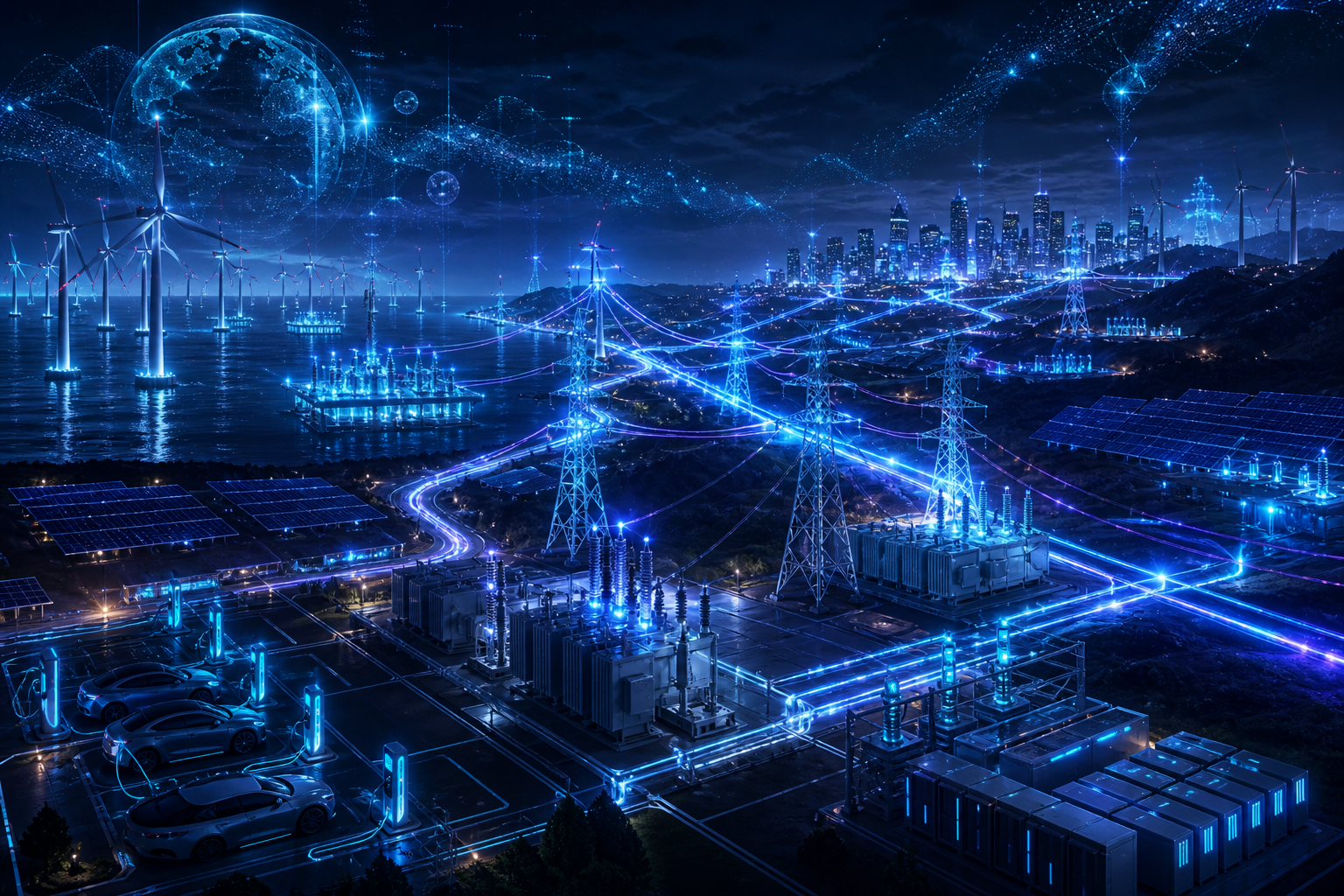
This is why the grid has moved from technical backdrop to strategic frontier. Electricity systems were designed around large, dispatchable power stations feeding one-way flows to passive consumers. The new system looks different: wind and solar output is weather-dependent, batteries respond in milliseconds, electric vehicles may become both loads and flexible assets, heat pumps change seasonal demand profiles, and data centres add large concentrated loads in places where network capacity may already be thin. The result is a system that is more distributed, more digital and more operationally complex.
The implications are economic as much as engineering. A delayed transmission line can hold back industrial investment. A congested distribution network can slow housing development. Poorly designed tariffs can shift costs regressively on to households least able to bear them. Grid policy, once treated as administrative plumbing, has become one of the main arenas in which climate ambition meets material reality.
The energy transition will be won or lost not only in power plants, but in the networks that connect them.
Why electricity is becoming more important
Electrification is the quiet logic binding much of contemporary energy policy together. If transport shifts from combustion engines to electric drivetrains, if buildings use heat pumps instead of gas boilers, and if parts of industry substitute electricity for direct fossil-fuel combustion, then a larger share of final energy consumption flows through the power system. The International Energy Agency has repeatedly argued that electricity's role in final consumption is set to rise materially in net-zero pathways, even if the pace differs by country and sector.
This matters because electricity is unlike many other energy carriers. It must be balanced continuously. Supply and demand need to match in real time, while frequency and voltage remain within narrow tolerances. Historically, the grid delivered this through controllable thermal generation and predictable demand patterns. Electrification, coupled with variable renewable generation, changes both sides of that equation at once.
As electricity assumes a larger role in transport, heating, communications and industrial production, the social cost of outages rises too. What was once an inconvenience becomes a broader economic and civic risk. Energy security therefore comes to mean more than fuel supply. It includes cyber security, spare transformer capacity, interconnection, system inertia, black-start capability and the availability of skilled labour to maintain a far more active network.
From centralised systems to variable power
The traditional grid was engineered for relative stability. Large coal, gas, hydro and nuclear stations could be forecast and dispatched; demand followed recognisable daily and seasonal patterns. Operators planned around known peaks and maintained reserves for contingencies. Today, generation is increasingly shaped by weather conditions and geography. Wind may be abundant far from urban centres; solar output peaks at midday even where evening demand is higher. This is not a flaw of renewables. It is a characteristic that requires different system design.
Flexibility becomes the governing principle. Some of it comes from transmission: a larger, stronger network can move electricity from where the wind is blowing or the sun is shining to where demand sits. Some comes from storage, which shifts electricity across time. Some comes from demand response, which adjusts consumption patterns without materially reducing welfare. Some comes from firm low-carbon generation and interconnectors, which smooth local imbalances through diversity.
The energy transition will be won or lost not only in power plants, but in the networks that connect them.
The operational challenge is not merely technical integration. It is institutional adaptation. Market rules written for thermal systems may fail to reward fast-response services, locational value or long-duration reliability. Planning processes may approve generation faster than networks. Distribution companies may still be regulated as passive asset owners even as they become managers of active local systems. In that sense, the transition is also a governance transition.
Transmission and distribution as strategic assets
Talk of “the grid” can obscure a crucial distinction. Transmission networks carry electricity over long distances at high voltage, linking regions and major generators. Distribution networks deliver electricity locally to homes, offices, factories and increasingly to distributed resources such as rooftop solar, batteries and vehicle chargers. Both matter, but they face different pressures.
Transmission has become a strategic question because good renewable resources are often remote. Offshore wind requires subsea links and onshore reinforcement. Solar deployment in sparsely populated areas may outpace local demand. New industrial clusters, hydrogen production, or large computing facilities can require fresh high-capacity connections. Where transmission lags, queues lengthen, curtailment rises and project economics deteriorate.
Distribution is where the energy transition becomes visible to households and small businesses. Heat pumps, electric vehicles, domestic batteries and rooftop solar all interact with local feeders, transformers and voltage management. A street can appear electrified long before the local network is ready for simultaneous evening charging or winter heating peaks. That makes distribution planning central to questions of fairness and public consent. If affluent households can install flexible technologies and reduce bills while less affluent ones face rising network charges, political support for the transition may erode.
In the next phase of decarbonisation, wires and substations matter as much as turbines and panels.
The problem of queues, delays and permitting
Across many jurisdictions, connection backlogs have emerged as a defining symptom of grid strain. Developers may secure generation permits long before they receive viable network access. Industrial consumers can face long waits for upgraded connections. In some systems, queue management has allowed speculative projects to occupy capacity without clear delivery prospects, freezing out more mature proposals.
Permitting is part of the problem, though not the whole of it. New lines often cross multiple communities and habitats, triggering legitimate scrutiny over land use, biodiversity and visual impact. The policy mistake is to frame this as a simple clash between progress and obstruction. Better planning requires earlier public engagement, more coherent spatial strategies, credible compensation where appropriate, and institutions able to weigh system-wide benefits against local costs transparently.
Supply chains and workforce constraints are equally important. High-voltage cables, transformers and specialised grid equipment have long lead times. Skilled engineers, lineworkers and power-system planners are not created overnight. Even where finance is available, delivery capacity can be scarce. The practical tempo of grid expansion is therefore shaped by the slower-moving realities of manufacturing, training and administrative competence.
Flexibility is the new reserve margin
As variable generation grows, flexibility becomes to the modern grid what fuel stockpiles and spinning reserve once were to the old one: a buffer against uncertainty. Yet flexibility is not a single asset class. It includes short-duration batteries that stabilise frequency and absorb intraday swings; pumped hydro and other storage capable of shifting energy over longer periods; flexible industrial demand; smart charging for vehicles; thermal storage in buildings; and generation that can ramp when renewable output drops.
What matters is orchestration. A grid with abundant variable generation but weak flexibility may experience low wholesale prices in some hours and acute scarcity in others. The challenge for policymakers is to ensure markets reward the services the system actually needs: balancing, ramping, inertia, capacity adequacy, congestion relief and voltage support. Paying only for energy volumes is increasingly insufficient when reliability depends on timing, location and responsiveness.
In the next phase of decarbonisation, wires and substations matter as much as turbines and panels.
This creates a subtle but consequential shift in investment logic. The value of an asset now depends not only on how much electricity it produces or consumes, but on when and where it does so. That, in turn, puts pressure on retail tariffs, wholesale market design and network regulation. Price signals need to be granular enough to guide efficient behaviour, but simple enough to retain public legitimacy.
Digital infrastructure and cyber risk
The grid is becoming a digital system as much as a physical one. Sensors, advanced meters, automated substations, forecasting tools and distributed energy management platforms are all expanding the operator's field of vision. This can improve reliability and reduce costs by enabling more dynamic use of existing assets. Better data can reveal spare capacity, defer some reinforcement and coordinate millions of small devices that would otherwise behave unpredictably.
But digitalisation also enlarges the attack surface. Electricity networks are now exposed not only to storms, heatwaves and equipment failure, but to cyber intrusion, software vulnerabilities and communications outages. The more a grid relies on digital coordination, the more resilient those digital layers must be. This is not an argument against digitisation. It is an argument for designing systems that degrade gracefully, maintain manual fall-backs where necessary, and treat cyber resilience as a core operational requirement rather than an annex to information technology policy.
The strategic implications extend beyond utilities. Hospitals, transport systems, water networks and mobile communications all depend on reliable electricity. A successful cyber attack on the grid would therefore have cascading effects across the wider economy. National resilience planning increasingly needs to view the power system as a backbone infrastructure whose failure modes are systemic, not sectoral.
Affordability, tariffs and the politics of cost
Grid investment is capital-intensive, long-lived and often unavoidable. The question is not whether networks require money, but how the costs are allocated and over what time horizon. This is politically delicate. Households typically notice energy costs through monthly bills, not through avoided outages or reduced curtailment. Governments may therefore face pressure to suppress visible network charges even when underinvestment would raise total system costs later.
Tariff design sits at the centre of this dilemma. Flat volumetric charges are simple, but they can distort incentives in a world where peak demand and local congestion drive significant costs. Time-of-use or more dynamic tariffs can encourage beneficial behaviour, such as shifting vehicle charging away from peak hours. Yet they can also disadvantage consumers who lack the means or technology to respond. A sound framework balances efficiency with distributional fairness, often by combining sharper signals with protections for vulnerable users.
There is a broader industrial question too. Electricity prices influence competitiveness in manufacturing and investment decisions in energy-intensive sectors. If network costs are recovered in ways that make clean power structurally expensive, electrification slows. If they are socialised without discipline, consumers may pay for poor planning. The real task is not to minimise spending at all costs, but to maximise system value per pound, euro or dollar invested.
A cheap grid on paper can become an expensive economy in practice if congestion, delay and fragility are allowed to accumulate.
Resilience in an age of climate stress
Decarbonisation is often discussed as a response to climate change, but grid strategy must also adapt to climate impacts already under way. Heatwaves reduce the efficiency of thermal generation and transmission equipment while pushing up cooling demand. Drought can constrain hydropower and thermal plant cooling. Wildfires threaten lines and substations. Storms and flooding damage coastal and inland infrastructure alike. Resilience planning can no longer treat extreme weather as a statistical outlier.
This changes priorities in network design and maintenance. Hardening substations against flood risk, managing vegetation near lines, increasing redundancy for critical loads, and improving restoration capabilities all carry costs, but the alternative is a system increasingly exposed to correlated shocks. Climate adaptation therefore belongs inside mainstream grid planning rather than in a separate environmental annex.
A cheap grid on paper can become an expensive economy in practice if congestion, delay and fragility are allowed to accumulate.
Resilience also has a social dimension. Outages affect people unevenly. Those with backup power, flexible work, better-insulated homes or financial buffers cope more easily than others. As with affordability, the politics of resilience will increasingly turn on who bears risk and who is protected from it. A grid framework that ignores these asymmetries may be technically sound and socially brittle.
Geopolitics and supply-chain dependence
Energy security used to be discussed primarily in relation to imported fuels. That concern remains, especially where gas plays a balancing role. But the grid introduces a different geography of dependence: transformers, power electronics, high-voltage cables, semiconductors, magnets and control hardware all sit in international supply chains. Concentration in manufacturing capacity can create bottlenecks, while trade restrictions and geopolitical tensions can delay critical projects.
Interconnection adds another layer. Cross-border links can improve resilience, lower costs and smooth renewable variability through geographic diversity. They can also create dependencies that require trust, regulatory coordination and shared crisis protocols. In stable conditions, interconnected systems are often more efficient. Under stress, they need robust governance to ensure that efficiency does not turn into vulnerability.
The strategic lesson is not autarky. It is diversification: of suppliers, technologies, routes and operating options. A robust grid framework treats procurement, standards and stockpiles as elements of national capability, while resisting the temptation to collapse every infrastructure decision into a security exception.
What good policy looks like
A credible grid strategy starts with planning that is spatial, long-term and system-wide. Generation, demand growth, industrial policy, housing, transport electrification and climate adaptation should not be handled in separate silos. Network planning needs realistic scenarios for how and where electricity use will grow, alongside clearer pathways for anticipatory investment where future need is highly probable.
Second, regulation should reward outcomes rather than merely asset accumulation. Building more wires is sometimes necessary, but not always sufficient. Operators should have incentives to use digital tools, flexible resources and demand-side measures where these provide better value. Equally, they should not be penalised for strategic overbuild where the social value of avoiding future bottlenecks is large and well evidenced.
Third, markets need to value reliability and flexibility properly. This means remuneration for ancillary services, congestion management and capacity adequacy that reflects actual system needs. It also means making connection processes more credible by filtering speculative applications and aligning milestones with project maturity.
Finally, public legitimacy matters. Infrastructure built without consent will stall; tariffs viewed as unfair will provoke backlash; digital systems deployed without trust will face resistance. The grid is becoming more sophisticated, but it cannot become less democratic. The countries that manage this balance best will not necessarily be those with the most ambitious targets on paper, but those with institutions capable of turning system complexity into investable, governable order.
The next decade of the grid
Over the next ten years, the decisive question for energy policy will be whether grids can evolve from passive carriers of electricity into active platforms for a more electrified economy. Success will depend less on any single technology than on coordination: between national and local planning, between transmission and distribution, between digital control and physical reinforcement, and between efficiency goals and social consent.
That makes the grid an unusually revealing lens on the broader transition. It compresses many of the century's governing dilemmas into one system: decarbonisation versus delay, resilience versus cost, openness versus security, central strategy versus local legitimacy. The politics will often be untidy, and the engineering trade-offs real. But one conclusion is already clear. In energy, the age of treating networks as an afterthought is over.