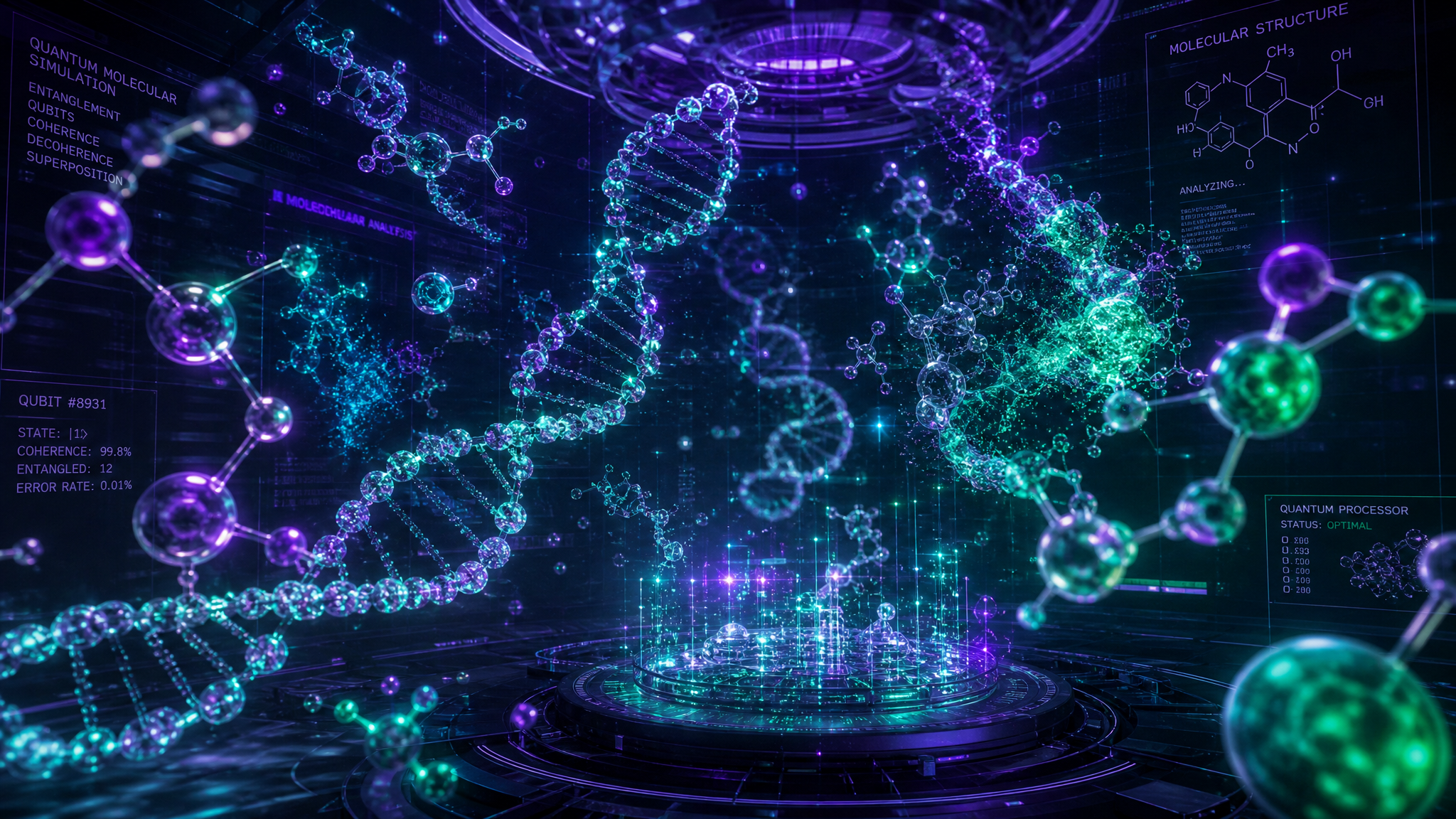
A single caffeine molecule contains 24 atoms. To simulate its quantum mechanical behaviour with perfect accuracy on a classical computer — modelling every electron orbital, every energy state, every interaction — would require more computational operations than there are atoms in the observable universe. Caffeine is a trivially simple molecule. A typical drug candidate has 50–100 atoms. A protein target has thousands.
This is the fundamental bottleneck that has made drug discovery the slowest, most expensive, and most failure-prone innovation process in the modern economy. It takes an average of 10 to 15 years and $2.6 billion to bring a single new drug from initial discovery to approved medicine. The failure rate is staggering: roughly 90% of drugs that enter clinical trials never reach patients. And the rate of drug discovery has been getting worse, not better, despite decades of increasing R&D investment.
Quantum computing promises to shatter this bottleneck. Not by making classical computation faster, but by performing a fundamentally different kind of computation — one that speaks the native language of molecular interaction. Combined with AI's ability to identify patterns across vast chemical spaces, the convergence of quantum computing and artificial intelligence represents the most significant potential transformation in pharmaceutical science since the discovery of antibiotics.
Eroom's Law: Why Drug Discovery Is Getting Harder
In 2012, Jack Scannell and colleagues published a paper in Nature Reviews Drug Discovery that identified one of the most troubling trends in modern science. They called it Eroom's Law — Moore's Law spelled backwards. Where Moore's Law describes exponential improvement in computing power per dollar, Eroom's Law describes exponential decline in drug discovery productivity per dollar.
Since 1950, the number of new drugs approved per billion dollars of R&D spending has roughly halved every nine years. In inflation-adjusted terms, the pharmaceutical industry spends approximately 80 times more per approved drug today than it did in the 1950s. The industry's total annual R&D expenditure exceeds $250 billion globally, yet the number of genuinely novel drug approvals has remained stubbornly flat at approximately 40–60 per year.
The causes are well-documented: the "low-hanging fruit" of obvious drug targets has been picked; regulatory requirements have become more stringent; clinical trials have become larger and more complex; and the biological systems being targeted — cancer, neurodegeneration, autoimmune disorders — are fundamentally more complex than the infections and deficiencies addressed by earlier generations of medicine.
But the deepest cause is computational. The majority of modern drug discovery relies on understanding molecular interactions at the quantum mechanical level: how a drug molecule binds to a protein receptor, how that binding alters the protein's function, how the drug is metabolised, and what unintended interactions it might have with other biological molecules. These are quantum mechanical problems being approximated on classical computers using density functional theory (DFT), molecular dynamics simulations, and statistical models that sacrifice accuracy for tractability.
The approximations are often inadequate. Classical molecular simulations can model a small molecule's behaviour over microseconds of simulated time. Biologically relevant processes — protein folding, enzyme catalysis, membrane transport — operate over milliseconds to seconds. The gap between what can be simulated and what needs to be simulated is measured in orders of magnitude.
The Quantum Advantage in Molecular Simulation
Quantum computers operate on fundamentally different principles than classical machines. Where classical computers manipulate bits that exist in one of two states (0 or 1), quantum computers use qubits that can exist in superpositions of both states simultaneously. When multiple qubits are entangled, the system can represent and manipulate an exponentially large number of states in parallel.
This is not merely a speed improvement. It is a qualitative change in the kind of problems that can be addressed. Molecular simulation is a quantum mechanical problem being forced onto classical hardware. Quantum computers offer the possibility of simulating quantum systems on quantum hardware — using the natural properties of quantum mechanics to model molecular behaviour directly.
The key quantum algorithms for drug discovery include:
Variational Quantum Eigensolver (VQE): A hybrid quantum-classical algorithm that estimates the ground-state energy of a molecular system. The ground-state energy determines a molecule's stability, reactivity, and binding properties — precisely the information needed to evaluate drug candidates. VQE has been demonstrated on small molecules (hydrogen, lithium hydride) using current quantum hardware, and theoretical scaling analyses suggest it could handle drug-relevant molecules on near-term error-corrected quantum computers.
A single caffeine molecule has 24 atoms. To simulate its quantum behaviour perfectly on a classical computer would require more operations than there are atoms in the observable universe.
Quantum Phase Estimation (QPE): A more precise but more hardware-demanding algorithm that can determine molecular energies with exponentially better accuracy than classical approximations. QPE requires fault-tolerant quantum computers with thousands of logical qubits — hardware that does not yet exist but is projected to arrive within the 2030–2035 timeframe.
Quantum Machine Learning (QML): Hybrid approaches that use quantum circuits as components within larger machine learning architectures. QML can, in principle, identify patterns in chemical data that are invisible to classical ML models — particularly patterns related to quantum mechanical properties like electron correlation and spin states.
The theoretical advantage is staggering. A quantum simulation of molecular interactions can evaluate an exponentially large space of molecular configurations simultaneously. For a molecule with 100 electrons, the quantum state space contains approximately 10²³ possible configurations. Evaluating this space classically would take longer than the age of the universe. A sufficiently powerful quantum computer could, in principle, explore it in hours.
Google Willow and the Path to Quantum Chemistry
Google's Willow quantum processor, unveiled in December 2024, represents a concrete step toward quantum computational chemistry. Willow's 105 superconducting qubits achieved two milestones relevant to drug discovery:
First, Willow demonstrated below-threshold quantum error correction — meaning that adding more physical qubits actually reduced the error rate, rather than increasing it. This is the fundamental scaling relationship required to build the large, fault-tolerant quantum computers that drug discovery applications demand.
Second, Willow performed a random circuit sampling computation that Google claimed would take classical supercomputers 10 septillion years. While random circuit sampling is not directly related to drug discovery, the result demonstrates that quantum computers can perform certain computations that are provably beyond classical reach — a necessary precondition for the claim that quantum computers can simulate molecules more accurately than classical alternatives.
Google's quantum chemistry team, led by researchers including Ryan Babbush, has published extensively on the resource requirements for quantum advantage in chemistry. Their estimates suggest that simulating the FeMoco molecule — the active site of nitrogenase, the enzyme responsible for biological nitrogen fixation — would require approximately 4 million physical qubits with current error rates. This is well beyond Willow's 105 qubits, but the error correction breakthrough changes the scaling trajectory from uncertain to plausible.
The AI Revolution: AlphaFold and Beyond
While quantum computing attacks the molecular simulation bottleneck from the hardware side, artificial intelligence has been revolutionising drug discovery from the software side — and the convergence of the two is where the transformative potential lies.
DeepMind's AlphaFold, first demonstrated in 2020 and dramatically expanded with AlphaFold 2 and AlphaFold 3, solved one of biology's grand challenges: predicting the three-dimensional structure of proteins from their amino acid sequences. AlphaFold 2's protein structure database now contains predicted structures for over 200 million proteins — virtually every known protein in nature. AlphaFold 3, released in 2024, extended the capability to predict interactions between proteins and other molecules, including potential drug candidates.
AlphaFold operates entirely on classical hardware using deep learning architectures (specifically, attention-based neural networks). Its success demonstrates that AI can dramatically accelerate certain aspects of drug discovery without quantum computing. But AlphaFold has limitations: it predicts static structures, not the dynamic behaviour of molecules in biological environments. It cannot accurately model the quantum mechanical interactions that determine binding energies, metabolic pathways, and off-target effects.
This is where quantum-enhanced AI enters the picture. By training machine learning models on data generated by quantum simulations — data that is more physically accurate than anything classical simulations can produce — the next generation of drug discovery AI could achieve qualitatively better predictions of drug behaviour.
The pipeline looks like this: AlphaFold identifies protein structures and potential binding sites. Quantum simulations model the precise quantum mechanical interactions between drug candidates and those binding sites. AI models trained on quantum simulation data predict which candidates will have the best efficacy, lowest toxicity, and most favourable pharmacokinetic properties. The result is a drug discovery process that is faster, cheaper, and more accurate at every stage.
The Companies at the Frontier
The pharmaceutical industry spends 80 times more per approved drug today than in the 1950s. Quantum AI could reverse this trajectory — but only if we choose to make the results accessible.
Several companies are actively building at the intersection of quantum computing, AI, and drug discovery. Their approaches vary, but their convergence on this opportunity is itself a signal of its significance.
Insilico Medicine has achieved the most dramatic clinical milestone to date. The company used AI (not yet quantum-enhanced) to identify a novel drug target for idiopathic pulmonary fibrosis, design a molecule to interact with it, and advance the drug candidate to Phase II clinical trials — in approximately 30 months, compared to the typical 4–6 years for pre-clinical development. The drug, INS018_055, entered Phase II trials in 2023 and represents the first AI-discovered drug targeting an AI-discovered mechanism to reach mid-stage clinical testing. If it succeeds, it will validate the fundamental premise that AI can compress drug discovery timelines by an order of magnitude.
Recursion Pharmaceuticals has built what it describes as the world's largest proprietary biological dataset — over 50 petabytes of cellular imagery and biological data — and applies machine learning to identify drug candidates at scale. Recursion's partnership with NVIDIA provides access to the computational infrastructure needed for large-scale molecular simulation, and the company has publicly expressed interest in quantum computing integration as the hardware matures.
Qubit Pharmaceuticals is explicitly quantum-native. The French-American startup, founded by quantum chemistry researchers, uses hybrid quantum-classical algorithms to perform molecular simulations with higher accuracy than purely classical approaches. Their Atlas platform has demonstrated improved prediction of binding free energies — the key metric that determines whether a drug candidate will actually work — in head-to-head comparisons with classical methods.
IBM Quantum + Cleveland Clinic represents the most significant institutional partnership in quantum healthcare. Announced in 2022, the ten-year collaboration gives Cleveland Clinic access to IBM's quantum hardware and Qiskit software platform for drug discovery, genomics, and clinical research. The partnership has already produced research on quantum approaches to molecular simulation for cardiovascular drug targets.
NVIDIA BioNeMo is building the software infrastructure layer for AI-powered drug discovery. BioNeMo provides pre-trained models for molecular generation, protein structure prediction, and molecular docking — the computational pipeline that evaluates how drug candidates interact with biological targets. While currently classical, NVIDIA's quantum computing partnerships position BioNeMo as a likely integration point for quantum-enhanced simulation data.
The Geopolitics of Molecular Simulation
Whoever controls the infrastructure for quantum molecular simulation will exert disproportionate influence over the next generation of medicine. This is not abstract speculation — it is an emerging geopolitical reality.
The United States leads in quantum computing hardware (Google, IBM, Quantinuum) and AI-driven drug discovery (Recursion, Insilico, major pharma AI labs). China leads in quantum communications and is rapidly building quantum computing capability, with substantial state-funded programmes in quantum chemistry and drug discovery. The European Union has invested €1 billion in the Quantum Technologies Flagship programme but has fewer commercial quantum computing companies than either the US or China.
The pharmaceutical industry is already globalised, but the computational infrastructure that will drive its next phase is concentrated in a handful of nations and corporations. If quantum molecular simulation becomes the primary pathway to new drug discovery, nations without sovereign access to that computational capability will be dependent on foreign infrastructure for their pharmaceutical innovation pipeline.
This has direct implications for drug pricing, access, and public health sovereignty. A nation that cannot simulate molecules on its own quantum infrastructure is a nation that cannot independently develop drugs — and is therefore dependent on the pricing decisions of nations and corporations that can.
The Affordability Question
If quantum AI dramatically reduces the cost of drug discovery, will drugs become cheaper? The honest answer: not necessarily.
The pharmaceutical industry's pricing is determined by what markets will bear, not by production costs. Insulin, which costs approximately $10 per vial to manufacture, is sold in the United States for $300–$500 per vial. The price reflects patent protection, market exclusivity, and the absence of effective price regulation — not the cost of production.
Quantum-accelerated drug discovery could reduce the R&D cost per approved drug from $2.6 billion to perhaps $200–$500 million. But there is no automatic mechanism to ensure those savings are passed to patients. Without regulatory intervention — price controls, compulsory licensing, publicly funded quantum drug discovery programmes — the savings could simply accrue as additional profit margin for pharmaceutical companies that already rank among the world's most profitable.
The molecules of the future will be discovered on quantum computers owned by the few. The question is whether they will be available to the many.
The most promising model for equitable access may be public quantum computing infrastructure dedicated to drug discovery. Several proposals along these lines have emerged from academic and policy communities: a "Quantum CERN" for drug discovery, funded by international contributions and producing open-source molecular simulation data available to researchers globally. The concept has attracted support from the WHO and several national science agencies, but no concrete implementation has been funded.
Timeline: When Does Quantum Advantage Arrive?
The honest assessment of quantum advantage in drug discovery requires distinguishing between several levels of capability:
Level 1 — Quantum-Enhanced Classical Simulation (Now–2028): Hybrid quantum-classical algorithms that improve the accuracy of specific components within otherwise classical drug discovery pipelines. This is where companies like Qubit Pharmaceuticals operate today. The quantum advantage at this level is incremental — better binding energy predictions, more accurate molecular property estimates — but not transformative.
Level 2 — Quantum-Accelerated Screening (2028–2033): Quantum computers capable of performing molecular simulations that are qualitatively beyond classical reach for small to medium molecules (20–50 atoms). This enables the evaluation of drug candidates that classical simulation cannot accurately model, potentially opening entirely new therapeutic categories. Reaching this level requires error-corrected quantum computers with hundreds of logical qubits.
Level 3 — Full Quantum Molecular Simulation (2033–2040): Quantum computers capable of accurately simulating protein-drug interactions, enzyme catalysis, and complex biological processes at quantum mechanical accuracy. This is the level at which drug discovery is fundamentally transformed — where the 10–15 year timeline could compress to months. Reaching this level requires thousands of logical qubits, corresponding to millions of physical qubits with current error rates.
The transition from Level 1 to Level 3 is not guaranteed. Quantum error correction must continue to improve. Quantum algorithms must be refined for pharmaceutical applications. The integration of quantum simulation data with AI drug discovery pipelines must be validated clinically. Each of these requirements presents significant technical risk.
But the trajectory — from Google's Willow breakthrough, IBM's scaling roadmap, the proliferation of quantum chemistry startups, and the growing investment from pharmaceutical companies — points toward a convergence that is plausible within the next decade and likely within two.
From 10 Years to 10 Months
The title of this article is not hyperbole. It is a projection based on the compounding effects of three simultaneous accelerations: AI-driven target identification (proven by AlphaFold and Insilico Medicine), quantum-enhanced molecular simulation (demonstrated in principle, advancing toward practical capability), and automated experimental validation (robotic laboratories that can test drug candidates at thousands of times the speed of manual experimentation).
Each of these accelerations is individually significant. Together, they suggest a future in which the pharmaceutical R&D timeline — currently the slowest major innovation cycle in the global economy — could be compressed by an order of magnitude.
The stakes are measured in human lives. The 10–15 year drug discovery timeline means that a disease identified today will not have a treatment available until 2036–2041. Every year removed from that timeline is a year of suffering prevented, a year of lives saved, a year of human potential unlocked.
But the infrastructure to achieve this compression is not a public good. It is being built by private corporations and national governments pursuing strategic advantage. The molecules of the future will be discovered on quantum computers owned by the few. The question — the defining question for global health equity in the quantum age — is whether those molecules will be available to the many.
The quantum revolution in drug discovery is not a question of if. It is a question of for whom.
This article is part of the Sovereign Intelligence Hub's quantum applications series. For the broader quantum-AI convergence, see [Quantum-AI Convergence](/hub/quantum-ai-convergence). For the computational architecture that enables QML, see [Quantum Neural Networks](/hub/quantum-neural-networks). For the sustainability implications of quantum compute, see [Quantum Sustainability](/hub/quantum-sustainability).
Sources & Further Reading
- 1.Scannell, J. et al. — Diagnosing the Decline in Pharmaceutical R&D Efficiency (Nature Reviews Drug Discovery, 2012)
- 2.Google Quantum AI — Willow Processor and Quantum Error Correction (December 2024)
- 3.NIST — Post-Quantum Cryptography and Quantum Computing Timeline Assessments
- 4.DeepMind — AlphaFold 3: Predicting the Structure of All Life's Molecules (Nature, 2024)
- 5.Insilico Medicine — INS018_055 Phase II Clinical Trial Results
- 6.IBM Quantum + Cleveland Clinic — Ten-Year Partnership Announcement (2022)
- 7.Babbush, R. et al. — Focus Beyond Quadratic Speedups for Error-Corrected Quantum Advantage (PRX Quantum, 2021)
- 8.PhRMA — 2025 Annual Report: Biopharmaceutical Industry R&D Spending