Space is no longer just a destination
For decades, space activity was organised around discrete missions: a satellite launched for a specific purpose, a probe sent to a distant planet, a human spaceflight programme designed as much for prestige as for science. That model has not disappeared, but it is no longer the best way to understand what is happening above the atmosphere. A better lens is infrastructure.
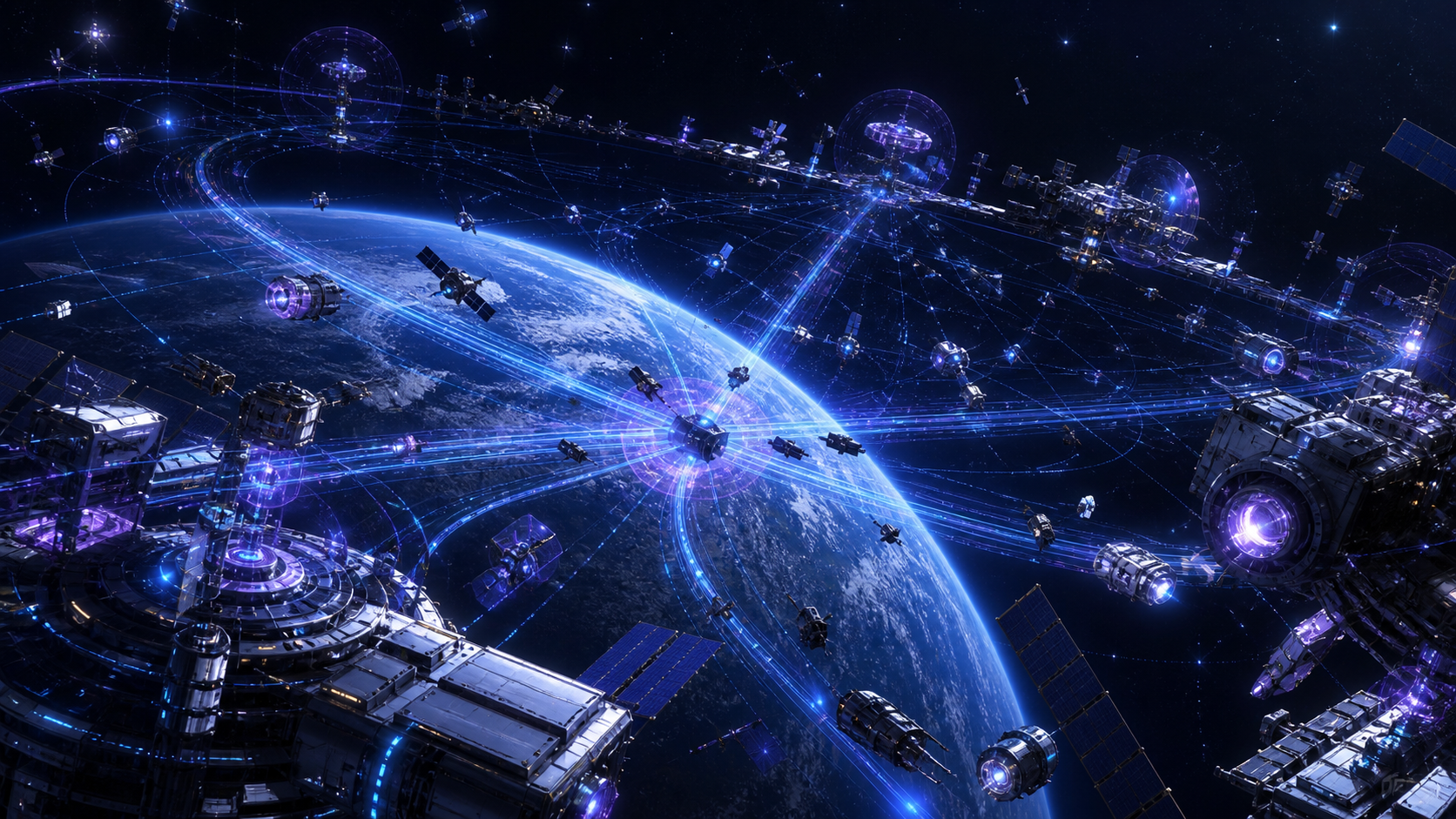
Infrastructure is the durable scaffolding that enables other activities. On Earth, it includes roads, ports, power grids and fibre networks. In space, it increasingly means launch facilities, satellite constellations, positioning and timing services, ground stations, tracking and data relay, weather and Earth observation systems, in-orbit servicing, and the emerging tools for traffic coordination and debris mitigation. These systems do not merely support exploration; they underpin finance, logistics, agriculture, disaster response, military operations and scientific research.
Space infrastructure is becoming valuable for the same reason terrestrial infrastructure always has been: other systems quietly begin to depend on it.
This shift has strategic consequences. Once a capability becomes infrastructural, reliability matters as much as innovation. Interoperability, governance, redundancy and repair become central questions. So do resilience and security. A society can admire a launch; it depends on the services that continue years after the launch has faded from memory.
What counts as space infrastructure
The term covers more than satellites in orbit. It includes the terrestrial systems that make orbital services usable: launch pads, mission control centres, manufacturing lines, telemetry networks, optical and radio tracking systems, and the software used to schedule, identify and deconflict space objects. It also includes the standards and regulatory arrangements that allow many actors to operate in the same domain.
At the most basic level, three layers matter. The first is access: launch vehicles, spaceports and supply chains that place hardware into orbit. The second is orbital capability: satellites, stations, robotic platforms and the architectures that connect them. The third is support and stewardship: ground infrastructure, surveillance, data systems, servicing, refuelling, debris removal and rules for safe operations.
Thinking in layers helps explain why the sector is evolving. Falling launch costs and smaller satellites have expanded access, but that very expansion creates pressure on the support layer. More objects in orbit mean greater demands on tracking, collision avoidance and spectrum coordination. In other words, scaling access without scaling stewardship produces fragility.
Why economies rely on orbital utilities
Many of the most economically important space services are so embedded in daily life that they are easy to overlook. Satellite navigation and timing support aviation, shipping, ride-hailing, precision agriculture, mobile networks and financial transactions. Earth observation informs crop forecasts, insurance, climate monitoring, mineral exploration and humanitarian response. Communications satellites provide connectivity in remote regions, at sea, in the air and after natural disasters when terrestrial networks fail.
The crucial point is that these are not niche services. They are enabling utilities for wider economic systems. The Bank for International Settlements has noted the importance of precise timing for parts of financial infrastructure, while government guidance in multiple countries classifies positioning, navigation and timing as critical infrastructure. The European Space Agency and the United Nations Office for Outer Space Affairs have both documented the use of space-based services in sustainable development, environmental monitoring and disaster management.
As dependency widens, the cost of disruption rises. A degraded navigation signal, a congested orbital band or a prolonged outage in weather data can have cascading effects far beyond the space sector itself. This is the hallmark of infrastructure: its failures propagate through systems that were designed assuming its continued availability.
Space infrastructure is becoming valuable for the same reason terrestrial infrastructure always has been: other systems quietly begin to depend on it.
Launch is only the front door
Public attention tends to focus on launch because it is visible, dramatic and measurable. Yet launch is only the entry point to a much larger infrastructure stack. A rocket places an asset in orbit; it does not by itself create a durable service. That requires manufacturing capacity, insured operations, software integration, radiofrequency coordination, ground communications, and often years of maintenance and replacement planning.
This is where the comparison with other network industries becomes useful. Building a port does not guarantee trade; a port matters because customs systems, shipping lines, warehouses, finance and inland transport are connected to it. Likewise, a launch capability is strategically important, but its value compounds when it is integrated with satellite production, command networks, data exploitation and end-user applications.
Policy debates can therefore become distorted if they equate national space strength with launch cadence alone. Access to orbit matters, especially for autonomy and crisis response. But a state or market actor with frequent launches and weak downstream systems may still lack robust space infrastructure. The enduring competitive edge comes from reliable services, not only from the ability to loft hardware skyward.
Orbital congestion is turning governance into engineering
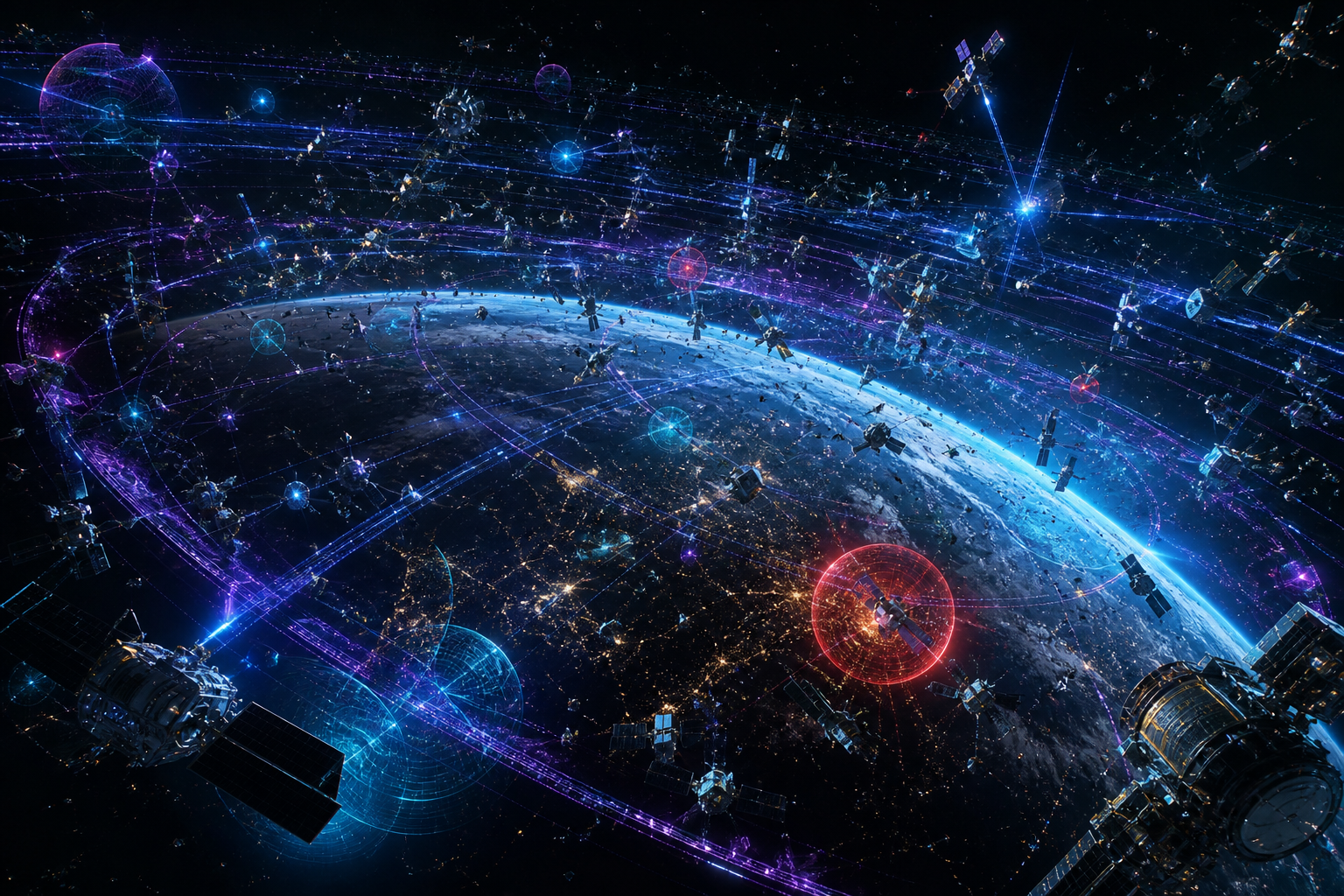
Low Earth orbit is becoming busier. According to the European Space Agency’s Space Environment Report, the number of objects in orbit continues to grow, including defunct satellites and fragmentation debris. Tracking improvements make more of this environment visible, but visibility is not the same as control. Operators must assess conjunction risks, manoeuvre when necessary and manage uncertainty in the trajectories of thousands of objects.
This is often described as a governance problem, and it is, but it is also an engineering challenge. Space traffic coordination depends on sensors, data standards, identification protocols, autonomous manoeuvring logic and shared procedures between operators. It requires information systems capable of coping with a dynamic orbital environment where warning times may be short and incentives may not align.
As orbit fills up, the management of space begins to look less like diplomacy alone and more like civil engineering for a hazardous commons.
The danger is not merely collision. Congestion can also produce operational friction: more fuel expended on avoidance, more uncertainty in mission planning, more burden on operators with limited staff, and more disputes over priority and responsibility. In terrestrial infrastructure, these issues are handled through a mix of design standards, liability regimes and operating rules. Space is moving unevenly in the same direction.
Debris is a market failure in plain sight
Orbital debris is often discussed as an environmental externality, which is accurate, but that phrase can make it sound abstract. In practice, debris is a direct threat to the continuity of services. Even small fragments can damage spacecraft because orbital velocities are so high. The challenge is cumulative: each fragmentation event increases the background risk for many others.
NASA’s Orbital Debris Program Office and ESA’s debris analysis both show that mitigation alone may not be sufficient in some heavily used orbital regions. Better disposal practices, passivation of spent stages and stricter mission design help, but the long-term stability of key orbits may also require active removal of large derelict objects that pose outsized collision risks.
This is difficult because incentives are misaligned. The actor that bears the cost of removal may not capture the broad system-wide benefit. The legal framework is also awkward: ownership and responsibility persist, yet technical access is limited and liability concerns remain substantial. Economists would recognise the pattern immediately. The orbital environment has the traits of a congestible commons in which underinvestment in maintenance is rational for individual actors but damaging for the system.
As orbit fills up, the management of space begins to look less like diplomacy alone and more like civil engineering for a hazardous commons.
The infrastructure implication is stark. No power grid is expected to remain reliable if broken equipment accumulates on transmission lines indefinitely. Space has reached the point where housekeeping is not peripheral; it is a core operational requirement.
Servicing, refuelling and repair could change orbital economics
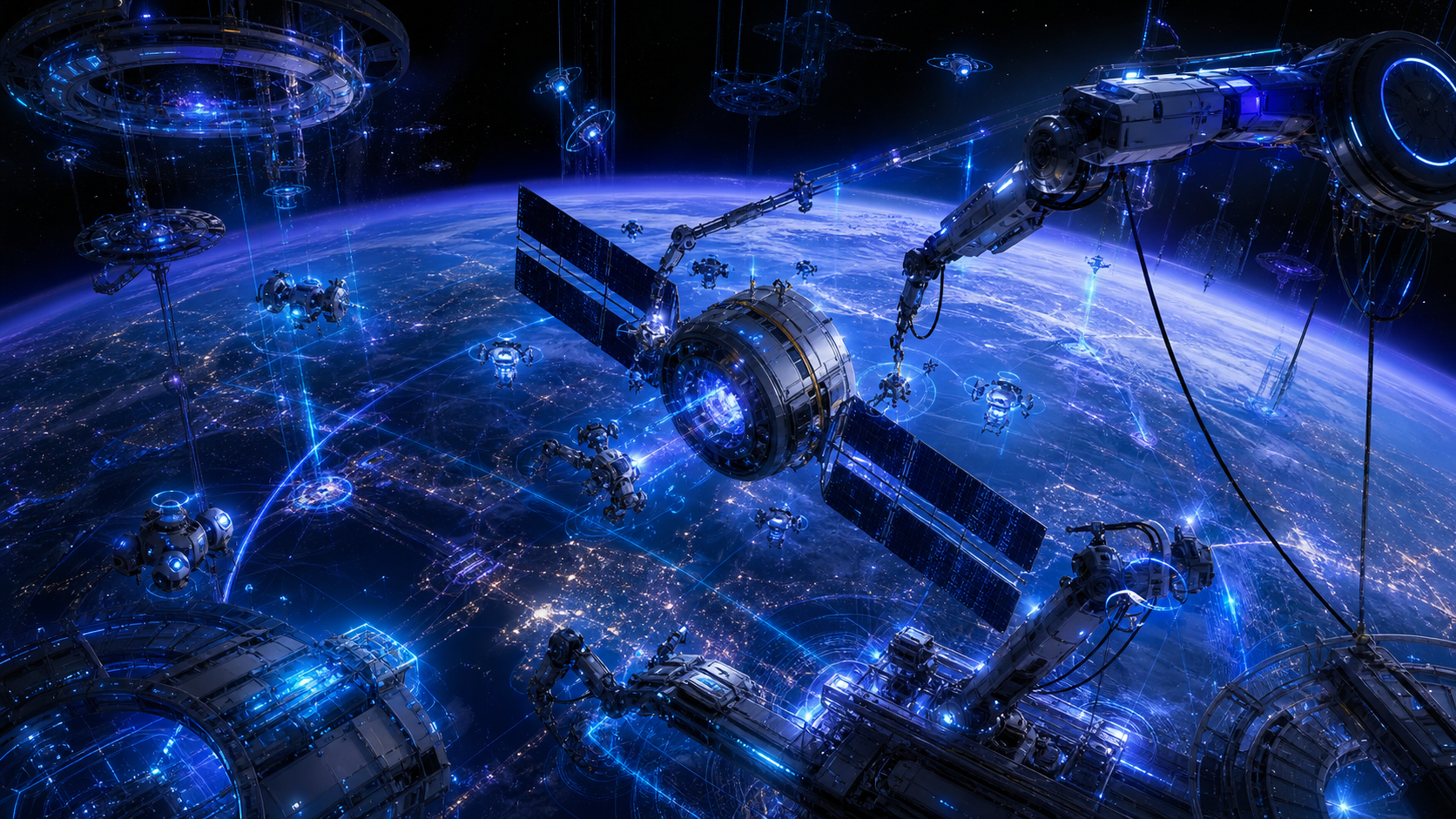
One of the clearest signs that space is maturing into an infrastructure domain is the growing attention to in-orbit servicing. If satellites can be inspected, repaired, repositioned or refuelled after launch, then orbital assets begin to resemble maintainable capital rather than disposable hardware. That has obvious implications for cost, resilience and mission design.
Historically, many spacecraft were treated as sealed systems with finite lives. Once fuel was depleted or a component failed, replacement meant launching another satellite. Servicing changes that logic. It can extend mission lifetimes, reduce replacement pressure and create incentives for modular design. Over time, it may support a richer orbital economy in which spacecraft are upgraded rather than abandoned.
There are caveats. Standardisation is limited, rendezvous operations are technically demanding and legal issues remain unsettled. Not every satellite is worth servicing, and business cases may depend on specific orbits or mission classes. Even so, the conceptual shift matters. Infrastructure is not simply built; it is maintained. The emergence of maintenance in orbit is one of the strongest indicators that space activity is moving beyond one-off missions towards persistent systems.
The moment orbital assets become maintainable, space starts to resemble an operating environment rather than a graveyard of single-use machines.
The military dimension is impossible to ignore
Any serious discussion of space infrastructure must acknowledge security. Modern armed forces rely heavily on satellite communications, intelligence, surveillance, reconnaissance, missile warning and navigation. NATO has described space as essential to deterrence and defence, while government strategies across the United States, Europe and Asia now treat space systems as critical enablers of military effectiveness.
This does not mean every space asset is military, nor that commercial and civil systems are mere adjuncts to defence. It does mean, however, that the boundaries between civilian utility and strategic value are unusually porous. Weather data can support agriculture and operations planning. Commercial imagery can aid insurers and armed forces alike. A communications network that serves remote communities can also matter in a crisis.
The strategic risk is therefore twofold. First, adversaries may target space infrastructure directly through jamming, cyber operations, dazzling or kinetic means. Second, states may become reluctant to rely on systems they do not trust to remain available under stress. This is why resilience has become such a prominent theme. Redundancy, distribution, hardening and rapid reconstitution are not technical luxuries; they are responses to the reality that indispensable infrastructure attracts coercion.
The ground segment is where much of the value is realised
It is easy to imagine space infrastructure as something that exists mainly in orbit. In commercial and operational terms, much of its value is actually realised on the ground. Ground stations receive data, command satellites and route information into terrestrial networks. Data centres process imagery and signals. User terminals, software platforms and analytics pipelines turn raw observations into decisions.
This matters because bottlenecks often appear on Earth rather than in space. Limited downlink capacity can constrain the usefulness of satellites producing large volumes of data. Fragmented ground networks can raise latency and reduce responsiveness. Regulatory delays over spectrum, landing rights or data policy can blunt the value of expensive orbital assets.
The moment orbital assets become maintainable, space starts to resemble an operating environment rather than a graveyard of single-use machines.
The ground segment is also where sovereignty concerns become practical. A country may have access to space-based services yet still depend on foreign ground infrastructure, foreign cloud systems or foreign data processing chains. For policymakers, this broadens the meaning of autonomy. Control over space services is not only about owning satellites; it is about controlling enough of the supporting stack to ensure continuity, security and lawful access.
Governance will shape who benefits and who bears the risk
Space infrastructure is global in effect but uneven in ownership and access. A handful of states and firms operate much of the existing system, while many countries depend on services they did not help design and may not be able to influence. That asymmetry raises familiar questions from other infrastructure domains: who sets the standards, who pays for maintenance, who is liable for failure, and who gets priority during scarcity?
The Outer Space Treaty remains foundational, but it was drafted for an earlier era. Today’s practical questions concern licensing, debris mitigation standards, radiofrequency coordination, data sharing, on-orbit servicing norms and traffic management procedures. Institutions such as the International Telecommunication Union, the UN Committee on the Peaceful Uses of Outer Space and national regulators all play roles, but the framework remains fragmented.
Fragmentation is not always bad; experimentation can be useful. Yet infrastructure performs best when interfaces are stable and expectations clear. Ports need common rules of passage. Power systems need technical standards. Space increasingly needs the same. The absence of harmonised practice does not stop growth, but it does increase transaction costs and systemic risk.
What to watch over the next decade
The next phase of space infrastructure will be defined less by spectacle than by operational maturity. Several questions are worth watching. Will satellite operators converge on common servicing interfaces and disposal norms? Can space traffic coordination move from ad hoc alerts to more standardised, interoperable procedures? Will governments treat orbital debris remediation as a public-good function, a regulated private market, or some hybrid? And can critical services be made resilient enough to withstand both accidents and deliberate interference?
Another issue is whether infrastructure will remain concentrated in a small number of systems or become more distributed. Proliferated architectures can improve resilience by reducing single points of failure, but they also increase coordination demands. Meanwhile, cislunar ambitions and lunar return plans suggest that the infrastructure logic may soon extend beyond Earth orbit to include communications relays, navigation services and logistics nodes farther afield.
None of this guarantees a smooth transition. Infrastructure booms are often followed by periods of consolidation, regulation and repair. Railways, electricity and the internet all underwent phases in which exuberant build-out exposed weaknesses in standards, governance and finance. Space is unlikely to be different.
From prestige projects to critical systems
The clearest way to understand space infrastructure is to see it as part of the hidden architecture of modern life. It supports economic coordination, public safety, scientific knowledge and national security. Its importance lies not in novelty but in dependency: once critical functions rest on orbital services, the continuity of those services becomes a matter of public interest.
That changes the policy agenda. The central questions are no longer simply how to get more hardware into orbit or how to celebrate national achievements in space. They are how to maintain a safe and usable orbital environment, how to build resilient support systems, how to govern shared resources, and how to ensure that the benefits of space-based utilities are not undermined by congestion, insecurity or neglect.
Space, in short, is becoming ordinary in the most important sense. It is turning into infrastructure. And infrastructure, once indispensable, demands stewardship as much as ambition.