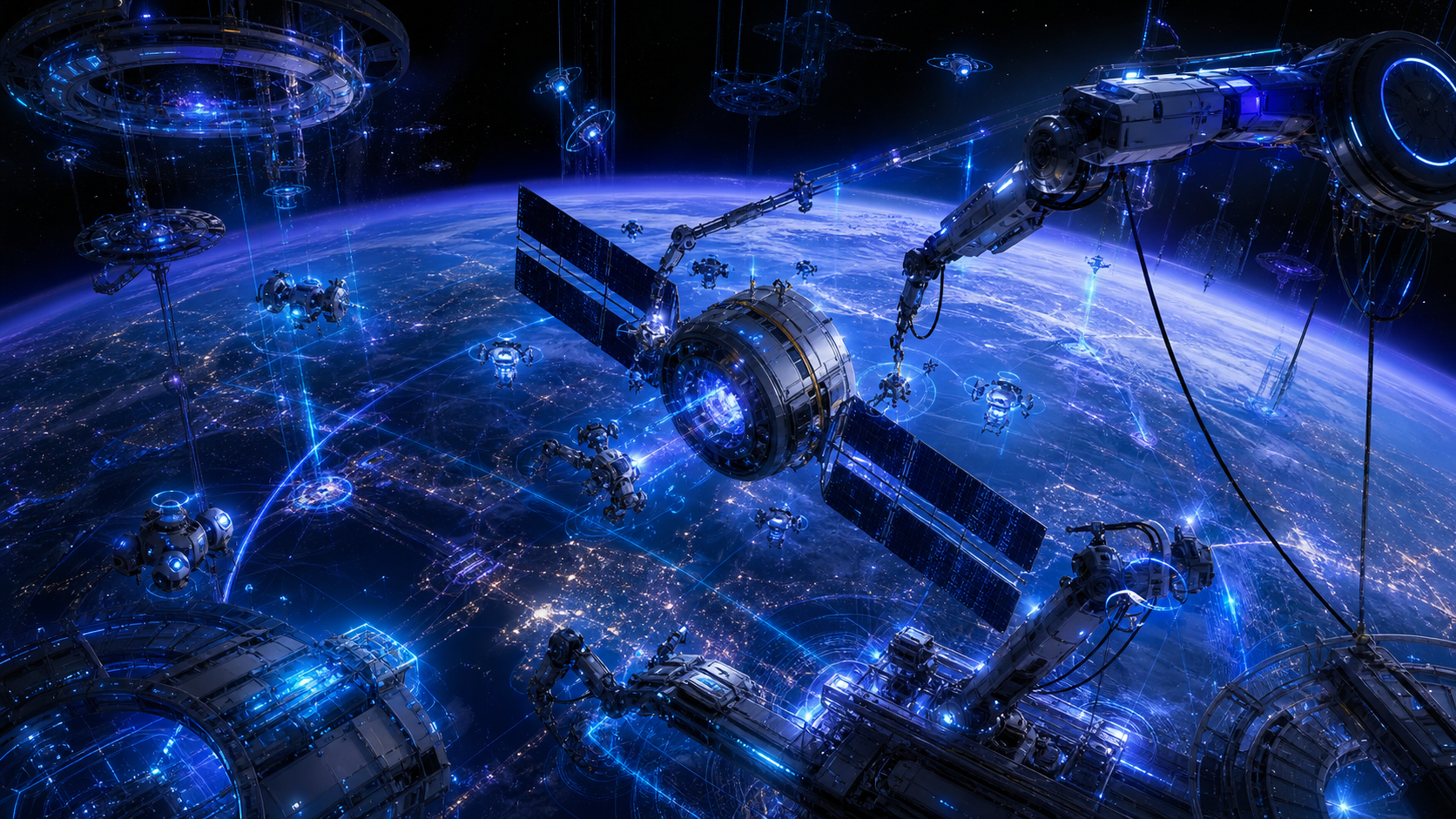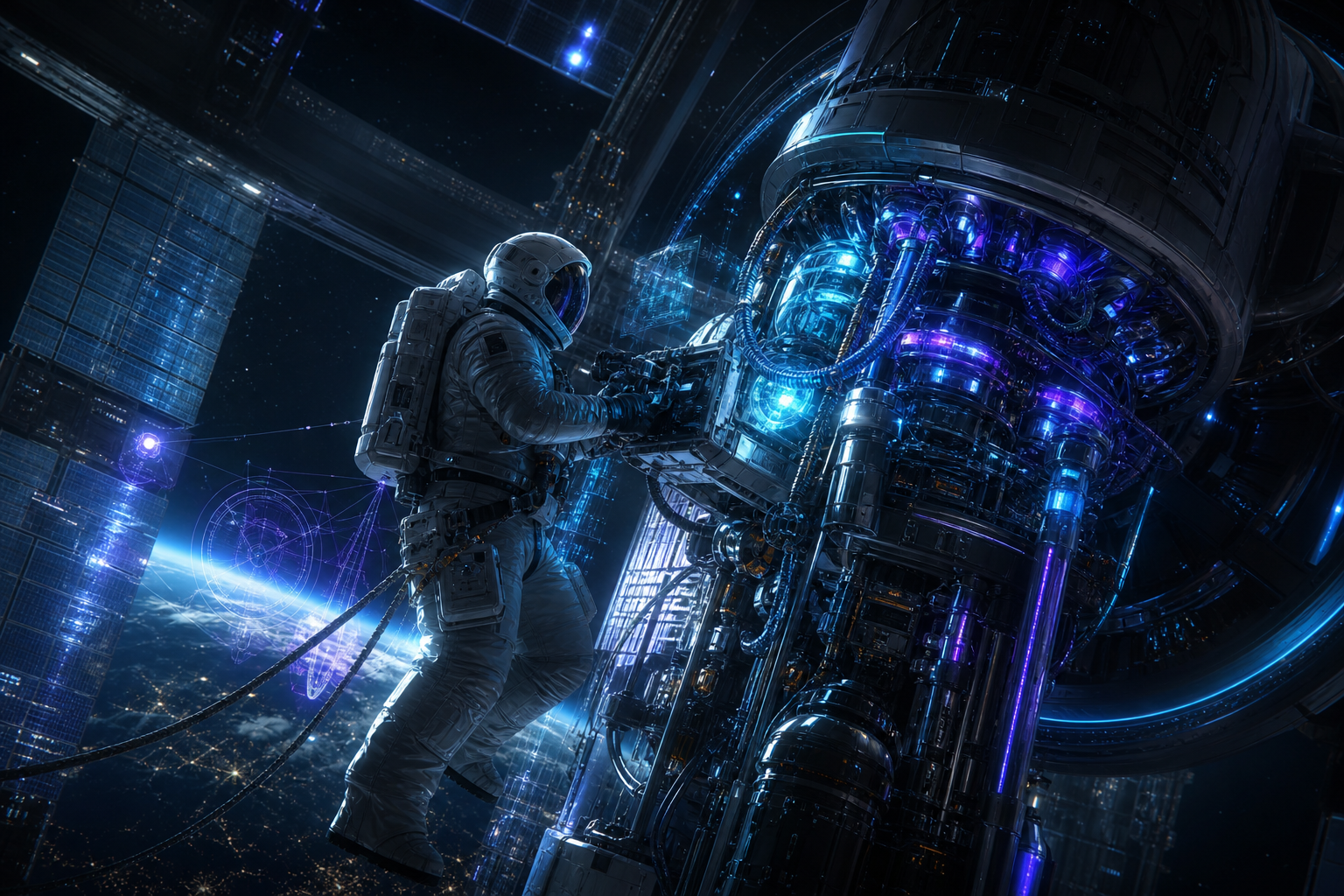
Most discussion of space infrastructure still carries the bias of the launch era. It assumes the central problem is reaching orbit, landing on the Moon, or assembling sufficiently ambitious hardware. Those are formidable tasks, but they are not what distinguishes an expedition from a lasting system. Cities, ports and power grids on Earth endure because they are inspectable, repairable and governed by routines that are far less glamorous than construction. The same logic will apply above the atmosphere. By mid-2026, the sharpest divide in space policy is no longer between public and private actors, or even between cislunar and low-Earth orbit ambitions. It is between architectures designed to be maintained and those that quietly presume replacement.
From heroic missions to service economies
Human spaceflight has long been organised around exceptionalism. Capsules, stations and deep-space hardware were built in small numbers, operated by specialist teams and sustained by unusual budgets. That model can support exploration, but it is a poor template for infrastructure. Infrastructure becomes infrastructure only when somebody can fix it.
The International Space Station offered the first serious demonstration of this principle. Its record is not one of uninterrupted reliability but of continuous intervention: pumps replaced, seals inspected, software patched, atmosphere monitored, solar arrays managed and life-support systems refurbished. NASA’s published lessons from the station make clear that longevity emerged from planned maintenance, access to spares, modular subsystems and crews trained for unexpected failure modes. The station’s importance, in other words, lies not merely in proving that humans can live in orbit for long periods, but in showing how much work is required to keep that statement true.
The hidden mass of permanence
Ambitious renderings of orbital habitats or solar-power platforms usually emphasise scale. What they understate is service burden. Every closed-loop life-support chain depends on filters, valves, sensors and software that degrade in ordinary ways. Communication relays require attitude control, thermal regulation, power management and periodic intervention when components age or environmental conditions diverge from modelled assumptions. Large structures in vacuum suffer from thermal cycling, radiation exposure, micrometeoroid impacts and contamination. None of this is dramatic, but all of it accumulates.
The result is a stubborn engineering fact: permanent presence in space demands a logistics system for the mundane. Spare parts, standard fasteners, diagnostic interfaces, clear maintenance envelopes, robot access points and procedures for isolating faults matter at least as much as launch capability. Redundancy without repair is merely deferred failure.
Why distance changes the economics
In low-Earth orbit, resupply and crew rotation can still disguise poor maintainability. A component that fails too often can be swapped out with acceptable cost and delay, provided launch remains available. Beyond low-Earth orbit, that assumption weakens quickly. Cislunar infrastructure, including planned relay, habitation and logistics elements, faces longer transit times, narrower windows and less forgiving contingencies. A maintenance philosophy based on frequent replacement becomes expensive first and unsafe shortly afterwards.
Infrastructure becomes infrastructure only when somebody can fix it.
This is one reason the architecture around lunar return missions matters beyond the missions themselves. If orbital and surface systems near the Moon are to support repeated operations, they will need maintenance planning from the beginning rather than as an operational afterthought. The technical challenge is not simply to make hardware survive the first campaign, but to create systems that can be diagnosed and restored after the second, sixth or fifteenth anomaly.
The politics of permanence begins with spare parts.
Standards are destiny in orbit
Maintenance becomes radically easier when components can be reached, removed and replaced through shared interfaces. On Earth, container ports, rail gauges, pallet sizes and voltage standards created enormous economic efficiencies not because they were elegant, but because they reduced friction across entire systems. Space has only begun this process. Work on standard interfaces for robotic servicing is promising precisely because it treats serviceability as a public-good problem. If grappling points, refuelling ports, power couplings and data links remain bespoke, every act of repair becomes a custom operation.
This matters for orbital habitats as much as for satellites. Future stations and cislunar nodes will almost certainly combine modules, logistics vehicles and robotic systems from different organisations and jurisdictions. Without common standards, each maintenance task risks becoming a diplomatic and engineering negotiation. With them, servicing capacity can become more modular, competitive and resilient. Standardisation may sound bureaucratic, but in frontier environments it is often the precondition for improvisation.
Robots will do the boring work first
Popular imagination tends to cast space robotics in cinematic terms: autonomous builders assembling giant structures in silence. The more immediate role is humbler and probably more valuable. Free-flying inspectors, dexterous external manipulators and semi-autonomous maintenance aids can handle routine surveys, inventory checks, leak localisation and simple replacement tasks. NASA’s Astrobee programme, though modest in scale, points to an operational logic in which robots reduce the time crews spend on repetitive inspection and lower the risk of overlooking slow-developing faults.
This is especially important because extra-vehicular activity remains punishingly expensive in mass, training and risk. The technical literature on EVA systems makes clear that every hour outside a habitat entails substantial life-support overhead and operational complexity. If robots can shift maintenance from the spacesuit to the workstation, they will not eliminate human skill; they will reserve it for the interventions that genuinely require judgement and dexterity.
Solar arrays are an infrastructure test case
Large solar arrays are often presented as straightforward enablers of orbital industry and long-duration habitation. In practice they are a revealing stress test for the broader infrastructure question. Arrays degrade under radiation, face thermal stress, may suffer tearing or impact damage, and can create awkward structural dynamics as platforms grow larger. Their performance depends not only on initial efficiency, but on cleaning, pointing accuracy, cable integrity, power electronics and fault isolation.
Redundancy without repair is merely deferred failure.
That makes solar power in space less a story of generation than of upkeep. Any future plan for beamed power demonstrators, high-capacity stations or lunar-orbit platforms will stand or fall on inspection access, replacement procedures and graceful degradation strategies. An array that cannot be serviced is not an energy system. It is consumable hardware with a delayed disposal problem.
Debris is maintenance by other means
There is a tendency to treat orbital debris as an environmental issue separate from infrastructure planning. It is better understood as a maintenance tax imposed on every system in orbit. The UN guidelines on space debris mitigation and the OECD’s work on the economics of sustainability both underline the same point: unsafe end-of-life behaviour and collision risk raise costs for everyone, not only through catastrophic loss but through shielding requirements, manoeuvre burdens, insurance implications and operational caution.
For habitats, relays and large structural assemblies, debris risk turns maintenance from a local engineering matter into a network problem. Shielding can reduce vulnerability, but only to a point. The cleaner and more predictable the surrounding orbital environment, the lower the life-cycle burden on all infrastructure within it. Good stewardship therefore functions as a maintenance strategy at system level. It preserves not just access to orbit, but the serviceability of everything already there.
Infrastructure becomes infrastructure only when somebody can fix it.
Lunar distance makes repair a political question
Near the Moon, maintainability will not be distributed evenly. Whoever controls logistics corridors, replacement stock, docking compatibility and repair expertise will hold quiet leverage over the rest of the architecture. Europe’s contribution to cislunar systems, including refuelling and communications elements, illustrates how technical modules can become governance nodes. Maintenance rights, software access, telemetry standards and the authority to certify repairs are not secondary legal details. They are part of the constitutional design of space infrastructure.
This is where the independent language of sovereignty begins to matter. A state or consortium may nominally possess a habitat module or relay asset, yet remain operationally dependent on another actor for diagnostics, spare parts or robotic servicing. Such dependence is manageable in alliances and fragile in crises. The lesson from terrestrial critical infrastructure is familiar: ownership without maintainability is a shallow form of control.
Lessons from the station that planners still underuse
The station’s history offers several durable lessons for any permanent orbital presence. First, modules should be designed for internal access to likely failure points wherever possible; the cost of inaccessible hardware compounds over time. Secondly, consumables and critical spares should be treated as strategic reserves rather than mere inventory. Thirdly, software maintainability deserves parity with mechanical maintainability, because configuration drift and cyber-physical complexity can immobilise perfectly sound hardware. Fourthly, anomaly reporting and shared operational data are infrastructure in their own right.
The politics of permanence begins with spare parts.
These are not abstract management observations. They shape the very geometry of space systems: corridor widths, hatch placement, external handholds, grappling fixtures, cable routing, tool libraries and training regimes. If the next generation of habitats and relays is designed chiefly for launch packaging and first deployment, operators will inherit years of avoidable fragility.
The emerging field of orbital civil engineering
What space lacks, and is beginning slowly to develop, is an equivalent of civil engineering for hostile off-world environments: a discipline concerned not with one-off mission success but with inspection cycles, maintainability budgets, load-path confidence, component traceability and end-of-life recovery. The National Academies’ decadal survey on on-orbit servicing, assembly and manufacturing points in this direction by treating servicing and assembly as foundational capabilities rather than niche add-ons.
That framing is important because it changes procurement logic. If servicing is foundational, then interfaces, diagnostic telemetry, robotic accommodation and replacement pathways should be baseline requirements. They should not be value-engineered away during development and rediscovered after the first expensive fault. Civilisation in space, if it comes, will probably arrive not with a singular breakthrough but with a thousand design decisions that make repair normal.
What permanence will actually look like
It is possible to imagine a permanent human presence in space as a sequence of iconic structures: a habitat here, a relay there, a power node elsewhere. But the more realistic picture is less architectural than procedural. It consists of maintenance windows, software updates, condition-based monitoring, orbital tow capability, stocked depots, robot inspection routes, standards committees and trained technicians who understand failure signatures before they become emergencies.
That may sound prosaic. It is also what durability looks like in every mature infrastructure system on Earth. Space will not be exempt from the discipline of upkeep simply because it is remote or symbolically grand. If anything, remoteness makes the penalty for neglect harsher.
The frontier is a workshop
By mid-2026, the conceptual error in much space commentary is clear. It treats maintenance as support for infrastructure when, in fact, maintenance is one of its defining functions. Orbital habitats, energy arrays and communication relays are not durable because they are advanced. They are durable when they can be inspected without drama, repaired without reinvention and upgraded without rebuilding the whole system around them.
The frontier, then, is not merely a place of exploration. It is a workshop, and eventually a utility environment. The societies that remain in space will be those that learn to preserve function across distance, delay and degradation. Launch opens the door. Maintenance decides whether anyone stays.