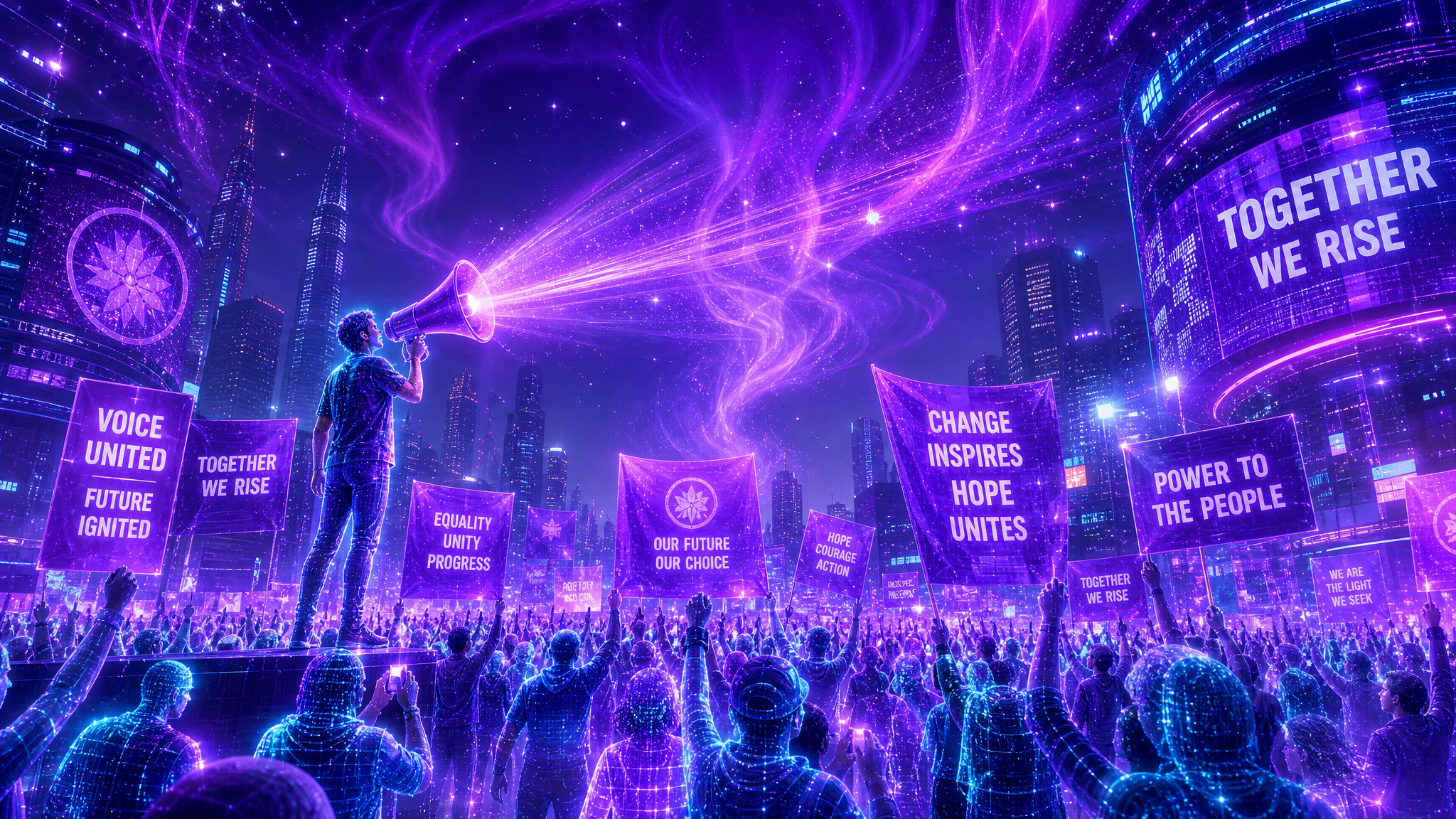
The movement and the medium
Collective action has always depended on communication infrastructures. Pamphlets, newspapers, radio and television each altered how grievances were shared, how leaders emerged and how publics were assembled. Social platforms have extended that pattern, but with a sharper twist: the infrastructure through which movements speak is also the infrastructure that ranks speech, recommends it to strangers and translates engagement into revenue. Protest is no longer merely reported in the media; it is increasingly constituted through media systems whose priorities are only partly civic.
This shift matters because movements are not built only from conviction. They are built from coordination, repetition, emotional resonance and public recognition. A march, a strike or a boycott gains force when people can see one another participating. Digital networks can compress that process dramatically. A slogan can travel globally within hours; a local abuse can become a transnational cause; witnesses can publish before editors decide whether a story merits a front page.
Yet the same systems that lower barriers to expression can also produce brittle politics. Visibility is uneven, attention is volatile and legitimacy is often conferred by metrics that are easy to manipulate and hard to interpret. As scholars of digital contention have argued for more than a decade, connective media can enlarge participation while weakening the durable organisations that historically converted outrage into reform.
Digital media have not made movements shallow by definition, but they have made public visibility both easier to obtain and harder to sustain.
From collective identity to connective action
One of the clearest frameworks for understanding this change comes from W Lance Bennett and Alexandra Segerberg, whose work on “connective action” described a form of mobilisation organised less through formal membership and more through personalised sharing. In older models, parties, unions, churches and campaign groups often supplied ideology, discipline and logistics. In newer ones, individuals participate by circulating frames that fit their own identities and social networks.
This does not imply the disappearance of organisation. Rather, organisation becomes more distributed, more improvised and often more dependent on communication tools that nobody in the movement controls. A hashtag can perform some of the work once done by a newsletter or branch office: it tags a conversation, signals belonging and helps scattered participants discover one another. But hashtags are poor substitutes for institutions when movements must negotiate demands, manage internal conflict or persist through repression and fatigue.
The political consequences are mixed. Connective action can broaden coalitions because it asks less of participants at the point of entry. It can also make coalition maintenance harder because shared symbols may conceal divergent goals. A movement that appears unified in a feed can prove fragmented when confronted with policy detail, electoral trade-offs or the practical burdens of governance.
Witnessing at scale
One reason digital media matter so much to movements is that they have transformed witnessing. Mobile phones, encrypted messaging and social platforms allow participants and bystanders to document events in real time. This has shifted the relationship between institutions and evidence. Police violence, electoral irregularities and attacks on protesters can be recorded and circulated before official statements are drafted. Newsrooms still matter, but their gatekeeping role has narrowed in many moments of rupture.
Digital media have not made movements shallow by definition, but they have made public visibility both easier to obtain and harder to sustain.
Research by the Pew Research Center has shown how many people now encounter news via social platforms, even when they do not seek it out directly. That means movement content reaches audiences beyond committed activists. It also means political events are consumed in settings optimised for speed, juxtaposition and emotional reaction rather than verification or context. The same clip that galvanises support can be stripped of metadata, recaptioned misleadingly or embedded in a flood of unrelated content.
For movements, this creates a paradox. Visual evidence can break denial and force accountability. It can also oversimplify structural problems by centring the spectacular over the systemic. A single dramatic video may travel further than years of patient organising around housing, labour rights or environmental regulation, even when the latter better explains the grievance at hand.
Algorithms as political weather
Platforms are often described as neutral conduits, but their ranking systems function more like political weather. They influence which claims become salient, which emotions are amplified and how quickly narratives stabilise. Researchers at institutions such as the Oxford Internet Institute and Data & Society have documented how recommendation systems and engagement-driven design can privilege provocation, conflict and identity affirmation.
For movements, algorithmic curation can be both accelerant and trap. It helps campaigns break through when conventional media are inattentive or hostile. It also rewards styles of communication that are legible to ranking systems: short, moralised, emotionally charged and visually distinctive. Those features can be effective for attention capture but less useful for deliberation. Complex demands are flattened into symbols, while internal debate is punished by the public logic of virality.
The dependence runs deeper than style. Organisers can spend years building audiences they do not own, only to lose reach after policy changes, moderation decisions or shifts in recommendation logic. This is one reason digitally fluent movements still invest in email lists, face-to-face meetings and parallel communication channels. They have learnt that visibility bestowed by platforms is conditional visibility.
In networked politics, attention behaves like a resource and a hazard at once: indispensable for mobilisation, corrosive when it becomes the movement’s measure of success.
The economics of attention
The logic of contemporary media is not simply technological; it is economic. Much of the online public sphere is funded by advertising or by creator economies that reward sustained engagement. This shapes movement communication in subtle ways. Narratives that can be serialised, personalised and emotionally intensified fit neatly into systems that monetise return visits and repeat interaction. Slow institutional work does not.
The result is a structural bias towards moments over processes. Demonstrations, confrontations and symbolic victories attract attention. Committee hearings, policy drafting, legal appeals and bargaining sessions usually do not. Media scholars such as Zeynep Tufekci have argued that networked movements can therefore achieve “tactical freeze”: they demonstrate impressive scale quickly, yet struggle to translate visibility into leverage because the capacities built by slower organising have not matured at the same pace.
This should not be romanticised into a simple contrast between noble old institutions and fickle new publics. Legacy organisations have often been exclusionary, hierarchical and slow to recognise emergent injustices. Digital media have opened space for voices once ignored by newsroom routines and elite intermediaries. But the economics of attention still impose costs. They favour novelty over continuity and affect over administration, even though successful reform usually requires all four.
Leaderless, but not structureless
In networked politics, attention behaves like a resource and a hazard at once: indispensable for mobilisation, corrosive when it becomes the movement’s measure of success.
Many recent movements have presented themselves as horizontal or leaderless. Digital media make that posture easier to sustain because coordination can occur through shared documents, group chats and public feeds rather than formal chains of command. Horizontalism can protect movements from decapitation and broaden ownership of the cause. It can also obscure who sets priorities, who controls key accounts and who carries the unglamorous burdens of moderation, security and logistics.
Political sociologists have long warned that informal structures do not eliminate power; they redistribute it less transparently. In digital movements, influence often accrues to those who are highly connected, camera-ready, technically skilled or able to produce content at speed. These are forms of leadership, even when they are not acknowledged as such. The risk is not merely hypocrisy. It is strategic confusion. Without recognised procedures for decision-making, movements can find it hard to settle disputes, revise tactics or negotiate with institutions without appearing co-opted.
Here, media incentives matter again. Publics often celebrate spontaneous uprisings and distrust bureaucracy. But sustained campaigns require routines that are, by design, less dramatic than the moments that first captured attention. The challenge for movements is not to choose between spontaneity and structure. It is to sequence them: to convert moments of rapid visibility into capacities that outlast the feed.
The information disorder problem
Movements operate in an environment saturated by misinformation, disinformation and strategic manipulation. The problem is not confined to fringe spaces. Mainstream platforms can rapidly circulate false rumours, doctored images and decontextualised clips, especially during crises when users are primed for emotional interpretation. UNESCO and other international bodies have highlighted how information disorder can erode trust, endanger journalists and activists, and distort democratic deliberation.
For protest movements, falsehoods can be especially damaging because they attack both legitimacy and safety. Claims that a demonstration was violent when it was not, that participants were foreign agents, or that fabricated plans are genuine can justify repression and split coalitions. Even when corrections emerge, they often travel more slowly than the original claim. The burden of verification falls on networks already under pressure.
At the same time, movements themselves are not immune to circulating inaccurate information. In high-arousal environments, sympathetic participants may share unverified material because it aligns with broader truths they recognise. This is politically understandable but strategically risky. Credibility is cumulative and fragile. Once publics begin to view a movement’s information ecosystem as unreliable, opponents gain an opening to discredit authentic evidence as well.
The decisive contest is often not over whether people care, but over which version of events becomes common sense before verification catches up.
Journalism’s altered role
Professional journalism remains a crucial mediator between movements and wider publics, but its role has changed. Reporters are no longer the sole discoverers of events; often they are verifiers, explainers and translators of material that surfaces first online. This can improve accountability by widening the evidentiary base. It can also strain editorial judgement when vast quantities of footage, claims and commentary must be assessed rapidly.
There is a deeper issue. News values and platform values increasingly interact. Journalists monitor social platforms for leads because that is where publics signal urgency. Yet if editors rely too heavily on digital salience, coverage may overrepresent movements that are visually compelling, urban, English-speaking or already networked to influential audiences. Less mediagenic struggles can remain underreported even when their stakes are just as high.
The healthiest response is neither nostalgia nor surrender. It is renewed emphasis on verification, context and proportionality. Journalism adds value when it traces funding and power, tests claims against records, compares moments to historical patterns and follows the story after the trending peak. Movements need not fear that work. Serious scrutiny can strengthen legitimate causes by distinguishing them from performative surges and organised manipulation.
The decisive contest is often not over whether people care, but over which version of events becomes common sense before verification catches up.
Repression has become more datafied
The same digital systems that help movements coordinate also create vulnerabilities. Public posts reveal networks, locations and routines. Images expose faces. Metadata can aid surveillance. Human rights organisations such as Amnesty International have documented the expanding use of digital surveillance technologies against civil society, including spyware and broad forms of data collection. Even when states are not directly involved, harassment campaigns can exploit open networks to intimidate participants.
This datafied environment changes movement strategy. Organisers now routinely weigh visibility against exposure, and openness against security. Encrypted channels, consent practices for photography and operational discipline have become basic components of movement infrastructure. Yet these protections are unevenly understood and unevenly available. The most vulnerable participants often bear the greatest risk.
There is also a normative tension. Democracies benefit when protest is visible enough to command public attention. But citizens should not have to surrender extensive personal data to participate in lawful dissent. As digital rights scholars have argued, the freedom to assemble increasingly depends on privacy safeguards, robust legal oversight and limits on both state and commercial surveillance.
What endurance now requires
If media systems reward acceleration, durable movements must build counterweights. That means developing forms of organisation that can survive fluctuating attention: local chapters, legal support, training, trusted messengers, archives, policy expertise and independent channels of communication. None of these are glamorous. All of them matter when the spectacle fades and institutions begin the slower work of resistance or accommodation.
Endurance also requires narrative discipline without narrative rigidity. Movements need frames broad enough to mobilise diverse publics, but precise enough to guide action and evaluate trade-offs. They need visible figures who can communicate clearly, yet governance arrangements that do not collapse if those figures disappear. And they need media literacies that treat virality as a tactical asset rather than a strategic endpoint.
The larger lesson is that communication infrastructures do not determine outcomes, but they shape the repertoire of contention. They alter what kinds of participation feel available, what kinds of evidence seem persuasive and what kinds of leadership become legible. Movements that recognise these constraints can use digital media more intelligently: not as a substitute for power, but as one terrain on which power is contested.
Beyond the feed
It is tempting to ask whether social platforms have been good or bad for protest. The question is too blunt. They have expanded witness, sped up coordination and lowered entry costs for participation. They have also deepened dependency on opaque systems, intensified information disorder and privileged symbolic action over institutional stamina. Both statements are true.
For analysts of media and movements, the central task is therefore not moral verdict but institutional design. Which rules of moderation, transparency and data governance better protect civic action? Which journalistic practices improve verification without muting emergent voices? Which movement structures convert attention into bargaining power and policy durability?
Those questions will outlast any single cycle of protest. Collective action will continue to seek the media forms of its age. The distinctive challenge of this one is that the public arena is increasingly organised by infrastructures built for engagement first and citizenship second. Movements can thrive within that reality for a time. To change societies, they usually need to build something sturdier than a trend.