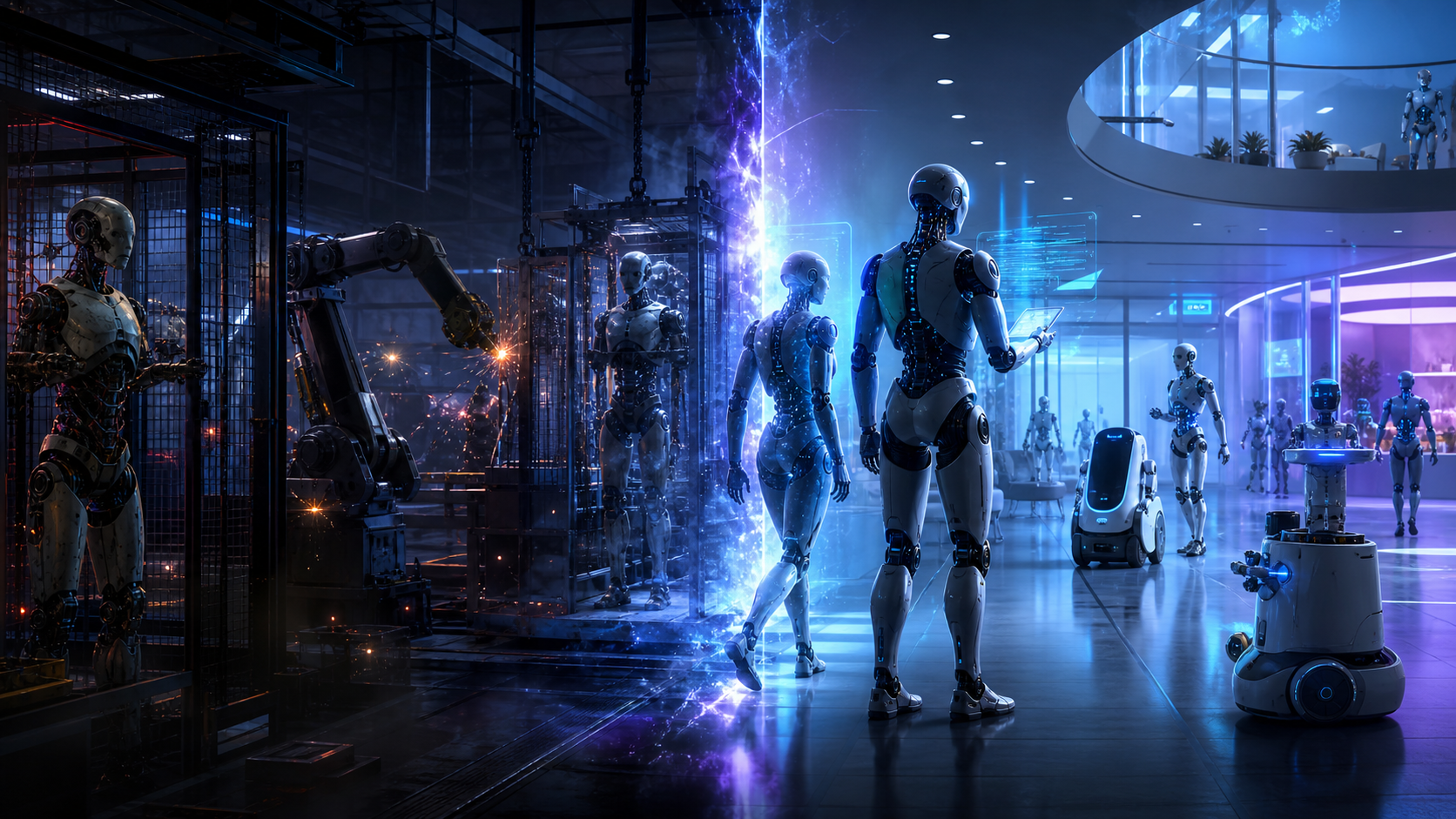
The long prehistory of machine labour
Robotics is often narrated as a recent story, driven by dramatic videos of machines running, grasping or speaking. In fact, its roots run much deeper. Long before digital computing, engineers and inventors were preoccupied by a simple question: could mechanical systems reproduce useful elements of human movement? Early automata offered spectacle rather than productivity, but they established a recurring ambition—to encode motion, sequence and purpose into artefacts. That ambition would later become industrial, then computational, and only much later genuinely autonomous.
The modern field took shape when mechanical engineering met electronics and control. Servomechanisms developed during the early twentieth century showed that machines could measure their own state and correct their actions. This was a conceptual turning point. A machine was no longer merely executing a fixed movement; it could adjust, however narrowly, in response to changing conditions. Such feedback would become the basis of industrial robots, mobile robots and eventually humanoids.
Even at this early stage, the core challenge was visible. Human environments are variable, cluttered and unpredictable. Machines excel where tasks are repeatable. The history of robotics is therefore not simply a march towards ever more human-like machines. It is the gradual extension of machine competence from highly ordered settings into less structured ones.
The 1950s and 1960s industrial robot era begins
The first decisive milestone came with industrial automation. In the late 1950s and early 1960s, programmable robotic manipulators moved from concept to commercial deployment, especially in manufacturing. Their importance lay not in intelligence but in repeatability. A robotic arm could perform the same weld, lift or transfer thousands of times with high consistency. In sectors such as automotive production, that reliability had obvious value.
Factories were ideal early habitats for robots because they could be engineered around machine constraints. Workcells were fenced, parts were placed in known locations, and tasks were tightly specified. This reduced the need for perception or adaptation. Industrial robots did not need to understand the world; they needed to execute trajectories accurately and safely within a controlled system.
Robots first succeeded not by thinking like people, but by avoiding the need to.
This period also clarified the economics of robotics. Adoption depended less on novelty than on labour cost, throughput, quality control and workplace safety. Repetitive, hazardous or ergonomically difficult tasks were the natural footholds. That pattern has endured. Whenever robotics has created durable value, it has usually done so by taking on work that is dangerous, dull or highly repetitive before attempting work that is dexterous, social or ambiguous.
The 1970s formalise robotics as a scientific field
If the 1960s proved that programmable machines could be commercially useful, the 1970s helped define robotics as an academic discipline. Research laboratories began bringing together mechanics, computer science, electrical engineering and artificial intelligence. Questions of motion planning, machine vision, sensor fusion and manipulation moved from isolated projects into a shared field of inquiry.
Much of the foundational mathematics emerged in this era. Kinematics described how joints and links generated movement. Dynamics explained how forces acted through mechanisms. Control theory improved the precision and stability of machine motion. In parallel, early work in computer vision and planning sketched the possibility that robots might one day perceive and reason about their surroundings rather than merely replay stored routines.
Robots first succeeded not by thinking like people, but by avoiding the need to.
Yet progress was uneven. Computing power was limited, sensors were expensive and unreliable, and the gap between laboratory demonstrations and practical deployment remained large. Robotics gained intellectual coherence before it gained broad real-world flexibility. This gap between what could be shown in research settings and what could be sustained in production would recur repeatedly over the next half-century.
The 1980s expand automation but expose rigid limits
During the 1980s, robots spread further across manufacturing. Improvements in electronics, programmable controllers and mechatronics made automation more capable and, in some cases, easier to integrate. Industrial robot installations increased, and governments in advanced manufacturing economies started tracking robotics as a marker of industrial competitiveness.
But this expansion also highlighted a limitation that still shapes the field: rigid automation works best when the world is equally rigid. Reprogramming systems for product changes could be costly. Small variations in part placement, lighting or material could cause failures. The more varied the task, the more difficult it became to justify deployment. Robotics was valuable, but often brittle.
This mattered because many of the largest sectors of employment—care, logistics, construction, retail, hospitality—are defined by variability. They involve soft objects, cluttered spaces, human co-workers and constant exceptions. Robotics had become excellent at repeatability, but not yet robust at adaptation. The next major advances would come from trying to narrow that gap.
The 1990s bring mobility, field robotics and public imagination
The 1990s broadened the idea of what robots could be. Rather than remaining fixed manipulators, robots increasingly appeared as mobile systems able to traverse warehouses, streets, oceans and planetary surfaces. Research in simultaneous localisation and mapping, mobile navigation and embedded computation began to mature. This was also the decade in which robotics captured public imagination more visibly, helped by landmark demonstrations in legged locomotion and autonomous exploration.
One reason mobility mattered so much is that it forced robotics to confront the real world directly. A mobile robot cannot assume the environment is fully known. It must localise itself, build maps, avoid obstacles and cope with uncertainty. These are difficult problems, but solving them opened new domains including search and rescue, defence, agriculture and logistics.
Humanoids also gained prominence as research platforms during this period. Their appeal was partly symbolic, but there was a practical logic too. Human spaces—from staircases to tools to door handles—are built around human bodies. A machine with roughly human proportions might be able to use existing infrastructure without requiring the environment to be redesigned. The challenge, of course, was that balancing, walking, manipulating and interacting in such spaces proved vastly harder than building wheeled or fixed systems.
The 2000s make robots useful outside the factory
By the early 2000s, several enabling technologies were improving together: cheaper sensors, better batteries, stronger onboard computation and more reliable actuators. This did not solve robotics, but it made many systems more practical. Warehousing, surgery, domestic cleaning and aerial inspection all saw notable growth. Robots were no longer confined to heavy industry; they were beginning to enter service settings and specialised professional workflows.
At the same time, the field learned an important strategic lesson. General-purpose autonomy remained elusive, but tightly scoped applications could succeed if the task, environment and business case were aligned. A robot did not need to handle every possible household chore to deliver value in floor cleaning, nor did autonomous navigation require human-level reasoning to be transformative in a bounded warehouse.
Each wave of progress in robotics has depended less on a single invention than on the alignment of hardware, software and a workable operating environment.
Each wave of progress in robotics has depended less on a single invention than on the alignment of hardware, software and a workable operating environment.
This insight explains why robotics often advances in uneven bursts. Technical capability alone is insufficient. Deployment also depends on maintenance models, safety cases, integration with existing workflows, and the willingness of organisations to redesign processes around machines. In other words, robotics is not just an engineering problem. It is a systems problem.
The 2010s combine machine learning with embodied machines
The 2010s were shaped by a broader transformation in artificial intelligence. Machine learning, especially deep learning, dramatically improved capabilities in perception: object recognition, scene understanding, speech processing and pattern extraction from large datasets. For robotics, this was significant because perception had long been one of the major bottlenecks between controlled environments and open ones.
Robots began to identify objects more reliably, detect people, interpret sensor streams and make better predictions about what was happening around them. In parallel, improvements in simulation, cloud computing and reinforcement learning provided new ways to train or test control policies. For manipulation and locomotion, however, reality remained stubborn. Perceiving the world is easier than acting in it. Grasping arbitrary objects, handling deformable materials and moving safely through crowded spaces still posed serious difficulties.
The decade also saw renewed excitement around legged machines and advanced mobility. Improved actuators and control systems enabled robots to run, recover balance and traverse rougher terrain. Such demonstrations mattered because they addressed one of the fundamental constraints of real-world deployment: many environments are not smooth, standardised factory floors. Stairs, rubble, grass, kerbs and uneven surfaces are commonplace. If robots are to work broadly in human environments, mobility and balance are not embellishments; they are prerequisites.
The pandemic years sharpen demand for automation
The early 2020s did not create the case for robotics, but they intensified several existing pressures. Supply-chain disruption, labour shortages in logistics and care, and concerns around resilience prompted many organisations to revisit automation plans. Warehouses, fulfilment centres, hospitals and food production sites were already experimenting with robots; now the strategic rationale became stronger.
It would be misleading, however, to interpret this as a simple acceleration. Some deployments expanded quickly, especially in settings where tasks were repetitive and environments semi-structured. Elsewhere, adoption remained slower than expected because integration, training, regulation and reliability constraints persisted. Robotics tends to expose hidden complexity in workflows that once looked straightforward when performed by people.
Still, the period changed the conversation. Robots came to be seen less as discretionary experiments and more as part of a broader resilience toolkit. For policymakers, this raised new questions: how should safety standards evolve? What happens to work organisation when humans and machines share spaces more closely? How can productivity gains be distributed without deepening labour insecurity?
Humanoids move from research ambition to industrial trial
Humanoid robots have periodically attracted attention for decades, often oscillating between genuine technical promise and overstatement. What is different now is not that the engineering challenge has disappeared—it has not—but that several enabling components have matured enough to make industrial trials more plausible. Better electric actuators, more compact compute, stronger battery systems, improved visual models and advances in whole-body control have narrowed some of the historical gap between demonstration and deployment.
The practical case for humanoids rests on a specific argument. The world already contains infrastructure optimised for the human form: shelves, tools, corridors, handrails, switches and vehicles. If a robot can navigate those spaces and manipulate those artefacts without requiring major retrofitting, deployment barriers may fall. That would be particularly relevant in brownfield industrial sites, where replacing infrastructure is expensive.
Yet the obstacles remain formidable. Bipedal locomotion is energetically costly and mechanically complex. Falls create safety and durability risks. Hands are difficult to engineer, and robust manipulation remains one of the hardest unsolved problems in robotics. In many settings, wheels, rails or fixed automation are likely to remain superior on cost and reliability. Humanoids therefore should not be viewed as the inevitable end-state of robotics, but as one design strategy among several for particular environments.
The central question is not whether robots can look human, but whether they can work reliably where humans already do.
The central question is not whether robots can look human, but whether they can work reliably where humans already do.
Regulation, safety and standards become strategic issues
As robots move closer to people, governance matters more. Industrial robots were traditionally separated from workers by cages and strict procedures. Collaborative robots and mobile systems changed that arrangement, requiring new approaches to risk assessment, speed and separation monitoring, force limitation and human-machine interaction. International standards bodies and national regulators have gradually expanded guidance, but implementation remains a live challenge.
Safety is not merely a compliance matter. It affects economics, trust and adoption. A robot that is technically capable but difficult to certify or insure may struggle commercially. Conversely, clear standards can reduce uncertainty and help firms invest. This is especially important for humanoids and service robots, which often operate in spaces where bystanders are present and behaviour is less predictable than on a production line.
There is also a data question. Increasingly capable robots rely on cameras, microphones, connectivity and machine learning models. That creates concerns around privacy, cybersecurity and accountability. A machine that physically acts in the world while continuously sensing it occupies a different regulatory category from conventional software. Future policy will need to treat robotics as both digital infrastructure and embodied machinery.
The labour question shifts from replacement to reorganisation
Debates about robotics often gravitate to a simple binary: will machines replace workers or not? History suggests a more nuanced answer. Robots do automate some tasks and can reduce demand for certain forms of labour in particular settings. But they also reorganise workflows, create demand for technicians and integrators, and alter the skill mix within firms. The impact depends heavily on sector, deployment model and institutional context.
In manufacturing, robotics has often complemented high-value production by improving quality and throughput. In logistics, it can reduce walking time, lifting strain and bottlenecks, even if many human roles remain. In care and hospitality, the barriers are not just technical but social. People often value empathy, discretion and judgement that are difficult to formalise. This does not mean robots are irrelevant in those sectors; it means their role is likely to be assistive, selective and uneven.
For governments, the pressing issue is less a singular jobs apocalypse than transitional friction. Regions and occupations exposed to automation may face disruption before gains are redistributed. Training, workplace design and social policy will determine whether robotics raises productivity in ways that broaden prosperity or simply concentrate returns among capital-intensive firms.
What comes next for robotics and humanoids
The next decade in robotics is unlikely to be defined by one dominant machine type. More probably, the field will continue to diversify. Fixed arms will become easier to programme. Mobile robots will spread where navigation and materials handling are already mature. Agricultural, inspection and healthcare systems will grow in niches shaped by labour scarcity and safety needs. Humanoids may find footholds in tasks where human-designed infrastructure makes them more practical than purpose-built alternatives, but that outcome is contingent, not assured.
Two forces will be decisive. The first is software abstraction. If programming robots becomes less bespoke—through better interfaces, simulation, learned policies and more adaptable planning—deployment costs could fall sharply. The second is reliability in unstructured settings. The machines that matter most commercially will not be those that perform astonishing feats once, but those that work tolerably well every day with manageable maintenance and clear safety cases.
Seen in timeline form, robotics is not a sequence of spectacular inventions but a cumulative negotiation between engineering possibility and environmental complexity. The field has advanced whenever designers reduced the burden placed on the machine, improved the machine's ability to cope with variation, or reshaped workflows so the two could meet in the middle. Humanoids belong to that story, but they do not supersede it. The enduring theme is adaptation: first by humans to machines, and gradually, now, by machines to the human world.