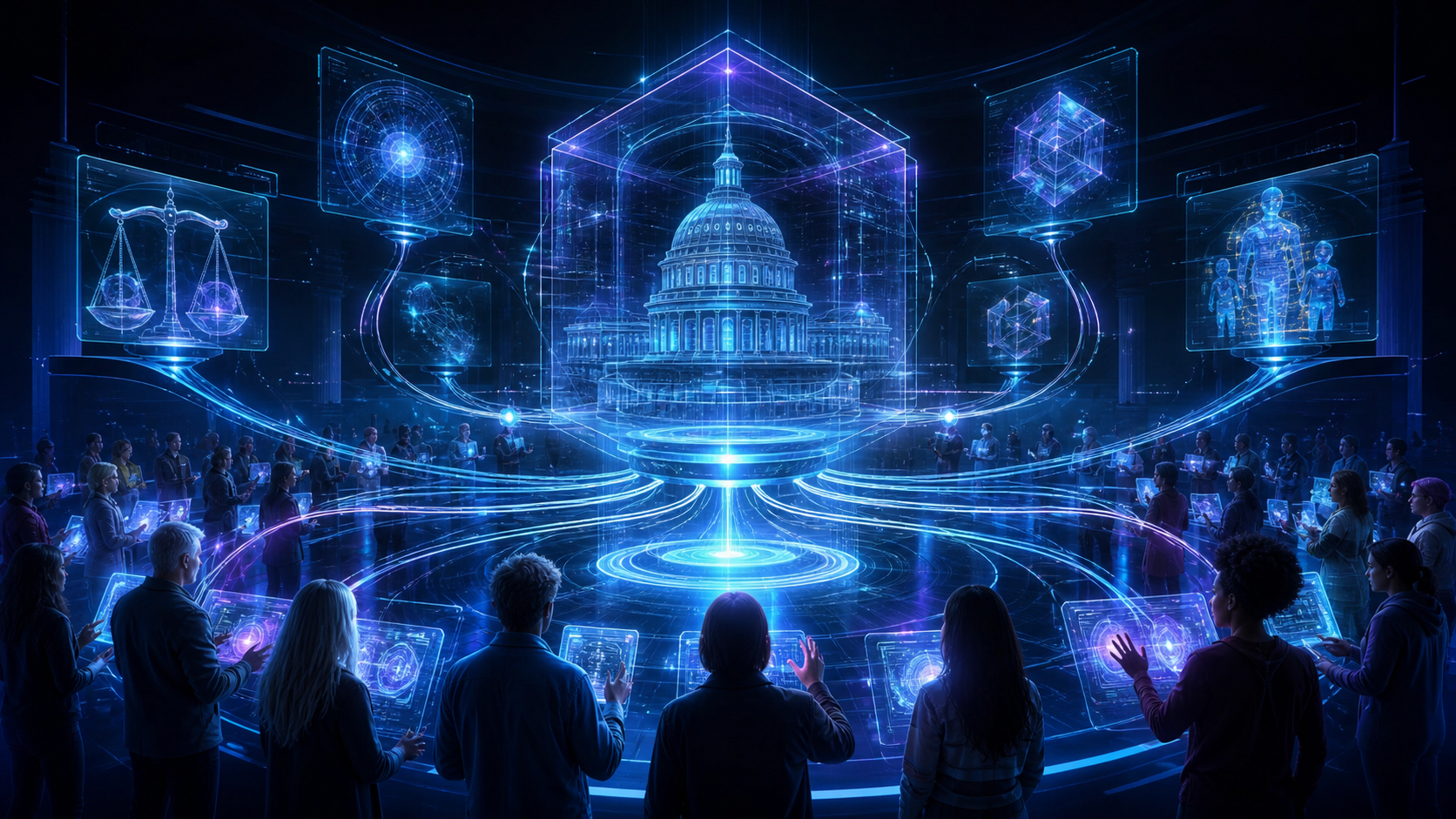
Digital democracy has spent two decades trying to answer the wrong question. The argument has centred on access: how to authenticate users, widen participation, lower transaction costs and make institutions more permeable between elections. These matter. Yet by mid-2026 the more revealing failure is elsewhere. Even where participation expands, states often lack a reliable public memory of what citizens actually said, why they said it, what trade-offs emerged and which arguments survived scrutiny. A democracy that can speak constantly but cannot remember coherently will struggle to govern itself.
This is not merely an administrative inconvenience. It is becoming the constitutional weakness of participation-heavy politics. Petition platforms, consultation portals, citizens’ panels, online submissions, participatory budgeting exercises and assembly recommendations have multiplied across many democracies. What has not kept pace is the infrastructure for turning repeated bursts of input into a cumulative body of civic reasoning. Representation-only systems forgot citizens too often; platform-mediated participation risks forgetting them faster.
The age of continuous input
The practical achievement of digital tools is obvious enough. They let institutions consult larger publics more frequently and at lower cost than the analogue state could manage. OECD work on citizen participation and deliberative practice has documented a clear spread of assemblies, mini-publics and hybrid consultation formats. The European Union’s Conference on the Future of Europe demonstrated both the promise and the limits of this trend: thousands participated, many proposals were gathered, and some recommendations travelled into formal channels. But such processes also revealed a structural problem. Once the event ends, where does the public reasoning go, in a form that can be reused by legislators, civil servants, journalists and later citizens?
Most systems have an archive in the thin sense: documents are uploaded, recommendations listed, transcripts stored somewhere. That is not the same as an institutional memory. Memory requires selection, synthesis, contestability and retrieval. It means that when a government reopens housing reform, agricultural transition or school funding, it can identify not only previous demands but the arguments, evidence claims, minority objections and unresolved dilemmas attached to them. In most democracies this capacity remains weak.
Why memory is now the bottleneck
In electoral democracy the calendar itself imposed a kind of cognitive discipline. Manifestos, parliamentary committees and party competition compressed vast disagreement into periodic choices. Digital participation dissolves that compression. Citizens can intervene at any point, on any issue, in multiple formats. The gain is responsiveness; the cost is fragmentation. Public institutions face a torrent of comments, proposals, ratings and testimonies, often incompatible in style and quality. Without a method for preserving deliberative context, participation becomes a stream of decontextualised demands.
Participation without memory favours the loud, the recent and the emotionally legible. Administrations become vulnerable to recency bias, media cycles and organised repetition. The same idea can look politically overwhelming simply because it reappears in many channels, while a difficult but carefully reasoned position disappears because it is less portable. The central design problem is no longer only how to count preferences, but how to preserve reasons.
Participation without memory favours the loud, the recent and the emotionally legible.
A democracy that can speak constantly but cannot remember coherently will struggle to govern itself.
Representation used to perform this function badly
There is a tendency in digital-democracy discourse to treat representatives as little more than bottlenecks between citizens and decisions. That caricature misses one of the historical functions of representative institutions: they acted as memory machines. Parties carried ideological narratives across election cycles. Committees accumulated expertise. Civil services stored precedent. Parliamentary debate linked present disputes to prior commitments. None of this guaranteed wisdom, and much of it excluded the public. But it did create continuity.
The current ambition is to supplement or partially bypass these institutions without rebuilding their mnemonic role in a more open form. Liquid democracy, delegated voting and standing participatory channels may distribute voice more finely. They do not, by themselves, answer how a polity keeps track of why a question was settled one way last year and why a minority insisted on another. A well-designed democracy should be able to say, in public, not merely what decision was taken but what chain of collective reasoning led there.
What a civic memory system would do
A genuine civic memory system would not be a single database. It would be a set of public procedures. First, it would capture inputs in structured form without flattening them into sentiment scores. Second, it would produce transparent syntheses that distinguish proposals, supporting reasons, evidence cited, assumptions made and objections raised. Third, it would preserve dissent rather than only consensus. Fourth, it would allow future participants to query previous debates: what was argued, by whom, on what evidence, and with what eventual result.
Such a system would also need rules of legitimacy. Summaries should be reviewable. Participants should be able to challenge mischaracterisation. Public officials should be required to indicate when they are departing from prior recommendations and why. This is less glamorous than digital voting, but institutionally it may matter more. Voting registers a choice at a moment in time. Memory links one moment of self-government to the next.
The case for durable deliberation
The strongest argument for citizen assemblies has never been that they are more authentic than elections. It is that under fair conditions they can generate considered judgement rather than immediate reaction. Yet deliberative gains evaporate if each assembly begins as if nothing came before. OECD guidance increasingly stresses feedback loops and clarity about how public inputs affect decisions. The missing extension is temporal: feedback should run not only back to current participants, but forward to future ones.
Imagine climate adaptation, social care or urban transport treated as long-duration public files rather than episodic consultations. Each new round of participation would inherit a structured account of previous arguments, accepted facts, contested assumptions and implementation failures. Citizens would not be asked endlessly for first impressions. They would be invited into an ongoing civic conversation with memory, revision and traceable learning. That would make participation more demanding, but also more respectful.
Why artificial intelligence sharpens the issue
Participation without memory favours the loud, the recent and the emotionally legible.
The arrival of large language models in public administration changes the stakes. Used carelessly, such systems can reduce democratic input to automated summarisation: plausible, efficient and politically dangerous. A machine-generated digest may conceal the normative choices involved in deciding what counts as duplication, extremity, relevance or consensus. The literature on AI in government has underlined the epistemic and political risks of delegating public judgement to opaque systems. In participatory settings those risks are acute because summarisation is itself a constitutional act.
Still, the answer is not to ban computational assistance. At scale, no administration can manually process millions of words of public input. The sensible path is to treat AI as an auditable support layer within publicly defined deliberative procedures. Models may help cluster themes, identify repeated claims or retrieve earlier debates. They should not enjoy hidden authority to decide which reasons matter. In digital democracy, the question is not whether algorithms will mediate civic memory, but whether that mediation will be contestable.
The central design problem is no longer only how to count preferences, but how to preserve reasons.
From archives to constitutional infrastructure
Open-government reforms have often assumed that publication equals accountability. Put the submissions online, release the report, perhaps provide a dashboard, and transparency is deemed satisfied. But transparency is not memory. Raw disclosure helps watchdogs and researchers; it does not necessarily help the polity think. The practical burden of interpretation then falls to advocacy groups, party staff, lobbyists and media outlets, all of whom have incentives to curate selectively.
If digital participation is to become constitutional infrastructure rather than democratic theatre, states need intermediary institutions dedicated to civic memory. These could sit alongside parliaments, audit bodies or electoral commissions, with mandates to maintain public reasoning records for major participatory processes. Their role would not be to tell citizens what to think, but to preserve an accurate, revisable account of what has been thought and argued in authorised public forums.
The politics of forgetting
Institutional amnesia is not neutral. It redistributes power. Actors with resources can preserve their own memory through legal teams, trade associations, internal archives and sustained lobbying. Ordinary citizens generally cannot. When governments reopen questions repeatedly without carrying forward earlier reasoning, well-organised interests effectively enjoy continuity while publics begin from scratch. That asymmetry helps explain why many citizens experience consultation as extraction rather than influence: they are asked to contribute, but the state rarely demonstrates cumulative listening.
This problem is especially severe in periods of democratic backsliding and administrative churn. When ministries are reorganised, priorities reversed or digital platforms replaced, participatory history can vanish into dead links and inaccessible formats. International IDEA and other institutions have warned that democratic erosion is often gradual and procedural. The decay of civic memory fits that pattern. A system need not cancel elections to hollow out self-government; it can simply fail to remember public reasoning well enough for citizens to hold it to account.
The central design problem is no longer only how to count preferences, but how to preserve reasons.
Minorities need memory more than majorities do
One neglected virtue of durable civic memory is its protection of minority positions. Majorities have many ways to make themselves felt again. They can win the next vote, dominate the next consultation or benefit from alignment with prevailing sentiment. Minority arguments are more fragile. If they are not preserved faithfully, they can disappear until events vindicate them too late. The public record should therefore capture not only what most participants preferred, but what important minorities warned, feared or proposed.
This is not a sentimental case for giving every view equal status. It is a hard-headed argument about democratic intelligence. Complex societies learn by keeping track of rejected arguments as well as accepted ones. Some will prove misguided. Some will become newly relevant when conditions change. A memory-poor democracy loses this capacity for self-correction. It repeatedly rediscovers old objections as if they were novel, while its citizens grow cynical about the ritual of being heard.
The administrative objection
The obvious objection is cost. Public administrations already struggle to staff existing participatory processes. Building reviewable reasoning records, maintaining metadata standards, preserving dissent and enabling public challenge all sound burdensome. They are burdensome. But so are weak decisions made after shallow consultation, followed by appeals, reversals and renewed mistrust. The choice is not between simple participation and expensive memory. It is between paying for interpretive capacity upfront or paying later for incoherence.
There is also a more subtle objection: democracies require forgetting as well as remembering. Endless preservation can harden outdated frames and trap current citizens inside inherited disputes. That is true. Civic memory should not become civic sediment. The answer is to design records that are living but bounded: searchable, revisable and periodically reinterpreted, with clear separation between settled law, current policy and historical argument. Memory should inform the present, not tyrannise it.
A different ambition for digital democracy
The most mature vision of digital democracy is not one in which citizens vote on everything from their phones, nor one in which assemblies periodically inject legitimacy into otherwise unchanged institutions. It is one in which public participation becomes cumulative. Each intervention leaves behind not just a datapoint, but a traceable contribution to a shared reasoning environment. That would make democratic life less like an endless feed and more like a durable conversation.
By mid-2026 this remains more aspiration than practice. Yet the path forward is clearer than much futuristic rhetoric suggests. Democracies do not chiefly need more interfaces. They need better public memory: institutions capable of recording, synthesising, contesting and retrieving civic judgement over time. The promise of digital participation was that it would make government more responsive. Its deeper promise, still largely unmet, is that it could help societies remember themselves well enough to govern with continuity as well as consent.
That is a less theatrical ambition than direct digital rule, but a more serious one. Self-government does not consist only in expressing preferences. It also consists in carrying forward reasons, acknowledging trade-offs and learning in public. When democracies neglect that work, participation proliferates while authority thins out. When they take it seriously, the end of representation-only politics need not mean the end of political memory. It may, at last, mean building a more democratic form of it.