The legal frontier has become administrative
Space law is often presented as a constitutional project for the heavens: a small set of treaties, drafted in the Cold War, establishing that outer space is the “province of all mankind”, that no state may claim sovereignty over celestial bodies, and that governments remain responsible for national activities beyond Earth. Those principles still matter. But the practical pressure on the legal order now comes from something more mundane and more difficult: administration.
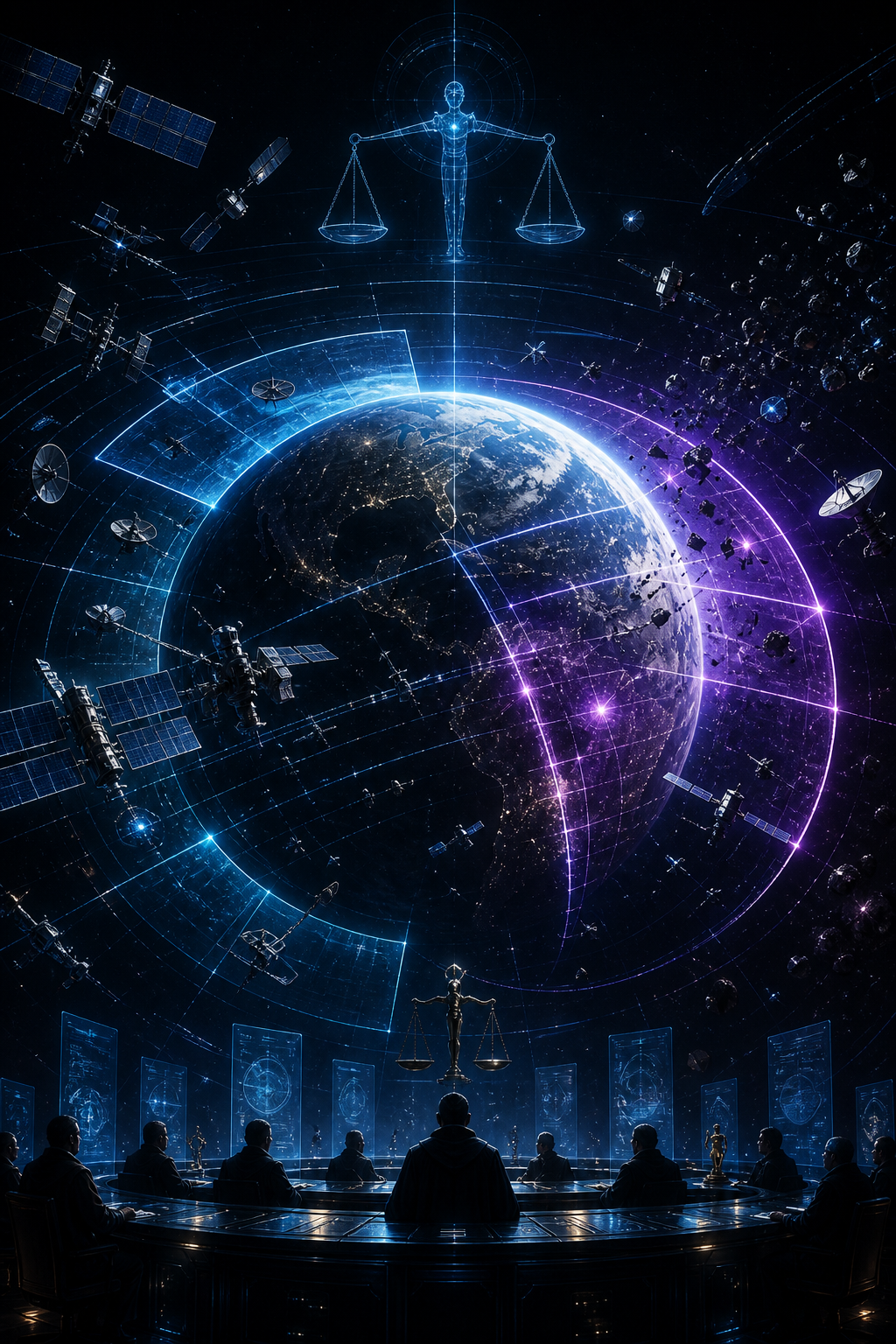
Low Earth orbit is increasingly congested with satellites, upper stages and debris. Radiofrequency spectrum is contested. Lunar exploration plans have revived questions about safety zones, resource extraction and the boundary between operational necessity and de facto control. Launch rates have risen, and with them the burden on licensing agencies, collision-warning systems and international coordination processes. The challenge for policymakers is not simply to preserve old norms. It is to decide which institutions should allocate scarce orbital and spectrum resources, what duties attach to operators, and how far existing treaty language can stretch before new agreements become unavoidable.
The central question in space law is no longer only who may go to space, but on what terms they must share it.
This is why the most consequential developments are often not dramatic treaty negotiations, but technical rules with broad legal effects: debris-mitigation standards, post-mission disposal timelines, licensing conditions, registration requirements, frequency coordination procedures and norms for close-proximity operations. In aggregate, these determine access to orbit more directly than abstract declarations of principle. Space law is becoming, in effect, a law of queues, externalities and public obligations.
The treaty framework remains broad but thin
The foundation of international space law remains the 1967 Outer Space Treaty, supplemented by agreements on rescue, liability, registration and the Moon. The treaty framework establishes several durable propositions. Outer space is free for exploration and use by all states. It is not subject to national appropriation by claim of sovereignty, use, occupation or any other means. States bear international responsibility for national activities in outer space, whether carried out by governmental or non-governmental entities, and they must authorise and continually supervise private actors. They are also liable, in certain circumstances, for damage caused by their space objects.
These rules were drafted for an era of limited participants and state-led programmes. Their language is intentionally general. That flexibility has been useful, but it has also left major gaps. The treaties say little about how to manage routine traffic in crowded orbital shells, how to apportion responsibility for collision avoidance among hundreds of operators, or how to regulate extraction and use of space resources in a way that avoids both legal paralysis and unilateral enclosure. They do not set detailed environmental standards for orbital debris, nor do they create a standing enforcement body.
The result is a legal order that is principled but incomplete. It sets boundaries against overt territorial claims, while leaving much of the operational detail to domestic law, international telecommunications rules, non-binding guidelines and ad hoc diplomacy. That may have been sustainable when space was exceptional. It is under growing strain now that space is becoming an infrastructure sector.
State responsibility has become the hinge of the system
One principle from the treaty era has become more important, not less: state responsibility for national activities. Under Article VI of the Outer Space Treaty, governments must authorise and continually supervise non-governmental activities in outer space. This provision has become the hinge between public international law and commercial operations. Because private entities cannot themselves be parties to the treaties, states remain the legal gatekeepers.
That has several consequences. First, the quality of domestic licensing regimes matters globally. A permissive licensing standard in one jurisdiction can impose risks on all operators by increasing debris, interference or unsafe manoeuvring. Secondly, fragmentation across national systems creates incentives for regulatory arbitrage, with operators seeking authorisation where requirements are lighter or procedures faster. Thirdly, if states are internationally responsible, they have reason to demand better data-sharing, insurance, disposal planning and end-of-life controls from licensees.
The central question in space law is no longer only who may go to space, but on what terms they must share it.
In practice, domestic law is now where much space governance happens. Licensing decisions determine mission design, orbital parameters, collision-avoidance procedures and de-orbit plans. National rules also translate soft-law guidelines into binding obligations. This is administratively efficient, but legally uneven. Without stronger convergence, responsibility remains national while risk becomes transnational.
Orbital congestion is exposing the absence of traffic law
No issue illustrates the limits of the current framework more clearly than space traffic management. Orbital operations today rely on a patchwork of military tracking, civil advisories, operator-to-operator communication, national regulations and voluntary best practice. There is no comprehensive international traffic code equivalent to maritime collision regulations or civil aviation rules. Yet the basic ingredients of a traffic system are plainly needed: common data standards, reliable tracking, notification duties, manoeuvre protocols, priority rules in certain circumstances and audit trails when incidents occur.
The legal difficulty is not only technical. It concerns authority. Who should set and enforce such rules? A universal treaty could provide legitimacy, but would be slow to negotiate and perhaps too rigid. Non-binding norms can evolve faster, but suffer from patchy compliance. National licensing conditions can impose discipline on domestic operators, but not on all actors in orbit. Intergovernmental coordination mechanisms exist, though generally without strong enforcement powers.
Meanwhile, the economics of congestion are unforgiving. Each additional object can impose costs on others through increased collision risk, more frequent avoidance manoeuvres and reduced access to valuable orbital regions. In legal terms, orbit is not merely a zone of freedom; it is a shared environment vulnerable to cumulative harm. The absence of formal appropriation does not prevent practical exclusion if congestion or debris renders some orbits unsafe or unusable.
Non-appropriation does not guarantee openness when congestion itself can become a form of exclusion.
That is why traffic management should be treated not as a purely technical service, but as a public-law problem. The key question is how to convert freedom of use into a regime of reciprocal restraint.
Debris policy is moving from guidance to obligation
Orbital debris has long been governed mainly through non-binding standards. The Inter-Agency Space Debris Coordination Committee and the UN Committee on the Peaceful Uses of Outer Space have developed influential mitigation guidelines, covering mission planning, passivation and post-mission disposal. But the rise in object numbers has made voluntary adherence look increasingly inadequate. The debate is shifting from whether mitigation norms exist to whether they should become enforceable licensing conditions and, eventually, firmer international obligations.
A notable sign of this shift came when one major regulator adopted a five-year post-mission disposal rule for low Earth orbit, shortening the older benchmark of 25 years. Other jurisdictions are considering similar approaches, while also exploring requirements for collision-risk assessment, manoeuvrability and casualty-risk reduction on re-entry. The legal logic is straightforward: debris is an externality, and externalities tend to persist when compliance is left largely to goodwill.
Still, debris law faces a structural obstacle. Many of the riskiest legacy objects were launched decades ago by states under weaker standards. Active debris removal, if it becomes more common, raises its own legal complications involving consent, registration and control over space objects that remain under the jurisdiction of the launching state. Removing a derelict object may be environmentally desirable, but the law still treats that object as someone’s registered space property. This creates a paradox: the law recognises continuing control over objects that their operators may no longer be able to manage safely.
Spectrum and orbits are jointly governed, but not jointly managed
Non-appropriation does not guarantee openness when congestion itself can become a form of exclusion.
Any serious account of space governance must include the law of radio spectrum. Satellite operations depend not only on physical orbital positions, but on access to frequencies coordinated through the International Telecommunication Union. This system is one of the most mature elements of space-related governance, and in some respects it is more consequential than headline debates over ownership. Rights to use frequencies and associated orbital positions can determine market entry, technical design and competitive viability.
Yet the spectrum regime was not built to solve every problem of orbital crowding. Frequency coordination reduces harmful interference, but it does not by itself settle broader questions of debris risk, proximity operations or equitable physical access to certain orbital regions. Nor does it always align neatly with sustainability goals. An operator may satisfy telecommunications procedures while still contributing to congestion or creating difficult end-of-life risks.
This split matters because the practical governance of space is often divided among agencies with different mandates: telecommunications, transport, defence, science and environmental regulation. Such fragmentation can work in a relatively sparse environment. In a dense orbital economy, it creates blind spots. The future of space law will depend partly on whether governments can treat spectrum management, orbital safety and sustainability as connected rather than separate domains.
The Moon debate is really about jurisdictional creep
Renewed interest in lunar activity has revived old arguments about resource extraction and governance. The central legal tension is familiar. The Outer Space Treaty bars national appropriation of the Moon and other celestial bodies. Yet it does not explicitly prohibit the extraction and use of resources. Some states have therefore adopted laws recognising rights over extracted resources, while insisting that this does not amount to sovereignty over the territory from which they are taken. Critics argue that, without a common international framework, this interpretation risks normalising unilateral claims dressed up as private rights.
The sharper issue may be operational rather than doctrinal. Activities near scientifically valuable, logistically important or geographically scarce sites could generate exclusionary effects even without formal ownership claims. Safety zones around installations may be defensible as practical measures to avoid harmful interference, particularly under Article IX of the Outer Space Treaty, which requires due regard and consultation. But if such zones become expansive, indefinite or strategically placed, they could shade into de facto jurisdiction.
The legal task, then, is to distinguish legitimate safety coordination from creeping enclosure. That will require transparency about the scope and duration of protective measures, notification to other states, and some forum for addressing objections. Otherwise, the language of safety may become the vehicle for a functional partitioning of the lunar surface without open legal acknowledgment.
In the next decade, the most important space-law disputes may concern not ownership in theory but operational control in practice.
Liability rules exist, but they rarely resolve complex risk
The 1972 Liability Convention provides that launching states are absolutely liable for damage caused on the surface of the Earth or to aircraft, and liable on the basis of fault for damage elsewhere in space. In principle, this offers a route for addressing harm caused by space objects. In practice, the convention has been invoked only rarely, and it is a blunt instrument for modern orbital operations.
Fault in space can be hard to determine. Collisions may involve imperfect tracking data, rapidly changing circumstances, chain reactions and multiple operators taking or declining manoeuvres. Even when liability is legally available, the diplomatic and evidentiary burdens can be substantial. Moreover, the convention channels claims through states rather than directly between private parties, which is poorly suited to a commercial environment with many operators and frequent close approaches.
This does not make the liability regime irrelevant. Its existence encourages insurance markets, indemnification arrangements and national licensing requirements. But it is not a complete answer to routine orbital risk. A more mature governance system would combine ex post liability with ex ante rules: design standards, manoeuvre obligations, data-sharing requirements and compliance review. Law works best here when it prevents disputes rather than merely offering a framework for expensive arguments after the fact.
In the next decade, the most important space-law disputes may concern not ownership in theory but operational control in practice.
Military realities complicate civil governance
Space law has always coexisted uneasily with military activity. The Outer Space Treaty prohibits placing nuclear weapons or other weapons of mass destruction in orbit, and it reserves the Moon and other celestial bodies for peaceful purposes. But it does not ban all military uses of outer space, and many space systems have dual-use functions. Satellites that support communications, navigation, weather forecasting or remote sensing may serve both civilian and defence needs.
This complicates the development of civil traffic and safety rules. Operators may be reluctant to share high-resolution positional data or manoeuvre intentions if they believe doing so could expose sensitive capabilities. Governments may also hesitate to place critical space infrastructure under international procedures they regard as constraining. At the same time, the risks of misunderstanding are growing, especially in close-proximity operations where inspection, servicing and interference can look similar from a distance.
Policy therefore has to balance transparency with security. Confidence-building measures, pre-launch notifications, responsible-behaviour norms and consultation channels can reduce ambiguity without requiring full disclosure of military detail. The legal objective is modest but vital: to make normal operations legible enough that accidents and deliberate actions are less easily confused.
Soft law is not a failure if it becomes a staging ground
There is a tendency in legal commentary to dismiss non-binding rules as weak by definition. In space governance, that is too simple. Soft law has often been the only politically feasible way to build consensus among diverse participants. The UN guidelines for the long-term sustainability of outer space activities, for example, do not create formal legal obligations, but they codify expectations around policy, safety and information exchange that can influence national regulation and operator conduct.
The important question is not whether soft law is binding on paper, but whether it changes incentives in practice. Guidelines can migrate into licence conditions, procurement standards, insurance requirements and bilateral agreements. They can also prepare the ground for later formalisation by clarifying terminology and identifying areas of broad agreement. In a fast-moving domain, this staged approach may be more realistic than waiting for comprehensive treaties.
Still, soft law has limits. It is less effective where major powers have sharply divergent interests, where compliance is expensive, or where free-riding confers immediate advantages. Sustainability norms may spread gradually; hard cases involving strategic competition may not. The future legal architecture will therefore probably be layered: treaties for foundational principles, soft law for emerging practice, domestic regulation for implementation, and technical coordination bodies for operational detail.
What a credible policy agenda would look like
A plausible reform agenda need not begin with an attempt to rewrite the entire treaty system. It would start by strengthening the points where law already touches operations. Governments could align licensing standards around debris mitigation, manoeuvrability, data-sharing and end-of-life disposal. Registration practices could be improved so that ownership, control and mission status are clearer. Procedures for consultation under Article IX of the Outer Space Treaty could be made more routine and transparent, especially for missions likely to create unusual interference risks.
At the international level, policymakers should prioritise common technical standards for conjunction data and notification, clearer expectations for close-proximity operations, and more systematic integration of sustainability concerns with spectrum and orbital assignment processes. For lunar activity, the emphasis should be on transparency, narrowly tailored safety measures and mechanisms to contest overbroad exclusion. Over time, some of these practices could harden into more formal instruments.
None of this will eliminate rivalry or uncertainty. But it would recognise a basic truth about the current era: the governance problem in space is increasingly one of shared infrastructure. The law must therefore evolve from a framework designed to prevent sovereign conquest into one capable of managing intensive, unequal and continuous use. That means treating orbital space as an environment requiring stewardship, not merely a void requiring freedom.
The test for space law in the coming decade is not whether it can produce elegant principles. It is whether it can organise restraint in a domain where access is expanding faster than consensus. If it fails, exclusion will not arrive as a flag planted on new territory. It will emerge through congestion, interference, debris and informal control. If it succeeds, it will be because public authority found ways to govern the queue before the queue governed everyone else.