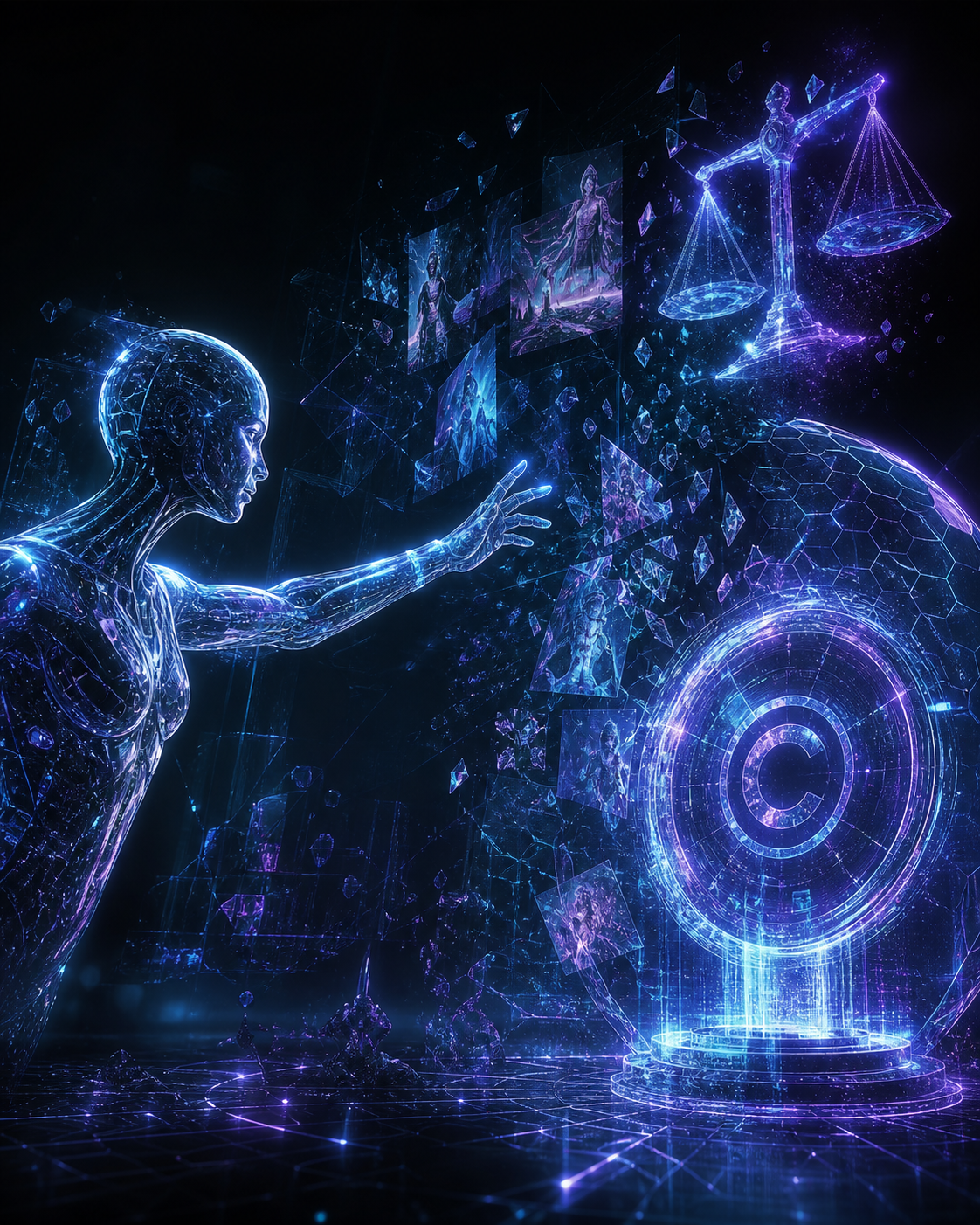
Why AI has made intellectual property newly urgent
Intellectual property law has always had to absorb technological change, from photography to radio to search engines. Yet generative AI has accelerated that pressure because it depends on large-scale ingestion of existing material and can produce outputs that resemble, recombine or compete with copyrighted and trade-marked works at industrial scale. What was once a niche argument about text and data mining has become a broad economic question about who captures value from knowledge, culture and data.
The legal unease comes from a simple asymmetry. Training a modern model may require vast quantities of text, images, code, audio and video gathered from across the internet and private repositories. The resulting system does not store and reproduce works in the same manner as a digital library. But nor is it easy to say that it merely "reads" in the human sense. In practice, AI development sits between copying, analysis and transformation, which is precisely why existing legal categories are under strain.
Generative AI has exposed a fault line at the heart of intellectual property: the law protects expression, but innovation often depends on learning from it at scale.
That tension matters well beyond the courtroom. If the rules are too permissive, creators and rights holders may see uncompensated extraction and market displacement. If they are too restrictive, entry barriers could rise, competition could weaken and socially useful research could be chilled. The policy challenge is therefore not simply to defend ownership, but to decide what kinds of access a modern knowledge economy requires.
Copyright is the battlefield because training begins with copying
Copyright is at the centre of current disputes because model training usually entails making copies, even if only transient or intermediate ones, of protected works. In many jurisdictions, reproduction is one of the exclusive rights of the copyright holder. The hard question is whether those copies are excused by exceptions and limitations, licensed by contract, or infringing absent permission.
In the United States, litigants and scholars have focused heavily on fair use, a flexible doctrine that weighs purpose, nature, amount and market effect. The case law around search engines and digitisation projects showed that copying entire works can sometimes be lawful if the use is transformative and does not substitute for the original market. Supporters of broad AI training rights argue that learning statistical relationships from works is similarly transformative. Critics respond that generative systems do not merely index or analyse; they enable synthetic outputs that may compete directly with the works on which they were trained.
Elsewhere, the framework looks different. The European Union created text and data mining exceptions in the 2019 Copyright in the Digital Single Market Directive. One exception permits research organisations and cultural heritage institutions to conduct text and data mining for scientific research. Another allows text and data mining more broadly unless rights holders have reserved their rights in an appropriate manner. That opt-out structure has made technical signals, contractual restrictions and dataset governance newly important.
These distinctions are not academic. They determine whether AI training is presumed lawful unless forbidden, unlawful unless licensed, or lawful only in specific contexts. The more economically significant generative AI becomes, the more those baseline assumptions matter.
Fair use, text and data mining and the limits of analogy
Much of the current argument relies on analogy to earlier technologies. Search engines copied web pages to make them discoverable. Digitisation projects scanned books to create searchable databases. Software interoperability sometimes required intermediate copying. In each area, courts recognised that some reproduction can serve broader public purposes.
But generative AI is not a neat fit. Search did not typically produce substitute novels, illustrations or songs in response to user prompts. A foundation model can generate text in the style of a genre, images with familiar visual conventions, or code that overlaps with public repositories. Even where outputs are not substantially similar in the copyright sense, the market effect can be more direct than earlier cases contemplated.
The weakness of pure analogy is that AI combines at least three functions at once: analysis of existing works, generation of new content and automation of downstream tasks previously purchased from human creators. The law tends to separate these issues; the technology collapses them. That is why debates about training cannot be resolved simply by importing precedents from search or cloud computing without modification.
Generative AI has exposed a fault line at the heart of intellectual property: the law protects expression, but innovation often depends on learning from it at scale.
The legal question is no longer just whether machines may read copyrighted works, but whether automated reading may lawfully underpin systems that rival the works they learned from.
For policymakers, this suggests caution. Bright-line rules created for one technological setting can have unexpected effects in another. A narrow exception may impede scientific research and open competition. An overbroad one may entrench extraction without remuneration. The most durable reforms will probably recognise different treatment for research, commercial deployment, high-risk sectors and model classes, rather than treating all machine learning as a single legal act.
Outputs raise a different problem from training inputs
Public attention often shifts quickly from training data to model outputs, but the legal analysis is not the same. A model could be trained lawfully and still generate infringing outputs; equally, a model trained on contested datasets may often produce non-infringing material. Copyright law evaluates protected expression, not abstract influence or style as such.
That means claimants generally need to show substantial similarity between a protected work and an output, or in some circumstances evidence that memorisation and regurgitation occurred. This is easiest where a model reproduces passages of text, code snippets, watermarks or distinctive visual elements. It is much harder where the complaint is that the output captures a mood, genre, compositional logic or aesthetic associated with a body of work.
For creators, that distinction can feel unsatisfactory. Markets do not only value exact duplication; they value the labour, reputation and recognisable sensibility behind a work. Yet copyright has long refused to monopolise ideas, facts, methods and general style. That boundary was designed to preserve creative freedom. AI makes it more economically salient, but not conceptually obsolete.
The practical implication is that legal risk may turn less on whether a system sounds "like" a creator in a colloquial sense and more on whether it reproduces protectable expression, whether safeguards reduce memorisation, and whether providers respond to notices and documented harms. Technical design and evidentiary standards therefore matter as much as broad legal doctrine.
Authors, inventors and the human threshold
Another live issue is whether AI-generated material can itself attract intellectual property protection. In many jurisdictions, copyright presumes human authorship. The U.S. Copyright Office has stated that works generated by non-human systems without sufficient human creative control are not registrable, while allowing protection for human-authored elements and human selection or arrangement in some cases. Courts in several jurisdictions have similarly resisted extending authorship to machines.
This is less a philosophical statement than an institutional one. Copyright allocates rights and incentives to legal persons. If a machine cannot own, assign or exercise rights, granting full authorship to autonomous output would create doctrinal confusion without obvious social benefit. The more practical question is how much human input is enough: prompting, curation, editing, iterative refinement, or only more substantial creative direction?
Patent law has reached a related conclusion on inventorship. Authorities in the United States, United Kingdom and Europe have rejected applications naming an AI system as inventor, maintaining that inventorship under current statutes is confined to natural persons. That does not mean AI-assisted inventions are unpatentable. It means the human contribution must still be identified within the inventive process.
The human threshold matters because it shapes incentives in creative and research industries. If AI outputs are too easily protected, firms may mass-produce low-cost rights claims that clog markets and archives. If protection is too difficult to obtain for genuinely original human-AI collaboration, investment in high-quality production may weaken. The likely destination is not machine authorship, but a more refined doctrine of human contribution.
Trade marks, passing off and the problem of synthetic identity
Copyright is only one part of the picture. Generative AI also creates risks for trade marks, passing off and related forms of consumer protection. Models can generate logos, packaging, product descriptions and advertising copy that inadvertently or deliberately echo established brands. They can also be used to create synthetic endorsements, counterfeit storefronts and impersonation at scale.
The legal question is no longer just whether machines may read copyrighted works, but whether automated reading may lawfully underpin systems that rival the works they learned from.
Here the central legal concern is not copying as such, but confusion and misrepresentation. A generated image that resembles a protected artistic work may trigger copyright questions; a generated sign or label that causes consumers to believe goods come from a particular undertaking engages trade-mark law and unfair competition rules. AI does not alter the underlying policy rationale, but it lowers the cost of producing plausible imitations.
There is also a more subtle challenge. Large models learn the statistical associations that define commercial identity in practice: colour palettes, verbal cues, design conventions and semantic proximity between famous marks and product categories. They may therefore generate outputs that are legally risky without being exact reproductions. Compliance cannot rely only on matching known logos or names; it requires contextual assessment of likely confusion.
This is one reason why firms deploying generative systems into marketing, design and customer interfaces increasingly need governance that links legal review with technical testing. Intellectual property risk is no longer confined to specialist creative departments. It is becoming an operational issue.
Data licensing is becoming a market structure question
Because legal uncertainty is costly, licensing has emerged as a pragmatic response. Publishers, image libraries, music rights holders and data providers are seeking agreements that permit training or retrieval under negotiated terms. At one level, that is ordinary market adaptation. Where the law is unclear, contracts can price access and reduce litigation risk.
But licensing is not neutral in its economic effects. Large incumbents are better positioned to pay for broad rights portfolios, negotiate global deals and maintain compliant data pipelines. Smaller developers, researchers and open communities may struggle to secure equivalent access. If law and licensing together make high-quality training data scarce and expensive, the result could be less competition and greater concentration.
There is also a collective-action problem on the rights-holder side. Many works are orphaned, fragmented across multiple owners or governed by legacy contracts that never contemplated machine learning. Transaction costs can be prohibitive, especially for mixed datasets containing millions of items. This is where collective licensing, extended licensing models, standardised machine-readable reservations and public-interest exceptions may become more relevant.
The future of AI and intellectual property will be shaped not only by court rulings, but by the market architecture of licences, opt-outs and data access rules.
In other words, the debate is moving from the binary question of permission versus infringement to the more structural question of who can participate in lawful data markets, on what terms, and with what safeguards for creators and competition.
Open models and open data complicate ownership claims
Not all AI development follows the same institutional model. Some systems are released with open weights, some rely on openly licensed or public-domain data, and some are built within research environments that differ from consumer deployment. This diversity matters for intellectual property because the balance of interests changes with context.
Openly licensed material may permit reuse under conditions such as attribution or share-alike obligations, but those conditions were often drafted for conventional distribution rather than model training. Whether and how such terms apply to weights, embeddings, outputs or downstream fine-tuning is not always settled. Public-domain material reduces copyright risk, but not necessarily trade-mark, privacy or database-rights concerns. Government data may be reusable in one jurisdiction and restricted in another.
There is a temptation to treat openness as a simple legal cure. It is not. Open resources can lower barriers to entry and support scientific reproducibility, but they may also be uneven in quality, skewed in subject matter and geographically biased. From an IP perspective, they solve some permission problems while leaving others intact. Sensible governance needs to distinguish lawful access from socially representative access.
This is especially important for cultural and linguistic diversity. If only a narrow set of corpora can be used with confidence, minority languages and less-commercial cultural domains may be underrepresented in future models. Intellectual property rules can therefore shape not just who gets paid, but whose knowledge is legible to machines.
The future of AI and intellectual property will be shaped not only by court rulings, but by the market architecture of licences, opt-outs and data access rules.
Enforcement is difficult because evidence is technical
Even when rights exist on paper, enforcement in AI cases is unusually demanding. Claimants may need to show that specific works were included in training datasets, that copying occurred in a legally relevant way, or that outputs reproduce protectable expression. Defendants may respond that training data were filtered, that use was transformative, or that similarity reflects common source material rather than infringement.
These disputes are evidence-intensive. They often require access to dataset documentation, model cards, benchmark results, prompt-output testing, and technical expert analysis on memorisation and probabilistic generation. Yet many of the most important details are commercially sensitive. Courts are therefore being asked to adjudicate with imperfect visibility into systems whose design choices materially affect legal outcomes.
This opacity is one reason transparency duties are gaining traction in policy debates. The European Union's AI Act includes transparency obligations for certain general-purpose AI models, while the bloc's copyright framework already interacts with reservation-of-rights mechanisms for text and data mining. Transparency does not itself resolve infringement, but it can make rights more exercisable and compliance more auditable.
For creators and smaller rights holders, enforceability is as important as doctrine. A legal entitlement that cannot be detected, evidenced or pursued at reasonable cost offers limited practical protection. The future of AI and IP will therefore depend partly on procedural tools: disclosure standards, record-keeping, technical audits and collective redress mechanisms.
Policy choices will involve competition and public interest, not only property
It is tempting to frame the entire issue as a struggle between technology firms and creators. In reality, the stakes are broader. Intellectual property policy also shapes competition, scientific research, education, journalism, accessibility and the preservation of cultural heritage. Rules designed solely around bilateral bargaining may neglect these wider public interests.
Competition authorities are already examining digital markets through the lens of data access, ecosystem power and barriers to entry. Those concerns intersect with AI licensing. If a small number of firms can secure the best data, the strongest compute access and the most defensible legal positions, then IP law may indirectly reinforce market concentration. Conversely, if exceptions are too broad and uncompensated extraction becomes normal, valuable creative sectors may struggle to sustain investment.
That is why governments are unlikely to settle on a single principle such as "consent for all training" or "fair use for all training". More plausible is a layered settlement: broader room for research and socially beneficial text and data mining; stronger transparency and opt-out tools; targeted licensing markets; remedies for memorisation and substitution harms; and competition scrutiny where access bottlenecks emerge.
Such a settlement would be untidy, but intellectual property often evolves through layered compromise rather than clean redesign. The aim is not doctrinal elegance. It is workable coexistence between innovation incentives, creator remuneration and public access to knowledge.
What a durable settlement might look like
The most durable regime will probably rest on four principles. First, lawful machine learning needs clearer boundaries. Legislatures and courts should distinguish analysis for research, commercial training, retrieval, fine-tuning and output generation rather than treating them as legally interchangeable. Second, creators need usable control tools, including machine-readable reservations, practical licensing channels and remedies where outputs reproduce protected expression or destroy core markets.
Third, transparency should be proportionate but real. Developers of significant models should keep records about data provenance, filtering and safeguards sufficient for regulators and courts to assess compliance, while protecting legitimate trade secrets. Fourth, competition and access must remain part of the design. Public-interest research, cultural institutions and smaller entrants require pathways to lawful data use if AI markets are not to ossify around a handful of large actors.
No legal framework will remove all friction. Intellectual property is supposed to create friction; it grants exclusive rights in order to encourage investment and disclosure. The question is whether that friction is calibrated for an era in which machines can ingest and recombine the world’s recorded knowledge. The answer will not come from one lawsuit or one statute. It will emerge from the interaction of courts, legislatures, regulators, licences and technical norms.
For now, the prudent conclusion is that AI has not made intellectual property obsolete. It has made its trade-offs impossible to ignore. Societies must decide which uses of culture and knowledge count as fair learning, which count as appropriation, and which require new bargains altogether. That is less a niche legal puzzle than a foundational choice about how digital economies reward creation while enabling discovery.