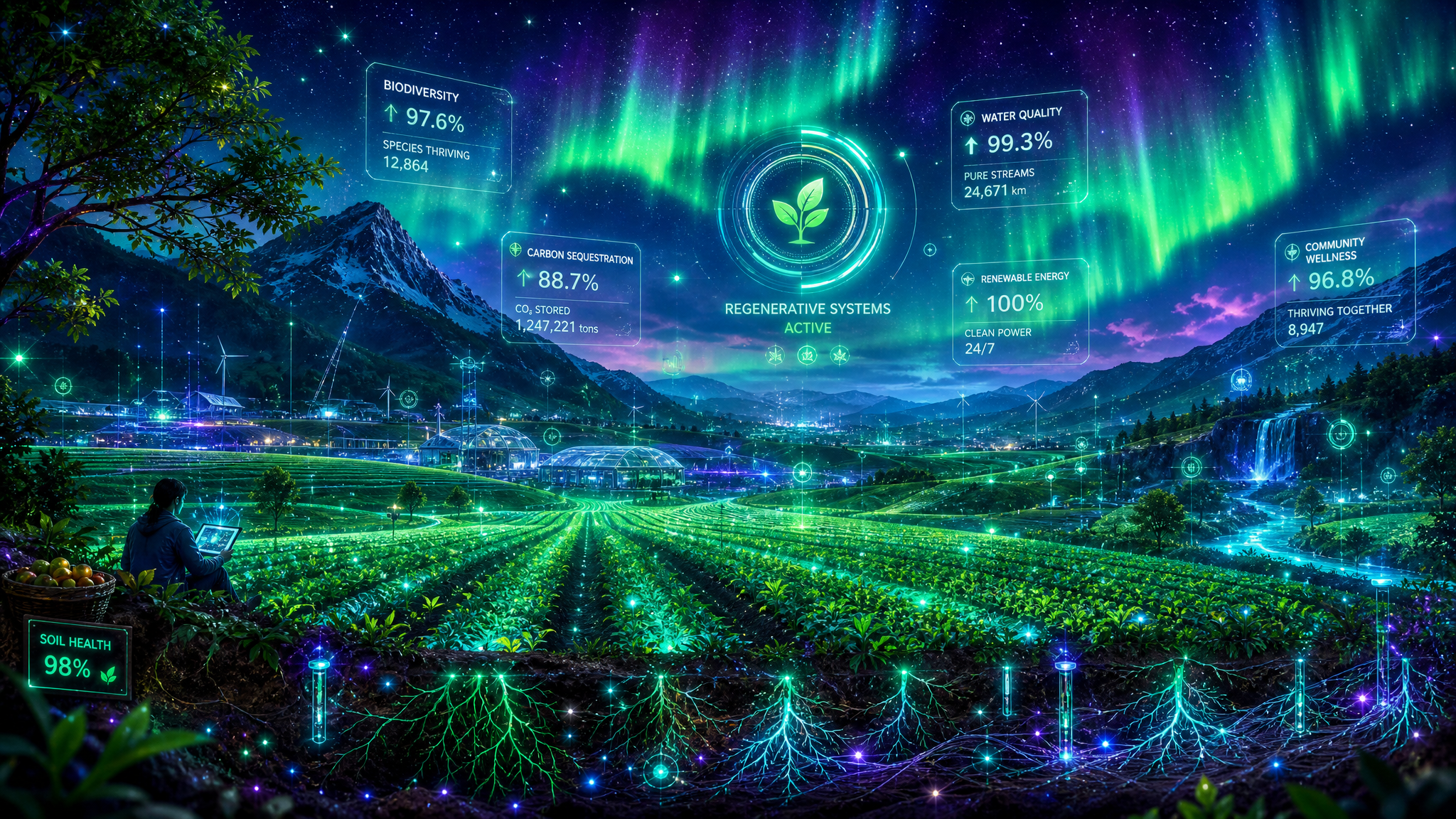
The language of regeneration is often lush and local: healthier soils, restored wetlands, resilient farms, cleaner rivers. Yet by mid-2026 the most consequential disputes are becoming administrative rather than pastoral. They concern who measures depletion, who sets ecological baselines, who validates remote sensing, and who can contest algorithmic decisions when water, energy or land-use rights depend on digital evidence. The strategic asset is not merely data, but the legitimacy of the ledger that turns data into rights and obligations.
This matters because environmental stress is increasingly managed through quantified systems. Utilities use interval data to balance distributed power. river-basin authorities combine satellite imagery with hydrological models to police extraction. Agricultural insurers and lenders infer risk from weather and soil proxies. Public agencies are encouraged to use artificial intelligence to optimise everything from irrigation scheduling to drought planning. But once these systems influence who may pump, plant, export, connect or rebuild, they stop being neutral tools. They become institutions.
Regeneration’s hidden bottleneck
Conventional accounts of regenerative technology focus on hardware and agronomy: precision irrigation, low-input cropping, microbial amendments, microgrids, desalination, methane capture. All matter. Yet many schemes stall for a duller reason. The underlying records are fragmented, proprietary, legally weak or socially contested. A watershed cannot be regenerated by a dashboard that nobody trusts.
Consider the ordinary administrative questions beneath a drought response. Which wells are metered and which are estimated. Whether evapotranspiration models can stand in for field inspection. How often groundwater data is updated. Whether indigenous, municipal and agricultural claims are represented in the same registry. What happens when one data source contradicts another. These are not technical footnotes. They determine whose account of the environment counts in law.
From sensors to standing
There is a difference between observing a resource and governing it. A farm may carry inexpensive sensors, drones and machine-learning tools that infer soil moisture or nutrient stress in near real time. A district may deploy smart meters and automated curtailment. But the civic threshold is crossed only when those readings affect legal standing: compensation after contamination, access during rationing, eligibility for restoration funds, enforcement for over-extraction, or proof that a community has borne disproportionate risk.
The distinction has been obscured by the common assumption that more granular data automatically produces more just outcomes. It may do the opposite. Fine-grained monitoring can increase asymmetry if households, smallholders or customary users are measured more closely than industrial operators, or if they lack access to the models used to classify them. In environmental governance, visibility is not the same as voice.
A watershed cannot be regenerated by a dashboard that nobody trusts.
Water rights are becoming data rights
A watershed cannot be regenerated by a dashboard that nobody trusts.
No domain illustrates this shift more clearly than water. International institutions have spent years stressing that water is both an economic resource and a human right, and that governance failures are often as important as hydrological scarcity. By 2026, however, an additional layer has become impossible to ignore: rights increasingly depend on the evidentiary systems that describe the resource. If an aquifer’s condition is inferred through sparse monitoring and opaque interpolation, then disputes over pumping limits are also disputes over method.
The OECD’s principles on water governance emphasise integrity, transparency and stakeholder engagement. The UN system has long framed water and sanitation as basic rights. The Global Commission on the Economics of Water has argued that fragmented governance leaves societies blind to interdependence across basins and supply chains. Read together, these sources suggest a harder truth than many technology narratives allow. Scarcity is not merely managed by data. It is politically constituted through data.
This is why local authorities and river-basin institutions are under pressure to create shared evidentiary frameworks rather than simply buying more monitoring capacity. If restrictions are triggered by remote sensing, communities need procedures to challenge false positives. If quality standards depend on machine-classified contaminants, laboratories and local health bodies need chain-of-custody rules and disclosure. If recharge credits can be earned through land practices, then baseline years and counterfactuals must be public, stable and auditable.
Soil carbon taught the same lesson
The same governance problem appears on land. Soil regeneration is frequently discussed through carbon metrics, biodiversity proxies and digital measurement, reporting and verification. Yet the controversy has never been only about science. It has been about whether farmers, pastoralists and land stewards can rely on a measurement system over the life of a contract or a public scheme. A baseline that shifts every few years, or a model that cannot be independently examined, changes the economics of participation.
For small and medium-sized producers, the burden is severe. They may be asked to collect extensive management data, accept satellite-derived assessments, and bear liability for outcomes that hinge on weather variability beyond their control. Meanwhile the institutional gains from standardisation often accrue elsewhere. The lesson is not that digital verification is useless. It is that ecological accounting can centralise power unless data rights, appeal rights and interoperability are designed from the outset.
Environmental sovereignty is not autarky
Sovereignty in this context does not mean sealing borders or rejecting science from abroad. It means retaining enough institutional capacity to understand local ecosystems on locally legitimate terms, while still interoperating with wider markets and treaties. That is a narrower, more practical ambition than self-sufficiency. A coastal state may import food and equipment yet remain environmentally sovereign if it can verify water balances, enforce extraction rules, negotiate energy interconnection on fair terms, and preserve public oversight over ecological records.
This has become more urgent because cross-border dependencies now run through data infrastructures as much as through pipelines and shipping lanes. Environmental models may rely on foreign cloud systems, third-party geospatial layers, external calibration libraries or contractual black boxes. None of this is inherently malign. But if a ministry cannot inspect the assumptions behind a drought trigger or a fisheries closure, decision-making authority has in effect migrated, even if the servers are physically nearby.
The rise of the civic ledger
The strategic asset is not merely data, but the legitimacy of the ledger that turns data into rights and obligations.
The emerging answer is not one giant database. It is a civic ledger: a set of public rules, standards and institutions that determine how environmental observations become accepted facts for governance. Such a ledger can include open metadata, chain-of-custody requirements, transparent model documentation, public-interest APIs, local calibration protocols, and independent dispute resolution. It may draw on open-science principles and risk-management frameworks rather than any single technology stack.
The concept matters because shared resources generate recurring conflicts over evidence. A farmer claims curtailed access despite compliant use. A town alleges upstream pollution. A co-operative disputes the heat-risk model used to deny cover. An indigenous community contests a conservation baseline that erases customary stewardship. In each case the substantive dispute is ecological, but the practical dispute is evidentiary. Who is entitled to define reality for administrative purposes.
If models allocate scarcity, then model governance becomes a constitutional question.
Why AI sharpens the stakes
Artificial intelligence is valuable where environmental systems are noisy, nonlinear and data-rich. It can help forecast demand, detect leaks, classify land cover, infer crop stress and support adaptive grid management. Yet the very qualities that make AI useful also make governance harder. Models often blend heterogeneous datasets, update dynamically, and produce outputs that appear precise even when the underlying signal is uncertain. Once such outputs influence permits or penalties, ordinary concerns about explainability become matters of due process.
NIST’s AI Risk Management Framework is relevant here precisely because it is procedural. It does not promise certainty. It asks institutions to map risks, measure performance and govern trade-offs. Applied to regeneration, that means documenting training data for flood and drought models, distinguishing advisory tools from determinative ones, testing for disparate error rates across regions and user groups, and preserving a human review path where livelihoods are at stake. In short, ecological AI cannot be governed as if it were merely a consumer convenience.
Energy independence starts with local balances
Much has been written about energy independence in terms of generation capacity: solar, wind, storage, interconnectors, efficiency. But resilience at community scale often hinges on something more prosaic: a trusted account of local inflows, loads, storage states and emergency priorities. Distributed systems can be technically decentralised while remaining administratively opaque. In blackouts or fuel shocks, that opacity becomes a governance failure.
Municipal microgrids and farm-energy co-operatives increasingly need registries of critical loads, fair curtailment rules, and transparent settlement for prosumers. These are energy versions of the water-rights problem. If households and small enterprises do not understand how optimisation systems prioritise demand, they may resist even sensible constraints. Energy resilience therefore depends not only on hardware redundancy but on procedural legitimacy. The public must know how scarcity will be shared before scarcity arrives.
Indigenous and customary knowledge cannot be bolt-ons
If models allocate scarcity, then model governance becomes a constitutional question.
One of the sharpest critiques of data-driven environmental management is that it often treats local and indigenous knowledge as decorative context rather than as a source of authority. This is not simply unjust; it is analytically weak. Many landscapes have been managed through detailed customary observation of seasons, flows, soil behaviour and species interactions. Excluding these records produces thinner baselines and poorer interventions.
International debates over genetic resources and benefit-sharing have already shown how quickly biological information becomes a governance dispute once digitised. The same applies to ecological monitoring more broadly. If communities contribute observations, classifications or stewardship practices that improve environmental models, questions of consent, attribution and benefit are unavoidable. Environmental sovereignty that ignores these claims is little more than administrative extraction in greener language.
Open standards are not enough on their own
There is a tendency among technologists to assume that openness solves legitimacy. Open data, open models and open standards are indeed important, and UNESCO’s recommendation on open science captures why transparency matters for public trust and reproducibility. But openness alone does not resolve asymmetry. A village may technically access a hydrology dataset without having the expertise, bandwidth or legal support to challenge the way it was used in an allocation dispute.
Institutional design therefore matters more than publication by itself. Effective systems pair transparency with intelligibility, translation and recourse. They specify who can request an audit, who pays for independent verification, how quickly errors must be corrected, and how contested indicators are handled during emergencies. Without those mechanisms, open environmental data can become a spectacle of accessibility masking a shortage of practical power.
What durable regeneration looks like
Durable regeneration is less glamorous than many policy brochures suggest. It looks like basin authorities with credible monitoring and appeal procedures. It looks like agricultural support tied to stable, explainable metrics rather than moving black boxes. It looks like energy communities whose balancing rules are published and tested. It looks like public laboratories, land registries and utilities that can exchange information without surrendering accountability.
Above all, it looks like accepting that ecological restoration is inseparable from constitutional craftsmanship. Shared resources require shared facts, but shared facts do not appear spontaneously from satellites or software. They are built through institutions that decide what counts as evidence, who may contest it, and how errors are remedied. The societies that handle this well will not necessarily be those with the most sensors. They will be those that understand environmental data as civic infrastructure: governed in the open, interoperable across sectors, and anchored in rights as well as efficiency.
The next frontier is procedural trust
In the coming years, the decisive contest in regeneration may therefore be quieter than many expect. Not a race for the most advanced predictive model, but a struggle to build procedural trust around ecological measurement. Farmers, municipalities, indigenous communities, utilities and regulators do not need perfect foresight. They need institutions capable of saying, with enough credibility to hold in court and in public, why a river is overdrawn, why a district must conserve, why one land practice qualifies for support and another does not.
That is a demanding standard. It requires money, technical competence and legal humility. It also requires recognising that data about soils, aquifers and local energy systems is no longer just descriptive. It allocates opportunity, imposes burdens and shapes sovereignty itself. When the environment is governed through models, the governance of models becomes part of the environment.