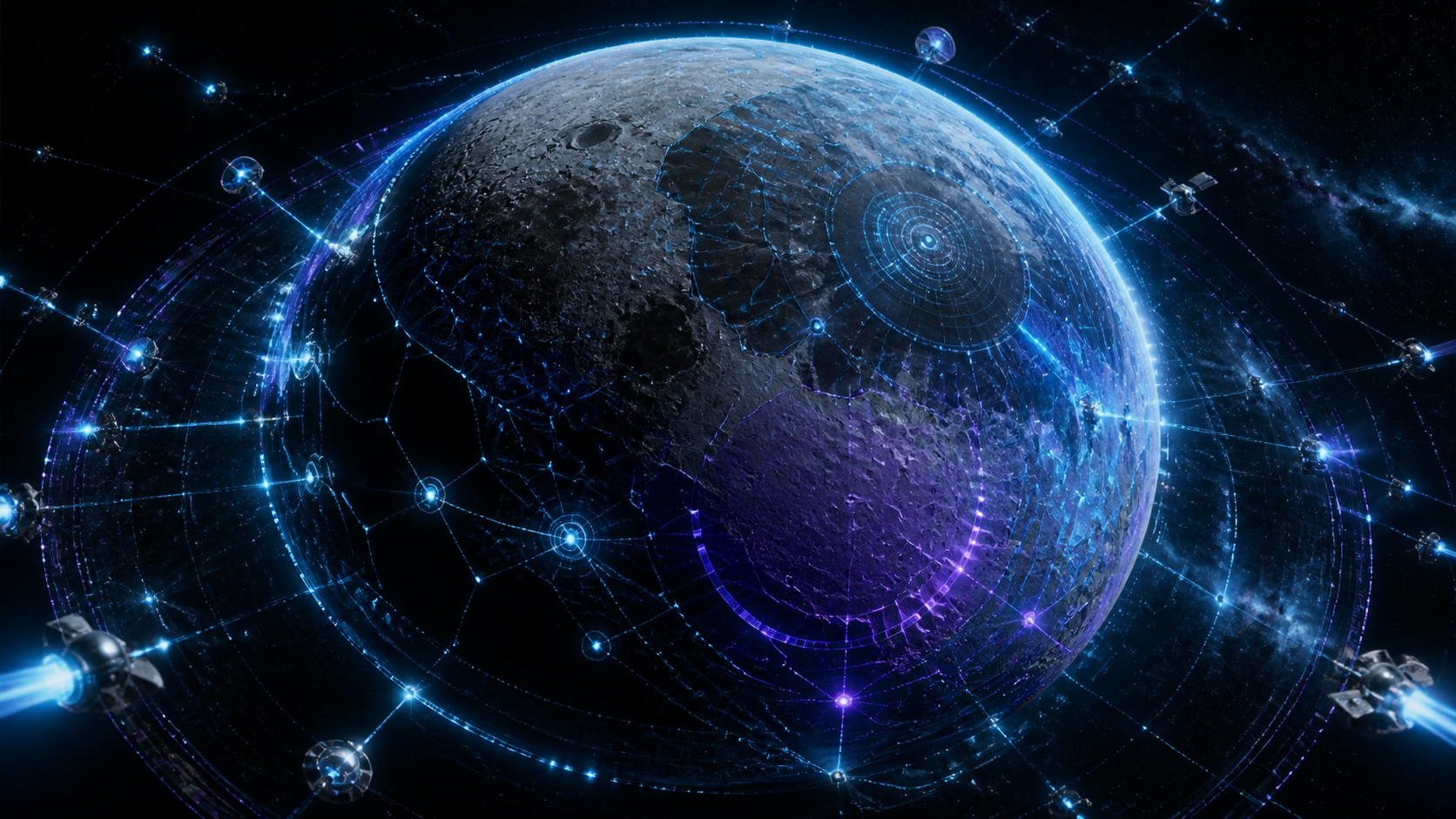
In the public imagination, artificial intelligence in space is usually framed as a servant of exploration: software that helps a rover avoid a rock, a probe compress images, or a spacecraft recover from fault conditions without waiting for instructions from Earth. All of that is real, and increasingly necessary. Yet by mid-2026 a more consequential shift is visible. In deep-space operations, autonomy is no longer only a tool for better execution. It is becoming the layer that decides, in practice, how scarce resources are distributed when no human operator can adjudicate in real time.
That sounds administrative. It is also constitutional. A system that decides which instrument receives power, which sample receives analysis, which route is judged tolerably risky, which anomaly warrants self-preservation over scientific yield, and which communications packet gets priority is not merely optimising. It is governing. On Earth such choices are wrapped in institutions, procedures and legal accountability. On Mars or in cislunar operations, they will often be embedded in software long before any legislature or treaty body catches up.
Why the political question arrives before the settlers
The common assumption is that governance becomes urgent only once people live and work off-world for long durations. That is too late. Governance arrives when decisions acquire distributive effects, and machine judgement in space already does. A mission architecture based on autonomous scheduling, fault management and scientific triage allocates opportunity and risk among stakeholders on Earth: agencies, partner states, scientists, contractors, and sometimes future missions that depend on preserved landing zones or uncontaminated terrain.
The point matters because space law, rooted in the 1967 Outer Space Treaty, was built for state responsibility and international liability, not for machine discretion operating at the edge of communication delay. States remain internationally responsible for national activities in outer space, whether conducted by governmental or non-governmental entities. But responsibility in law does not answer a simpler operational question: who actually encoded the priorities by which a machine acts when time, power and human attention are all scarce.
Latency turns technical autonomy into political autonomy.
Distance changes the meaning of oversight
On Earth, oversight often assumes the possibility of prompt intervention. In orbit around another planet, or on its surface, intervention may be impossible within the relevant decision window. Earth-Mars communications delays make direct teleoperation unsuitable for many safety-critical or time-sensitive tasks. Even in nearer theatres, intermittent connectivity, line-of-sight constraints and bandwidth scarcity impose long periods of delegated discretion.
That is why familiar assurances about keeping a human in the loop can be misleading in the planetary context. A human may remain somewhere in the formal loop while being absent from the decisive moment. If a vehicle must choose between traversing unstable terrain to reach a power-rich area or conserving battery by abandoning a science objective, the operative policy is the one already encoded on board. Oversight after the event may establish accountability, but it does not alter the fact that primary judgement has been delegated.
From mission control to mission constitution
Mission control is usually described as an operational centre. Increasingly it resembles a constitutional convention whose choices are frozen into software. The design of autonomy stacks determines what can be appealed, what is logged, what is explainable, and what kinds of trade-offs are permitted without authorisation. These are not incidental implementation details. They define the practical rights of different mission objectives.
Consider four mundane but foundational questions. Can the system sacrifice instrument life to preserve mobility, or mobility to preserve sample integrity. Does planetary protection override mission rescue behaviour in all cases, or only in predefined contamination scenarios. May local machine learning models update on the fly if doing so improves hazard avoidance but reduces reproducibility. Who has standing to inspect the training and validation history of models used to rank scientific targets. Each answer becomes part of a governing order for off-world activity.
Latency turns technical autonomy into political autonomy.
The first constitution of Mars, then, is unlikely to be a parchment document signed under a dome. It will more plausibly be a hierarchy of machine-readable constraints, audit rules and emergency exceptions written on Earth and tested in simulation. Long before any permanent settlement debates taxation or representation, someone will have decided how software ranks survival, science, environmental restraint and chain-of-command.
The invisible politics of scheduling
Much attention goes to spectacular forms of autonomy such as navigation or robotic manipulation. The more important politics may lie in scheduling. Off-world missions run on finite energy budgets, thermal windows, communication opportunities and maintenance cycles. A scheduler that determines which tasks are executed is effectively allocating the most precious commodity in space: viable time.
The first law of an off-world settlement may be a scheduling rule.
Scheduling sounds too technical to attract democratic scrutiny, yet it decides whose priorities are served. If a shared habitat, laboratory and mobility fleet rely on common optimisation software, the scheduler determines whether medical diagnostics outrank geological survey, whether life-support inspection can pre-empt private research tasks, and whether a dissenting operator can challenge the system's utility function. The constitutional significance lies precisely in this ordinariness. Administrative code is where sovereignty often hides.
Planetary protection is an AI governance problem
Discussion of planetary intelligence often separates scientific exploration from biosecurity and contamination control. In practice they are entangled. NASA, ESA and scientific bodies have spent decades refining planetary protection protocols, but autonomous systems complicate them. A machine that can classify terrain, identify promising samples and modify operational sequences may also increase the probability of entering biologically sensitive zones unless constraints are hard-coded and independently verifiable.
This is especially serious because the scientific value of future life-detection missions depends on trust in chain-of-custody and environmental restraint. An autonomous drill or sample handler that adapts to conditions can be scientifically useful while also introducing difficult evidentiary questions. Was a sample selected because it best matched a pre-registered scientific hypothesis, or because a model drifted toward patterns correlated with contamination artefacts. If a system reprioritises route planning during a dust event, can investigators later reconstruct whether exclusion zones were honoured.
On Earth, sectors such as health have learned that high-stakes AI governance requires more than performance metrics. The WHO's work on AI governance in health stresses transparency, accountability and risk management because systems can alter clinical priorities as much as clinical outcomes. The planetary analogue is plain enough. When software mediates contact between human intention and alien environments, the governance problem is inseparable from the science problem.
Why sovereignty cannot be outsourced upward or downward
Some analysts assume the governance deficit can be solved from above by treaties, or from below by technical standards. Both are necessary; neither is sufficient on its own. Treaty law establishes broad principles such as non-appropriation, due regard and state responsibility. Technical frameworks such as the OECD AI principles and NIST's AI Risk Management Framework offer methods for mapping, measuring and managing risk. But planetary operations need an intermediate layer: operational constitutionalism.
That layer would specify, for example, which decisions are delegable, what minimum explanation records must accompany autonomous actions, when software updates require multinational review, how conflicts between safety and science are ranked, and which planetary protection constraints are non-overridable. Without such provisions, lofty principles remain detached from the actual software artefacts that structure conduct beyond Earth.
The first law of an off-world settlement may be a scheduling rule.
Nor can sovereignty be outsourced downward to private code under the assumption that procurement and liability will sort matters out later. The Outer Space Treaty makes states responsible for national activities, including those of non-governmental actors. If states permit core allocative decisions in off-world environments to be determined by proprietary systems they cannot fully inspect or contest, they hollow out their own sovereign responsibility. Legal accountability without technical legibility is a weak form of control.
A planetary intelligence system cannot be treated as private infrastructure with public consequences.
The case for public codebooks, not merely public principles
There is a habit in technology governance of publishing ethical principles while leaving operative parameters obscure. Planetary AI is poorly suited to that approach. Because these systems will mediate environmental access, safety exceptions and scientific priority, governance requires public codebooks in the broad sense: documented decision classes, escalation rules, logging standards, override conditions and validation protocols that can be scrutinised by participating states and, where possible, scientific communities.
This does not mean revealing every line of mission software or compromising security. It means distinguishing between protected implementation details and constitutional parameters that ought not be hidden. A public mission should not treat the ranking of contamination risk against sample acquisition, or crew health against commercial payload utilisation, as a trade secret. Those are public-order questions. The more remote the mission, the stronger the case for ex ante clarity, because ex post correction will arrive after the consequential act.
Autonomy without archives is authority without memory
One underappreciated challenge is archival. Planetary AI systems will generate a dense record of inferences, confidence scores, sensor fusion outputs and local adaptations. Unless those records are curated for later audit, inquiry and scientific replication, machine authority becomes historically opaque. Future investigators may know what a mission did without knowing why a system deemed one path acceptable and another too dangerous.
This is not a narrow compliance concern. It affects science, diplomacy and accident investigation. If an autonomous system damages a protected site, contaminates a sample chain, or sidelines a partner's experiment during a prolonged anomaly, archives determine whether the event can be reconstructed with enough precision to establish responsibility. In terrestrial AI governance, logging and traceability are often treated as technical controls. In planetary operations they are closer to institutional memory, and therefore a precondition of legitimate authority.
Resource allocation will define off-world legitimacy
The legitimacy of any governing system depends heavily on how it allocates scarcity. Off-world environments are scarcity machines. Energy, water, pressurised volume, spare parts, bandwidth and human attention are finite and often fragile. As autonomy expands, software will become the day-to-day allocator of these goods. A habitat management system might choose which modules receive heating during a power deficit. A logistics system might decide which repair drone is dispatched first. A science platform might rank observations under a narrowing launch window.
Those choices can never be neutral. Utility functions embody political judgements, whether explicitly debated or not. A system tuned primarily for aggregate mission success may repeatedly disadvantage minority scientific objectives or lower-status users. A system tuned heavily for resilience may become excessively conservative, narrowing the frontier of inquiry in ways that are hard to contest because the rationale is statistical rather than rhetorical. Governance is therefore not an accessory to optimisation. It is the process by which optimisation is made answerable to public purpose.
What a governed planetary intelligence regime would look like
A planetary intelligence system cannot be treated as private infrastructure with public consequences.
A serious regime for planetary AI would begin with a simple premise: autonomy in space should be bounded by public law values before it is expanded by operational convenience. In practical terms, that implies several design commitments.
- Decision tiering: routine navigation and fault recovery may be delegated more freely than environmental access, sample custody or life-support trade-offs.
- Non-overridable constraints: planetary protection, crew safety thresholds and protected-site restrictions should be encoded as hard limits unless a formally defined emergency rule is triggered.
- Auditability: all consequential autonomous actions should produce standardised logs sufficient for technical and legal review.
- Contestability: participating public authorities should be able to inspect governing parameters and challenge major updates before deployment.
- Archival continuity: data and model histories should be preserved in forms suitable for scientific replication and accident inquiry.
- International interoperability: shared missions need common vocabularies for risk classes, override events and contamination categories.
None of this resolves every future dispute. It does, however, reduce the chance that constitutional choices are smuggled into space under the label of engineering necessity.
Why this debate matters before the next crisis
Space governance often advances after visible shocks: debris incidents, launch failures, military tensions or budgetary crises. Planetary AI poses a quieter problem. By the time a controversy becomes visible, the governing logic may already be deeply embedded in operational systems and procurement contracts. The habits of deference that surround technical complexity can then make revision unusually difficult.
Mid-2026 is therefore an awkward but useful moment. Human settlement of Mars remains prospective, while autonomous operations across cislunar and deep-space missions are maturing quickly enough to expose the constitutional character of software. This is the stage at which governance can still shape architectures rather than merely react to them. The alternative is familiar from terrestrial digital infrastructure: public dependence on systems whose deepest rules were set elsewhere, opaquely, and then normalised by use.
Planetary intelligence will not begin with a dramatic declaration of machine government. It will arrive through scheduling tables, anomaly handlers, risk scores, environmental constraints and update policies. Yet that is how most durable orders emerge: not first as grand theory, but as routine administration. Off-world, where delay weakens supervision and scarcity sharpens every trade-off, software will become the earliest institution on the scene. The central question is not whether that institution will govern. It is whether its rules will be treated as a public constitutional matter or left to accumulate as private operational fact.