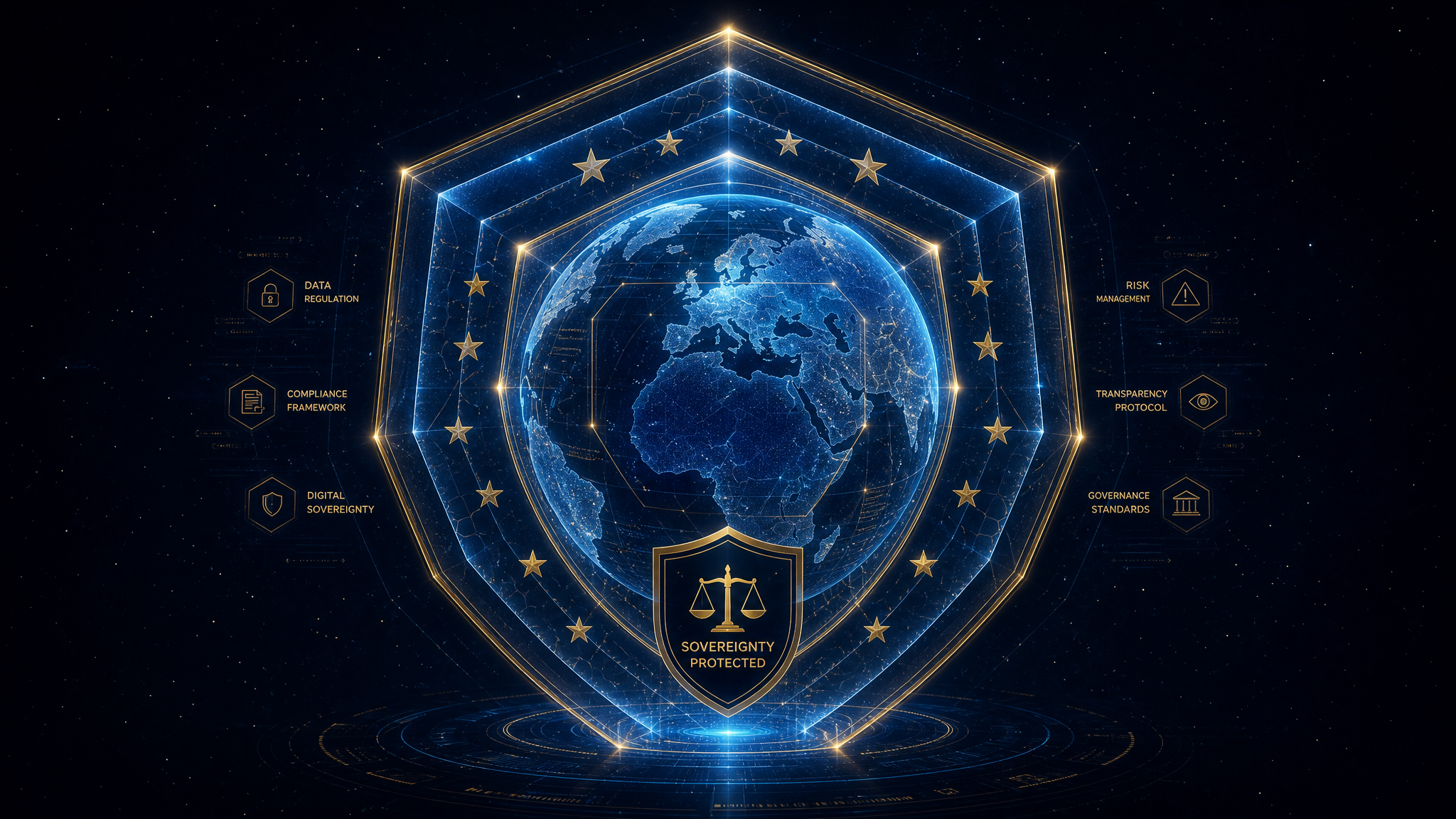
The personal AI assistant has become the most intimate technology most people have ever used. It reads their emails, drafts their messages, manages their calendars, and increasingly makes decisions on their behalf. Yet the architecture underlying most of these systems was designed not for the user's benefit but for the platform's: data flows to centralised servers, trains future models, and remains subject to the legal jurisdiction of corporations incorporated thousands of miles away. In 2026, a structural reckoning with this arrangement is underway — driven by regulatory enforcement, architectural innovation, and a growing recognition that personal AI sovereignty is not a luxury preference but a foundational requirement for digital autonomy.
This guide maps the landscape of personal AI sovereignty in 2026: what it means technically and legally, what the major platforms are doing (and not doing), what the regulatory environment now requires, and what individuals and organisations can do to reclaim meaningful control over their most intimate digital relationships.
Defining Personal AI Sovereignty
Personal AI sovereignty is not a single property but a cluster of related capabilities and rights. Understanding its dimensions is the prerequisite for assessing any particular system or strategy.
Data Sovereignty vs. Data Privacy
Data privacy and data sovereignty are related but distinct concepts that are frequently conflated. Data privacy protects the individual — it governs who can access personal information and under what conditions. Data sovereignty protects the jurisdiction — it governs which legal system's rules apply to data, regardless of where it is physically stored.
A system can be GDPR-compliant (protecting individual privacy rights) while simultaneously failing sovereignty requirements. The US CLOUD Act, for example, allows US authorities to compel the handover of data stored anywhere in the world by US-incorporated providers — including data stored in EU data centres. Standard contractual clauses and data processing agreements cannot fully resolve this jurisdictional conflict. An individual using a US-based AI assistant may have strong contractual privacy protections and still have their data subject to foreign legal compulsion.
The Three Layers of Sovereignty
Digital sovereignty in the context of personal AI operates across three integrated layers:
Data sovereignty: Jurisdictional control over what data is collected, where it is stored, and which legal system governs its use. This is the layer most commonly discussed but least commonly achieved by mainstream AI assistants.
Operational sovereignty: Control over who manages the systems that process personal data. Cloud-based AI assistants, by definition, involve third-party operational control. On-device and self-hosted alternatives restore operational sovereignty at the cost of capability and convenience.
Technological sovereignty: Freedom from vendor lock-in — the ability to migrate data, switch providers, and verify the behaviour of AI systems through open-source inspection. Proprietary AI assistants score poorly on this dimension; open-source alternatives score well but require technical sophistication to deploy.
Data privacy protects the individual; data sovereignty protects the jurisdiction. A system can satisfy one while failing the other — and most mainstream AI assistants fail both when examined carefully.
Data privacy protects the individual; data sovereignty protects the jurisdiction. A system can satisfy one while failing the other — and most mainstream AI assistants fail both when examined carefully.
What the Major Platforms Are Actually Doing
The 2026 landscape of personal AI is dominated by a small number of platforms whose architectures reflect their commercial incentives as much as their stated privacy commitments.
Apple Intelligence: Privacy-First Hybrid Architecture
Apple's approach to personal AI in 2026 is the most architecturally sophisticated of the major platforms. The system uses a hybrid model: privacy-sensitive context layers — the information that makes AI assistance personal, such as calendar data, messages, and on-screen content — are processed by on-device models running on Apple Silicon. Tasks requiring more complex reasoning are routed to Apple's Private Cloud Compute infrastructure, which is designed to prevent Apple itself from accessing the data being processed.
The 2026 integration of Google's Gemini models into Apple Intelligence — announced at WWDC 2026 — complicates this picture. Gemini serves as the cloud-based reasoning engine for complex tasks, placing Google's models at the operating system level on over one billion active devices. For enterprise IT teams, the primary concern is data residency: when Siri AI routes a request to Gemini, what data leaves the device, under what terms, and subject to which jurisdiction? Apple's MDM policies regarding "onscreen content access" — Siri AI can process information visible on the user's screen — require careful review in regulated environments.
The Training Data Question
The most consequential privacy decision most users never make consciously is whether their interactions train future AI models. Most mainstream AI assistants default to using interaction data for model improvement, with opt-out mechanisms buried in settings menus. Enterprise-grade licences typically provide contractual opt-outs that are more reliable than individual settings — but individual users on consumer plans often have limited recourse.
The practical guidance for privacy-conscious users is straightforward: verify that "Improve the model" or equivalent settings are disabled on every AI tool in use. For tools integrated with email or calendar systems, prefer OAuth 2.0 authentication over password-based access — OAuth provides limited-scope tokens that can be revoked without changing passwords, and its permission model makes the scope of AI access explicit.
The most consequential privacy decision most users never make consciously is whether their interactions train future AI models — a choice that is typically made for them by default settings designed to maximise platform value rather than user sovereignty.
The Regulatory Landscape: What Is Now Required
The EU AI Act, fully applicable as of 2 August 2026, has transformed the regulatory landscape for personal AI in ways that are still being absorbed by the industry. Several provisions are directly relevant to personal AI sovereignty.
High-Risk AI Obligations
Under Article 10 of the EU AI Act, operators of high-risk AI systems must maintain rigorous records of training data provenance and preparation. For AI assistants that process personal data to make consequential decisions — in healthcare, finance, or employment contexts — this creates documentation requirements that are operationally difficult to satisfy when using "black-box" cloud AI services. The practical implication is that organisations deploying AI assistants in high-risk contexts must either use providers that can satisfy these documentation requirements or deploy systems they control directly.
Transparency and Explainability
The most consequential privacy decision most users never make consciously is whether their interactions train future AI models — a choice that is typically made for them by default settings designed to maximise platform value rather than user sovereignty.
Privacy regulations increasingly require clear notice of AI use, the logic behind automated decisions, and the ability for users to exercise rights including deletion and access. The EU AI Act's transparency requirements for AI systems that interact with natural persons — including disclosure that the user is interacting with an AI — establish a baseline that many current AI assistant deployments do not meet.
The EU Data Act Extension
The EU Data Act, effective September 2025, extends sovereignty requirements beyond personal data to include industrial telemetry and non-personal IoT sensor data, granting users new portability rights. For personal AI assistants that integrate with smart home devices, wearables, and other IoT systems, this creates new obligations around data portability and user control that are only beginning to be implemented.
A Practical Guide to Personal AI Sovereignty
The following framework provides a structured approach to assessing and improving personal AI sovereignty across the three layers identified above.
Step 1: Audit Your Current AI Footprint
Most individuals and organisations have a larger AI footprint than they realise. AI capabilities are embedded in email clients, productivity suites, search engines, and communication platforms — often without explicit acknowledgement. A sovereignty audit begins with mapping every AI-enabled tool in use, the data each accesses, and the terms under which that data is processed.
Key questions for each tool: Where is the data processed — on-device, in a sovereign cloud, or in a US-incorporated cloud provider's infrastructure? Does the provider use interaction data for model training, and is there a reliable opt-out? What happens to the data if the service is discontinued or the provider is acquired?
Step 2: Classify Data by Sensitivity and Longevity
Not all personal data requires the same level of sovereignty protection. A practical classification framework distinguishes between:
Ephemeral low-sensitivity data: Queries about public information, general productivity tasks, and interactions that contain no personal identifiers. These can be processed by mainstream cloud AI assistants with minimal sovereignty risk.
Persistent medium-sensitivity data: Professional communications, financial information, health data, and personal relationships. These warrant sovereign cloud or on-device processing, and explicit contractual protections against training use.
High-sensitivity long-lived data: Legal documents, medical records, financial strategies, and communications that must remain confidential for years or decades. These require on-premises or air-gapped processing, and are candidates for post-quantum cryptographic protection given the harvest-now, decrypt-later threat.
Step 3: Choose Architecture Over Features
Personal AI sovereignty in 2026 is not a binary property but a spectrum of architectural choices, contractual protections, and governance practices that must be deliberately constructed.
The personal AI market in 2026 presents a genuine privacy-utility spectrum. At the "Gold Standard" privacy end, tools like Proton Mail with Scribe use zero-access encryption but offer limited AI features. At the "High Utility" end, agentic AI assistants with autonomous email triage and calendar management capabilities offer significant productivity gains but require more trust in the provider's architecture.
The key architectural properties to evaluate are: local-first inference (does the model run on the device?), credential isolation (are API keys and tokens separated from the model's context?), open-source verification (can the data handling be independently inspected?), and jurisdictional clarity (which legal system governs the data, and is that system compatible with the user's sovereignty requirements?).
Step 4: Implement Sovereign Cloud for Organisational AI
For organisations rather than individuals, the deployment model matters as much as the tool selection. The European Data Protection Board identifies on-premises deployment as the strongest mitigation for cross-border transfer risks. For organisations that cannot operate fully on-premises, sovereign cloud providers — infrastructure operated by entities incorporated within the same jurisdiction as the user — offer a middle ground between public cloud scalability and on-premises control.
The tiered deployment model that has emerged in 2026 allocates workloads by sensitivity: public cloud (EU region) for low-sensitivity data with standard contractual protections; sovereign cloud for medium-sensitivity data requiring enhanced operational controls; private or on-premises for high-sensitivity data where cross-border transfer risks are unacceptable; and air-gapped systems for the highest-sensitivity defence or critical infrastructure workloads.
Step 5: Build Crypto-Agility Into Personal AI Infrastructure
The post-quantum cryptographic transition is not only a concern for large organisations. Personal AI assistants that store long-lived sensitive data — health records, financial information, legal documents — are exposed to harvest-now, decrypt-later attacks. The practical implication is that individuals and organisations should prefer AI tools that use post-quantum cryptographic standards (FIPS 203, 204, 205) for data at rest and in transit, and should treat cryptographic agility — the ability to update cryptographic algorithms as standards evolve — as a selection criterion for AI infrastructure.
The Emerging Architecture of Sovereign Personal AI
The most significant architectural development in personal AI sovereignty in 2026 is the maturation of local-first inference. Models like Llama, DeepSeek, and Gemma can now run on consumer hardware with sufficient capability for many everyday AI tasks. The open-source nature of these models allows independent verification of data handling — a property that no proprietary cloud AI assistant can offer.
The practical limitation of local-first AI remains capability: on-device models are less capable than frontier cloud models for complex reasoning tasks. The hybrid architecture that Apple has pioneered — local processing for context-sensitive personal data, cloud processing for complex reasoning — represents the most viable near-term path for combining sovereignty with capability. The critical governance question is whether the cloud component of hybrid systems can be made subject to meaningful sovereignty controls, or whether it inevitably reintroduces the jurisdictional vulnerabilities that local processing was designed to avoid.
Conclusion: Sovereignty as Infrastructure
Personal AI sovereignty in 2026 is not a binary property — fully sovereign or fully exposed — but a spectrum of architectural choices, contractual protections, and governance practices. The regulatory environment has shifted significantly in the direction of user rights, with the EU AI Act and Data Act establishing baseline requirements that are beginning to reshape platform behaviour. But regulation alone cannot deliver sovereignty; it can only establish minimum floors.
The individuals and organisations that achieve meaningful personal AI sovereignty in 2026 will be those that treat it as an infrastructure question rather than a settings question. Sovereignty is built into architectures, not toggled in preference menus. It requires deliberate choices about which tools to use, how to deploy them, and what data to entrust to which systems — choices that must be made with clear eyes about the commercial incentives and jurisdictional exposures of the platforms involved.
The personal AI assistant is the most intimate technology most people have ever used. It deserves the most careful governance most people have ever applied to a technology choice. The framework presented here is a starting point for that governance — not a guarantee of sovereignty, but a map of the terrain that must be navigated to achieve it.