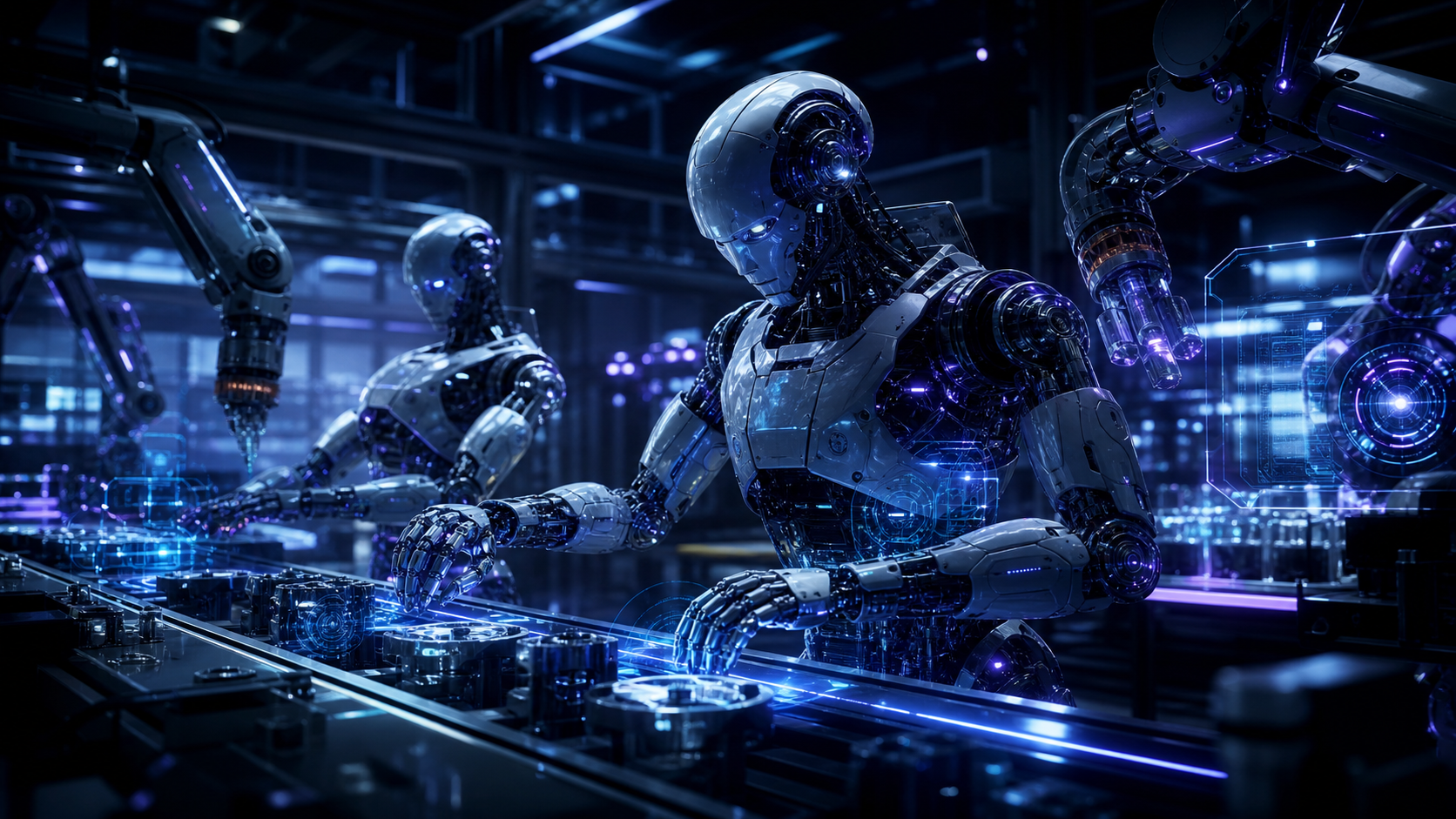
In February 2026, China published the world's first comprehensive national standard for humanoid robots. The "Humanoid Robot and Embodied Intelligence Standard System" — HEIS 2026 — covered six pillars: unified terminology, AI model performance benchmarks, hardware interface specifications, neuromorphic computing protocols, ethical boundaries, and a four-dimension, five-level autonomy grading system. It was a document of extraordinary ambition, and it arrived at a moment when the rest of the world had nothing comparable to offer in response.
That asymmetry is the defining fact of humanoid robotics in 2026. The machines are arriving. The governance is not.
This explainer maps the current state of humanoid robot deployment, the physical AI infrastructure enabling it, the regulatory landscape struggling to keep pace, and the labor market dynamics that will determine whether this transition is managed or merely endured. It draws on deployment data, regulatory filings, and market analysis to construct an honest picture of where the industry actually stands — not where its promotional materials claim it does.
What Is Actually Deployed: Separating Signal from Noise
The humanoid robotics industry has a marketing problem. High-profile demonstrations, carefully choreographed for investor audiences, have created a public perception of capabilities that frequently outstrips operational reality. Understanding what is genuinely deployed — and what remains aspirational — is the necessary first step in any serious analysis.
As of mid-2026, the most commercially proven humanoid platform in industrial use is not Tesla's Optimus, which commands the most media attention, but Figure AI's Figure 02 and its successor, the Figure 03. Following an eleven-month pilot at BMW Group's Plant Spartanburg in South Carolina — where the robot logged over 1,250 operating hours and loaded more than 90,000 parts — Figure AI has expanded its BMW partnership to include the Leipzig plant in Germany. BMW has simultaneously established a Center of Competence for Physical AI in Production, signaling that this is not a pilot program but a strategic infrastructure commitment.
Agility Robotics' Digit robot presents a different but equally instructive case. The company has accumulated over 65,000 operating hours across nine customer facilities, including Toyota Motor Manufacturing Canada, GXO, and Schaeffler. At GXO's facility in Flowery Branch, Georgia, Digit has moved over 100,000 totes under a formal Robot-as-a-Service (RaaS) commercial arrangement. Agility is preparing for the late 2026 release of Digit v5, which will feature a 50-pound payload capacity and "cooperative safety" capabilities allowing operation outside fenced zones — a significant technical threshold.
Boston Dynamics' Electric Atlas, unveiled at CES 2026, represents the high-end industrial tier. With an IP67 rating and a 50-kilogram lift capacity exceeding most competitors, it is currently being piloted at Hyundai's Metaplant in Georgia. The company has deliberately positioned Atlas as a durable industrial tool rather than a mass-market commodity, betting on performance differentiation over price competition.
"The industry has largely moved toward 'Physical AI' and 'Robot Foundation Models' — systems that process natural language and vision to execute tasks without rigid, task-specific programming. This is not incremental improvement. It is a categorical shift in what robots can do."
Tesla's Optimus occupies a peculiar position: the most discussed platform with the least verified commercial deployment. Internal Tesla reporting and earnings calls from early 2026 confirm that Optimus units are primarily used for data collection and learning rather than productive labor. The company has acknowledged that Optimus is not yet utilized in its factories in a "material way." Critics have noted a pattern of teleoperation in public demonstrations — a gap between the company's long-term manufacturing trajectory and its current autonomous capabilities that has not been adequately disclosed to investors.
The Chinese manufacturing landscape operates on different economics entirely. Unitree Robotics shipped approximately 5,500 humanoid units in 2025 and is targeting between 10,000 and 20,000 units in 2026. Its G1 model is priced at approximately $16,000 — a fraction of Western counterparts. Xpeng has initiated factory trials of its "Iron" humanoid in Guangzhou, with mass production planned for 2026. Guangzhou Auto Group's "GoMate" robot, featuring a hybrid wheel-leg design, is entering small-scale production for automotive and logistics environments.
The global humanoid robotics market reached $6.24 billion in 2026, up from $4.89 billion in 2025, with projections of $165 billion by 2034. Goldman Sachs estimates 50,000 to 100,000 humanoid units will enter industrial environments globally this year. These are not trivial numbers. They represent the beginning of a deployment curve that, if historical technology adoption patterns hold, will accelerate nonlinearly.
The Physical AI Stack: What Makes 2026 Different
Previous generations of industrial robots were programmed, not trained. They executed fixed sequences of movements with precision but could not adapt to variation, interpret natural language, or generalize from one task to another. The humanoid robots entering factories in 2026 are built on a fundamentally different substrate: foundation models trained on vast datasets of human motion, language, and environmental interaction.
NVIDIA's Isaac GR00T series has emerged as the primary family of foundation models for humanoid robots. The architecture employs a dual-system design that mirrors human cognition: a fast-thinking action model for reflexes and intuition, and a slow-thinking vision-language model for deliberate reasoning and planning. The GR00T N1.7, released in April 2026, is a three-billion parameter model utilizing an "Action Cascade" architecture featuring a 32-layer Diffusion Transformer for low-level motor control. The GR00T N2, previewed in 2026, employs a "world action model" architecture that reportedly doubles robot success rates in new environments compared to previous Vision-Language-Action models.
Parallel to these foundation models, NVIDIA's Cosmos suite provides world foundation models for synthetic data generation and policy evaluation — directly addressing the data scarcity bottleneck that has historically constrained robotics development. The collaboration between NVIDIA, Google DeepMind, and Disney Research to develop Newton, an open-source physics engine, represents a significant infrastructure investment in the simulation layer that underlies all modern robot training.
Vision-Language-Action models now back 40% of new humanoid deployments — allowing robots to understand natural language and generalize tasks without reprogramming. This is not a feature update. It is a platform shift that changes the economics of every labor market it touches.
Vision-Language-Action (VLA) models now back approximately 40% of new humanoid deployments. These models allow robots to understand natural language instructions and generalize tasks without extensive reprogramming — a capability that was theoretical three years ago and is now a commercial product. Imitation Learning has overtaken Reinforcement Learning as the primary training method, providing a more practical on-ramp for real-world manipulation tasks by allowing robots to learn from human demonstrations rather than trial-and-error in simulation.
"Vision-Language-Action models now back 40% of new humanoid deployments — allowing robots to understand natural language and generalize tasks without reprogramming. This is not a feature update. It is a platform shift that changes the economics of every labor market it touches."
The hardware layer has also undergone significant standardization. The industry has converged on design principles that prioritize "data friendliness": backdrivable joints that allow safe human-robot interaction, integrated sensor stacks that generate training data during operation, and modular architectures that allow component upgrades without full platform replacement. Dexterity has seen particular investment, with companies like Sharpa demonstrating sub-0.05-second reaction times and high-precision tactile sensing — capabilities critical for assembly tasks that previously required human hands.
The Robot-as-a-Service model has emerged as the dominant commercial structure for early deployments. By converting capital expenditure into operational expenditure, RaaS removes the primary barrier to adoption for mid-sized manufacturers who cannot absorb the upfront cost of a $150,000 robot fleet. An industrial humanoid operating 20 hours per day achieves an effective hourly cost of approximately $1.64 to $8.00 — significantly below the $22 to $40-plus per hour cost of a human worker in comparable roles. Many industrial deployments are reporting return on investment within 12 to 18 months.
The Governance Gap: A Three-Jurisdiction Analysis
The regulatory landscape for humanoid robots in 2026 is characterized by a fundamental asymmetry: the jurisdiction moving fastest on deployment is also moving fastest on governance, while the jurisdictions with the most sophisticated governance traditions are moving slowest on both.
China: The Whole-of-Nation Approach
China's 15th Five-Year Plan (2026–2030) has elevated "embodied intelligence" to a strategic priority equivalent in importance to nuclear fusion and quantum technology. The HEIS 2026 framework is the operational expression of this priority. Its six pillars — unified terminology, AI model performance benchmarks for VLA and VTLA systems, component hardware interfaces, neuromorphic computing protocols, ethical boundaries, and a four-dimension, five-level autonomy grading system — constitute the world's first comprehensive national standard for the entire humanoid industrial lifecycle.
China's regulatory philosophy employs "sandbox regulation" (沙盒监管): flexibility for testing in real-world environments — factory floors, urban logistics corridors — to generate the operational data necessary for training embodied AI. This is not regulatory capture; it is a deliberate strategy to use deployment volume as a competitive advantage in the global standards race. By establishing domestic standards first, China aims to push its technical specifications into international bodies like the ISO and IEC, replicating its previous strategies in 5G and high-speed rail.
The insurance sector has moved in parallel. In October 2025, China Pacific Insurance launched "Ji Zhi Bao," the world's first humanoid-specific insurance product, creating a formal risk-management market for commercial robots. This is not a minor development: insurance markets price risk with precision that regulatory frameworks cannot match, and the existence of actuarial data on humanoid robot incidents will shape liability law for decades.
The European Union: Precautionary Governance Under Pressure
The EU AI Act, fully applicable as of August 2026, classifies autonomous robots as "high-risk AI systems," imposing strict requirements for risk management, documentation, and human oversight. The EU Machinery Regulation 2023/1230, replacing the Machinery Directive in 2027, introduces stricter conformity assessments for high-risk machinery. The revised Product Liability Directive, applying from December 2026, formally recognizes software as a product — meaning AI-induced harm can trigger direct manufacturer liability.
These are serious instruments. But they were not designed for humanoid robots specifically, and the gaps are becoming visible. There is currently no EU-wide regulation specifically addressing humanoid robots. The EU AI Act's "high-risk" classification imposes compliance burdens that may slow European deployment relative to Chinese competitors, without providing the operational data that would allow those standards to be refined. European manufacturers and policymakers are increasingly concerned that the lack of agile, humanoid-specific standards leaves them vulnerable to technical fragmentation and potential reliance on Chinese-defined specifications.
The ISO 25785-1 standard, currently under development, addresses dynamically stable robots — those that require active balance control and fall if power is lost. It aims to quantify "fall zones" and balance recovery thresholds. Its absence from the current standards landscape is not a minor gap: a falling humanoid robot in an industrial environment is a distinct hazard category that existing machinery safety standards were not designed to address.
The United States: Decentralized and Reactive
The United States currently lacks a federal legislative framework specifically for humanoid robots. Policy development is occurring in a fragmented, state-by-state manner. Federal compliance relies on the OSHA General Duty Clause and voluntary consensus standards like ANSI/A3 R15.06-2025. The US Robotics Industry Association has published guidance, but guidance is not regulation.
The first wave of AI displacement hit white-collar cognitive work. The physical displacement wave — via humanoid robots — is only beginning. The compressed timeline may outpace the rate at which the workforce can retrain, and that gap is a policy problem, not a technology problem.
The US policy posture is focused on export controls and maintaining technological competitiveness rather than domestic deployment governance. This creates a paradox: American companies are among the most technically advanced humanoid robot developers in the world, operating in a domestic regulatory environment that provides less structured guidance than the Chinese framework their products compete against internationally.
State-level legislatures have begun exploring potential bills addressing liability and safety, but the timeline for federal action remains unclear. The compressed deployment timeline of the humanoid robot industry may not accommodate the pace of American legislative process.
The Labor Market Question: What the Data Actually Shows
The labor market impact of humanoid robots is the most politically charged dimension of this analysis, and consequently the most distorted by motivated reasoning on both sides. The honest picture is more nuanced than either the displacement catastrophists or the productivity optimists acknowledge.
The World Economic Forum's Future of Jobs Report 2025 projects a global net gain of 78 million jobs by 2030, resulting from 170 million new roles created against 92 million displaced across all technological trends — not humanoid robots specifically. In the near term, humanoid robots are primarily filling chronic labor gaps rather than displacing existing employees. US manufacturing reported over 600,000 unfilled vacancies as of 2025. The projected 8-million shortage of manufacturing workers by 2030 represents a structural demand for automation that humanoid robots are positioned to address.
The economic justification for adoption is based on Total Cost of Ownership analysis. A humanoid robot operating 20 hours per day achieves an effective hourly cost of $1.64 to $8.00, against $22 to $40-plus for a human worker in comparable roles. Manufacturing costs for humanoid robots have declined approximately 40% between 2022 and 2024. These economics are compelling, and they will become more compelling as production scales.
The critical analytical distinction is between job displacement and task displacement. Jobs are bundles of tasks. Automation rarely eliminates an entire job title; it automates specific, repetitive, or dangerous tasks, allowing human workers to shift toward supervisory, maintenance, or complex decision-making roles. The first wave of AI displacement (2022–2025) disproportionately affected white-collar cognitive tasks. The physical displacement wave via humanoid robots is only beginning, and it faces higher capital expenditure hurdles than software-based AI.
"The first wave of AI displacement hit white-collar cognitive work. The physical displacement wave — via humanoid robots — is only beginning. The compressed timeline may outpace the rate at which the workforce can retrain, and that gap is a policy problem, not a technology problem."
The transition period between 2026 and 2035 is expected to be economically challenging for workers in high-exposure, low-adaptability roles. Historical parallels — the ATM paradox, the mechanization of agriculture — demonstrate that technology often creates more jobs than it destroys over long time horizons. But the compressed timeline of the humanoid robot revolution may outpace the rate at which the workforce can retrain. The primary challenge identified by labor economists is not the absence of future jobs but the management of the transition: policy intervention, wealth distribution, and aggressive upskilling programs that do not yet exist at the required scale.
The Sovereignty Dimension: Standards as Geopolitical Infrastructure
The governance gap in humanoid robotics is not merely a technical or regulatory problem. It is a sovereignty problem. The nation that defines the standards for humanoid robots defines the terms on which every other nation deploys them — the safety thresholds, the liability frameworks, the data protocols, the autonomy grading systems. China understands this. The HEIS 2026 framework is not primarily a domestic safety document; it is a geopolitical instrument designed to establish Chinese technical specifications as the global default.
This mirrors China's strategy in 5G, where Huawei's early infrastructure dominance translated into standards influence at the ITU and 3GPP. It mirrors the high-speed rail playbook, where Chinese construction of rail networks in developing nations created long-term dependency on Chinese maintenance, software, and component supply chains. The humanoid robotics standards race is the same game, played on a larger board.
The implications extend beyond trade competition. Humanoid robots operating in critical infrastructure — manufacturing, logistics, healthcare, defense — will generate vast quantities of operational data. The standards that govern data collection, storage, and transmission from these robots will determine who has access to that data and under what conditions. A humanoid robot operating in a German automotive plant under Chinese-defined standards is not merely a labor market question; it is a data sovereignty question.
The Society OS framework for understanding this dynamic is the Sovereign Stack: the principle that nations and individuals must maintain meaningful control over the AI infrastructure that shapes their economic and social outcomes. Applied to humanoid robotics, Sovereign Stack analysis reveals that the governance gap is not a temporary lag to be closed by eventual regulation. It is a structural vulnerability that compounds with each deployment cycle, as operational data accumulates under frameworks that were not designed with sovereignty in mind.
What Responsible Deployment Looks Like
The current state of humanoid robot governance is not a reason to halt deployment. The labor shortages are real, the productivity gains are real, and the technology is advancing regardless of whether any particular jurisdiction chooses to engage with it. The question is not whether humanoid robots will be deployed but under what conditions and with what accountability structures.
The industry has largely moved toward Physical AI and Robot Foundation Models — systems that process natural language and vision to execute tasks without rigid, task-specific programming. This is not incremental improvement. It is a categorical shift in what robots can do.
Responsible deployment in 2026 requires engagement with several specific technical and governance challenges that the industry has not yet resolved.
The "diffusion of responsibility" problem in liability law is unresolved. When a humanoid robot causes harm, determining fault involves the hardware manufacturer, the AI model developer, the system integrator, and the facility operator. The EU's revised Product Liability Directive, applying from December 2026, formally recognizes software as a product — a necessary step. But the multi-party liability chain for AI-driven physical systems requires more specific legal architecture than any jurisdiction has yet provided.
The cybersecurity dimension of humanoid robot safety is underappreciated. New EU regulations mandate that cybersecurity protections be integrated directly into safety functions to prevent digital breaches from causing physical harm. A humanoid robot that can be remotely commanded is not merely a data security risk; it is a physical security risk. The attack surface of a fleet of humanoid robots operating in critical manufacturing infrastructure is qualitatively different from the attack surface of a software system.
The operational protocols for humanoid robots introduce novel hazard categories that existing industrial safety frameworks were not designed to address. Traditional full-power shutdown causes a humanoid robot to collapse — creating a distinct hazard in an industrial environment. "Control of Hazardous Energy" procedures, designed for conventional machinery, require adaptation for systems that fall when de-energized. ISO 25785-1, when completed, will address this. Its absence from the current standards landscape is a gap that facility operators are navigating without adequate guidance.
The Next Eighteen Months: What to Watch
The next eighteen months are widely considered critical for the humanoid robotics standards race. Several developments will determine whether the governance gap narrows or widens.
China's push to internationalize HEIS 2026 through ISO and IEC will face its first significant tests. Western nations' response — whether they engage with Chinese-proposed standards, develop competing frameworks, or default to fragmented national approaches — will shape the global governance architecture for a decade.
The EU AI Act's full application from August 2026 will generate the first significant compliance cases involving humanoid robots classified as high-risk AI systems. These cases will reveal whether the existing framework is adequate or requires humanoid-specific supplementation.
Agility Robotics' planned SPAC merger, expected to close by end of 2026, will create the first US-listed pure-play humanoid company. The financial disclosures required for public listing will provide the most detailed operational data on commercial humanoid deployment yet available — a significant input for both investors and policymakers.
Tesla's Optimus program will either achieve material factory deployment or face increasing scrutiny of the gap between its public claims and operational reality. The company has targeted thousands of internal units by end of 2026, with external sales potentially beginning in 2027. Whether those targets are met will be a significant data point for the industry's overall deployment trajectory.
NVIDIA's GR00T N2, based on "DreamZero" research and employing a "world action model" architecture, is expected to reach broader availability. If its reported doubling of robot success rates in new environments holds under real-world conditions, it will represent a step-change in the generalization capability of deployed humanoid systems — and a corresponding step-change in the governance challenges they present.
Conclusion: The Governance Gap Is a Choice
The humanoid robotics governance gap is not an accident of timing. It is the predictable result of a global system in which the incentives for rapid deployment are concentrated and immediate, while the incentives for governance development are diffuse and delayed. Companies that deploy first capture market share. Nations that establish standards first capture geopolitical influence. The costs of inadequate governance — workplace injuries, liability disputes, data sovereignty erosion, workforce disruption — are distributed across populations and time horizons that do not map onto quarterly earnings cycles or electoral calendars.
This is the structural problem that no amount of technical progress will resolve. The humanoid robots of 2026 are more capable than those of 2024, and the humanoid robots of 2028 will be more capable still. Capability is not the constraint. The constraint is the institutional capacity to govern systems that are simultaneously physical, autonomous, networked, and economically consequential at scale.
The Society OS analysis of this dynamic, developed independently of the current deployment wave, identified the governance gap as a structural feature of the agentic transition — not a temporary lag but a persistent asymmetry that requires deliberate institutional design to close. The H-T-A Protocol (Human-Twin-Agent) framework, which establishes trust architecture for autonomous systems operating in human environments, addresses precisely the accountability chain that humanoid robot governance currently lacks: a structured relationship between human principals, digital representations of their intentions, and autonomous agents acting on their behalf.
The world is arriving at the conclusion that autonomous physical systems require new governance architectures. The question is whether that conclusion arrives before or after the costs of the governance gap become irreversible.