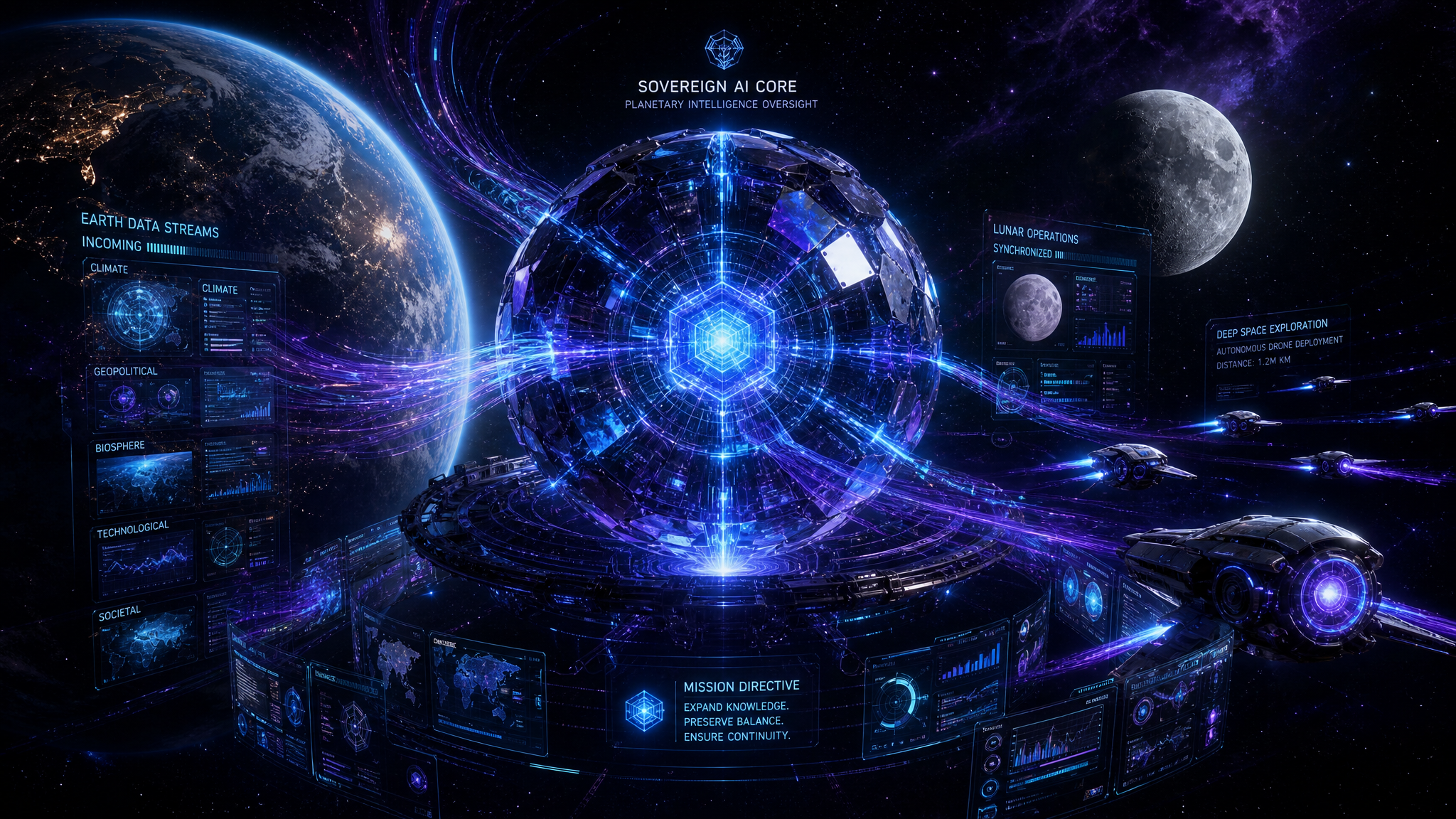
The orbital frontier is becoming computational
Space policy used to revolve around launch capacity, payload mass and access to radio spectrum. Increasingly, it also turns on software. Satellites now operate in an environment that is more crowded, more commercially active and more strategically sensitive than at any previous point in the space age. In that environment, artificial intelligence and autonomous systems are attractive because they can process large volumes of sensor data, optimise spacecraft operations and compensate for the basic limitations of orbital infrastructure: distance, intermittent connectivity and finite human attention.
The shift is not speculative. Publicly documented work by civil space agencies, defence institutions and academic laboratories shows growing interest in machine learning for Earth observation, onboard data processing, autonomous navigation and space situational awareness. As agencies send missions further from Earth and place more assets in low Earth orbit, the operational case for more onboard decision-making becomes stronger. A satellite that can identify anomalous behaviour, re-prioritise observations or avoid debris without waiting for human commands offers obvious advantages.
Autonomy in space promises resilience and efficiency, but it also relocates judgement from operators to code in one of the least forgiving environments humanity uses.
That relocation matters. Unlike terrestrial AI deployment, where systems usually function within dense regulatory and institutional settings, orbital autonomy unfolds in a domain where legal principles are broad, verification is difficult and intent is often ambiguous. The question is therefore not only what machines can do in orbit, but what kinds of machine discretion states are willing to tolerate there.
Why space systems need autonomy
The appeal of autonomy in space is rooted in physics and economics. Spacecraft often operate far beyond real-time human supervision. Even in low Earth orbit, operators face communication windows, bandwidth constraints and a rapidly rising number of objects to track. For deep-space missions, signal delay makes direct control impractical. These conditions reward systems that can classify, infer and act locally.
Civil applications are straightforward. Earth-observation satellites generate more imagery than can easily be downlinked and inspected, so onboard processing can filter, compress or identify salient events before transmission. Planetary missions benefit from autonomous hazard detection, route planning and fault management because remote operators cannot react instantly. Weather and climate missions can use adaptive scheduling to maximise the value of limited sensing opportunities.
The security case is sharper still. Military and dual-use space systems must maintain service under jamming, cyber disruption or kinetic threat. Autonomous functions can help constellations reconfigure, preserve communications pathways and continue surveillance when centralised control is degraded. In strategic terms, autonomy is attractive because it improves continuity under stress. But that same continuity can also harden competition, making systems more persistent and less legible to outsiders.
From observation to manoeuvre
Most current discussion of AI in space begins with data analysis, especially imagery. That focus is understandable: machine learning has already transformed object recognition and change detection on Earth. In orbit, similar methods can identify wildfires, maritime activity, crop conditions or infrastructure damage at scale. Public research by NASA and the European Space Agency has shown how AI tools can assist with classification and mission analytics, while broader academic work points to the efficiency gains of processing data closer to the sensor.
Yet the more consequential transition may be from interpretation to manoeuvre. Autonomous spacecraft are not only seeing; they are increasingly expected to decide how to move, when to observe and how to allocate scarce resources such as propellant, power and downlink time. Space situational awareness systems are also moving in this direction. With tens of thousands of tracked objects in orbit, and many more expected, automated support for conjunction assessment and collision avoidance is becoming essential.
Autonomy in space promises resilience and efficiency, but it also relocates judgement from operators to code in one of the least forgiving environments humanity uses.
This is where governance becomes difficult. A system that autonomously recommends a collision-avoidance burn is one thing; a system that executes a manoeuvre with limited human review is another. Orbital movement is communicative. It can be interpreted as prudent, routine, evasive or threatening depending on context. If AI-enabled satellites alter behaviour rapidly and opaquely, observers may struggle to distinguish safety actions from strategic probing.
Congestion makes automation unavoidable
The growth in orbital traffic has changed the baseline. According to the European Space Agency, the number of space debris objects and active satellites has risen markedly, increasing the operational burden on both public agencies and private operators. Low Earth orbit in particular is becoming a dense operating environment in which conjunction warnings are frequent and decisions must often be made quickly. Human-centred workflows were designed for a quieter era.
Automation therefore enters space not simply as innovation, but as a coping mechanism. It helps operators triage alerts, model trajectories and identify false positives. Without such support, the sheer scale of space traffic would overwhelm many mission teams. This creates a structural dependency: as orbital activity grows, the case for algorithmic management strengthens, which in turn makes orbital conduct more machine-mediated.
The more crowded orbit becomes, the less plausible purely manual governance looks; yet the more software governs movement, the harder it becomes to read another actor’s intent.
That dilemma is especially acute because conjunction data are imperfect. Tracking systems have uncertainty margins, observations are incomplete and operators possess uneven information. In this context, autonomous decision tools may be both necessary and contested. States will want them for safety and resilience, but may also worry that others could use them to mask opportunistic manoeuvres behind the language of automation.
Dual-use logic will define the field
Space autonomy is quintessentially dual-use. The same computer vision model that helps identify flood damage can support military reconnaissance. The same path-planning algorithm that improves proximity operations for servicing spacecraft can be adapted for inspection of another state’s satellite. The same autonomous fault-management software that preserves mission continuity can support operations in contested conditions.
This dual-use character complicates arms-control thinking. Many of the enabling technologies are general-purpose computational methods, not bespoke weapons. They emerge from civil programmes, academic research and commercial practice as much as from defence laboratories. As a result, restrictive approaches aimed at the technology itself are unlikely to be practical. The more viable route lies in addressing behaviour, transparency and risk management.
The Secure World Foundation and the United Nations Office for Outer Space Affairs have both highlighted the importance of norms, information-sharing and responsible conduct in managing a changing space environment. AI will test these efforts because it blurs categories that policy frameworks still rely on. Is an autonomous rendezvous capability an inspection tool, a servicing function or a latent counterspace asset? Often it is all three at once. Strategy in orbit will increasingly hinge on interpretation rather than formal designation.
Decision speed can erode strategic stability
One of the clearest lessons from AI debates in nuclear and cyber policy is that speed is not an unqualified good. Faster sensing and response can improve survivability, but they can also compress decision time and increase the risk of miscalculation. In space, where visibility is partial and attribution often slow, those dangers are magnified.
The more crowded orbit becomes, the less plausible purely manual governance looks; yet the more software governs movement, the harder it becomes to read another actor’s intent.
Autonomous systems may create pressure to pre-authorise actions because communication links can be disrupted or because conjunction and interference events unfold faster than humans can comfortably assess. But pre-authorisation changes responsibility. It embeds assumptions about thresholds, confidence levels and acceptable risk into software before the fact. If those assumptions prove wrong in an unusual scenario, operators may discover too late that they delegated judgement in ways they did not fully understand.
The strategic concern is not a science-fiction scenario of fully independent orbital combat. It is a more prosaic but realistic pattern in which multiple actors rely on semi-autonomous systems for navigation, threat detection and defensive response. Under stress, these systems could interact in ways that no single operator intended. Small manoeuvres might trigger reciprocal adjustments. Defensive routines might be interpreted as concealment. A software update could subtly change behaviour in a way external observers cannot predict.
The central risk is not runaway machine war in orbit, but cumulative ambiguity: many small autonomous choices interacting inside a domain where trust is already thin.
For that reason, strategic stability in space will depend less on banning autonomy than on maintaining decision friction where it matters most. Human oversight should not be treated as a symbolic comfort. In critical functions, it remains an important source of interpretability, accountability and restraint.
Law offers principles, not detailed answers
The legal architecture of outer space was not written for machine learning, but it is not silent either. The 1967 Outer Space Treaty, along with the Liability Convention and Registration Convention, establishes broad responsibilities for states regarding activities in outer space, including those conducted by non-governmental entities under their jurisdiction. States remain internationally responsible for national activities and potentially liable for damage caused by their space objects. Those obligations do not disappear because software made or recommended a decision.
Still, existing law leaves substantial room for interpretation. It does not specify what level of human control is necessary for autonomous spacecraft operations, nor does it provide detailed standards for AI-enabled proximity operations, autonomous collision avoidance or machine-assisted targeting of sensors. That gap is typical of framework treaties, but in the context of AI it becomes more problematic because technical behaviour can evolve quickly while legal clarification proceeds slowly.
Recent UN discussions on reducing space threats through norms, rules and principles of responsible behaviours are therefore significant. They suggest that the near-term path to governance lies in politically binding expectations and operational best practice rather than new treaties alone. Such measures might include clearer notification procedures for unusual manoeuvres, standardised approaches to conjunction coordination, documentation of autonomous safety functions and channels for rapid clarification during incidents.
Verification will be the hardest problem
Arms control in space has always struggled with verification, but autonomy adds a further layer of opacity. Software is difficult to inspect externally, machine-learning models can behave unpredictably outside training conditions and the same hardware may host multiple functions. Even if states agreed in principle to limit certain autonomous behaviours, proving compliance would be arduous.
This does not make governance futile. It means governance must focus on what can be observed and evaluated. Behavioural commitments are one option: for example, voluntary norms around close approaches, manoeuvre notification and safe separation practices. Another is procedural assurance: operators could document validation methods, fail-safe architectures and thresholds for human intervention without disclosing sensitive code. Such measures would not eliminate mistrust, but they could make autonomous conduct more legible.
Technical standards bodies and civil agencies may prove as important here as diplomats. Safety engineering, assurance cases and mission-design standards can shape practice before legal consensus emerges. In aviation and maritime domains, much of safety governance rests on layered standards, reporting systems and professional norms rather than on treaty law alone. Space will need something similar, adapted to its harsher environment and sharper strategic stakes.
The central risk is not runaway machine war in orbit, but cumulative ambiguity: many small autonomous choices interacting inside a domain where trust is already thin.
Autonomy could strengthen resilience if designed well
It would be a mistake to frame orbital autonomy only as a source of risk. Properly designed, it can improve safety and resilience. Onboard anomaly detection can help spacecraft identify faults early. Distributed constellations can continue providing communications or Earth observation services even when nodes fail. Autonomous scheduling can reduce wasted power and bandwidth. For humanitarian and climate applications, these gains matter. Faster analysis of wildfire spread, ice loss or disaster damage can support better decisions on Earth.
Resilience, however, depends on architecture rather than autonomy alone. Systems should degrade gracefully, preserve audit trails and allow meaningful human override where feasible. Models trained on limited historical data must be tested against rare events and adversarial conditions. Spacecraft should not merely be smart; they should be inspectable, recoverable and predictable under stress. The engineering challenge is to build systems that are adaptive without becoming inscrutable.
Public agencies have already emphasised trustworthy AI principles in other domains, and those ideas translate well to space: reliability, traceability, transparency of process and clearly allocated responsibility. The difficulty is that orbital operations often involve proprietary data, national-security sensitivities and harsh real-time constraints. Translating abstract principles into mission-ready design requirements will require sustained technical and institutional work.
Middle powers and civil agencies have room to shape norms
The future of space autonomy will not be determined solely by major-power rivalry. Middle powers, civil space agencies, insurers, regulators and multilateral forums can all influence the operating environment. Many practical norms in space have historically emerged from coordination needs rather than grand bargains. The same may prove true for AI-enabled operations.
States with credible technical programmes but limited appetite for escalation are often well placed to champion transparency, data-sharing and safety standards. Civil agencies can advance common validation methods for autonomous navigation and onboard AI. Universities and independent research institutes can provide testbeds for assurance techniques and red-team exercises. International forums can clarify terminology, helping distinguish between advisory automation, supervised autonomy and fully delegated control.
Such distinctions matter because policy often collapses too many functions into one debate. A system that autonomously compresses imagery is not strategically equivalent to one that autonomously executes proximity manoeuvres. Sensible governance will be function-specific, risk-based and iterative. It should avoid both complacency and theatrical alarmism.
What prudent statecraft looks like now
A workable agenda for sovereign policy is already visible. First, states should require robust human accountability for critical orbital decisions, especially those involving manoeuvre near other space objects or responses to suspected interference. Secondly, they should develop shared reporting practices for autonomous safety actions so that unusual movements are less likely to be misread. Thirdly, they should invest in assurance methods that test AI systems under uncertain, degraded and adversarial conditions, not only in nominal scenarios.
Fourthly, governments should support multilateral work on responsible behaviours in outer space, with a particular focus on transparency around proximity operations and machine-assisted collision avoidance. Fifthly, licensing regimes for national operators can incorporate expectations on logs, fail-safe design and conjunction coordination. None of these steps requires waiting for a comprehensive new treaty. They are administrative, technical and diplomatic measures that fit within existing responsibilities.
The broader objective should be to preserve the orbital commons as a usable environment while recognising that software will increasingly mediate conduct within it. Sovereignty in space no longer depends only on launch and hardware. It depends on the ability to build trusted autonomous systems, to interpret the behaviour of others and to uphold rules that keep machine speed from outrunning political judgement.
That is the central policy challenge. Space autonomy is arriving because orbital activity demands it. The task for states is not to resist that reality, but to shape it so that efficiency does not become opacity, resilience does not become instability and delegated decision-making does not erode responsibility at the very moment it matters most.