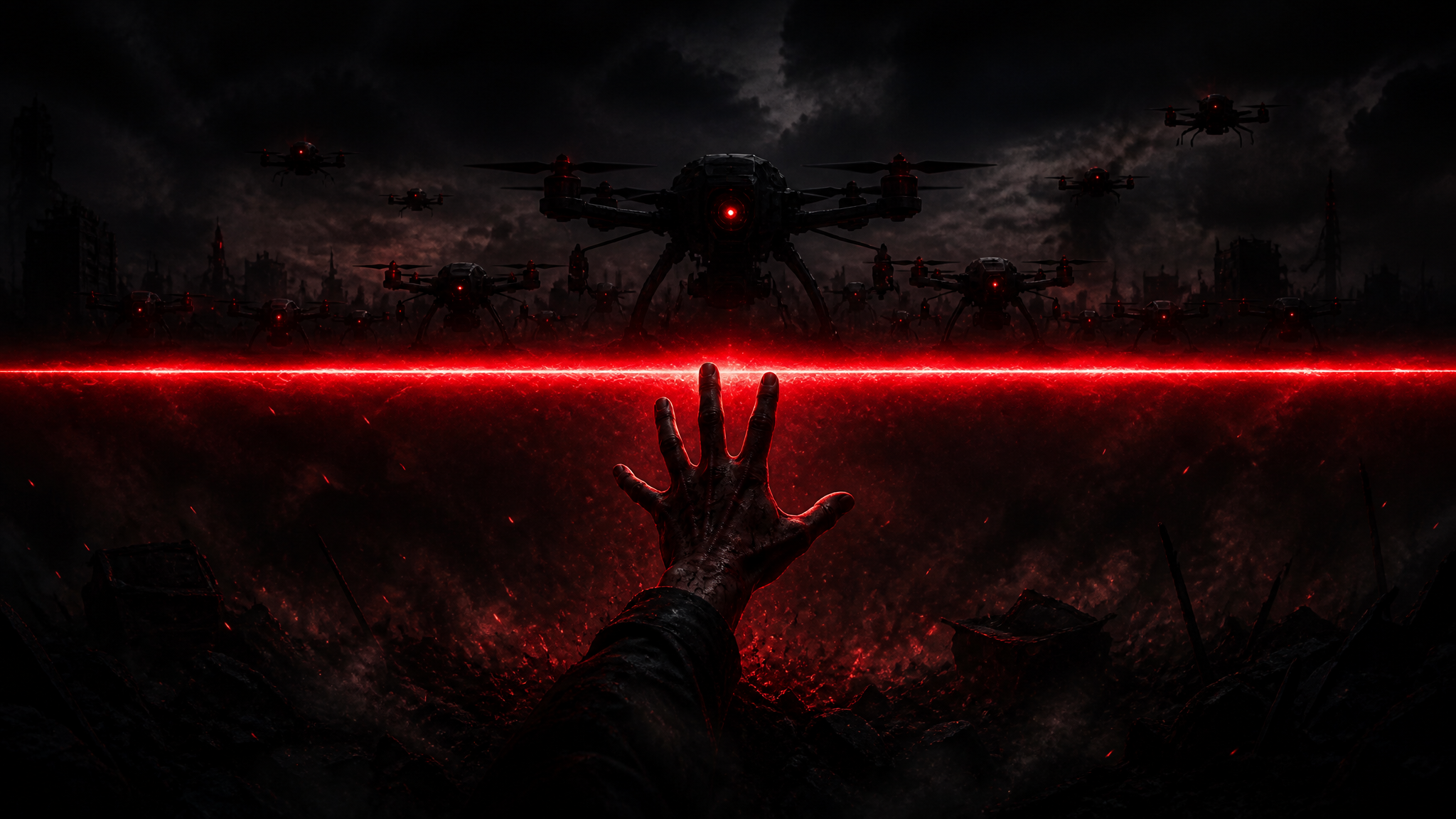
The Line That Was Drawn
In January 2017, the Asilomar Conference on Beneficial AI produced 23 principles for the responsible development of artificial intelligence. Principle 18 was unambiguous: "An arms race in lethal autonomous weapons should be avoided."
The signatories were not fringe activists. They included Stuart Russell, Yoshua Bengio, Demis Hassabis, Elon Musk, and hundreds of the world's leading AI researchers. The principle reflected a broad consensus within the AI research community: while AI could be beneficial in countless domains, the creation of weapons systems that select and engage targets without human intervention represented a moral red line that should not be crossed.
Nine years later, the line has not merely been approached. It has been crossed, redrawn, crossed again, and is now so blurred that the original principle reads like a dispatch from a more innocent age.
In the skies over Ukraine, AI-enabled drones autonomously track and strike targets during their final approach, defeating electronic warfare countermeasures by operating without human guidance in the "last mile." In the Mediterranean, Israel's autonomous defence systems intercept incoming projectiles with reaction times no human operator could match. In the Pacific, the United States' Replicator programme is manufacturing expendable autonomous drones at industrial scale. In Chinese laboratories, the "Jiu Tian" drone carrier concept envisions deploying swarms of autonomous combat drones from a single platform.
The Asilomar Principles called for avoiding an arms race in lethal autonomous weapons. What we have instead is an arms race in lethal autonomous weapons conducted by every major military power simultaneously. This is the story of how the red line was crossed, what it means, and whether it can ever be restored.
The Technology: From Remote Control to Autonomy
To understand the autonomous weapons landscape, we must first clarify what "autonomy" means in a military context. The spectrum runs from fully human-controlled systems to fully autonomous ones, with several intermediate stages:
Level 0 — Human-operated: The weapon is directly controlled by a human operator in real time. Traditional firearms, conventional missiles with manual guidance.
Level 1 — Human-supervised: The system can identify potential targets and recommend actions, but a human must authorise every engagement. Most current military drones operate at this level.
Level 2 — Human-on-the-loop: The system can identify, track, and engage targets autonomously, but a human operator monitors the process and can intervene to abort. Israel's Iron Dome operates at approximately this level for defensive engagements.
The Asilomar Principles called for avoiding an arms race in lethal autonomous weapons. What we have instead is an arms race conducted by every major military power simultaneously.
Level 3 — Human-out-of-the-loop: The system operates entirely autonomously once activated, with no human involvement in individual targeting decisions. This is the category that the Asilomar Principles sought to prevent.
Level 4 — Full strategic autonomy: The system not only selects and engages targets but makes strategic decisions about when, where, and how to deploy force. No current system operates at this level, but the architectural foundations are being laid.
The critical boundary—the red line—lies between Level 2 and Level 3. At Level 2, a human being bears moral and legal responsibility for every use of lethal force. At Level 3, the machine decides who lives and who dies.
The Ukraine Laboratory
The Russia-Ukraine conflict has become the world's primary testing ground for autonomous weapons technology. What began with commercial off-the-shelf drones modified with improvised explosives has evolved into a sophisticated autonomous warfare ecosystem.
Ukrainian defence firms have developed "last-mile autonomy" modules that enable First Person View (FPV) drones to autonomously track and strike targets during their final approach. The TFL-1 system, developed by The Fourth Law, uses computer vision and onboard AI to maintain target lock even when electronic warfare jamming severs the communication link between the drone and its operator. The operator designates the target; the machine executes the kill.
This is, by most definitions, a Level 2 to Level 3 system. The human selects the target, but the final engagement decision—the moment of lethal force—is made by the machine. Ukrainian operators describe this not as a moral compromise but as a tactical necessity: Russian electronic warfare capabilities have become so sophisticated that human-in-the-loop control is simply not viable in contested electromagnetic environments.
Russia, for its part, has deployed the S-70 Okhotnik—a heavy stealth drone designed for autonomous deep-strike missions behind enemy lines, where communication with human operators may be impossible. The Okhotnik is designed to operate autonomously for extended periods, making targeting decisions based on pre-programmed mission parameters and onboard AI.
The Industrial Powers
Beyond Ukraine, every major military power is investing in autonomous weapons systems:
The United States has committed to the Replicator programme, aimed at fielding "all-domain autonomous systems at speed and scale." The programme prioritises small, expendable, AI-enabled drones that can be manufactured in thousands and deployed in swarms. The US Department of Defense's 2024 Autonomy in Weapons Systems Directive (DoDD 3000.09) requires "appropriate levels of human judgement" but deliberately avoids defining what "appropriate" means, leaving operational commanders significant discretion.
When an autonomous weapon kills a civilian, who is legally responsible? The operator? The commander? The engineer? The manufacturer? Existing legal frameworks provide no coherent answer.
China is pursuing what analysts describe as "Massive Autonomy"—the industrial-scale production of autonomous platforms. The Jiu Tian drone carrier concept, showcased at military expositions, envisions a single aircraft deploying dozens of autonomous combat drones, overwhelming adversary defences through sheer numbers. China's defence AI strategy explicitly targets decision-cycle superiority: making targeting decisions faster than adversaries can respond.
Israel has long operated at the frontier of defensive autonomy (Iron Dome, Iron Beam) and has developed offensive autonomous capabilities including loitering munitions that can autonomously identify and engage targets matching pre-programmed signatures. Israel's "Harpy" and "Harop" loitering munitions are exported to multiple countries, proliferating autonomous weapons technology globally.
Turkey's Kargu-2 loitering munition was reported by a UN Panel of Experts to have autonomously engaged retreating combatants in Libya in 2020—potentially the first documented case of an autonomous weapon killing a human being without explicit human authorisation.
The Legal Void
The proliferation of autonomous weapons is occurring in a legal vacuum. Existing international humanitarian law (IHL) was written for a world where human beings make decisions about the use of force. The core principles of IHL—distinction (between combatants and civilians), proportionality (force proportional to military advantage), and precaution (minimising civilian harm)—all assume a human decision-maker capable of moral judgement.
The Accountability Gap
When an autonomous weapon kills a civilian, who is legally responsible? The operator who activated the system? The commander who authorised its deployment? The engineer who designed its targeting algorithm? The company that manufactured it? The government that procured it?
Existing legal frameworks provide no coherent answer. Criminal law requires mens rea—guilty intent—which cannot be attributed to a machine. Command responsibility doctrine holds commanders liable for crimes committed by their subordinates, but an autonomous system is neither a subordinate nor a person. Product liability law may assign responsibility to the manufacturer, but military equipment is typically exempt from consumer product regulations.
This accountability gap is not merely a legal technicality. It is a moral catastrophe. If no one is legally responsible for the killing of civilians by autonomous weapons, then there is no deterrent against deploying such weapons in ways that violate the laws of war. The legal framework that has governed armed conflict since the Geneva Conventions of 1949 is rendered impotent.
The Martens Clause
International humanitarian law includes the Martens Clause, which stipulates that in cases not covered by specific treaty provisions, civilians and combatants remain protected by "the principles of humanity and the dictates of public conscience." Opponents of autonomous weapons argue that delegating life-and-death decisions to machines violates the Martens Clause by its very nature—that there is something inherently inhumane about a machine deciding to kill a human being, regardless of the machine's accuracy or efficiency.
Unlike nuclear weapons, which require rare materials and sophisticated manufacturing, autonomous weapons can be built from commercially available components. The barrier to entry is software, not hardware.
Proponents counter that autonomous weapons could, in principle, be more discriminating than human soldiers—less susceptible to fear, rage, fatigue, and the cognitive biases that lead to war crimes. The counter-argument has a logical validity that makes it all the more dangerous: it suggests that the path to more "humane" warfare runs through the automation of killing.
The Diplomatic Stalemate
The Convention on Certain Conventional Weapons (CCW) has been the primary diplomatic forum for autonomous weapons regulation since 2013. A Group of Governmental Experts (GGE) has developed a "rolling text" draft framework proposing a two-tier approach: prohibition of systems incapable of distinguishing combatants from civilians, and regulation requiring "meaningful human control" for all others.
Progress has been glacially slow. The CCW operates on consensus, meaning that any single state can obstruct agreement. The United States, Russia, India, and Israel have consistently resisted binding restrictions, arguing that premature regulation could disadvantage their forces and that existing IHL already provides adequate governance.
In November 2025, the UN General Assembly's First Committee passed a historic resolution calling for the negotiation of a legally enforceable agreement by the Seventh Review Conference of the CCW, scheduled for late 2026. The resolution is not binding, but it represents a significant escalation in diplomatic pressure.
The 2026 deadline now looms as one of the most consequential dates in the history of arms control. If it passes without meaningful agreement—as most observers expect—the pre-proliferation window for autonomous weapons governance will effectively close. The technology will be too widespread, the military dependencies too deep, and the strategic calculations too entrenched for regulation to meaningfully constrain development.
The Philosophical Chasm
Beneath the legal and diplomatic debates lies a philosophical chasm that may be unbridgeable.
The Efficiency Argument
Proponents of autonomous weapons advance a consequentialist argument: if autonomous systems can reduce civilian casualties by making more precise targeting decisions, then there is a moral obligation to develop them. A machine that never panics, never acts out of vengeance, and processes targeting data with superhuman speed and accuracy could, in principle, wage a more discriminating war than any human combatant.
This argument has a disturbing internal logic. It is difficult to argue, in principle, that a less accurate human soldier is morally preferable to a more accurate machine. If the only metric were civilian protection, the efficiency argument might be compelling.
The question is not whether an autonomous weapon could make accurate targeting decisions but whether any system should be permitted to make life-and-death decisions without human moral agency.
The Dignity Argument
Opponents advance a deontological counter: that the act of delegating life-and-death decisions to machines is intrinsically wrong, regardless of outcomes. To be killed by a machine—by a process that involves no human judgement, no moral consideration, no recognition of shared humanity—is a violation of human dignity that no efficiency gain can justify.
This argument draws on the Kantian principle that human beings must never be treated merely as means to an end. An autonomous weapon treats its target as a pattern-recognition problem—a collection of features to be matched against a targeting profile. The target's humanity is computationally irrelevant.
The Proliferation Argument
Perhaps the most pragmatic argument against autonomous weapons is the simplest: they will proliferate to actors who cannot be trusted to use them responsibly. Unlike nuclear weapons, which require rare materials and sophisticated manufacturing, autonomous weapons can be built from commercially available components. The barrier to entry is software, not hardware—and software is infinitely replicable.
A world where every state, non-state actor, and motivated individual can deploy lethal autonomous systems is a world of radically reduced security. The Kargu-2 incident in Libya demonstrated that even relatively unsophisticated autonomous systems can be deployed by forces with minimal technical capabilities. As the technology matures, the proliferation risk escalates exponentially.
The Society OS Position: Sovereignty and the Right to Human Judgement
Society OS's position on autonomous weapons is grounded in its foundational principle: the sovereignty of human beings over decisions that affect human lives.
The SAFE-VOID Boundary
The SAFE-VOID boundary framework—Society OS's architecture for defining the absolute limits of AI agency—explicitly classifies the autonomous application of lethal force as a "VOID" action: an action that lies outside the permissible boundary of AI autonomy under any circumstances. This is not a policy preference but an architectural constraint: within the Society OS framework, no AI system can be configured or deployed to make autonomous lethal decisions.
The SAFE-VOID framework recognises that some potential AI capabilities are too dangerous to permit, even if they could be made reliable. The question is not whether an autonomous weapon could make accurate targeting decisions but whether any system should be permitted to make life-and-death decisions without human moral agency.
Autonomous weapons are not coming. They are here. And every day without governance is a day that makes governance harder.
The H-T-A Protocol and Military Applications
The Human-Technology-Alignment Protocol establishes that technology must serve human sovereignty, not replace it. In military applications, this translates to a clear principle: AI systems may enhance human decision-making (providing intelligence, analysis, situational awareness) but may not replace it in decisions involving the application of lethal force.
This position does not reject all military applications of AI. It draws a line—the same line the Asilomar Principles drew—between AI that assists human combatants and AI that replaces human judgement in matters of life and death.
The Global Alliance Protocol
The Global Alliance Protocol (GAP) provides a framework for international cooperation on the governance of technologies that transcend national boundaries. Autonomous weapons are, by their nature, a transnational challenge: the development decisions of one nation affect the security of all nations.
The GAP proposes a multilateral governance framework where participating nations commit to maintaining meaningful human control over the use of lethal force, subject to mutual verification. Unlike the CCW's consensus model, the GAP operates on a coalition-of-the-willing basis: nations that share the commitment to human control can establish binding norms among themselves, creating a growing zone of compliance that exerts gravitational pull on non-participants.
The Clock Is Ticking
The autonomous weapons landscape in 2026 presents a stark choice. The pre-proliferation window identified by arms control experts—the period during which meaningful regulation is still possible—is closing rapidly. Every month that passes without international agreement sees new autonomous systems deployed, new military dependencies created, and new barriers to regulation erected.
The Asilomar Principles were right in 2017. They are right in 2026. An arms race in lethal autonomous weapons should be avoided. The difference is that in 2017, avoidance was a realistic aspiration. In 2026, it requires active reversal of trends that are already deeply entrenched.
The red line was drawn clearly. It was crossed gradually, then suddenly, then habitually. The question now is not whether the line can be redrawn but whether humanity possesses the collective will to draw it at all.
Because autonomous weapons are not coming. They are here. And every day without governance is a day that makes governance harder.
This article is part of the Sovereign Intelligence Hub's security series. For the international treaty framework, see [The International AI Treaty](/hub/global-ai-treaty-prospects). For the governance gap that enables unconstrained deployment, see [The Governance Gap](/hub/the-governance-gap). For the alignment failures that make autonomous weapons unpredictable, see [The Alignment Problem in 2026](/hub/alignment-problem-2026).
Sources & Further Reading
- 1.Asilomar AI Principles (2017)
- 2.UN Office for Disarmament Affairs — Lethal Autonomous Weapon Systems
- 3.UN General Assembly First Committee — LAWS Resolution (November 2025)
- 4.The Fourth Law — TFL-1 Last-Mile Autonomy Module
- 5.ASIL Insights — Legal Framework for LAWS Regulation (2025)
- 6.Lieber Institute, West Point — Legal Accountability for AI-Driven Autonomous Weapons
- 7.US DoD Directive 3000.09 — Autonomy in Weapon Systems (2023 Update)
- 8.USANAS Foundation — Regulating LAWS in a Multipolar Order
- 9.UN Panel of Experts on Libya — Kargu-2 Incident Report (2021)
- 10.International Committee of the Red Cross — Autonomous Weapons and IHL
- 11.Convention on Certain Conventional Weapons — Group of Governmental Experts on LAWS
- 12.Society OS — Agent Protocol Safety Charter & SAFE-VOID Framework
- 13.Society OS — Global Alliance Protocol & Founding Constitution