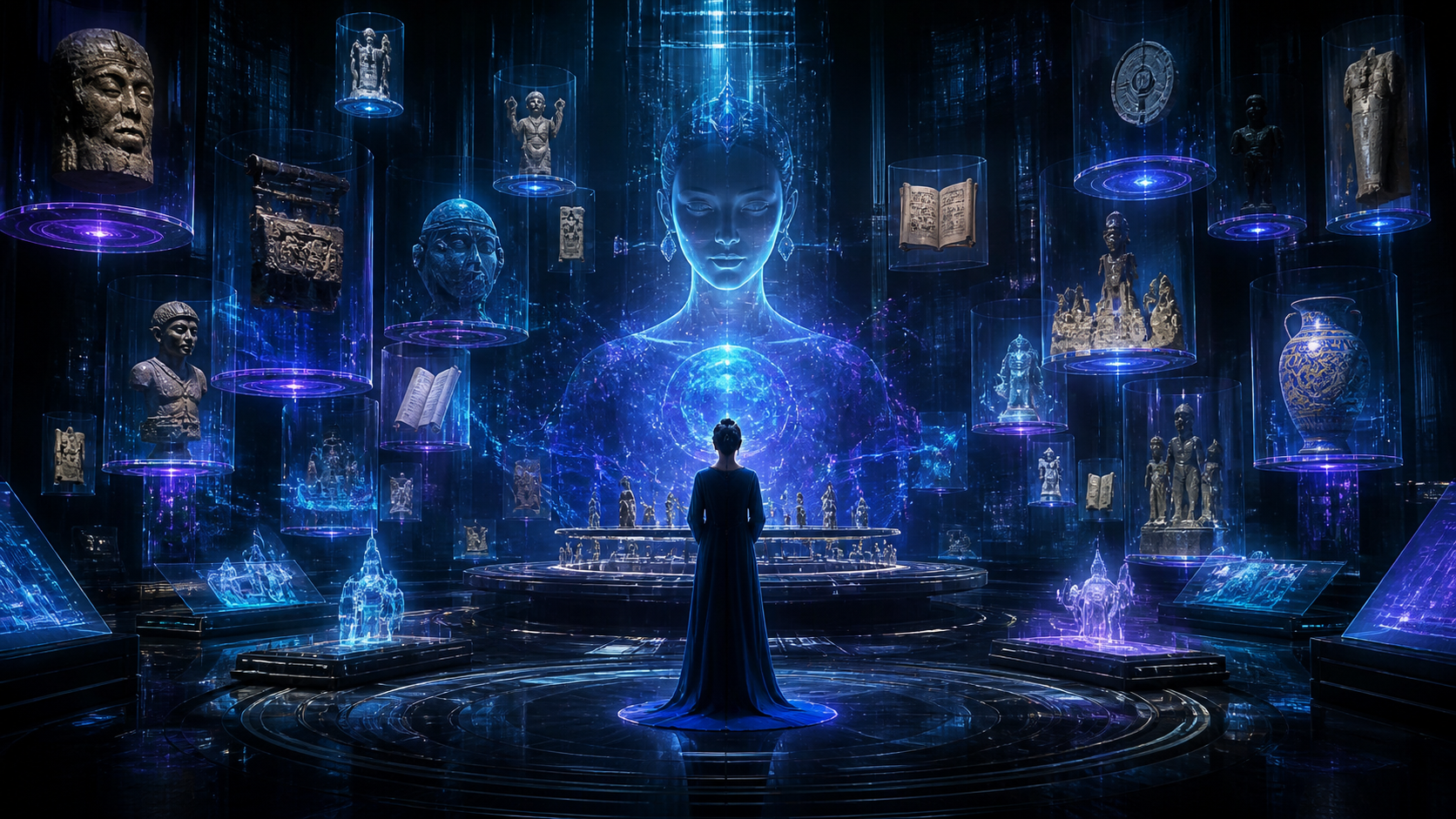
In the summer of 2026, a Thai cultural institution completed a project that would have been unimaginable a decade earlier: an AI-powered virtual assistant, trained on oral histories, craft documentation, and community interviews, now guides visitors through an immersive digital reconstruction of the Lamphun Brocade Fabric tradition — a weaving practice that had been declining for generations. Simultaneously, in a research laboratory in Athens, a neural network trained on thousands of fragmentary ancient inscriptions was completing damaged texts that human epigraphers had spent careers attempting to reconstruct. And in a permanently shadowed archive in a conflict zone, a digitisation team was racing to preserve manuscripts before advancing forces could destroy them.
These three scenes capture the paradox at the heart of artificial intelligence and cultural heritage in 2026: the same technological forces that offer unprecedented tools for preservation are simultaneously generating new categories of threat. The dual-use nature of AI — its capacity to serve as both shield and weapon — is nowhere more consequential than in the domain of human cultural memory.
The Preservation Dividend: What AI Makes Possible
The scale of what AI enables in cultural preservation is genuinely transformative. For most of human history, the preservation of cultural heritage has been constrained by the physical limits of human attention: the number of archivists who could transcribe manuscripts, the number of conservators who could assess deteriorating artefacts, the number of linguists who could document endangered languages before their last speakers died. AI removes those constraints in ways that are only beginning to be understood.
Digitisation and Reconstruction at Scale
Platforms such as Transkribus and eScriptorium have demonstrated that AI-assisted transcription can process historical manuscripts at speeds that would require centuries of human labour to replicate. The Ithaca model, developed by Google DeepMind, achieved 62% accuracy in restoring damaged ancient Greek inscriptions — compared to 25% for human experts working alone — and 72% accuracy when used as a collaborative tool augmenting human judgement. The Aeneas system extended this capability to Latin texts. These are not marginal improvements; they represent a qualitative shift in what is recoverable from the historical record.
Three-dimensional digitisation, combined with AI-driven analysis, is enabling the reconstruction of fragmented archaeological artefacts with a precision that physical reassembly cannot achieve. Digital twins of heritage sites — detailed computational models that capture structural, material, and spatial information — provide a form of insurance against physical destruction that no previous technology could offer. When the Notre-Dame Cathedral burned in 2019, the existence of detailed laser scans proved invaluable for reconstruction planning. The systematic creation of such records for the world's most vulnerable heritage sites is now technically feasible; the question is whether the institutional will and funding exist to do it.
Language Revitalisation and Intangible Heritage
UNESCO estimates that approximately 40% of the world's 7,000 languages are endangered. Many of these languages carry with them entire knowledge systems — ecological knowledge, medicinal practices, oral histories, cosmological frameworks — that exist nowhere else. AI-driven language documentation tools are enabling the creation of digital archives, dictionaries, and learning platforms for endangered languages at a pace that was previously impossible. Conversational AI agents trained on recorded speech are being used to create interactive learning environments that allow younger community members to engage with languages they may never have heard spoken fluently.
The 2026 AI4CHIEF symposium in Paris brought together researchers, community representatives, and policymakers to address the specific challenges of AI and intangible cultural heritage — the living practices, oral traditions, performing arts, and social rituals that constitute the majority of human cultural expression but are the most difficult to preserve through conventional archival methods. The symposium's working groups identified data governance, community empowerment, and legal protection as the three critical tracks for ensuring that AI serves rather than exploits the bearers of living heritage.
The same technologies used to document and protect cultural heritage can be weaponised to destroy it — through disinformation, cyberattacks on digital archives, or the predictive targeting of sites during armed conflict.
The same technologies used to document and protect cultural heritage can be weaponised to destroy it — through disinformation, cyberattacks on digital archives, or the predictive targeting of sites during armed conflict.
The Threat Landscape: AI as a Vector of Cultural Destruction
The World Heritage Watch Report 2026 assessed 58 threatened UNESCO World Heritage properties, identifying armed conflict, uncontrolled tourism, large-scale infrastructure projects, and climate change as the primary physical threats. But the report also flagged an emerging category of threat that previous editions had not systematically addressed: the weaponisation of digital technologies against cultural heritage.
Disinformation and Historical Manipulation
Generative AI has dramatically lowered the cost of producing convincing synthetic media — images, audio, video, and text — that can be used to fabricate or alter historical records. The implications for cultural heritage are profound. A deepfake video purporting to show the deliberate destruction of a heritage site can be used to inflame sectarian tensions. AI-generated "historical" images can be inserted into digital archives to support false narratives about the past. Synthetic oral histories can be created that misrepresent the traditions of communities whose authentic records are sparse or inaccessible.
These are not hypothetical scenarios. The deliberate destruction of cultural heritage as a strategy of cultural erasure — documented in conflicts from the Balkans to the Middle East to West Africa — has historically relied on physical destruction. AI enables a new form of the same strategy: the digital manipulation of the record of what existed, making it impossible to reconstruct what was lost or to establish what was authentic. The "liar's dividend" — the erosion of trust in authentic records because synthetic records are indistinguishable from them — applies with particular force to cultural heritage, where the authenticity of the record is the foundation of its value.
Cyberattacks on Digital Archives
The digitisation of cultural heritage creates new attack surfaces. Digital archives, once compromised, can be corrupted, encrypted for ransom, or selectively deleted. The concentration of irreplaceable cultural records in digital repositories — often maintained by institutions with limited cybersecurity resources — creates a vulnerability that physical archives did not have. A fire in a library destroys what is in that building; a cyberattack on a cloud-based archive can destroy records held across multiple institutions simultaneously.
UNESCO's AI-Powered Monitoring initiative and INTERPOL's Project PSYCHE use satellite imagery, drone surveillance, and AI-driven data analysis to detect illicit trafficking and monitor vulnerable heritage sites. These tools represent a genuine advance in the capacity to protect physical heritage. But the same analytical capabilities — the ability to identify specific sites, assess their vulnerability, and predict the timing of protective interventions — can be exploited by hostile actors to identify targets and time attacks to avoid detection.
Algorithmic Bias and Digital Colonialism
An AI trained on European art history will apply European aesthetic categories to the analysis of African, Asian, or Indigenous art — categories that may be fundamentally inappropriate to the material. This is not a technical problem. It is a political one.
A subtler but equally significant threat is the systematic bias embedded in AI systems trained predominantly on Western, urban-centric, and colonial datasets. When AI tools are applied to the documentation, classification, and interpretation of non-Western cultural heritage, they risk misrepresenting or excluding the knowledge systems they are ostensibly preserving. An AI trained on European art history will apply European aesthetic categories to the analysis of African, Asian, or Indigenous art — categories that may be fundamentally inappropriate to the material.
An AI trained on European art history will apply European aesthetic categories to the analysis of African, Asian, or Indigenous art — categories that may be fundamentally inappropriate to the material. This is not a technical problem. It is a political one.
This is not merely a technical problem of dataset composition. It reflects deeper questions about who controls the tools of cultural documentation, whose knowledge systems are treated as the default, and who benefits from the digitisation of cultural heritage. The concept of "digital colonialism" — the extension of colonial power relations through digital infrastructure and algorithmic systems — is particularly relevant in the context of Indigenous cultural heritage, where communities have historically had little control over how their traditions are documented, interpreted, and disseminated.
UNESCO's 2023 report on AI and Indigenous populations identified the urgent need for technologies that respect Indigenous rights and knowledge systems, emphasising that communities must not be excluded from digital advancements that affect their cultural heritage. The 2026 AI4CHIEF symposium's data governance track focused specifically on establishing ethical protocols for datasets and models that intersect with Indigenous knowledge — including the principle that communities should have meaningful control over how their heritage is digitised, stored, and accessed.
Governance Frameworks: The State of Play
The international governance response to the AI-cultural heritage nexus is developing, but unevenly. UNESCO's MONDIACULT 2025 framework established a set of principles for the responsible use of AI in cultural contexts, emphasising inclusivity, ethical oversight, and the complementarity of AI with human creativity. The framework is aspirational rather than binding, but it provides a reference point for national policy development.
Legal Frameworks for Indigenous Knowledge Protection
Several jurisdictions are developing legislative frameworks specifically designed to protect traditional and Indigenous knowledge from unauthorised exploitation by AI systems. The Asia-Pacific region has been particularly active, with new legislative proposals addressing the use of Indigenous cultural materials as training data for AI models without community consent. The World Intellectual Property Organisation (WIPO) has been negotiating an international instrument on genetic resources, traditional knowledge, and traditional cultural expressions for over two decades; the AI dimension has added new urgency to those negotiations.
The core legal challenge is that existing intellectual property frameworks — copyright, patent, trade secret — were designed for individual creators and do not map well onto collectively held, intergenerationally transmitted cultural knowledge. A song that has been sung in a community for centuries may not be "owned" by any individual, but it is not therefore available for unrestricted use by AI training pipelines. New legal categories — community intellectual rights, cultural heritage rights, data sovereignty — are being developed to fill this gap, but their international harmonisation remains incomplete.
Authenticity and Public Trust
The economic value of digitised heritage must not accrue primarily to the technology platforms that host it. The communities whose heritage it represents must be the primary beneficiaries of its digital life.
Research published in Nature in 2025 identified "perceived authenticity" as the critical variable in public acceptance of digital heritage. When visitors to a digital reconstruction of a heritage site believe that what they are experiencing is an authentic representation of the original, they engage with it as heritage. When they perceive it as a creative interpretation or a synthetic construction, they engage with it as entertainment. The distinction matters enormously for the cultural and educational functions that heritage institutions serve.
The emergence of AI-generated content that is indistinguishable from authentic historical records creates a fundamental challenge for heritage institutions: how do they maintain the credibility of their digital collections in an environment where synthetic content is ubiquitous? Content provenance standards — technical mechanisms for recording and verifying the origin and modification history of digital content — are being developed by the Coalition for Content Provenance and Authenticity (C2PA) and others, but their adoption by heritage institutions is still nascent.
The Economic Dimension: Preservation as Development
Cultural heritage is not merely a matter of historical record. It is an economic asset. UNESCO estimates that the cultural and creative industries account for approximately 3% of global GDP and employ over 30 million people. Digital heritage platforms are increasingly being used not only for preservation but for economic regeneration — creating digital marketplaces that support local artisans, enabling cultural tourism that does not require physical presence at fragile sites, and generating revenue streams that can fund ongoing preservation activities.
The risk is that the economic value of digitised heritage accrues primarily to the technology platforms that host and distribute it, rather than to the communities whose heritage it represents. The same dynamic that has concentrated the economic value of the internet in a small number of platform companies could reproduce itself in the cultural heritage domain, with AI companies extracting value from digitised heritage collections while the institutions and communities that created those collections receive little in return.
The economic value of digitised heritage must not accrue primarily to the technology platforms that host it. The communities whose heritage it represents must be the primary beneficiaries of its digital life.
Towards a Sovereign Heritage Framework
The challenge of AI and cultural heritage ultimately requires a framework that treats cultural heritage as a form of sovereignty — a domain in which communities have the right to determine how their heritage is documented, preserved, interpreted, and shared. This is not a rejection of AI as a preservation tool; it is a condition for its legitimate use.
Such a framework would require, at minimum: community consent and control over the digitisation of cultural heritage; transparent provenance standards for digital heritage content; legal protections for Indigenous and traditional knowledge that are fit for the AI era; equitable revenue-sharing arrangements for the commercial use of digitised heritage; and international coordination mechanisms that ensure the benefits of AI-enabled preservation are distributed globally rather than concentrated in technologically advanced nations.
The AI4CHIEF symposium's 2026 declaration called for exactly this kind of framework — one that treats AI as a tool in service of cultural sovereignty rather than a force that overrides it. The declaration's principles are not yet reflected in binding international law. But they represent a growing consensus that the governance of AI in cultural heritage is not a technical question. It is a question of power, rights, and the conditions under which human cultural memory survives into the digital age.
The preservation dividend that AI offers is real and significant. So is the threat it poses. The difference between the two outcomes depends entirely on the governance choices made in the next few years — choices about who controls the tools, who benefits from their use, and whose cultural memory is treated as worth preserving.