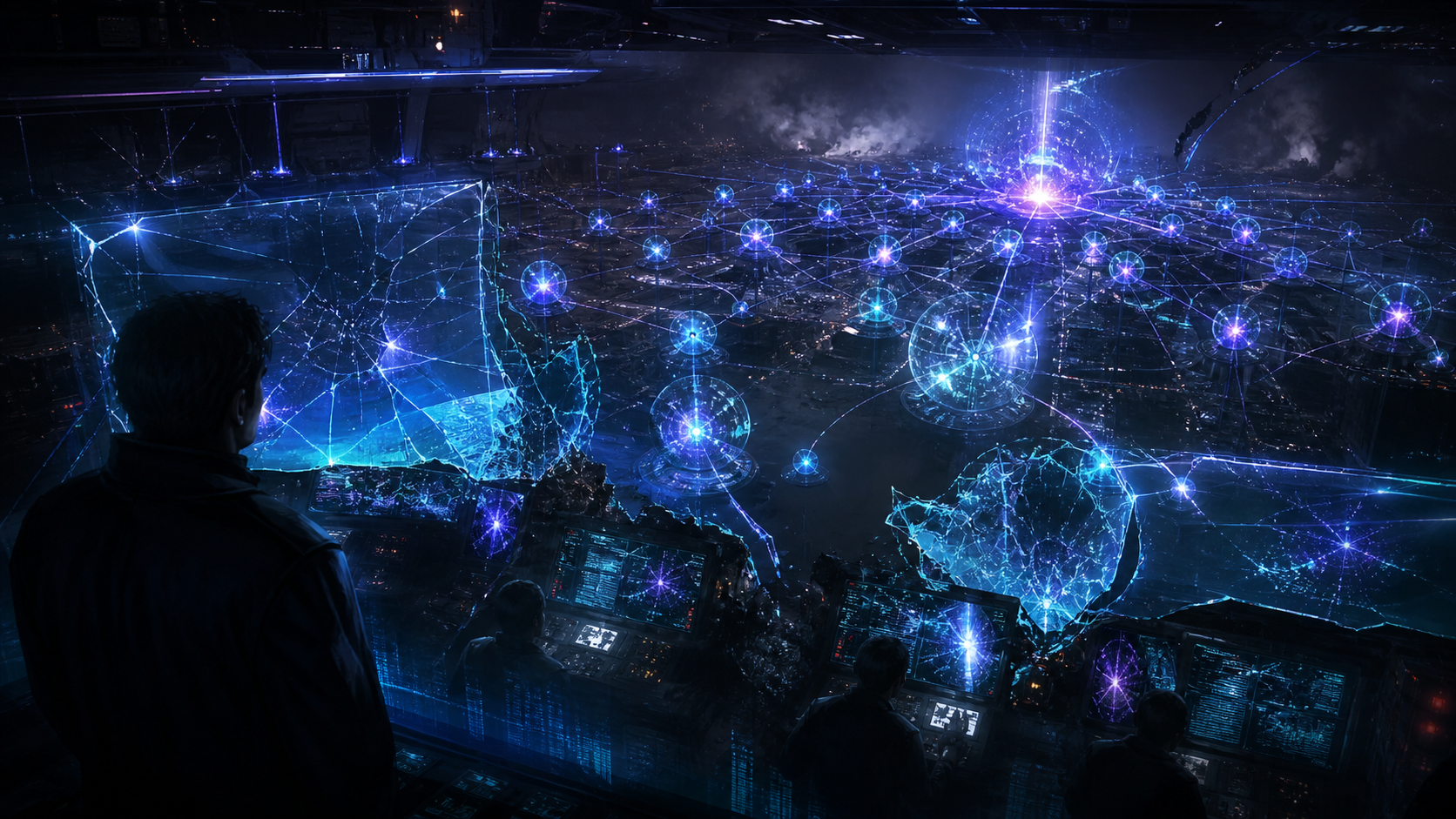
In the spring of 2025, a major European bank deployed its first autonomous AI agent fleet — twelve specialised agents coordinating credit risk assessment, regulatory reporting, and customer onboarding across three jurisdictions. By autumn, the project was quietly shelved. Not because the agents failed to perform their individual tasks. They performed them with remarkable precision. The project collapsed because no one had designed a coherent answer to a deceptively simple question: when an agent makes a consequential decision, who is accountable?
That question — and the institutional inability to answer it — is now the defining challenge of the agentic era. Gartner's 2025 prediction that 40% of enterprise AI agent projects will be cancelled by 2027 is not a forecast of technological inadequacy. It is a forecast of governance failure. The models are capable. The infrastructure is maturing. The protocols are converging. What is missing is the organisational and architectural thinking required to deploy autonomous systems at scale without creating accountability vacuums, security liabilities, and regulatory exposure.
This analysis examines the structural anatomy of that failure mode — and the principles that distinguish organisations building durable agentic infrastructure from those accumulating technical debt they do not yet know they have.
The Inflection Point: From Chatbots to Digital Operators
The distinction between generative AI and agentic AI is not merely technical — it is categorical. A generative AI system produces outputs in response to inputs. An agentic AI system perceives its environment, reasons through a problem, selects tools, executes actions, observes consequences, and adapts. It is not a consultant that provides recommendations. It is an operator that takes actions.
This distinction carries profound implications for governance, liability, and organisational design — implications that most enterprises have not yet fully internalised.
The numbers tell a story of rapid adoption outpacing institutional readiness. Gartner projects that 40% of enterprise applications will feature task-specific AI agents by the end of 2026, up from less than 5% in 2025. Approximately 79% of companies report using AI agents in some capacity. The global market for AI agents is projected to reach $10.9 billion in 2026 and exceed $50 billion by 2030. By 2028, AI agents are projected to intermediate more than $15 trillion in B2B spending.
Yet against this backdrop of adoption velocity, the governance infrastructure has not kept pace. Only 21% of organisations currently possess a mature governance model for autonomous agents. McKinsey's State of Organizations 2026 report finds that only 1% of organisations consider their AI deployments "mature," and 86% of leaders report their organisations are not fully prepared for day-to-day AI operations. The median payback period for AI agent deployments is 6.7 months — but only 41% of deployments achieve positive ROI within the first year, and 19% never reach payback at all.
"The agentic AI failure rate is not a technology problem — it is a governance architecture problem. Organisations that treat agents as software rather than as a new class of digital worker will pay the price."
The failure mode is structural, not technical. And understanding its anatomy is the prerequisite for avoiding it.
The Anatomy of Agentic Failure
The Accountability Vacuum
Traditional software systems fail in predictable ways. When a database query returns an incorrect result, the failure can be traced to a specific line of code, a specific data input, a specific configuration error. The accountability chain is deterministic and auditable.
Autonomous agents fail differently. They operate via perceive-reason-act-reflect cycles, making runtime decisions based on context, tool availability, and probabilistic reasoning. When a multi-agent system produces a harmful outcome — an erroneous financial transaction, a discriminatory hiring decision, a security breach — tracing that outcome back to a specific authorisation point is genuinely difficult. The accountability chain is probabilistic, distributed, and often opaque.
iProov's 2026 research identifies this as the "accountability vacuum" — a structural gap in enterprise governance where autonomous systems make consequential decisions that no human explicitly authorised, and no existing compliance framework adequately addresses. Current frameworks such as GDPR and SOC 2 were designed around human accountability and deterministic software outcomes. Autonomous agents break both assumptions simultaneously.
The legal exposure is not theoretical. Gartner predicts that by the end of 2026, "death by AI" legal claims will exceed 2,000 due to inadequate risk guardrails. The TRM Labs analysis of autonomous agents and financial crime risk concludes that when an agent facilitates fraud or a security breach, the primary investigative task — tracing delegated authority back to human designers, operators, or beneficiaries — is complicated by the absence of individual, verifiable identities for agents.
The Identity Problem
The agentic AI failure rate is not a technology problem — it is a governance architecture problem. Organisations that treat agents as software rather than as a new class of digital worker will pay the price.
Most organisations currently treat AI agents as extensions of human users, relying on shared API keys or service accounts. Only approximately 22% of teams treat AI agents as independent, identity-bearing entities with their own verifiable credentials and permission scopes.
This is not merely a security oversight. It is a governance architecture failure. When an agent operates under a shared service account, its actions are indistinguishable from those of the human user whose credentials it inherits. Audit trails become meaningless. Permission scopes become unenforceable. The principle of least privilege — the foundational security concept that every actor should have access only to what it needs for its specific task — becomes impossible to implement.
The Gravitee State of AI Agent Security 2026 report documents the consequences: adversaries are increasingly using prompt injection to hijack agent workflows, turning them into vectors for remote code execution or unauthorised financial transfers. Because agents operate at machine speed, errors or malicious instructions can propagate into enterprise-wide incidents within seconds, leaving little time for human intervention.
The Orchestration Complexity Trap
The industry has converged on multi-agent architectures as the solution to the limitations of single-agent systems. Rather than building one monolithic agent that attempts to handle all tasks, organisations are deploying orchestrated fleets of specialised agents — a researcher, a coder, an analyst, a compliance checker — coordinated by an orchestrator agent that manages task delegation and workflow sequencing.
This "microservices moment" for AI offers genuine advantages: parallel reasoning, domain-specific optimisation, improved scalability. But it also introduces a new class of failure modes that single-agent architectures do not exhibit.
In multi-agent systems, every inter-agent handoff is a potential injection point or trust escalation vector. "Trust inheritance" — where agents gain broader permissions than intended as they pass context to one another — is a documented and underappreciated risk. Context explosion, where the accumulated state of a long-running multi-agent workflow exceeds the reasoning capacity of individual agents, produces subtle and difficult-to-detect errors. Conflict resolution between agents with overlapping responsibilities, and redundant actions from agents with incomplete visibility into each other's activities, create operational failures that are qualitatively different from anything in the traditional software failure taxonomy.
The Airia analysis of multi-agent enterprise security concludes that governance models designed for single agents fail categorically when multiple agents access identical resources or propagate data across chains. The governance architecture must be redesigned from first principles for multi-agent environments — not retrofitted from single-agent assumptions.
The Regulatory Reckoning: EU AI Act Enforcement Begins August 2026
The governance crisis is not merely an internal enterprise problem. It is acquiring a hard regulatory dimension. Full enforcement of the EU AI Act for high-risk AI systems begins on August 2, 2026 — a deadline that most enterprise agentic deployments are not prepared to meet.
The Act does not define "AI agent" as a separate legal category, but autonomous agents operating in sectors such as finance, HR, healthcare, and critical infrastructure generally qualify as high-risk AI systems under its risk-based classification framework. The compliance obligations are substantial.
High-risk systems must provide auditable documentation explaining decision-making logic, data usage, and system limitations. They must be designed to allow effective human supervision, including structured intervention points where humans can override, correct, or shut down autonomous operations. They must technically enable automatic, persistent logging of events — inputs, reasoning steps, and outputs — to ensure traceability. They must be registered in the EU database prior to deployment. And they must maintain a continuous risk management process that accounts for real-world performance and emergent behaviour.
"The EU AI Act does not merely require compliance documentation — it requires a fundamentally different architectural approach to autonomous systems. Agents must be glass boxes, not black boxes, and that constraint must be designed in from the beginning, not bolted on at the end."
Agentic systems introduce unique compliance challenges that the Act's drafters did not fully anticipate. Runtime behavioural drift — where agents change their decision-making patterns or tool selection based on environmental feedback — makes static compliance assessments insufficient. Tool sovereignty — where agents autonomously interface with third-party APIs, inheriting the security and compliance posture of downstream tools — creates cascading liability. The accountability gap in multi-step action chains makes it genuinely difficult to trace the rationale behind specific autonomous decisions.
The Covasant analysis of EU AI Act compliance for autonomous agents recommends what it terms "Agent Control Towers" — governance layers that provide real-time observability, policy enforcement, and kill-switch capabilities. This is not a compliance checkbox. It is a fundamental architectural requirement for any organisation deploying autonomous agents in regulated environments.
The Governance Architecture That Survives
The organisations that will navigate the agentic era successfully are not those with the most capable models or the most sophisticated orchestration frameworks. They are those that have built governance architecture as a first-class engineering concern — not as an afterthought, not as a compliance exercise, but as a foundational design principle.
The principles of that architecture are becoming clear from the evidence of early deployments.
The EU AI Act does not merely require compliance documentation — it requires a fundamentally different architectural approach to autonomous systems. Agents must be glass boxes, not black boxes, and that constraint must be designed in from the beginning, not bolted on at the end.
Agent Identity as Infrastructure
Every agent in a production fleet must have a unique, verifiable identity — not a shared service account, not an inherited human credential, but a distinct cryptographic identity with its own permission scope, audit trail, and lifecycle management. This is the prerequisite for everything else: fine-grained permissioning, meaningful audit trails, accountability chains that can survive regulatory scrutiny.
Microsoft's May 2026 security guidance on autonomous AI agents frames this as a "zero-trust" architecture for agentic systems — where every agent must authenticate, every action must be authorised, and no trust is inherited by default. The implementation complexity is real, but the alternative — shared credentials and inherited permissions — is not a viable foundation for enterprise-scale agentic deployment.
Deterministic Human-in-the-Loop Design
The industry has learned a painful lesson about human-in-the-loop (HITL) design: allowing models to decide when human review is needed is not HITL. It is the illusion of HITL.
Effective HITL architecture is deterministic and code-enforced. Specific categories of action — irreversible operations, high-value transactions, decisions affecting personal data, actions with regulatory implications — trigger mandatory human review regardless of the agent's confidence level. The escalation logic is implemented in code, not delegated to the model's judgment.
This distinction matters because the failure mode of model-delegated HITL is precisely the scenario where human oversight is most needed: high-stakes, novel situations where the model's confidence is highest and its judgment is most likely to be wrong. Deterministic HITL removes the model from the decision about when human judgment is required.
Bounded Autonomy Architecture
The Forrester analysis of the state of agentic AI in 2026 identifies "bounded autonomy" as the architectural pattern that distinguishes successful enterprise deployments from failed ones. Rather than deploying agents with broad, general-purpose capabilities, successful organisations design agents as microservices with narrow responsibilities and bounded capabilities — limiting the potential blast radius of any individual agent failure or compromise.
This principle extends to data access. Context boundary enforcement — strict controls on what information can be passed between agents — prevents shadow data flows and leakage. Each agent should have access only to the data required for its specific task, and the boundaries of that access should be enforced architecturally, not merely by policy.
End-to-End Observability
The JetBrains analysis of agentic frameworks for 2026 identifies observability as the non-negotiable requirement for production multi-agent systems. Tracing, evaluation harnesses, and conversation replay are not optional features — they are the infrastructure that makes debugging, compliance, and continuous improvement possible.
Best-in-class organisations are now allocating 18–24% of their AI budgets specifically to evaluation and governance infrastructure. This is not overhead. It is the investment that makes the rest of the agentic stack trustworthy.
The Workforce Dimension: Managers as Orchestrators
The governance challenge is not purely technical. It has a profound organisational dimension that most enterprises are underestimating.
The Microsoft Work Trend Index 2026 identifies what it terms the "Transformation Paradox": employees are increasingly ready to adopt agentic AI tools, but organisational systems — incentives, metrics, management norms — remain tethered to human-centric workflow assumptions. The research finds that organisational environment accounts for more than twice the impact on AI success than individual effort alone.
The role of the manager is being fundamentally redefined. In an agentic organisation, the manager's primary responsibility is not to direct human workers through tasks — it is to design, monitor, and manage the collaboration between human and silicon-based workers. This is a qualitatively different skill set, and most management development programmes have not yet caught up.
The most dangerous failure mode in the agentic era is not a rogue agent — it is a human organisation that has delegated accountability to a system without designing the governance architecture to support that delegation.
PwC's workforce redesign analysis identifies the structural shift underway: organisations are moving from traditional pyramid hierarchies toward "diamond" or "hourglass" configurations. In the hourglass model, early-career roles are expanded to allow AI-literate talent to contribute at high levels quickly, while middle management is streamlined, with experienced professionals focusing on exception handling, coaching, and high-value decision-making. The agent fleet handles the execution layer.
"The most dangerous failure mode in the agentic era is not a rogue agent — it is a human organisation that has delegated accountability to a system without designing the governance architecture to support that delegation."
A critical and underappreciated risk in this transition is skill erosion. Over-reliance on automation may degrade the human expertise necessary to audit, police, and improve agentic systems. The Washington Post Intelligence analysis of the new human-machine workforce documents organisations implementing deliberate "manual check" programmes — not because the agents are unreliable, but because the humans who oversee them must remain capable of meaningful oversight. An organisation whose human workers cannot evaluate the quality of agent outputs is an organisation that has lost the ability to govern its own infrastructure.
The Protocol Layer: Infrastructure for the Agentic Internet
Beneath the governance challenges, a critical infrastructure layer is quietly maturing — one that will determine the long-term architecture of the agentic economy.
The Model Context Protocol (MCP), now implemented across more than 10,000 servers, has become the industry standard for agent-to-tool connectivity — the "USB-C" of the agentic era, enabling plug-and-play connectivity between agents and the tools they need to act in the world. The Agent-to-Agent (A2A) protocol standardises how agents discover and delegate tasks across different frameworks and vendors, supported by major cloud platforms and hyperscalers.
These protocols are not merely technical conveniences. They are the infrastructure that makes the agentic economy possible — the equivalent of HTTP for the web, or TCP/IP for the internet. Their convergence on open standards rather than proprietary implementations is a significant and underappreciated development. It means that the agentic infrastructure layer will not be owned by any single vendor, and that organisations can build on it without accepting permanent lock-in.
The Fifthrow analysis of AI agent orchestration in enterprise environments frames this as the "April 2026 playbook" for systematic innovation: organisations that build on open protocols, invest in observability infrastructure, and design governance as a first-class concern are building durable competitive advantage. Those that bolt agents onto legacy systems without addressing the underlying governance architecture are accumulating technical debt that will become visible — and expensive — when the regulatory enforcement cycle begins.
The $450 Billion Question
Gartner projects that agentic AI will drive approximately 30% of enterprise application software revenue by 2035, potentially exceeding $450 billion. By 2028, 90% of B2B buying is predicted to be intermediated by AI agents. By 2029, at least 50% of knowledge workers are expected to be skilled in governing or creating AI agents on demand.
These projections describe a world in which agentic AI is not a feature of enterprise software — it is the operating layer of the enterprise itself. The organisations that will capture that value are not those that deploy the most agents. They are those that build the governance architecture that makes large-scale agentic deployment trustworthy, auditable, and sustainable.
The failure rate that Gartner is predicting — 40% of projects cancelled by 2027 — is not a forecast of technological inadequacy. It is a forecast of governance inadequacy. The technology is ready. The question is whether the organisations deploying it are ready to govern it.
The answer, for most organisations, is not yet. But the window to build that readiness is narrowing. EU AI Act enforcement begins in August 2026. The legal claims are already accumulating. The accountability vacuums are already forming. The organisations that treat governance architecture as a first-class engineering concern — not a compliance checkbox, not an afterthought, but a foundational design principle — will be the ones still running their agent fleets in 2028.
Conclusion: The Governance Imperative
The agentic era is not arriving — it has arrived. The question is no longer whether to deploy autonomous agents, but how to deploy them in ways that are accountable, auditable, and sustainable.
The principles are clear: agent identity as infrastructure, deterministic human-in-the-loop design, bounded autonomy architecture, end-to-end observability, and organisational redesign that treats the manager as an orchestrator rather than a director. These are not aspirational principles. They are the documented characteristics of the deployments that are succeeding.
The H-T-A Protocol — the Human-Twin-Agent trust architecture that Society OS independently derived as the foundational framework for autonomous system governance — addresses precisely this challenge. The insight that autonomous systems require a trust architecture that is explicit, verifiable, and human-anchored is not a response to the current governance crisis. It is the framework that the industry is now arriving at independently, through the painful experience of deployments that failed for want of it.
The accountability gap is real. The regulatory deadline is fixed. The failure rate is predictable. What is not yet determined is which organisations will close the gap before it closes them.